


Most AI projects fail for the wrong reasons – not because the model was incorrect.
They fail because the team supporting the model isn’t complete; no one is responsible for the data pipelines, no one can reliably deploy the model, or no one can tell if the output is good enough to trust.
Hiring the right people for AI and machine learning is, therefore, not just a technical but also a business choice.
In other words, the ideal AI engineering team is a small group of complementary roles (AI product owner, ML/Generative AI engineers, data engineers and MLOps) that you can hire, build a team of, and combine with partners at your stage.
This guide will delve into the different roles you should seek, the sourcing models you should consider, how to screen candidates, and how to assemble a team that will make it past the pilot.
Why Building an AI Team Is Harder Than It Looks
The need for AI skills is outpacing the number of individuals with them.
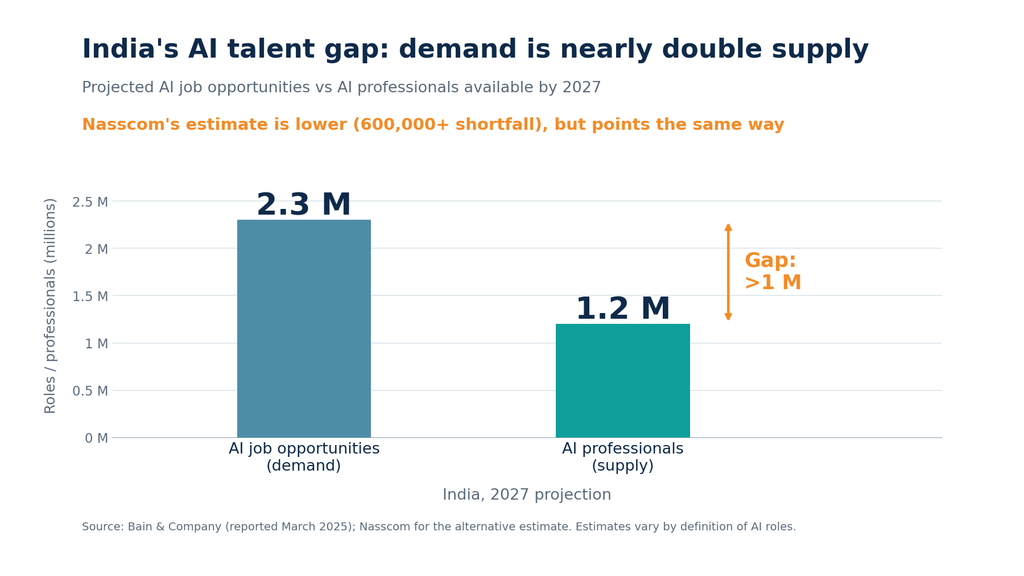
In a report released in March 2025, Bain & Company estimated that by 2027, India’s AI industry will generate over 2.3 million jobs, while there are approximately 1.2 million professionals in the field.
Nasscom’s estimate of shortage of more than 600,000 AI professionals is more conservative but is in the same direction.
The forecasts vary due to different definitions of what a role is in AI, so consider them a range rather than an exact estimate.
This lack is not just about numbers of players but also in terms of depth.
According to Nasscom, over 90 percent of the early career tech professionals are using AI tools, but just 23 percent can be considered AI-native engineers, and possess the technical expertise and ability to solve problems independently to build and implement AI systems.
According to the 2026 Talent Shortage Survey conducted by ManpowerGroup, 82% of Indian employers are challenged to recruit the skills they require, and AI skills are at the helm. In reality, doing so would result in a slow hiring plan that would be costly.
What an AI Engineering Team Actually Needs
AI engineer is a non one-size-fits-all career. It’s multiple, overlapping ones, and one of the most frequent causes of projects getting stalled in the early stages is hiring the wrong version. A practical team consists of 5 groups of capability.
The core roles
The business problem is related to technical work by the AI product owner. They know what success means, focus on use-cases and determine at what point output is adequate to ship. If this person isn’t in a team, they create great demos that no one uses.
The ML or generative AI engineer designs, trains or adapts models, builds retrieval and prompting pipelines and evaluates output quality. The work now is not so much creating new models but using the models that are available to them consistently to the data of the company.
Data engineer is responsible for creating pipelines to gather, clean and publish data. Data work is often underestimated in plans and budgets and models are only as good as what they see in data.
The MLOps or platform engineer brings models to production and maintains them: deploy, monitor, cost control, version and rollback. Focus on applied skills like RAG and MLOps is revealed as the areas where the gap is the greatest through analyses from Nasscom.
Finally, quality, security and governance capability covers testing, evaluation sets, access controls, privacy and responsible use. This is not a designated position in smaller teams; it is a shared responsibility, but somebody has to be responsible for it.
Match the team to your stage
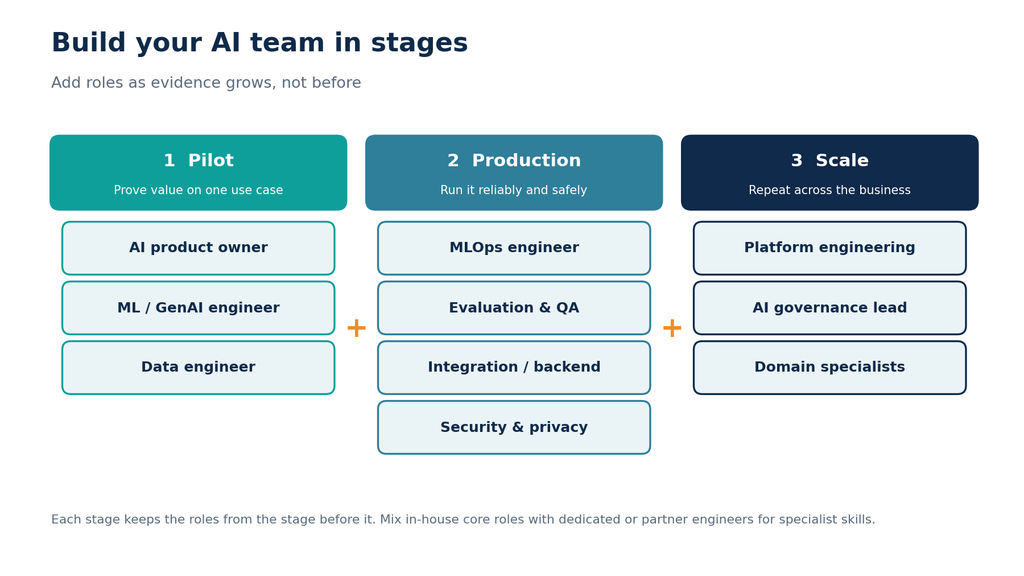
A company that runs its first pilot doesn’t need to have the same team as a company that is running AI across ten products.
The pilot phase typically requires just a small team of product owner, one or two engineers and a data engineer to demonstrate or disprove value.
With the pilot becoming a production system, you add MLOps, evaluation and security.
At scale, add platform engineering, governance leadership and domain specialists.
Hiring in stages ensures that the cost is aligned with evidence – something that is common to have a large staffing team before the first use case is validated.


Hire, Partner or Blend: Choosing a Sourcing Model
Most organisations end up using more than one of the four realistic models.
In house hiring provides the most complete control of knowledge and the most complete long-term culture, but is the slowest process, and the most susceptible to the shortage mentioned above. It is ideal for positions that possess institutional knowledge, like an AI product owner and a lead engineer.
Vetted engineers are brought in for a specific period of time via the service of dedicated teams or staff augmentation.
This is frequently the quickest approach to address a specialist need, like MLOps or data engineering, and allows to scale up or down according to the project’s needs.
What you have to be aware of is that there’s a cost, you have to “manage” knowledge transfer consciously, otherwise capability will leave you after the engagement.
Project-based delivery provides a clear product, such as a recommendation engine, or a document processing workflow, to a partner. It is best suited to environments where needs are well defined and there’s a greater need for a working system than building a team.
A blend combines a solid team of in-house engineers with partner engineers to cover the peaks and special skills.
This provides the optimal speed, cost and control for many mid-size businesses: you retain the people who need to know your business and then you rent the amount of capacity you need, which changes.
Most of the data and ML stack is written in Python and engineers that have strong Python engineering fundamentals are more easily transitioned between projects.
How to Evaluate AI Engineers
Given that almost everyone is using AI tools, credentials and familiarity with the tools is weak signals. Test for depth instead of this.
Start with production experience. Question the candidate about what they deployed, how they monitored it, what it broke and what they changed. A model living person, versus a model who only has done models in books.
Next test evaluation thinking. Strong engineers can discuss how they would measure the success of work of an LLM or ML system: test sets, metrics, human review and failure analysis. Poor ones take a direct dive to the tool.
Instead of trivia use a practical exercise. A short task over “messy data”, a conversation about a system design for a retrieval-based assistant, or a collection of observations about a broken pipeline demonstrates much better judgment than a list of definitions.
Lastly, the handling of probe data and security, such as their handling of personal information, prompt injection, and third-party model risk. They are no longer optional topics.
Retaining and Growing Your Team
Talent can go elsewhere with AI, and it is more economical to keep them than to replace them.
An interesting finding from the ManpowerGroup survey is that 37% of their employers are investing in upskilling their existing workforce, with 35% offering opportunities for new talent to enter their organisation, indicating that many companies are not just looking inward for talent, but are also expanding their internal capabilities.
Provide engineers with real issues to solve, clear accountability, and time to develop, and train strong, generalist engineers to become AI engineers. Architecture, evaluation sets, and runbooks are also documents that help minimize reliance on a single person.
Governance, IP and Data Protection
If you develop your AI, you are responsible for its actions. In writing agree who owns the code, models, prompts and evaluation data. Identify the location of data storage and data processing, the persons authorized to access and how data will be removed.
The Digital Personal Data Protection Act, 2023 has requirements for consent, purpose and data minimisation that pertain to AI projects involving personal data, and should be considered during the design phase, not in the launch phase.
Use clear NDAs, access controls and offboarding checklists when dealing with external engineers.
Common Staffing Mistakes to Avoid
The most common error is recruiting the researcher, in place of the engineer, that the business requires. Successful delivery is typically not the issue, it is original model research. The second is data engineering, where the talented ML engineers spend their time on pipelines that they were never hired to build.
The third is that there is no discipline of evaluation, so there is no one to know whether a change has improved or harmed output. The fourth is relying on one brave engineer, that poses risk when the person is gone. And the fifth, which is hiring before proof of value, is to hire a big team before the first use case is worth it.
A 90-Day Plan for Standing Up an AI Team
In the first month, select one use case with quantifiable business result, review your data and designate an accountable product owner. In the second month, form a lean pilot team with both internal and partner engineers if needed to balance out the missing skills, set baseline metrics and an evaluation set.
Send a limited pilot in the third month; monitor outcomes against baseline and make evidence-based decisions for expanding, adjusting or stopping. This sequence provides fast learning and provides leadership a good basis for the next set of staffing.
Frequently Asked Questions
What roles do I need on an AI engineering team?
At minimum, an AI product owner, an ML or generative AI engineer and a data engineer. As you move to production, add MLOps and evaluation capability, and as you scale, add platform engineering, security and governance leadership.
Should I hire AI engineers in-house or use a dedicated team?
A blend usually works best. Keep the product owner and a lead engineer in-house to protect institutional knowledge, and use dedicated engineers or partners for specialist skills and peaks in workload. Plan knowledge transfer from day one.
How big should my first AI team be?
Start as small as the use case allows, typically a few people covering product, engineering and data. The right size depends on data readiness and integration complexity, so let the pilot’s evidence, not ambition, justify growth.
How do I assess whether an AI engineer is actually skilled?
Look for production deployment experience, clear thinking about evaluation, and performance on a practical task using realistic data. Familiarity with AI tools alone is not enough, since most candidates now have it.
What is the difference between an ML engineer and a data scientist?
Data scientists typically focus on analysis, experimentation and model prototyping. ML engineers focus on turning models into reliable, scalable production systems. Many teams need both, but production-focused projects lean more on ML engineers and data engineers.
Is it better to hire AI developers from a partner in India?
India has a large engineering talent base, but competition for skilled AI engineers is intense. A reputable partner can provide vetted engineers faster than most recruitment cycles, provided you agree clear terms on IP, security and knowledge transfer.
Build the Team Your AI Roadmap Needs
The organisations that succeed with AI are rarely the ones with the biggest teams.
They are the ones with the right mix of roles at the right stage, a clear owner for outcomes and sourcing choices that keep them flexible.
If you are planning your first AI pilot or scaling an existing one, AddWeb Solution’s team can help you scope the roles you need and provide dedicated engineers who integrate with your workflow. Explore our AI development capabilities or talk to our experts about building your AI engineering team.
Build Your AI Engineering Team

Pooja Upadhyay
Director Of People Operations & Client Relations
