


The Question Every EdTech Founder Gets Wrong: “Can We Automate Grading?”
Wrong question. CBSE already answered a version of it in 2026, and the answer wasn’t a clean yes.
The board introduced On-Screen Marking for board exams, digital display of scanned answer sheets with AI assistance, but was explicit that AI is not autonomously checking Class 10 or 12 scripts. If you’re building an assessment product for the Indian market, that single clarification tells you more about your product roadmap than any accuracy benchmark will.
The Number That Should Set Your Accuracy Bar: 95%, Not 100%
Founders pitching investors love to promise “human-level accuracy.” The actual benchmark data tells a more useful, more specific story.
Independent research shows AI grading agrees with human examiners about 95% of the time overall, dropping to 85 to 90% on medium-length descriptive answers of 200 to 500 words. Accuracy improves meaningfully when examiners calibrate the system on a 20 to 25% sample and review flagged or borderline scripts, a human-in-the-loop setup that keeps evaluation error rates under 5%.
That gap between “overall” and “descriptive answers” is where most grading products either earn trust or lose it.

What “AI Grading” Actually Means in an Indian Classroom Right Now
Skip the marketing language for a second. Here is what’s technically shipping in Indian schools today, not what’s theoretically possible.
Modern systems use handwriting recognition powered by vision-LLMs and intelligent character recognition, not legacy OCR, achieving roughly 95% accuracy even on messy, varied handwriting. This matters enormously for India specifically, where answer scripts range from disciplined cursive to genuinely difficult-to-parse handwriting across regional scripts and second-language English.
Platforms like Chanakya AI have built end-to-end pipelines, worksheets to printing to collection to scanning to grading to reports, aimed specifically at CBSE and ICSE schools, positioning the product around saving teachers 8 to 10 hours a week rather than replacing them.
The Line CBSE Drew, and Why Every Vendor Should Draw It Too
This is the single most important design decision in this entire guide, and it comes straight from the regulator, not from a best-practices blog.
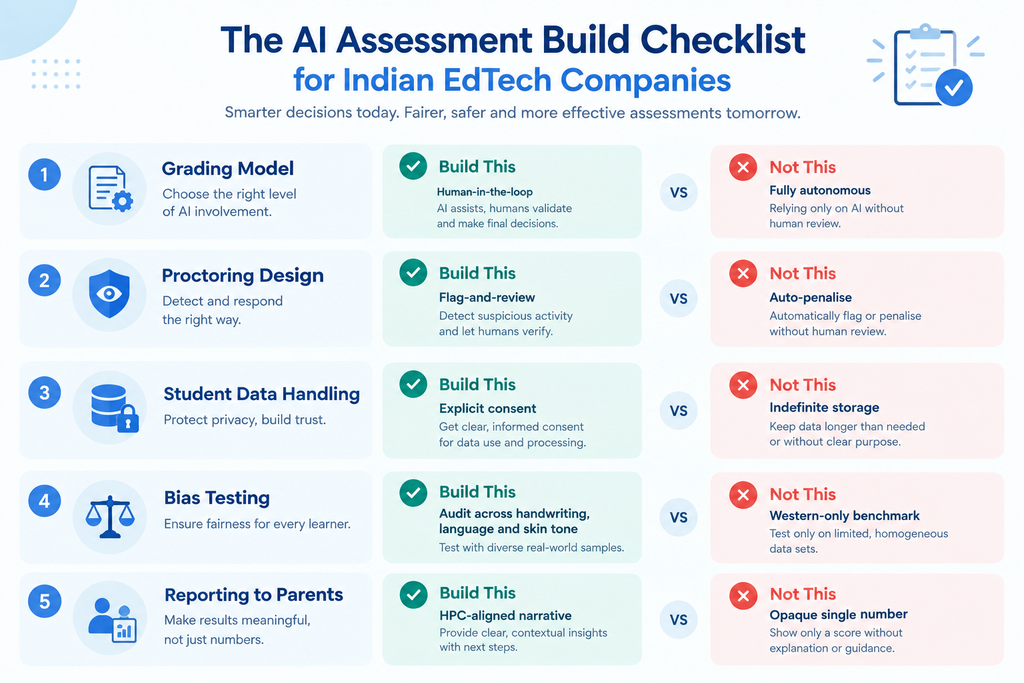
CBSE clarified directly, in response to social media speculation, that AI is not autonomously checking board exam answer sheets. What’s live instead is On-Screen Marking, where technology displays and assists but a human teacher makes the final evaluation call. If your product architecture doesn’t have a clean, visible human-override path built in from day one, you are building against the direction Indian regulation is already moving, not with it.
Assessment Is Also Being Redefined From Above, Not Just Automated From Below
Grading automation is only half the picture. The definition of what counts as a good assessment is changing underneath it, and any serious platform needs to design for both at once.
PARAKH, the Performance Assessment, Review and Analysis of Knowledge for Holistic Development body under NCERT, has built the Holistic Progress Card to move Indian schools from marks-centric evaluation to competency-based, narrative assessment. The HPC captures interpersonal relationships, self-reflection, creativity and emotional development alongside academic performance, categorising foundational-stage students by attainment level rather than by percentage score.
An AI product that only outputs a numeric grade is already behind where CBSE’s own reporting framework has moved. The products likely to win institutional contracts are the ones that generate structured, competency-aligned narrative feedback, not just a faster red pen.
Proctoring Is Where the Technology Is Most Powerful and Most Legally Exposed
If grading automation is the low-controversy half of this market, AI proctoring is the high-stakes half, and Indian EdTech companies building it need to treat it that way from the architecture stage.
Modern AI proctoring achieves 90 to 95% accuracy in detecting cheating behaviours and reduces cheating by up to 96% compared with unsupervised tests, by tracking eye movement, typing patterns and multiple-face detection in real time.
But the same underlying technology carries a well-documented failure mode: facial recognition systems show measurably lower accuracy for darker skin tones and non-Western facial features, which creates direct discrimination risk in a market as diverse as India’s.
The credible response isn’t to abandon proctoring AI. It’s to flag deviations for human review rather than auto-penalising, and to always offer a non-biometric alternative for students who are affected by bias or would simply prefer not to use facial recognition.
The Compliance Layer You Cannot Build Around: DPDP
This is the part of the guide every technical founder wants to skip and every legal advisor insists you read twice.
Under India’s DPDP Act and its 2025 Rules, schools and EdTech platforms must reassess how they handle consent, profiling and monitoring specifically because children receive heightened legal protection.
Remote assessment tools that involve continuous webcam monitoring, screen recording or behavioural analysis carry significant compliance risk, and institutions must be able to clearly justify why that level of surveillance is necessary, limit retention periods, and disclose it transparently to students and parents.
Biometric identifiers used for attendance or proctoring authentication raise the compliance bar further. Biometric data is sensitive and functionally irreplaceable if compromised, and there’s real risk of “function creep,” where data collected for one purpose, say identity verification during an exam, quietly gets used for another.
Under the DPDP framework, even limited data breaches involving children can trigger mandatory notification to the Data Protection Board of India and to affected parents.
Bias in Automated Scoring Is Not a Theoretical Concern, It’s a Documented Pattern
Anyone building an essay or long-answer scoring engine needs to internalise this before writing a line of model code, not after a complaint lands.
Research on automated scoring systems has found they often inherit embedded biases from their training data, systematically downplaying essays written by non-native speakers, penalising writing styles common in certain cultural or regional communities, or simply favouring verbosity over substance.
For a country with 22 scheduled languages and enormous variation in English fluency by region, an assessment engine trained predominantly on Western student writing samples is not a neutral tool, it’s a tool with a specific, undisclosed bias baked in.
The responsible response, according to researchers tracking this space, is transparency rather than false confidence: platforms should acknowledge that all automated scoring carries potential bias and build continuous audit cycles rather than marketing the system as objectively perfect.


What Experts and Regulators Are Actually Signalling
Put together, the signals from CBSE, NCERT and the compliance world point in one consistent direction: augmentation with guardrails, not autonomous replacement.
Industry commentary on the shift is direct about the intended role of AI here: “AI in Education 2026 supports teachers by automating repetitive tasks, generating structured assessments, and providing performance analytics.
Teachers remain essential for mentoring, creativity, emotional development, and classroom leadership.” On the assessment-technology side specifically, ethics researchers have been equally direct about the risk of overclaiming: “The excitement surrounding AI in edtech often overshadows urgent concerns about algorithmic bias, data privacy, and accountability.”
On proctoring specifically, practitioners emphasise operational discipline over pure technology: platforms should require a mock proctored exam 48 to 72 hours before any high-stakes test, gather structured feedback from a pilot group of 200 to 500 students, and build in a documented appeals process before wide deployment.
Where the Market Is Actually Heading in 2027
This is the forward-looking section, clearly separated from the confirmed data above it, because the next eighteen months carry more regulatory and technical change than the last five years combined.
AI adoption for grading among educators is projected to cross 60% by 2026, and momentum research suggests that share keeps climbing as human-in-the-loop tooling matures and schools get more comfortable with AI-assisted, teacher-led evaluation.
Expect Class 9 and 10 students to start encountering AI as a compulsory subject from 2027-28, which will itself create demand for AI-literacy assessment tools, a category that barely exists yet in the Indian market.
Watch three things closely as you build: how CBSE’s On-Screen Marking model evolves once initial pilots report back, whether DPDP enforcement produces its first high-profile EdTech penalty (which would reshape the entire vendor landscape overnight), and whether any Indian-built automated essay scoring engine achieves the bias-audited, multilingual benchmark that would let it credibly serve regional-language boards, not just CBSE and ICSE English-medium schools.
People Also Ask
Is AI legally allowed to grade board exams in India?
Not autonomously. CBSE has explicitly clarified that AI assists through On-Screen Marking, digitally displaying scanned scripts, but a human teacher makes the final evaluation. Fully autonomous AI grading of board exams is not currently sanctioned.
How accurate is AI grading compared to human teachers?
Around 95% overall agreement with human examiners, though this drops to 85-90% specifically on longer descriptive answers, which is why human-in-the-loop review of flagged or borderline scripts remains standard practice.
What data privacy rules apply to AI assessment tools in India?
The DPDP Act and its 2025 Rules require explicit consent for processing children’s data, clear justification for surveillance-heavy tools like proctoring, defined data retention limits, and mandatory breach notification to both the Data Protection Board of India and affected parents.
Can AI proctoring discriminate against students?
Yes, this is a documented risk. Facial recognition systems used in AI proctoring show lower accuracy for darker skin tones and non-Western facial features, which is why responsible implementations flag-and-review rather than auto-penalise, and always offer non-biometric alternatives.
What is the Holistic Progress Card and how does it affect AI assessment products?
The HPC, developed by PARAKH under NCERT, shifts Indian school assessment from marks-only scoring to competency-based, narrative evaluation covering academic and non-academic development. AI assessment tools built only around numeric scores are increasingly out of step with this national framework.
Do Indian teachers actually want AI grading tools?
Adoption data suggests strong appetite when the tool saves time without removing teacher control, over 60% of educators are projected to use some form of AI for grading by 2026, with the most successful products framed explicitly as augmenting, not replacing, the teacher’s final judgment.
What accuracy should an AI grading product target in India?
Industry benchmark data points to roughly 95% agreement with human graders overall, with human review built in for the 10-15% of descriptive-answer cases where AI confidence is lower.
Is facial recognition proctoring legal in Indian schools?
It’s permitted but carries elevated DPDP compliance risk due to its use of biometric data on minors; platforms must justify necessity, limit retention, and offer non-biometric alternatives.
What is CBSE’s official position on AI grading?
CBSE has stated AI is not autonomously grading board exam answer sheets; the current system, On-Screen Marking, is teacher-led with digital and AI-assisted support.
The Bottom Line for Builders
The Indian EdTech companies that win in assessment won’t be the ones with the most autonomous AI. They’ll be the ones that made the human-override button impossible to miss, the consent flow impossible to skip, and the bias audit impossible to fake.
CBSE, NCERT and DPDP have already told you where the line is. The competitive advantage now isn’t finding a clever way around it, it’s being the first credible platform that builds directly on top of it.
Talk to our automation and AI experts

Pooja Upadhyay
Director Of People Operations & Client Relations
