


Author’s Note
Earlier in my career, I believed expertise was measured by how quickly someone could solve a problem.
Today, I think expertise begins much earlier.
It begins with noticing the right problem.
That sounds like a small difference.
It isn’t.
Because solving the wrong problem brilliantly still produces the wrong outcome.
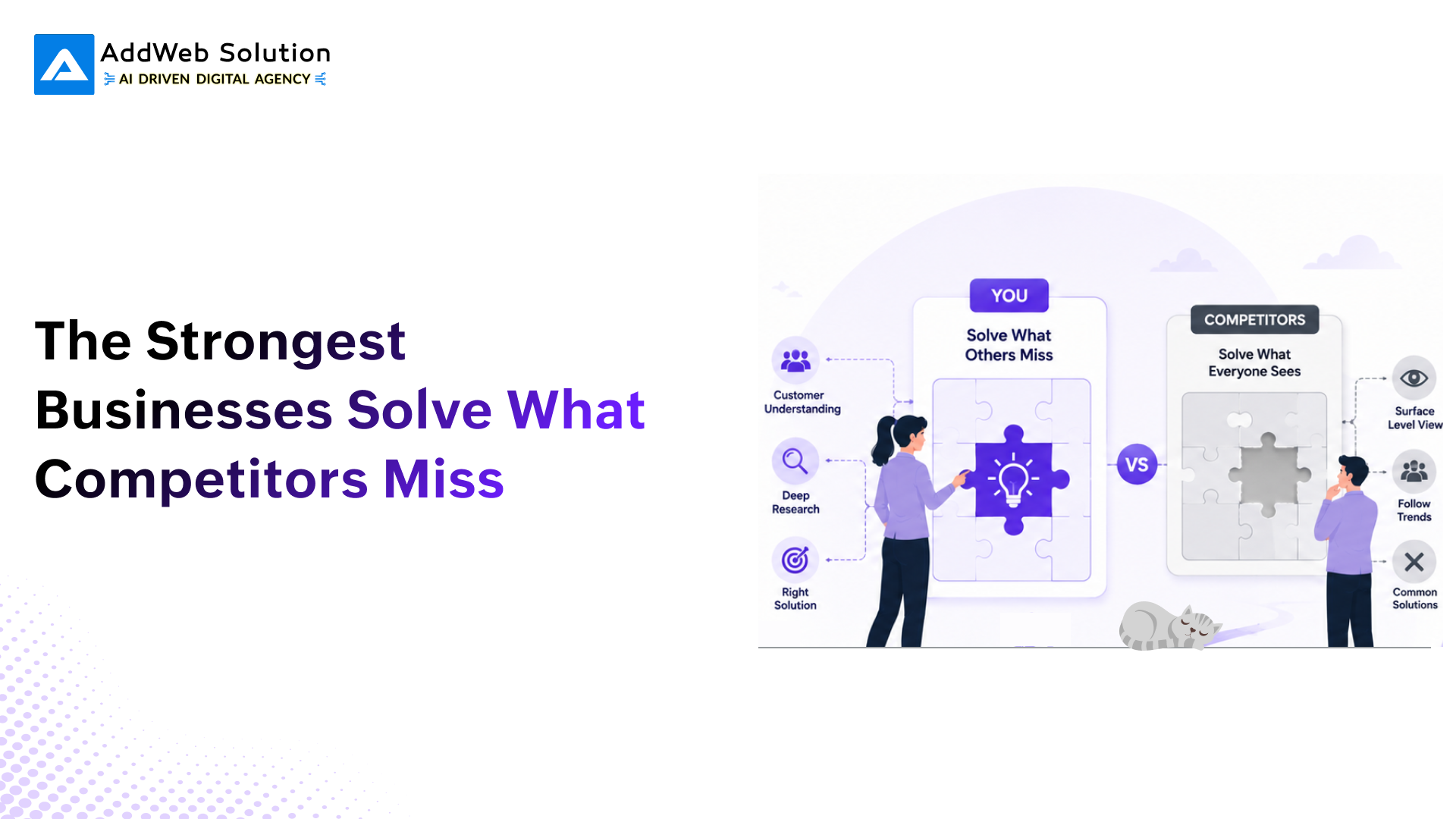
The businesses I admire most don’t simply execute better.
They see differently.
And that ability has become one of the most valuable competitive advantages I’ve encountered.
Key Takeaways
- Better questions often create better businesses.
- Solving the wrong problem wastes even excellent execution.
- Curiosity is a strategic advantage.
- Clients often describe symptoms rather than root causes.
- Great businesses become known for insight before execution.
Introduction
One lesson has quietly changed the way I approach almost every client conversation.
People are usually very good at describing what they see.
They’re not always describing what’s actually happening.
A client says they need a new website.
Do they?
Or do they need more qualified leads?
Someone asks for a mobile app.
Or are they really trying to reduce operational delays?
A business requests AI integration.
Or are they trying to improve decision-making?
Those aren’t the same conversations.
Earlier in my career, I focused on answering the question the client asked.
Today, I spend much more time understanding the question behind the question.
That shift has improved my recommendations far more than learning any new technology.
Because the quality of the solution depends entirely on whether we’ve correctly identified the real problem.
1. Why Most Businesses Start Too Late
One pattern has repeated itself throughout my career.
Many businesses begin solving a problem before they’ve fully understood it.
That’s understandable.
Clients usually arrive with urgency.
Teams want momentum.
The temptation is to move quickly.
I’ve felt that pressure myself.
But speed can become expensive when it’s directed at the wrong challenge.
I’ve gradually come to believe that the first responsibility of any trusted advisor isn’t providing answers.
It’s improving the quality of the question.
Peter Drucker once observed,
“The most serious mistakes are not being made as a result of wrong answers. The truly dangerous thing is asking the wrong question.”
The more experience I gain, the more I appreciate that statement.
Great businesses aren’t defined only by their ability to solve problems.
They’re defined by their ability to discover the right ones.
2. Symptoms Are Not the Problem
One lesson I’ve learned repeatedly is that clients usually describe symptoms.
Not causes.
“We need a faster website.”
“We need more developers.”
“We need AI.”
Sometimes they’re right.
Sometimes those are simply visible symptoms of something deeper.
Poor positioning.
Inefficient processes.
Unclear customer journeys.
Weak internal communication.
Technology can solve many problems.
It can’t solve the wrong problem.
That realization has fundamentally changed how I approach discovery.
Instead of asking,
“How do we build this?”
I increasingly ask,
“What business problem are we really trying to solve?”
Those conversations often lead to entirely different solutions.
Albert Einstein is often credited with saying,
“If I had an hour to solve a problem, I’d spend fifty-five minutes thinking about the problem and five minutes thinking about solutions.”
Whether or not every word is exact, the principle has endured because it reflects an important truth.
The quality of the solution depends on the quality of the understanding.
3. The Value of Better Questions
One of the biggest changes in my professional life wasn’t learning a new technology.
It was learning to ask better questions.
Earlier in my career, I often arrived at meetings prepared with answers.
Today, I arrive prepared with questions.
Not because I know less.
Because I’ve learned that thoughtful questions reveal opportunities that obvious answers never will.
Questions like:
Why is this happening now?
What happens if we do nothing?
How will we know we’ve actually solved the problem?
What business outcome matters most?
Those conversations often uncover assumptions that nobody had challenged.
Sometimes the original request changes completely.
Not because the client was wrong.
Because the conversation became deeper.
I’ve gradually realised that great advisors don’t impress clients by having immediate answers.
They earn trust by helping clients see their business more clearly.
Warren Berger, author of A More Beautiful Question, wrote,
“The ability to ask the right question is one of the greatest competencies of the twenty-first century.”
That idea has stayed with me because questions do something answers rarely achieve.
They create understanding.
And understanding usually precedes good decisions.
4. Insight Creates Differentiation
Technology can be copied.
Processes can be copied.
Even pricing models can eventually be copied.
Insight is much harder to replicate.
I’ve noticed that clients rarely remember every technical detail of a project.
They remember moments like these:
“We hadn’t thought about it that way.”
“That’s a much bigger issue than we realised.”
“We were solving the wrong problem.”
Those moments create value long before implementation begins.
They also create trust.
Not because the agency had more information.
Because it interpreted the information differently.
That’s why I no longer believe differentiation begins with execution.
I believe it begins with perspective.
Clayton Christensen observed,
“Questions are places in your mind where answers fit.”
I’ve come to appreciate that insight because the quality of the answer can never exceed the quality of the question that produced it.
Businesses that consistently ask better questions rarely struggle to remain relevant.


5. Curiosity Is a Competitive Advantage
Curiosity doesn’t usually appear on a balance sheet.
It isn’t listed as a service.
Clients rarely ask whether your company is curious.
Yet I’ve become convinced that curiosity is one of the most valuable capabilities an organization can develop.
Curiosity encourages people to investigate before recommending.
To understand before assuming.
To explore before concluding.
In fast-changing industries, that’s an extraordinary advantage.
Knowledge eventually becomes outdated.
Curiosity keeps renewing knowledge.
I’ve noticed that the strongest professionals I’ve met continue asking questions even after decades of experience.
Not because they lack expertise.
Because they understand that certainty ages much faster than curiosity.
6. Building a Business That Sees Differently
If I were building an agency from the beginning today, one capability would receive as much attention as technical excellence.
Observation.
I’d want people who notice patterns.
Who ask thoughtful questions.
Who challenge assumptions respectfully.
Who understand the commercial impact of technical decisions.
Because those skills become increasingly valuable as technology becomes more accessible.
I’ve gradually realised that clients don’t simply hire agencies to produce work.
They hire them to reduce uncertainty.
To reveal blind spots.
To help them make better decisions.
That’s a responsibility that begins long before the first line of code is written.
And I believe it will remain valuable regardless of how technology continues to evolve.
Statistics
Research consistently shows that organizations that encourage curiosity and critical thinking are better equipped to innovate and solve complex business problems.
Harvard Business Review has highlighted that curiosity improves learning, innovation, and organizational performance by encouraging people to challenge assumptions and explore alternatives.
Source:
McKinsey & Company has found that organizations creating the most value from digital transformation invest as much in problem definition and business understanding as they do in technology implementation.
Source:
https://www.mckinsey.com/capabilities/mckinsey-digital/our-insights
IBM’s Institute for Business Value has repeatedly emphasized that organizations combining technology with deep business insight consistently outperform those focusing on technology alone.
Source:
https://www.ibm.com/thought-leadership/institute-business-value
A Few Observations
- Businesses often solve the problem they can see rather than the problem that matters most.
- Better questions reduce the risk of expensive execution.
- Insight creates value before implementation begins.
- Curiosity becomes increasingly valuable as information becomes increasingly abundant.
Frequently Asked Questions
Should agencies challenge client assumptions?
Yes, but respectfully and with evidence.
The objective isn’t to prove clients wrong.
It’s to help them make better business decisions.
Doesn’t asking more questions slow projects down?
It may extend the discovery phase slightly.
But it often prevents costly rework later.
A thoughtful beginning usually creates a faster ending.
Can curiosity really become a competitive advantage?
Absolutely.
Knowledge can be acquired.
Technology can be adopted.
Curiosity shapes how organizations continue learning long after others stop asking questions.
How can leaders encourage better problem-solving?
Reward thoughtful questions.
Create space for discussion.
Challenge assumptions without blaming people.
Build a culture where understanding the problem is valued as much as solving it.
My Framework – The Problem Discovery Pyramid™
Every successful solution begins with understanding.

The idea
Most projects begin at the bottom.
The best projects reach the top before implementation starts.
The higher you climb, the greater the long-term value you create.
A Thought to Leave You With
The quality of your solutions will never exceed the quality of the problems you choose to solve.
Technology rewards execution.
Business rewards understanding.
The strongest companies become known not because they work faster than everyone else…
But because they consistently solve the problems that matter most.
Don’t build a solution for the wrong problem. Partner with a team that focuses on business outcomes, not just technical delivery.

Pooja Upadhyay
Director Of People Operations & Client Relations
Closing Thoughts
Looking back over the years, I no longer think the most valuable skill I’ve developed is technical expertise.
It’s learning to pause before proposing a solution.
To ask another question.
To understand another perspective.
To look beyond the obvious request.
Because I’ve learned that clients rarely remember who delivered the quickest answer.
They remember who helped them understand the problem differently.
That insight has shaped many of the conversations I’ve had throughout my career.
And I believe it will become even more valuable in the years ahead.
As AI accelerates execution and information becomes easier to access, the ability to identify the right problem before solving it may become one of the few competitive advantages that cannot be automated.
In the end, exceptional businesses aren’t defined only by the quality of their solutions.
They’re defined by the quality of the questions they ask before those solutions are ever created.
My Principle
Answers create progress. Questions create direction.
The businesses that endure don’t just become better at solving problems.
They become better at discovering the ones worth solving.
