


Overview
Customer churn measures the proportion of customers that cease doing business with a company within a given time frame, and it is an essential metric for any subscription or recurring revenue business. The high churn rate not only affects the monthly recurring revenue but also puts additional pressure on sales and marketing to acquire more customers just to maintain its position. By using predictive analytics through Python, organizations can shift from addressing the churn rate of customers once they have left to anticipating customers’ likelihood of churn and taking action before any financial loss occurs.
This tutorial discusses everything needed to develop a customer churn prediction project in Python without focusing on the coding aspect of building the model.
What Is Customer Churn and Why It Matters
The churn rate is the rate of loss of customers or subscribers in your business in a fixed period. In a subscription model of a business, an increased churn by any small amount will make an enormous impact on your recurring revenue because the loss of customers means the loss of future potential as well.
The formula for churn rate is:
Churn rate=Number of customers lost in periodNumber of customers at start of period100
For instance, you begin your month with 350 customers, and you end it with 50 less; your churn rate stands at about 14%. The churn rate in subscription-based businesses ranges somewhere below ten percent per month, and B2C is normally higher than B2B.
Types of churn to track
Each type of churn perspective highlights distinct risks as follows:
- Customer churn: Number of customers who churn during a certain period.
- Revenue churn: The recurring revenue generated by those customers.
- Voluntary churn: Customers who consciously chose to stop using your services.
- Involuntary or passive churn: Churn caused by payment failures, expiry of credit card etc.
Predictive analytics will be helpful for all kinds of churn analysis, but it becomes more useful for predicting and mitigating voluntary churn.
How Predictive Churn Analytics Can Help Your Organization
Predictive churn analytics applies advanced statistical algorithms to your company’s past and present customer data to forecast the likelihood of each individual customer leaving your business in the near future. Rather than applying one general average churn rate, your company can obtain a prioritized list of customers based on the degree of their risk.
According to real-life examples, businesses adopting churn prediction technology are capable of decreasing churn rates by 15% to 30% while ensuring their safety from millions of dollars of revenue loss. Besides that, the insights gained through predictive churn analytics help find the root cause of customer churn.
Typical outcomes from business
The following list shows some typical outcomes from the business when implementing predictive churn analysis:
- Attrition prevention via early detection and contact.
- Improved customer retention and value.
- Optimized spending on marketing efforts by targeting high-potential customers.
- Alignment between product teams, customer success teams, and marketing departments regarding risks.
Python-Based Approach to Predictive Analysis (Without Code)
Creating a churn prediction model that uses Python has a number of major steps. They remain common across all industries, despite having certain differences.
- Defining Churn and Goals
Establish what constitutes churn for your company (subscription cancellations, three months without activity, etc.) and which decisions you want the model to help make. - Gathering and Integrating Data
Unify customer relationship management records, purchase history, usage logs, support communications, payment data, and marketing information into one dataset. - Feature Engineering
Generate features like the frequency of logins, decrease in usage, amount of complaints, or plan change from raw events that may be indicative of churn. - Training and Assessing Models with Python
Employ Python-based machine learning tools to train and compare various predictive models, including logistic regression, decision trees, or random forest models. - Scoring Customers and Implementation
Use your preferred model to produce churn risk scores for existing clients and include them within CRM systems, dashboards, or campaigns. - Taking Action and Iteration
Develop strategies for handling different customer segments depending on their risks and monitor the results before retraining the model.
Visual 1: Pie Chart of Churn vs Retained Customers
One straightforward method of socializing the issue of customer churn inside the organization would be a simple pie chart depicting two categories: “Retained” and “Churned” customers within a particular period of time.
Example pie chart:
- Category 1: Retained customers (such as 80 percent).
- Category 2: Churned customers (such as 20 percent).
Such a visual will allow you to easily recognize the share of churned customers and can be used repeatedly in order to demonstrate progress achieved by means of predictive analytics.
In your blog post, you could place such a picture:

Replace path/to-churn-pie-chart.png with the actual path or URL of your chart image generated from your BI or plotting tool.


The Data Needed for Churn Prediction
Predictive models for churn require quality data that is both rich in detail and free from inaccuracies. Research carried out in various industries like telecom, software services, and banking confirms that usage activity, contract terms, pricing factors, and customer feedback are among the key indicators for predicting churn.
Categories of data to collect
Some common data points to consider for churn prediction models are as follows:
- Customer information and demographics: Segmentation, location, length of association, company size, subscription type.
- Contract details: Contract length, renewal terms, contract discount, add-ons available, months left.
- Usage activity: Weekly sessions, feature usage, time spent on app, active seats.
- Payment behavior: Invoice size, payment method, failed payments, outstanding balance.
- Feedback: Number of tickets raised, feedback sentiment, support resolution time, complaints filed.
- Marketing activities: Open rates, response rates, NPS scores, marketing campaigns.
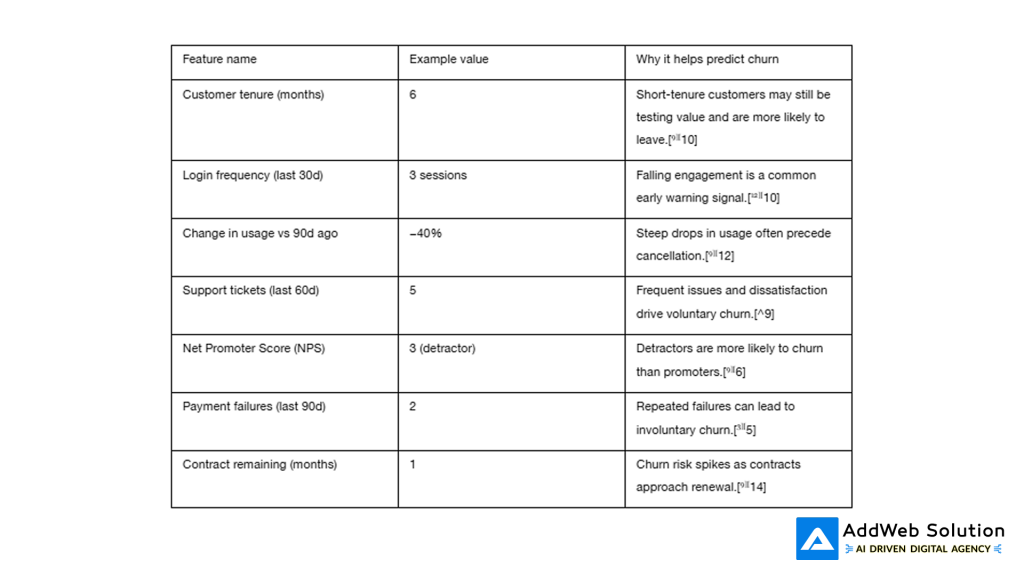
Example feature table
Below is an example of how raw data can be summarized into model-ready features in a table.
| Feature name | Example value | Why it helps predict churn |
| Customer tenure (months) | 6 | Short-tenure customers may still be testing value and are more likely to leave.[9][10] |
| Login frequency (last 30d) | 3 sessions | Falling engagement is a common early warning signal.[12][10] |
| Change in usage vs 90d ago | −40% | Steep drops in usage often precede cancellation.[9][12] |
| Support tickets (last 60d) | 5 | Frequent issues and dissatisfaction drive voluntary churn.[^9] |
| Net Promoter Score (NPS) | 3 (detractor) | Detractors are more likely to churn than promoters.[9][6] |
| Payment failures (last 90d) | 2 | Repeated failures can lead to involuntary churn.[3][5] |
| Contract remaining (months) | 1 | Churn risk spikes as contracts approach renewal.[9][14] |
This structure is easy to build in a spreadsheet or data warehouse and then exported to Python for modeling.
Visual 2: Bar Chart of Top Churn Drivers
With the model being developed, one may calculate feature importance scores in order to determine which are the main predictors of churn. Studies examining the phenomenon of customer churn in software as a service and telecoms have shown that the top influencing factors include engagement characteristics like time spent on the site and login frequency, as well as billing factors.
Recommended visualization for bar graph:
- X-axis: Top 8-10 features (time spent, login frequency, months left on contract, complaint count, payment issues).
- Y-axis: Feature importance/contribution to prediction.
Example in markdown:
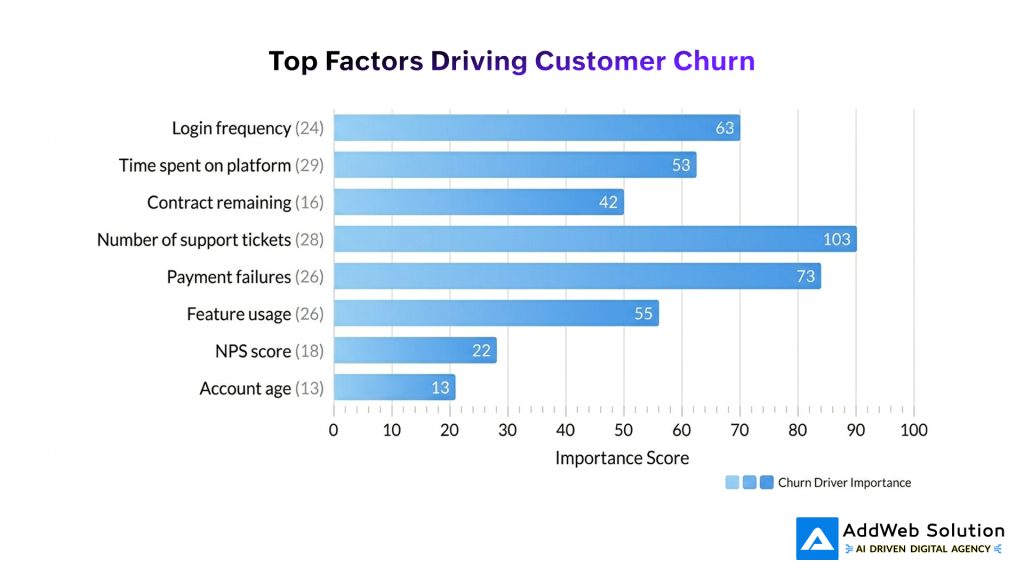
Presenting this chart in your blog helps non-technical stakeholders see which levers they can pull to reduce churn.
Approaches to Modeling Churn in Python
A range of machine learning algorithms can be employed for predicting churn, and each algorithm has its own pros and cons regarding accuracy, interpretability, and complexity.
Algorithms for churn modeling
- Logistic regression: Simple yet effective linear classifier for calculating the likelihood of churn. Quick to implement, however, lacks in complexity.
- Decision trees: A family of classifiers that group customers using certain criteria in order to create a “tree,” producing human-readable results at the cost of higher risk of overfitting.
- Random forests: A collection of multiple decision trees, usually more accurate and less prone to overfitting than just one tree.
- Gradient boosting machine (GBM): Ensemble algorithms for creating highly accurate predictive models from a combination of weak learners.
- Support vector machine (SVM) and others: Used in various cases of churn in telecommunications companies and banks where feature space is complicated.
According to surveys among SaaS professionals, GBM and random forests are more popular approaches to modeling churn because of their overall performance.
Criteria for selecting models
If you’re working with a data science team, some of the considerations to keep in mind include:
- Does the model predict most of the high-risk customers (high recall)?
- Is it okay to have false positives, or does that result in costly or bothersome communications with customers?
- Can your team articulate what makes a particular customer high-risk in the eyes of the model?
- Is the model easy to maintain and update using Python as data changes?
These technical decisions could be made with Python packages like scikit-learn or other software, but as far as business considerations go, it all comes down to clarity.
Visual 3: Graph Showing Churn Rate Pre- and Post-Model Deployment
For visualization purposes, you may plot your graph using the monthly churn rate. This will illustrate the effectiveness of deploying the predictive analytics approach and the new retention strategy.
Recommended graph:
- X-axis: Months (for example, 12-24 months).
- Y-axis: Monthly churn rate.
- Vertical line: Month of deployment of the churn prediction model.
Example in markdown code:
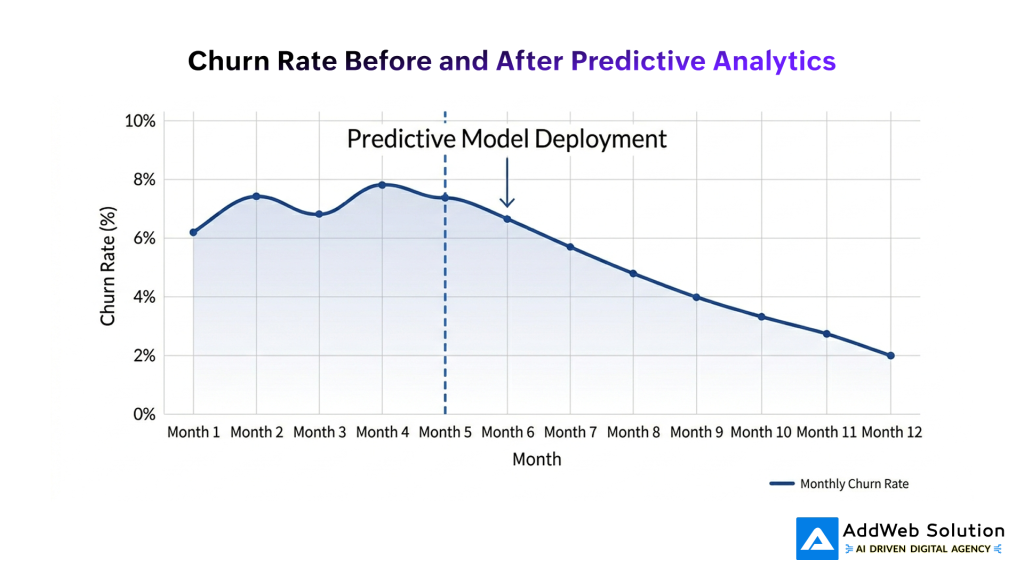
The diagram clearly links investment in analytics to tangible benefits, just like case studies illustrating double-digit declines in customer churn after implementing predictive analytics.
Implementation Steps (Business Approach)
Below is the step-by-step approach that most teams could use for building their churn predictor in Python without losing sight of the business side.
Step 1: Establish Objectives and Scope
- Formulate a precise definition of churn (“customer canceling the subscription,” “not renewing,” “becoming inactive”).
- Decide how far out you want your prediction to go (“customers who will leave us within the next 30, 60, or 90 days”).
- Establish your business objectives, such as “lowering churn rate by 20 percent” or “adding 1 percent more revenue through retention,” as seen in certain case studies involving millions in savings.
Step 2: Assess and Prepare Data
- Identify the systems that matter – including billing systems, customer relationship management systems, product analytics, support desks, and marketing tools.
- Relate today’s data to each of the feature categories discussed above.
- Partner with data engineers/analysts to cleanse and consolidate the data into one table.
Example of data readiness table:

This table helps align stakeholders on what is possible immediately and what needs investment.
Step 3: Developing the first model using Python
- Use a historical data set that already has information on whether a customer left or not.
- Split your data for training and validation purposes and check your model’s generalizability.
- First, build a simpler model to have something to compare to, and if necessary, develop tree-based models later.
Data scientists will be able to do this in Python using available libraries, whereas business leaders will look at metrics and model interpretation reports.
Step 4: Evaluate performance with the right metrics
Churn prediction is often imbalanced—only a minority of customers churn each month—so accuracy alone can be misleading. Evaluation should consider:
- Recall: Of all churners, what percentage did the model correctly flag?
- Precision: Of customers the model marked as high risk, what percentage actually churned?
- F1-score: A balanced measure combining precision and recall, commonly used in churn studies.
- Lift and gain charts: How much better is the model than random targeting at capturing churners in the top X percent of customers?
Step 5: Operationalize scores and playbooks
Once the model is satisfactory, Python scripts can be scheduled to generate daily or weekly churn scores. Those scores should be integrated into tools that teams already use:
- CRM (for account managers and customer success).
- Marketing automation platforms (for campaigns).
- Internal dashboards (for leadership).
Then develop clear playbooks for each risk band:
- High risk: Personal outreach, save offers, or tailored consultations.
- Medium risk: Targeted education, usage nudges, or feature adoption programs.
- Low risk: Standard lifecycle communications, referrals, and upsell campaigns.
Case studies show that when such playbooks are informed by data and executed consistently, organizations can achieve meaningful reductions in churn and improvements in customer lifetime value.
Step 6: Monitor, explain, and improve
A churn model is not a “set-and-forget” asset. To keep it effective:
- Monitor drift in input data and model performance over time.
- Use explainability tools (such as feature importance and local explanations) to validate that the model behaves sensibly.
- Periodically retrain the model in Python using more recent data.
- Use qualitative feedback from sales, support, and customers to refine features and retention strategies.
Turning Predictions into Concrete Retention Actions
Predictive analytics only generates value when predictions lead to action. Research and case studies highlight several effective, data-informed retention tactics.
Targeted save campaigns
- Offer high-risk, high-value customers tailored discounts or feature bundles based on their usage patterns.
- Trigger outreach when engagement suddenly drops or when key stakeholders stop logging in.
- Use insights about top churn drivers (for example, support issues or missing features) to personalize messaging.
Proactive customer success
- Assign customer success managers to accounts with rising churn risk scores.
- Schedule check-ins before renewal dates, especially for customers with short remaining contract terms.
- Provide training or onboarding refreshers to users who appear to be underutilizing key features.
Product and experience improvements
- If churn is strongly linked to specific features, performance issues, or pricing tiers, share those insights with product and pricing teams.
- Use NPS and survey feedback together with churn predictions to prioritize experience improvements.
- Address involuntary churn by improving payment retries, card updater services, and payment UX.
Visual 4: Customer Journey Heatmap
To humanize churn insights, create a heatmap of the customer journey that shows where churn probability spikes.
Suggested heatmap:
- Rows: Journey stages (Onboarding, Adoption, Expansion, Renewal).
- Columns: Key behaviors (logins, feature usage, tickets, payment issues, NPS).
- Cell color: Average churn propensity at that stage-behavior combination.
In Markdown, an image placeholder might be:

This type of visual helps teams see churn not just as a number but as a lived customer experience.
Governance, Ethics, and Customer Trust
Churn prediction models rely on customer data, so governance and ethics are important:
- Data privacy: Ensure compliance with relevant privacy regulations and internal policies.
- Fairness and bias: Avoid including features that proxy for protected attributes in ways that could lead to unfair treatment.
- Transparency: Be prepared to explain, at a high level, how predictions are made and how data is used.
Transparent practices build customer trust and reduce the risk of negative reactions to highly targeted retention efforts.
Implementation Checklist
To recap, here is a concise, business-friendly checklist to guide implementation of churn prediction using Python.
- Clarify churn definition, time horizon, and success metrics.
- Audit available data sources and prioritize those most related to engagement and value.
- Design a unified customer dataset with clear features.
- Partner with data scientists to build and validate models in Python.
- Choose an algorithm that balances performance and explainability.
- Integrate churn scores into CRM, marketing, and dashboards.
- Define playbooks for high-, medium-, and low-risk segments.
- Track churn, revenue impact, and campaign performance over time.
- Retrain and refine models as behavior, products, and markets evolve.
By following these steps, organizations can shift from reactive churn reporting to proactive, data-driven retention, using Python as the engine behind the scenes and human teams as the decision-makers and relationship builders.
Ready to Reduce Customer Churn with Predictive Analytics?
Start building intelligent churn prediction models in Python and turn customer data into actionable retention strategies today.

Pooja Upadhyay
Director Of People Operations & Client Relations
References
- https://www.zuora.com/resources/subscriber-churn/
- https://stripe.com/resources/more/subscription-churn-101
- https://www.mckinsey.com/capabilities/growth-marketing-and-sales/our-insights
- https://pmc.ncbi.nlm.nih.gov/articles/PMC7982234/
- https://arxiv.org/abs/2102.09379
- https://www.sciencedirect.com/science/article/pii/S0957417420305245
- https://towardsdatascience.com/customer-churn-prediction-using-machine-learning-8f1f1a6e3d1a
- https://www.ibm.com/topics/customer-churn
