


Executive summary
All three languages are capable of supporting cutting-edge machine learning technology, yet they fill drastically different niches within businesses.
Python leads data science and artificial intelligence projects from beginning to end due to its expansive ecosystem, deployment capabilities, and expertise.
R stays true to its roots as an expert statistical analysis language for report writing and academic research purposes.
Julia is positioning itself as a next-gen language for scientific computing and highly numerically-intensive models that prioritize speed over other considerations.
In practice, Python should be the go-to language for most companies creating industrial ML solutions, while R and Julia should be considered supplements to address specific issues.
Visual overview: where each language shines
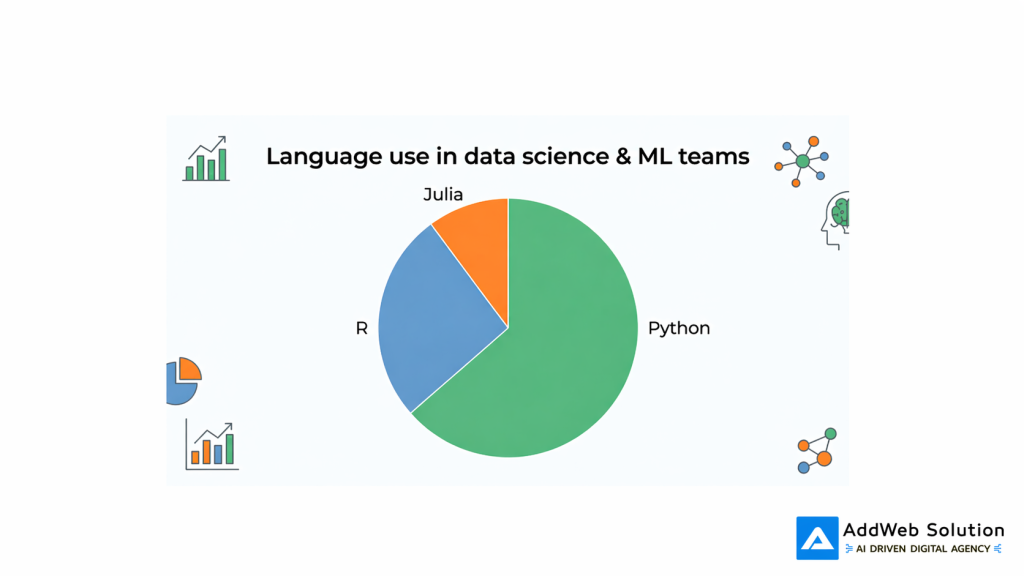
The infographic below works well near the top of a blog post to give non‑technical stakeholders a quick feel for language usage.
One‑glance comparison table
| Dimension | Python | R | Julia |
| Primary strength | General‑purpose language for end‑to‑end ML, automation, and applications. | Deep statistical analysis, reporting, and research‑oriented analytics | High‑performance numerical and scientific computing for ML |
| Ecosystem maturity for ML | Very mature: scikit‑learn, TensorFlow, PyTorch, XGBoost, rich MLOps tooling. | Mature for statistics and visualisation; good but narrower ML ecosystem (caret, tidymodels, H2O). | Growing ML ecosystem (Flux.jl, MLJ.jl) but smaller community and fewer battle‑tested libraries. |
| Business adoption | Dominant in data science and ML roles; widely used across industries. | Strong in academia, public sector, and specialist analytics teams. | Niche but rising in research labs, quantitative finance, and scientific organisations. |
| Performance profile | Fast enough for most workloads; heavy lifting often delegated to optimised C/C++ and GPU backends. | Adequate for statistics; slower for heavy numerical loops than compiled languages. | Near‑C performance on numerical workloads; significant speedups vs Python in CPU‑bound tasks. |
| Typical business use | Production ML services, data pipelines, automation scripts, dashboards, experimentation. | Regulatory reporting, experimental design, biostatistics, survey analysis. | Optimisation engines, scientific ML, simulation‑heavy models (e.g., climate, physics, risk engines). |
Language choice considerations for business machine learning
Language choice is not only a technical consideration but also a factor that influences the process of hiring, vendor selection, governance, and future maintenance costs.
The language selection will impact the speed of prototyping by data scientists and data engineers, the ability to take models to production, and the reliability of operation and auditing in the future.
Some of the business factors to consider include:
- Speed to value: The ability to leverage a language ecosystem and syntax to implement ideas and take them from concept to pilot.
- Operational risk: Maturity of tooling and operational processes to avoid fragile and bespoke scripts managing mission-critical workflows.
- Talent management: Hiring, contracting, and training on industry‑preferred languages.
- Governance and compliance: Good visualization and reproducibility for models that inform decisions and reports at the executive level.
Ecosystem and libraries for machine learning
Python: the default for end‑to‑end ML systems
Python is now the de facto default language for use in data science and machine learning within industries.
This is because it provides an extremely extensive ecosystem ranging all the way from data ingestion to serving models:
- Core ML and AI frameworks: scikit-learn, for classic machine learning, Tensorflow, and PyTorch, for deep learning, along with XGBoost and LightGBM and many other similar platforms.
- Data and features engineering: pandas and numpy, as well as various ecosystem libraries, including Dask and Ray.
- MLOps and deployment: API frameworks, such as FastAPI and Flask, and orchestrations libraries, such as Airflow, as well as libraries for experiments and model monitoring.
Because the ecosystem encompasses not only analytics but also software development, companies have no need to switch languages while building their full stack solutions.
R: specialist in statistics and visualisation
R is a language developed by statisticians for statistical computation, and its library suite bears this pedigree.
Some of the key features in R are:
- Sophisticated statistical algorithms: great strength in areas such as econometric calculations, experiment design, time-series modelling, and biostatistics.
- Data visualisation: ggplot2 and Shiny provide a combination of high-quality graphics and interactive applications that makes R the preferred platform for exploratory analytics and stakeholder engagement.
- Subject-matter solutions: there are numerous government, healthcare, and research projects based on R, and regulatory authorities sometimes require R output.
However, although R does contain ML packages, including integration with H2O and other platforms, its capabilities show through most strongly in analysis and report-oriented work flows.
Julia: performance‑centric scientific ML
Julia was designed to provide the productivity of high-level languages with performance approaching that of C and Fortran.
The ML ecosystem in Julia is relatively new but growing rapidly, with efforts such as Flux.jl and MLJ.jl dedicated to deep learning and modeling.
Characteristics of the ecosystem include:
- Scientific machine learning: robust support for differential equations, simulations, and physics-informed neural networks.
- Numeric computing composability: use of one language for prototype and production-grade development to mitigate the “two-language” problem seen in Python ecosystems.
- Interoperability: calls from Julia to Python and C when necessary, facilitating the bridging of gaps until Julia’s libraries are more developed.
Performance and scalability
Raw performance
Julia tends to outperform Python and R due to efficient compilation of source code to machine code by means of just-in-time (JIT) compilation technology.
According to scientific computing research, Julia programs run orders of magnitude faster compared to equivalent Python programs under CPU-bound tasks without significant optimization efforts.
While R and Python largely depend on pre-optimized libraries for good performance, pushing workloads inside libraries such as NumPy, BLAS or GPU kernel execution enables performance comparable with compiled languages, while language loops and complex numerical processing is not as fast.
In practice, though, many enterprise environments are dominated by I/O, network operations and DB accesses, rendering differences in theoretical CPU efficiency not as relevant as ecosystem considerations.
Practical business perspective on performance
From the business angle, performance discussions should focus on user experience and infrastructure expenses:
- Does model latency satisfy application needs? Interactive pricing tools have stricter latency requirements than batch-based risk analysis.
- Is scaling economically viable? Consider moving to Julia-based development when scaling to higher loads results in significantly higher infrastructure costs.
- Where is the bottleneck? Often, in pipeline architectures, the database, message bus, or external API calls limit performance rather than the inference algorithm itself, rendering language-level optimizations secondary.
In reality, most organizations begin using Python due to rapid prototyping needs and evaluate whether Julia or another low-level language becomes necessary only when a bottleneck arises in specific layers of the stack.
Integration with existing business systems
Python: strong systems capabilities
Python has excellent systems integration capabilities because it can easily integrate with databases, REST APIs, message brokers, ERPs, and clouds; this explains why Python is the dominant language in enterprise-level data processing and artificial intelligence.
It is available on all popular cloud platforms, is embedded in a wide variety of analytics software, and has extensive libraries supporting SQL and NoSQL databases, SaaS APIs, and internal microservices.
Therefore, it becomes easy to incorporate machine learning models in enterprise processes such as supply chain optimization, dynamic pricing, fraud detection, and customer segmentation.
R: strong with BI and reporting tools
R integrates well with BI and reporting tools, especially when there is an existing use of RStudio, RMarkdown, and Shiny apps in communicating business insights.
It is regularly used to create statistical analysis models that are usually invoked by other platforms or applications, but it is not widely used in production service development.
However, companies normally follow a hybrid approach by using R for exploratory purposes and compliance reporting, followed by deployment of the models in Python or similar general-purpose programming languages.
Julia: integration is developing but is still at an immature stage
Although Julia can be integrated with databases and even allows access to external libraries, the overall ecosystem, such as for DevOps, logging, and monitoring, is not yet as developed as in the case of Python.
For organizations working within the framework of high-performance computing platforms, Julia fits into current scientific processes better than Python does.
Talent, hiring, and community support
Market availability of skills
According to various industry studies and job-market surveys, Python is the leading required skill in the field of data science and machine learning, as the percentage of employment that uses Python is predominant.
However, R is still significant in some job descriptions, particularly those related to the public sector, academic organizations, or biostatistics, while being much less often mentioned in general data science positions.
Skills for Julia are quite rare; typically, experienced specialists work in research labs, financial modeling, or other scientific sectors requiring high-performance.
Thus, using Julia entails additional costs for hiring and training.
Community and ecosystem health
All three languages are open source and benefit from global communities, but the depth and breadth of those communities differ.
- Python: very large, with extensive documentation, tutorials, conference ecosystems, and vendor support; problems are often solvable via widely viewed resources.
- R: strong within statistics, academic research, and specific industries; community output often focuses on methodological rigour and reproducible research.
- Julia: smaller but highly technical community centred on numerical computing and scientific applications; discussion often occurs in specialised forums and research collaborations.
From a risk perspective, Python’s community depth reduces the likelihood of becoming stuck on obscure issues, while R and Julia may require more specialist expertise for advanced use cases.
Cost, licensing, and tooling
Python, R, and Julia are all open‑source and free to use, which is attractive compared with proprietary analytics platforms such as SAS or SPSS.
The primary cost drivers therefore come from infrastructure, developer time, and vendor tooling choices rather than licence fees.
Relevant cost considerations include:
- Infrastructure usage: more efficient languages or libraries may reduce cloud compute costs for large‑scale workloads.
- Commercial tooling: many paid platforms and MLOps tools are optimised around Python workflows, which can lower integration and maintenance costs.
- Training and upskilling: choosing a niche language may require more internal training and limit the pool of contractors and partners.
Security, governance, and risk
Security and governance concerns apply more to the surrounding stack than to the core language, but ecosystem maturity does matter.
Python benefits from well‑established security guidance, enterprise‑grade libraries, and cloud‑provider best practices for packaging, dependency management, secrets handling, and API security.
R and Julia can be operated securely, but organisations will typically find fewer off‑the‑shelf patterns and platform integrations, shifting more responsibility to internal teams.
From a governance standpoint, R’s history in regulated analytics and reproducible research makes it appealing for audit‑heavy workflows, provided productionisation concerns are addressed.
Python, meanwhile, offers strong support for versioning, testing, and CI/CD around ML applications, which supports good model‑risk management at scale.
Which language for which business scenario?
The table below summarises practical choices for common business ML scenarios.
| Scenario | Recommended primary language | Rationale |
| Customer‑facing ML product (e.g., recommendations, pricing) | Python | Strong deployment story, rich ML frameworks, easy integration with web services and cloud infrastructure. |
| Executive dashboards and regulatory reports | R (often with Python in the background) | Excellent visualisation and reporting, wide acceptance in research and regulatory circles. |
| Supply‑chain analytics and optimisation | Python | Fits optimisation libraries, simulation tools, and integration with ERP and planning systems. |
| Biostatistics, clinical trials, survey analysis | R | Designed for rigorous statistics, with domain‑specific packages and long‑standing use in life sciences. |
| Real‑time risk engines and simulation‑heavy models | Julia (with Python at the edges) | High performance for numerical simulations and scientific ML, while Python handles orchestration and glue code. |
| Enterprise‑wide analytics platform standard | Python first, R as a complement | Python for shared infrastructure and applications, R for specialist statistical teams that need its tooling. |


Practical decision checklist for business leaders
When deciding between Python, R, and Julia for machine learning initiatives, leadership teams can use the following practical checklist.
- Clarify primary objectives
- If the goal is to embed ML into products and operational systems, start with Python.
- If the goal is rigorous statistical analysis and reporting, ensure R is available alongside other tools.
- If the goal is solving numerically intensive scientific problems, evaluate Julia for performance‑critical components.
- Assess current team skills
- Map existing analyst and engineering skills to languages already in use.
- Prefer solutions that build on current strengths rather than forcing a wholesale language switch.[10][1]
- Consider ecosystem and vendor landscape
- Review cloud platforms, MLOps tools, and BI systems in use; most have first‑class support for Python, with varying levels of support for R and limited support for Julia.
- Plan for governance and reproducibility
- For regulated workloads, design workflows where R or Python notebooks feed well‑documented, version‑controlled code pipelines that auditors can review.
- Start simple, evolve deliberately
- Begin with the language that gets the first valuable solution into users’ hands fastest—often Python for production applications or R for analytical reporting—then introduce Julia or additional tooling only when clear bottlenecks appear.
Conclusion
Python, R, and Julia each bring distinct strengths to business machine learning, and the “best” choice depends more on context than on abstract benchmarks.
Python offers breadth, integration, and talent availability, making it the default backbone for many enterprise AI efforts.
R delivers depth in statistical analysis and visual storytelling, anchoring research‑heavy and regulated analytics domains.
Julia adds a high‑performance option for numerically demanding workloads where speed and scientific computing are central concerns.
For most organisations, a pragmatic strategy is to standardise on Python for shared ML infrastructure, support R for specialist analytics teams, and selectively adopt Julia where performance requirements clearly justify it.[2][6][^1]
Get expert guidance on choosing the right language, tools, and architecture for your Business roadmap.

Pooja Upadhyay
Director Of People Operations & Client Relations
References
- https://en.wikipedia.org/wiki/Julia_(programming_language)
- https://en.wikipedia.org/wiki/R_(programming_language)
- https://en.wikipedia.org/wiki/Python_(programming_language)
- https://github.com/dot-agi/dl-benchmark
- https://julialang.org/benchmarks/
- https://stackoverflow.com/questions/tagged/julia
- https://stackoverflow.com/questions/tagged/python
- https://stackoverflow.com/questions/tagged/r
