


“Donors are not numbers in a CRM; they’re people who give when they feel seen, understood, and valued.”
Introduction
Nonprofit teams have always known that relationships drive giving, but the playbook has changed. Donors now expect the same relevance they get from retail, media, and subscription brands, and generic “Dear supporter” messaging no longer earns attention.
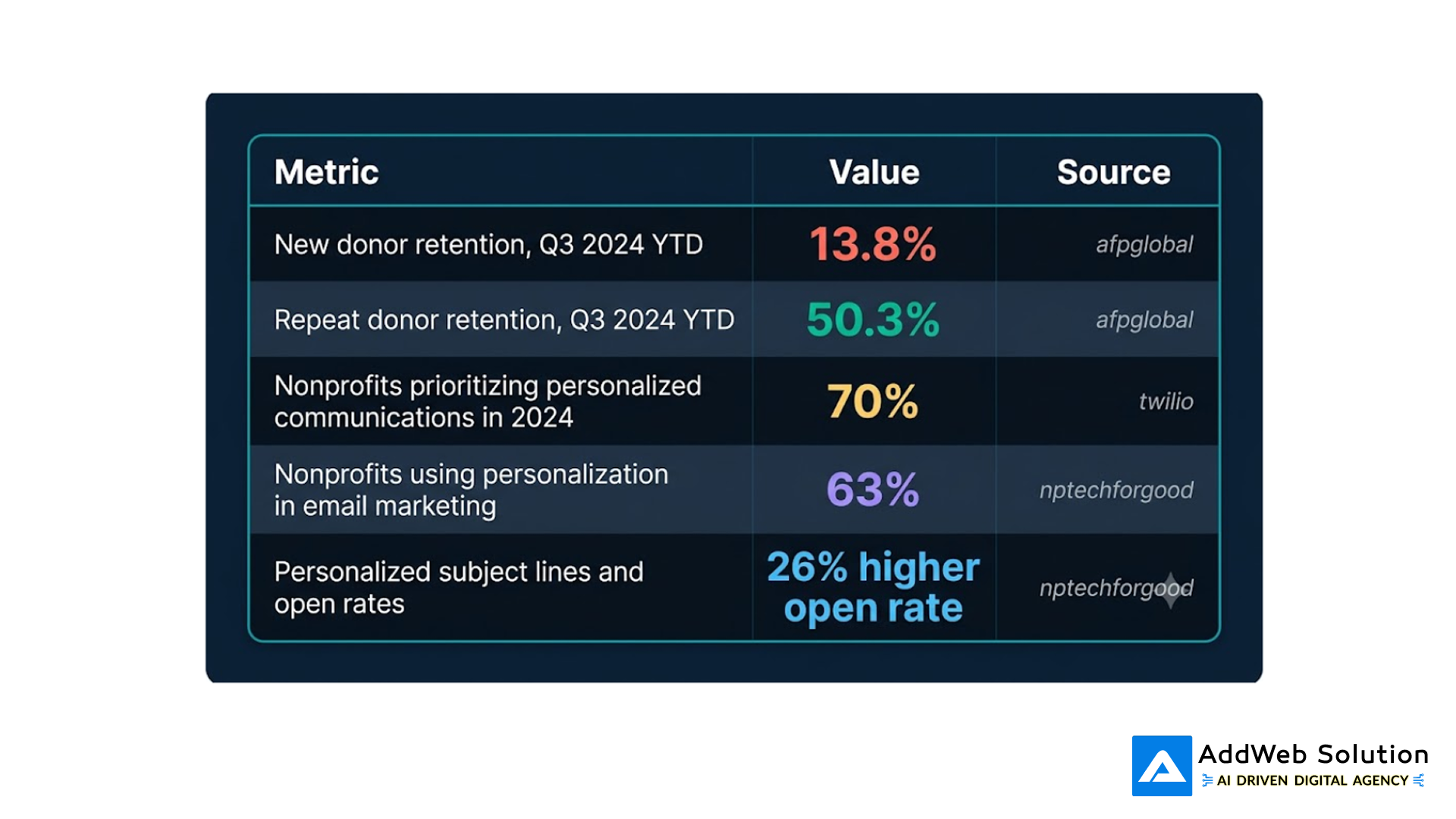
That matters because donor retention is still under pressure: the AFP Fundraising Effectiveness Project reported only 13.8% of new donors retained year to date in Q3 2024, while repeat donor retention stayed much higher at 50.3%.
Personalization helps close that gap by making each message feel like a continuation of a real relationship instead of a mass broadcast.
Why it matters
Personalization works because it respects context. A first-time donor does not need the same message as a monthly giver, and a lapsed donor does not need the same follow-up as a major prospect.
A simple example makes this obvious: if someone gives to your clean-water campaign, the next message should probably show local impact, not a broad annual report. That shift from generic updates to behavior-based storytelling is where nonprofit communication becomes more human and more effective.

What donors respond to
The strongest personalization usually starts with the basics: name, giving history, channel preference, and timing. But the real lift comes when nonprofits use that data to tailor stories, images, asks, and calls to action.
This is also where the sector is moving in 2024–2025. Twilio’s nonprofit engagement research shows personalization is a top priority, and broader personalization research shows many organizations still struggle to execute it consistently at scale.
In practice, that means the competitive advantage is no longer “we personalize”; it is “we personalize well, and we do it reliably.”



Tools and workflows
A nonprofit CRM is usually the backbone of personalized donor communication because it stores, organizes, tracks, and analyzes donor data for targeted outreach. Once that data is clean, teams can build segmentation rules for first-time donors, recurring donors, event attendees, volunteers, and lapsed supporters.
Automation then makes the process sustainable. Instead of manually writing every message, teams can trigger thank-you emails, impact updates, renewal reminders, and re-engagement sequences based on donor behavior.
That keeps the experience relevant without turning the fundraising team into a full-time message factory.

What the data says
The numbers behind personalization are hard to ignore. The AFP Fundraising Effectiveness Project found that new donor retention in Q3 2024 was 13.8%, while repeat donor retention was 50.3%, showing how much more stable known supporters are than first-time givers.
AFP also reported that donor numbers and retention declined in 2024 overall, reinforcing the need for stronger stewardship, not just more acquisition.
There is also strong evidence that personalized messaging improves digital engagement. Nonprofit email guidance from 2026 cites that emails with personalized subject lines are about 26% more likely to be opened, and nonprofit-tech reporting shows 63% of nonprofits already use some form of email personalization. In other words, the sector has moved from “should we personalize?” to “how well are we doing it?”
Real-world examples
A practical nonprofit example is a donor who gives to disaster relief. A strong personalized sequence might thank them immediately, send a project-specific update a week later, and then invite them into a matching campaign only if they showed strong engagement. That sequence feels helpful rather than pushy.
Another common example is image personalization. A wildlife nonprofit can show cat-related visuals to a donor who previously supported feline rescue, while a conservation donor sees habitat-restoration stories instead.
Small changes like this often create the feeling that the organization actually remembers the donor, which is the real point.

Conclusion
Personalization is no longer a nice-to-have in nonprofit donor communication; it is the baseline for staying relevant, keeping attention, and improving retention. The nonprofits that win here will be the ones that combine clean data, smart segmentation, and timely storytelling without sounding automated.
For teams building this capability at scale, the right mix of CRM strategy, automation, and donor journey design can turn routine outreach into stronger relationships, and that is exactly the kind of transformation AddWeb Solution helps organizations plan and execute.
Personalized donor engagement starts with the right CRM strategy. Partner with AddWeb Solution to build automated donor journeys, improve retention, and create meaningful supporter experiences.

Pooja Upadhyay
Director Of People Operations & Client Relations
Source URLs
https://www.mckinsey.com/capabilities/quantumblack/our-insights/the-state-of-aimckinsey
https://www.ibm.com/think/topics/generative-ai-marketingibm
https://www.pewresearch.org/social-trends/2025/02/25/u-s-workers-are-more-worried-than-hopeful-about-future-ai-use-in-the-workpl/pewresearch
