


Scalable eCommerce APIs have now become the very backbone of the future-ready retail platform, helping you cope with unexpected traffic, orchestrate omnichannel experiences, and introduce new functionalities without ripping apart your entire stack.
By designing APIs as first-class products rather than as an afterthought, you are able to gain agility, robustness, and performance that commerce requires today.
Scalable eCommerce APIs: The Foundation of Future‑Ready Retail Platforms
Why APIs Sit At The Center Of Modern Retail
APIs are responsible for connecting front-ends, back-ends, and third-party applications, thus determining the flow of information between products, carts, payment gateways, logistics, and any customer contact points.
For eCommerce, the API-based approach means that all business logic will be accessible via robust and scalable APIs capable of handling high loads and any changes in the customer journey without breaking the downstream clients.
The main purpose of scaling APIs is to manage resources and IT costs in the most efficient way while ensuring responsiveness during the flash sales or Black Friday.
From Monoliths To API‑First Microservices
The monolithic system will incorporate everything from the storefront, catalog, checkout process to admin capabilities within one deployable entity making it difficult to scale at all.
The API based microservices architecture will separate the monolith in the form of smaller services such as product catalog, inventory, pricing, checkout, order management, payments with each of these services accessible through their well defined versions of APIs.
It helps in scaling independent hot paths like search, cart and checkout processes.
Quick comparison: monolith vs API‑first
| Dimension | Monolithic commerce | API‑first microservices |
| Release cadence | Large, infrequent, high risk | Small, frequent, safer deployments |
| Scalability | Vertical only, limited per node | Horizontal across services and regions |
| Integration effort | Tight coupling, point‑to‑point | Standardized APIs, reusable contracts |
| Omnichannel readiness | Web‑first, mobile as add‑on | Channel‑agnostic from the start |
| Maintainability | Shared codebase, fragile refactors | Isolated services, clearer ownership |
Core Architectural Principles For Scalable eCommerce APIs
Scalable retail API architecture is less of a technology issue and more of an approach that consists of several architectural concepts that work together.
Main concepts include:
- API-first approach: Define models and agreements before creating a user interface, treat APIs as products with documentation, versioning, and SLAs.
- Stateless services: Store state in databases, caches, and tokens so that API instances can be scaled horizontally without session affinity.
- Loose coupling through events: Utilize message brokers and streaming solutions to link services with events instead of synchronous API calls.
- Unified API for all access points: Reuse the same API interface when interacting from websites, mobile apps, point-of-sales systems, marketplaces, and social media.
- Observability-by-design: Collect observability data at the API layer, not just at the infrastructure level.
Key Scalability Requirements For Retail APIs
There are four specific architectural needs listed by Virtocommerce that affect the scalability of eCommerce API.
- API-powered real-time services
Your API calls have to have an ability to work with services that are scalable in real-time, self-scaling deployments, distributed caches, sharding of the database. - Customizable business logic layer
Developers must be able to customize rules regarding pricing, promotions, shipping, and personalization without affecting clients, which means good domain separation and test coverage of your API. - Stable contracts on different touchpoints
Your API is required to behave identically on mobile applications, on marketplaces, in-store devices, despite the changes in the backend part. - GraphQL and flexible querying
Using GraphQL can decrease payload size and over-fetching since client will have the opportunity to query exactly the fields he needs, especially when the number of dependencies on one page (products, recommendations, inventory, prices) is big.
Performance & Reliability: Designing For Spikes, Not Averages
Managing millions of users at any given point of time needs APIs that scale easily and have low latency and are fault-tolerant.
The companies such as Salesforce B2C Commerce provide detailed SCAPI performance metrics, such as request latency, requests, and cache hit rates.
In today’s world, the performance best practices have highlighted the need to set up latency budgets in percentiles (like p95 and p99).
Example performance metrics table (illustrative)
The table below shows indicative numbers contrasting a traditional monolith with an API‑first microservices setup. Treat these as example values to visualize the trend rather than hard industry benchmarks.
| Metric | Traditional monolith | API‑first microservices |
| Latency (ms) | 450 | 180 |
| Error rate (%) | 1.8 | 0.4 |
| Cache hit rate (%) | 55 | 82 |
| Requests per minute | 12,000 | 35,000 |
Bar chart: indicative API performance
To make the performance gap more tangible, the grouped bar chart below compares these metrics for the two architectures.
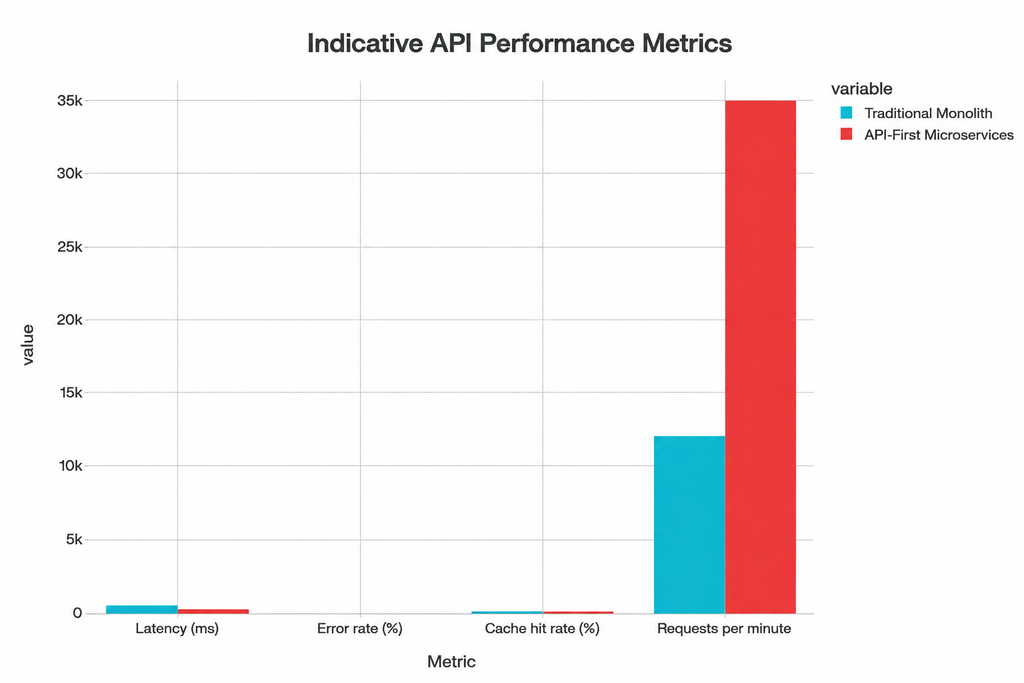
Even in a simplified example, you can see how better caching, horizontal scale, and stateless design translate into lower latency, lower error rates, and higher throughput for the same hardware envelope.
Omnichannel & Headless Commerce: Why APIs Are Non‑Negotiable
The key selling point about headless and composable commerce platforms is that everything gets done using an API, from products and shopping carts to promotions, checkouts, and even the content itself.
That way, developers can use them to create virtually any kind of commerce experience imaginable, from web apps and native mobile commerce solutions to social media commerce experiences and even physical in-store kiosks.
Lists of headless commerce API software platforms reveal companies boasting hundreds of APIs, webhooks, and localization capabilities, making it possible for brands to sell worldwide with no duplicated logic.
Pie chart: order share by channel (illustrative)
Below is an example distribution showing how orders might be spread across channels in an API‑driven retail operation today.
- Web storefront: 40%
- Mobile app: 25%
- Marketplace: 15%
- Social commerce: 12%
- In‑store POS: 8%
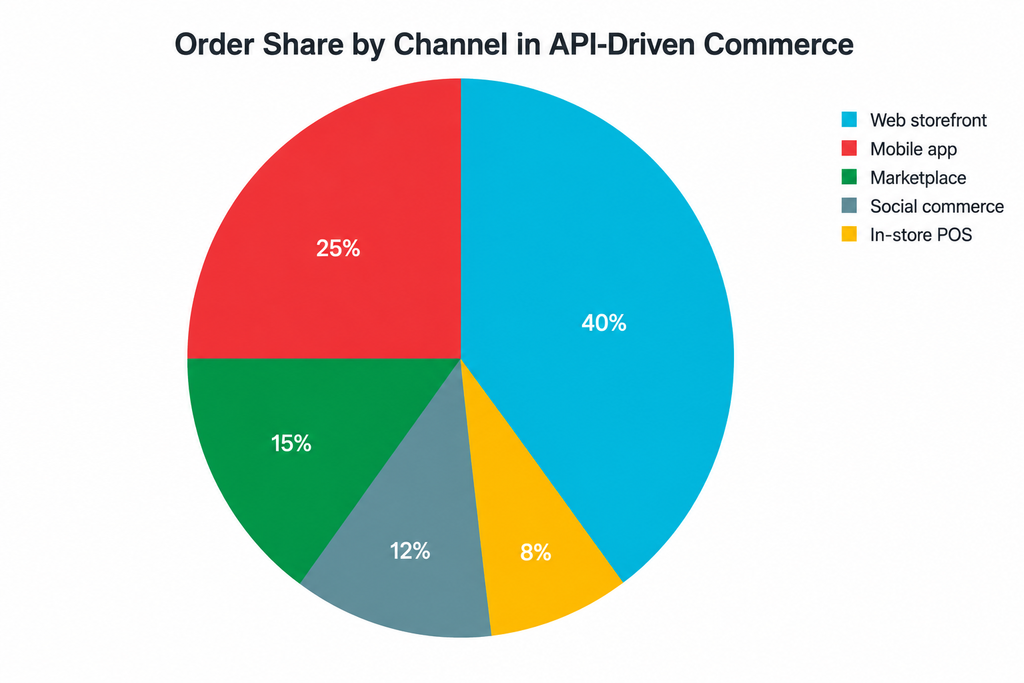
In reality, the exact mix will depend on your category and geography, but the key takeaway is that APIs make it possible to serve all of these channels with consistent pricing, inventory, and promotions without copy‑pasting business rules everywhere.
Security, Compliance, And Trust At Scale
Scalable e-commerce API architecture without proper security measures is an invitation to problems, especially since your scope of operations and payment systems increase.
It’s recommended by all best practice guidelines to utilize modern HTTPS, use authentication with OAuth 2.0 or JWT, implement rate-limiting mechanisms to prevent misuse and DDoS attacks. One should also consider compliance with data protection legislation such as GDPR or CCPA.
Security checklist for retail APIs
- Enable HTTPS on all services; do not allow any mixed content.
- Use OAuth2 and JWT for token-based authentication and stateless access control.
- Employ rate limiting, throttling and IP filtering at the gateway layer.
- Isolate your internal, partner and public APIs using separate policies.
- Maintain proper logging/traceability to be able to detect fraud.


Practical Design Patterns That Actually Scale
Experience-driven guidelines for eCommerce SaaS APIs point out a list of patterns that reliably appear on those platforms which manage to withstand peak moments without collapsing.
1. Stateless, versioned REST APIs
Create resources clearly – /api/v1/products, /api/v1/inventory, /api/v1/orders, /api/v1/users, and use URL-based versioning to evolve your contract without breaking existing clients.
Try to keep methods idempotent where it is possible (GET, PUT, DELETE), use cache control headers (ETag, Cache-Control) to shift repeat requests to browsers and CDN caches.
2. Event‑driven architecture
Publish domain events (change in inventory, change in cart, place order, send out shipment) to message brokers (Kafka, RabbitMQ, cloud-based queues).
Subscribe downstream services to those streams and achieve eventual consistency without brittle dependency on synchronous API requests.
3. Global load balancing and API gateways
Use API gateways (AWS API Gateway, Kong, NGINX, Traefik) for SSL termination, authentication, routing, rate limiting, logging centrally. Use GeoDNS together with them to deploy multiple regions and route users to the nearest one.
4. Horizontal scaling via containers and orchestration
Orchestration systems such as Kubernetes allow you to scale your API server pods by CPU usage, memory, or requests, deploy rolling updates without downtime, and implement blue/green or canary deployment strategies.
These are the techniques which allow for modern commerce platform to scale from 10k to hundreds of thousands of concurrent users without touching the codebase at all.
Line chart: vertical vs horizontal scaling (illustrative)
This line chart demonstrates the way how throughput changes with concurrent users increasing in case of scaling based mostly on vertical scaling technique (larger nodes) and horizontal scaling one.

While the numbers are illustrative, the pattern is accurate: at some point, vertical scaling hits diminishing returns, and only horizontal scaling with stateless APIs and sharded data stores can sustain growth.
What To Measure: API‑Level KPIs For Retail Teams
Not having metrics is out of the question when aiming to regard your APIs as true products rather than just an implementation detail of your system. Salesforce SCAPI as well as other observability platforms provide standard metrics that are used by DevOps to monitor health.
Core metrics for APIs to collect:
- Request latency (p50, p95, p99): Time spent on processing requests in the API itself without including external network latency.
- Request rate: Number of requests per API family and per endpoint to detect anomalies or suspicious patterns.
- Error rate and timeout: Fraction of requests that result in errors and/or are timed out.
- Cache hit ratio: Ratio of the number of responses, which were obtained via caching rather than origin services.
- Dependency budget: How many downstream calls your user journeys can sustain until they get too slow.
Knowing all these KPIs at the API level greatly facilitates setting up performance budgets for product teams (“this page can accommodate only five dependencies”) and creating corresponding dashboards.
Visual Summary: Architecture & Metrics Together
Table: example API performance dashboard metrics (conceptual)
| KPI | Why it matters | Typical tooling |
| Latency (p95) | Captures tail‑end user experience | Prometheus, Grafana, APM tools |
| Error rate | Highlights reliability issues | Logs + traces (ELK, OpenTelemetry) |
| Cache hit rate | Reveals caching effectiveness | CDN and gateway metrics |
| Request count | Detects anomalies and spikes | API gateway, SCAPI dashboards |
You can mirror these metrics in pie charts, stacked bars, or trend lines inside your internal analytics tools to keep non‑technical stakeholders aligned on API health without drowning them in implementation details.
Implementation Roadmap: Turning Principles Into A Plan
However, when it comes to scaling eCommerce APIs for an enterprise team, it is not about a one-time big bang. It is more like a gradual transition.
Step 1: Baseline and audit
- Audit the current APIs and dependencies within the journey flows (search, PDP, cart, checkout, and account).
- Establish the initial benchmarking measures (latency, failure rate, cache hit rate).
Step 2: Design the Target Architecture that is API-first
- Establish the service boundary of domain-driven services (catalog, inventory, pricing, checkout, orders, customer)
- Specify the resource design, versioning mechanism, and authentication mechanisms upfront.
- Choose where REST is needed, where GraphQL is required, and where the event streams need to play a part.
Step 3: Add Gateways, Observability, and Caching
- Implement an API gateway to enable routing, authentication, rate limiting, and caching.
- Add distributed caching (Redis/Memcached) and global CDN for static assets and product data.
Step 4: Carving microservices one piece at a time
- Work from lower risk domains like recommendations, content, and search rather than core payment and checkout paths.
- Implement strangler-fig architecture by routing specific endpoints to new services without altering the monolith.
- Use event-driven integration for new services to avoid unintentional coupling.
Step 5: Tweak peak performance for new channels
- Perform tests using traffic spikes based on real-world peak experiences such as discount programs and special holiday times.
- Tweak autoscaling, throttling, and caching rules from lessons learned.
- Once core APIs are mature, extend their reach to new channels (such as social commerce, marketplaces, and PoS integration).
Making Your Platform Future‑Ready
The future-ready retail platforms won’t be judged as much on their particular store-front technology but on how developed their API strategy is in terms of exposure, management of performance, and evolution of their channel strategy and business models.
Having a good API architecture allows you to have freedom to test new experiences (live commerce, artificial intelligence-powered personalization, AR try-ons) without having to change the entire backend each time the customer experience changes.
Treating your APIs as true products that are versioned, observable, secure and scalable will provide enough flexibility for your eCommerce ecosystem to evolve alongside retail.
Need a Scalable API Architecture for Your Commerce Platform?

Pooja Upadhyay
Director Of People Operations & Client Relations
Source URLs:
https://virtocommerce.com/blog/api-ecommerce-scalability
https://www.f6s.com/software/category/headless-commerce-api
https://help.salesforce.com/s/articleView?id=cc.b2c_metrics_scapi.htm&language=en_US&type=5
