


Every boardroom in India has an AI pilot to show off right now.
A chatbot here, a forecasting model there, maybe an agent that drafts emails. Confidence is high, budgets are flowing, and demos land well.
Then almost nothing happens next. The pilot sits in a slide deck, the champion moves to a new project, and six months later someone asks what happened to that AI initiative.
This is not a technology problem. It is the most predictable failure pattern in enterprise AI right now, and the data on why it happens is finally catching up to the frustration.
The Uncomfortable Math Behind Every AI Pilot
Global research on this gap is blunt, almost brutally so.
IDC and Lenovo’s AI CIO Playbook found that for every 33 AI proof of concepts an enterprise starts, only four ever reach production. That is roughly 88 percent that never make it out of the lab.
MIT’s Project NANDA pushed the number further, finding that 95 percent of generative AI pilots deliver zero measurable impact to the profit and loss statement.
RAND Corporation’s 2025 analysis broke the failure down by stage. 33.8 percent of AI projects are abandoned before production, 28.4 percent reach production but underdeliver, and 18.1 percent run without ever justifying their cost.
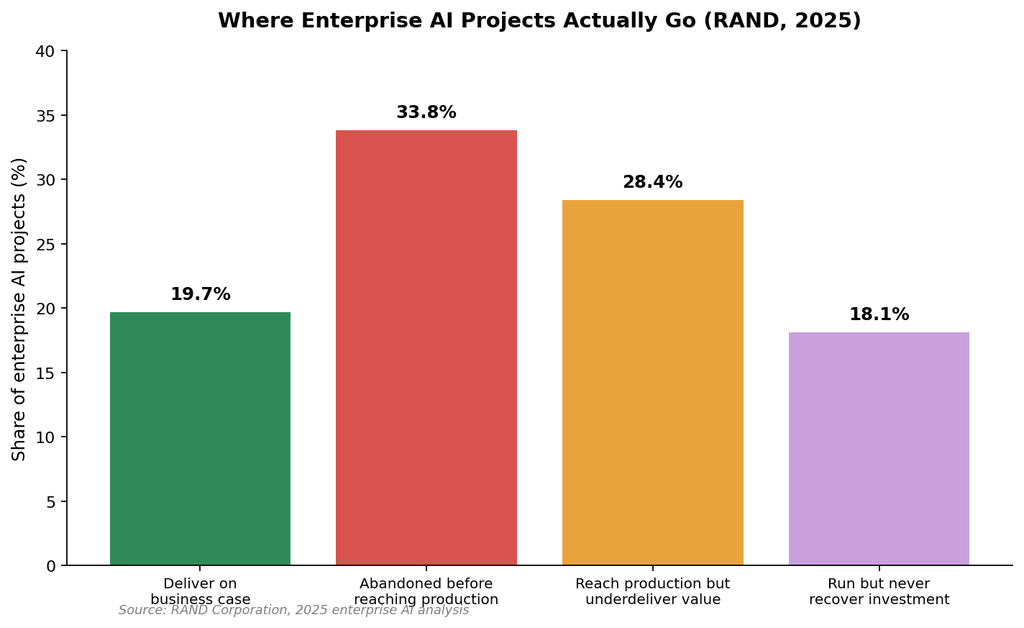
Only 19.7 percent of AI projects deliver on their original business case, according to that same RAND breakdown. That is not a rounding error. That is most of the market stuck in what researchers now call pilot purgatory.
Is India Actually Doing Better Than the Rest of the World
Here is the twist most global reports miss: India is not the laggard in this story.
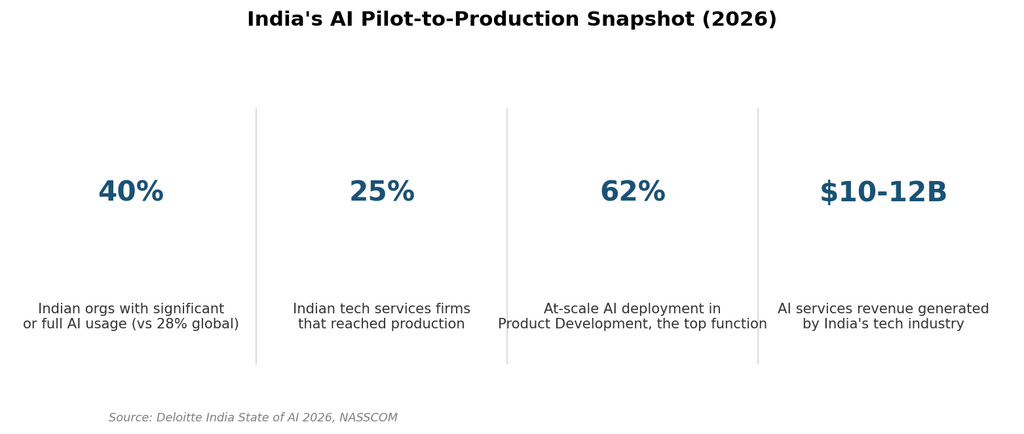
Deloitte India’s State of AI 2026 report found that 40 percent of Indian respondents report significant or full AI usage, well ahead of the 28 percent global average.
At-scale deployment is strongest in product development at 62 percent, followed by strategy and operations at 56 percent, marketing and sales at 55 percent, and supply chain at 48 percent.
NASSCOM data adds more texture. Roughly 25 percent of Indian technology services firms have already moved AI experiments into production, generating an estimated 10 to 12 billion dollars in AI services revenue, with about 85 percent of providers now running agentic AI platforms.
So Indian enterprises are not behind on ambition. They are ahead on ambition and still catching up on the operational discipline needed to convert that ambition into working systems.


Why Pilots Actually Stall, Not the Excuses People Give
Ask any team why their AI pilot never scaled and you will hear “the model wasn’t good enough.”
That is almost never the real answer. NASSCOM’s own report on this, titled From Pilots to Production, points to poor quality data, legacy technology systems, weak governance, unclear business objectives, and limited organisational readiness as the actual blockers.
Gartner’s research backs this up sharply. It predicts organisations will abandon 60 percent of AI projects that are not supported by AI ready data, and separately finds that 85 percent of all AI projects fail due to poor data quality alone.
A pilot usually runs on a small, hand-cleaned dataset that a data science team assembled manually. That process simply does not survive contact with production volume across a real organization.
There is a second, quieter killer: cost surprise. Production-grade generative AI deployments typically run three to five times the cost of the original pilot once observability, monitoring, and governance are added in, and that gap alone kills a lot of ROI cases before they get a fair test.
What The Experts Are Actually Saying
IDC Group Vice President Ashish Nadkarni summed up the core issue in one line: the high volume of AI pilots paired with low conversion to production points directly at weak organisational readiness in data, process, and infrastructure.
Deloitte’s global AI report echoes this from a different angle, noting that enterprises are pivoting from experimentation toward integrating AI into the core of the business, with a real focus on scale and impact rather than novelty.
One telecom executive interviewed for Deloitte’s 2026 report put the workforce anxiety to rest just as plainly: the goal was never pure automation, it was giving existing employees a force multiplier so they can be more effective, not simply removing them from the loop.
Gartner’s own survey of infrastructure leaders found that only 28 percent of AI use cases fully succeed and meet their original ROI expectations, a number that lines up almost exactly with what RAND and MIT found from completely different angles.
The Fix: What Separates Scalers From Stuck Pilots
Digital Applied’s March 2026 survey of 650 enterprise technology leaders found something genuinely useful buried in the numbers.
Organizations that successfully scaled AI were not spending more overall than the ones stuck in pilot mode. They were spending differently.
Successful scalers put proportionally more budget into evaluation infrastructure, monitoring tooling, and dedicated operational staffing, and proportionally less into model selection and prompt tweaking.
In plain terms, the companies that cross the production gap treat AI like production software engineering, not like a science experiment that occasionally gets deployed.
That means clean, AI ready data pipelines built before the pilot starts, not patched together after it succeeds.
It means named owners for what happens when a model breaks at two in the morning, not a data science team that quietly moved on to the next demo.
It means governance and evaluation frameworks built in from day one, especially given that over 70 percent of Indian enterprises rate data security and privacy as a high or very high concern.
And it means starting with a clear AI strategy and readiness assessment rather than picking a flashy use case first and figuring out the infrastructure later.
People Also Ask
Why do most AI pilots fail to reach production in India? The core blockers are poor data quality, legacy systems that cannot integrate cleanly with AI tools, weak governance, and unclear ownership, not the underlying AI models themselves.
What percentage of AI projects actually succeed? Global research puts it between 12 and 28 percent depending on the study and definition of success, while Indian enterprises report stronger at-scale usage than the global average at 40 percent versus 28 percent.
How much more does production AI cost compared to a pilot? Production grade AI deployments typically run three to five times the initial pilot cost once monitoring, evaluation, and governance infrastructure are factored in.
Is India ahead or behind on enterprise AI adoption? Ahead on usage and ambition according to Deloitte India’s 2026 data, but still building the governance, evaluation, and data infrastructure maturity needed to convert that ambition into durable production systems.
What is pilot purgatory? It describes an AI initiative that never formally fails or scales, staying stuck indefinitely between proof of concept and production while budgets and enthusiasm slowly drain away.
Which business functions are seeing the most AI production use in India? Product development leads at 62 percent at-scale deployment, followed by strategy and operations, marketing and sales, and supply chain, according to Deloitte India’s 2026 report.
Where This Leaves Indian Enterprises
The pilot to production gap is not a talent problem or a model quality problem.
It is a discipline problem, and it is entirely fixable with the right data foundation, governance structure, and a partner who has actually shipped production AI systems before.
If your organization has pilots that never quite made it past the demo stage, AddWeb Solution’s AI strategy and MLOps team can help you diagnose exactly where the gap is and build the infrastructure to close it. You can also book a free AI opportunity assessment to get a prioritized roadmap for your specific pilots.
The companies that solve this in 2026 will not be the ones with the flashiest demo. They will be the ones who quietly moved past pilot purgatory while everyone else kept presenting the same slide.
Talk to our automation and AI experts

Pooja Upadhyay
Director Of People Operations & Client Relations
References
- Experts Explain Why Enterprise AI Projects Struggle to Move Beyond Pilots, Business Standard
- AI Agent Scaling Gap March 2026: Pilot to Production, Digital Applied
- Why 88 to 95 Percent of Enterprise AI Pilots Never Reach Production, SoftwareSeni
- From AI Pilot to Production: Why 80% of Enterprise AI Stalls in 2026, Webpuppies
- Enterprise AI Adoption in 2026: From Pilot Purgatory to Production Scale, TechStoriess
