


Walk into an auto plant in Pune or an electronics unit in Noida today and you will see something that did not exist five years ago.
Robotic arms welding chassis at superhuman speed. AI vision systems catching defects the human eye would miss. Machines that learn, adjust, and improve on their own.
India’s factories are changing fast, and two forces are driving that change together: government money through PLI schemes and a wave of AI powered automation. This is not a slow evolution. It is a full reset of how India makes things.
In this guide, you will get the latest numbers, real expert predictions, and a clear picture of where this is headed, plus quick answers to the questions people keep typing into Google.

Why Is India’s Factory Floor Suddenly Full of Robots
For decades, India competed on cheap labor, not smart machines.
That playbook is breaking down. Wages are rising, global buyers demand consistent quality, and China Plus One sourcing is pushing manufacturers to prove they can match world class output.
Robotics is the fastest way to close that gap. A single AI powered robotic arm can run three shifts without fatigue, without defects, and without a single sick day.
That is why India’s industrial automation market is projected to grow from around 19.19 billion dollars in 2026 to 28.73 billion dollars by 2031, an 8.41 percent CAGR according to Mordor Intelligence.
Software layers like manufacturing execution systems are growing even faster, near 9.62 percent CAGR, because factories need brains, not just arms.
PLI Schemes Decoded: The Money Behind the Machines
The Production Linked Incentive scheme is the single biggest reason Indian manufacturers are opening their wallets for automation.
Here is the blunt version: the government pays you extra for producing more, and producing more at scale almost always means robots.
As of December 2025, PLI carries a government incentive outlay of Rs 1.91 lakh crore across 14 sectors. It has already pulled in Rs 2.16 lakh crore in committed investment from 836 approved applications.
The payoff so far includes over Rs 20.41 lakh crore in incremental sales and jobs for 14.39 lakh people, according to PIB data from the Ministry of Commerce and Industry.
There is a compliance angle too that most articles skip. PLI payouts are tied to real time production tracking and efficiency benchmarks.
That means beneficiaries must install advanced controllers and plant wide software just to prove eligibility and unlock their incentive checks. Automation stopped being optional the moment it became a condition for getting paid.
Electronics got an extra push in Budget 2026-27. The Electronics Components Manufacturing Scheme outlay nearly doubled from about Rs 22,919 crore to Rs 40,000 crore, a clear signal that Delhi wants deeper, robot assisted electronics self sufficiency.
What The Latest Numbers Actually Say About India’s Robot Boom
Numbers move fast in this space, so here is the current snapshot.
India’s robotics market is one of the fastest growing anywhere, with independent trackers pegging year over year growth between 17 percent and 34 percent depending on scope and methodology.
The catch is density. India runs at roughly 4.7 robots per 10,000 manufacturing workers, compared with 1,012 in South Korea, 730 in Singapore, 415 in Germany, and 392 in China.
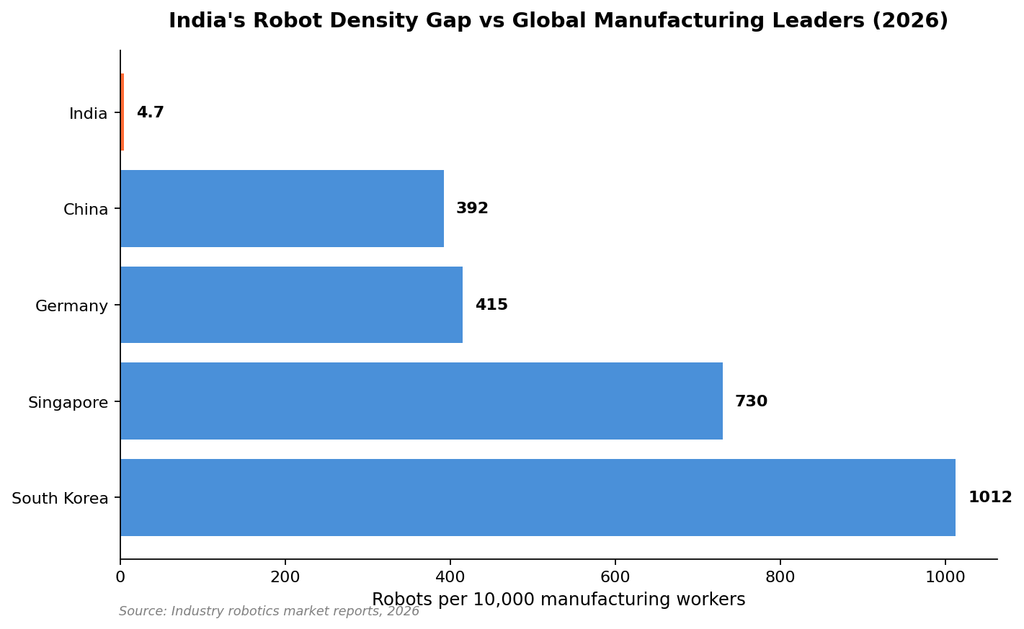
Read that gap correctly and it is not bad news. It is the single biggest automation opportunity left in global manufacturing.
Articulated robots dominate today because India’s largest robotics buyer, the automotive sector, needs multi axis arms for welding, painting, and assembly. SCARA robots are gaining fast in electronics and pharma packaging, both PLI priority sectors.
The real momentum, though, is in collaborative robots and autonomous mobile robots. Cobots cost less, need less floor space, and can work safely next to existing human teams without a full line redesign.
India’s manufacturing PMI backs this up on the ground. It moved from 53.9 in March 2026 to 54.7 in April and 55.0 in May, a steady climb that signals sustained factory expansion, not a one off spike.
What The Experts Are Predicting
You do not have to take a marketer’s word for where this is going. The people running the global robotics conversation are saying it plainly.
Takayuki Ito, President of the International Federation of Robotics, put it simply: AI is transforming the field of robotics at a rapid pace.
He describes this shift as moving AI from a supporting technology into a powerful enabler, one that is opening the door to wider robot adoption across every industry it touches.
The IFR’s 2026 trend report backs this with specifics. Analytical AI is now catching equipment failures before they happen on smart factory floors, while generative AI is teaching robots new tasks without a human reprogramming every step.
Deloitte’s own 2026 forecast adds a hard number to the story. Global industrial robot installations, running near 500,000 units a year in 2025 and 2026, are expected to climb by roughly 100,000 units annually through 2030, pushing the installed base past 5.5 million robots worldwide.
For India specifically, market analysts frame it as a rare double advantage. The country pairs a huge volume manufacturing push under Make in India and PLI with one of the deepest software engineering talent pools on earth.
That combination is why several 2026 industry reports call India the likely global back office for robotics research and development, even before it becomes a robot manufacturing powerhouse in its own right.


How This Is Actually Playing Out, Sector by Sector
Automotive is where automation started and where it runs deepest.
EV battery assembly, robotic welding, and precision machining are the largest single demand driver for industrial robots in the country right now.
Electronics is the PLI showcase. Apple’s supply chain shift alone has pushed Foxconn and Tata Electronics to build greenfield factories designed around automation from day one, not retrofitted for it later.
Pharma and white goods manufacturers are leaning on SCARA robots and AI vision for packaging accuracy, since a single labeling error can trigger a regulatory recall.
MSMEs remain the laggards here, and that is exactly where the next phase of growth will come from. State level programs are closing that gap. Karnataka’s Robotics and Automation Policy, for example, offers up to 30 percent subsidy on machinery and equipment for smaller manufacturers.
The Real Obstacles Nobody Puts On The Brochure
None of this is frictionless, and pretending otherwise would not help you plan around it.
Capital cost remains the top barrier for small and mid sized manufacturers, even with PLI incentives softening the blow. A 4 to 6 percent sales incentive does not fully offset the upfront cost of a robotic cell.
Skilled operators are scarce. Robots need technicians who can maintain, reprogram, and troubleshoot them, and India’s mechatronics talent pipeline is still catching up to demand.
Data and integration bottlenecks also slow things down. Deloitte flags cybersecurity and data quality as the two issues that could cap robot adoption growth even as hardware gets cheaper.
People Also Ask
Is AI replacing factory jobs in India? Not in net terms so far. PLI backed sectors have added 14.39 lakh jobs even as automation scaled, because higher output usually needs more supervisors, technicians, and quality staff, not fewer.
Which Indian sector is most automated right now? Automotive, by a wide margin, because of heavy reliance on robotic arms for welding, painting, and assembly across passenger and EV manufacturing.
How much does the PLI scheme pay manufacturers? Incentives typically range from 4 to 6 percent of incremental sales, varying by sector, paid out against real time production and efficiency benchmarks.
Why is India’s robot density so low compared to other countries? India is still early in its automation curve, at roughly 4.7 robots per 10,000 workers versus over 1,000 in South Korea, but analysts view this gap as the market’s biggest growth runway rather than a weakness.
What is Physical AI and why does it matter for factories? It is the shift of AI from a screen based tool into a robot body that learns from simulated environments. It lets robots train themselves and adapt on the job instead of running fixed, pre programmed routines.
Will PLI schemes expand further? Recent budget moves suggest yes. The Electronics Components Manufacturing Scheme outlay nearly doubled in Budget 2026-27, showing the government is still increasing, not winding down, its automation push.
Where This Leaves Indian Manufacturers
The direction is not really in question anymore.
PLI money rewards scale, AI robotics delivers that scale, and India’s low robot density means there is enormous room left to grow before the market matures.
The manufacturers who move now, even with MSME level budgets and state subsidy support, will be the ones setting the pace when India’s robot density starts closing in on the rest of Asia.
The ones who wait will be automating under pressure instead of by choice.
Talk to our automation and AI experts

Pooja Upadhyay
Director Of People Operations & Client Relations
References
- The State of Robotics Automation in India, Robolabs
- Manufacturing Industries in India and its Growth, IBEF
- State of Robotics 2026, India, Robotics Center of Silicon Valley
- India Robotics Market 2026, Robotics Center
- India Industrial Automation Market Report, Mordor Intelligence
- Make in India Robotics: Policy, Incentives and Domestic Manufacturing, RobotWale
