


Will artificial intelligence and robots take away jobs in India?
The short answer is more complicated than a simple yes or no. In 2026, the evidence points toward job transformation, automation of tasks, changing hiring patterns, and the creation of new AI-related roles, rather than every job simply disappearing.
India is already experiencing this shift. AI hiring inside India’s IT sector increased 16% year over year in June 2026, even while overall IT recruitment declined 3%, according to Naukri data reported by Reuters.
At the same time, AI and machine learning job listings across 14 sectors increased 25%, showing that demand is spreading beyond traditional technology companies.
So, is AI coming for Indian jobs?
It is certainly changing them. The bigger question is which tasks machines will perform, which skills humans will continue to own, and whether workers can adapt quickly enough.
The 2026 Answer in One Sentence
AI is unlikely to eliminate work in India altogether, but it is likely to eliminate or reduce many repetitive tasks while increasing demand for people who can work effectively with AI.
The International Labour Organization’s 2026 research says most jobs exposed to generative AI are more likely to be transformed than completely displaced, although the effects can differ significantly by occupation, industry and worker group.
This distinction matters because a job is usually a collection of tasks.
AI may automate five tasks within a job while leaving the remaining tasks to a human worker.
2026 India AI Jobs Data You Should Know
Here are the numbers that tell the story better than headlines about robots taking everyone’s jobs.
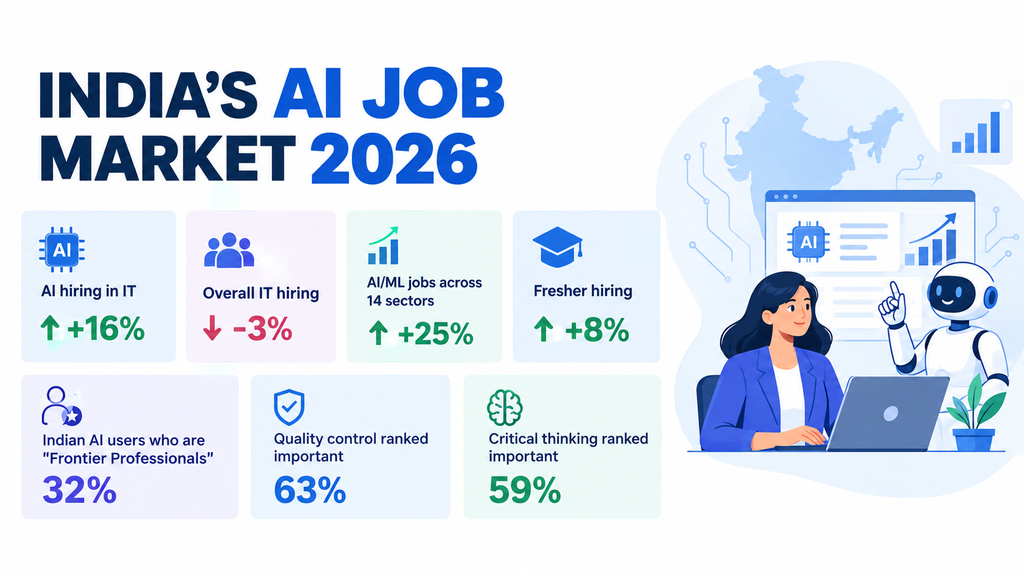
16% – AI hiring in India’s IT sector increased year over year in June 2026.
3% – Overall IT recruitment declined year over year during the same period.
25% – AI and machine learning job listings increased across 14 sectors in June 2026.
8% – Fresher hiring in India increased year over year in June 2026.
32% – Among India’s AI-using knowledge workers surveyed by Microsoft in 2026, 32% qualified as “Frontier Professionals”, people actively redesigning workflows around AI agents.
63% – The share of Indian AI users who ranked quality control of AI output as an important skill, according to Microsoft’s 2026 India findings.
59% – Indian AI users who identified critical thinking as an important skill in an AI-powered workplace.
India’s AI Jobs Story
The important takeaway is that India’s employment market is not moving uniformly in one direction.
Some traditional roles are under pressure while AI-related and specialised roles are expanding.
Are Robots Actually Taking Jobs in India?
Robots are different from generative AI because they can automate physical tasks as well as digital ones.
Manufacturing, logistics, warehouses, automotive production and other repetitive physical environments are therefore particularly relevant to robotics.
The World Economic Forum’s Future of Jobs Report 2025 projects that robotics and autonomous systems could produce a net decline of 5 million jobs globally by 2030.
That number should not be interpreted as 5 million Indian jobs disappearing.
It is a global projection based on employer expectations, not a forecast of India’s exact employment losses.
AI Versus Robots: What Is More Likely to Change Your Job?
AI is particularly powerful when the work involves information.
Robots become particularly powerful when the work involves predictable physical actions.
AI
↓
Writing
Analysis
Coding
Customer support
Research
Documentation
Data processing
Decision support

ROBOTS
↓
Assembly
Warehousing
Packaging
Inspection
Material handling
Repetitive manufacturing
Autonomous transport
Many future workplaces will combine both.
An AI system may plan the work while a robot performs the physical operation and a human supervises the overall process.
The Biggest Myth: AI Will Replace Entire Jobs Overnight
This is where the conversation often becomes misleading.
The WEF estimates that by 2030, technological and other labour-market trends could create 170 million jobs while displacing 92 million, producing a projected net increase of 78 million jobs globally.
That does not mean every displaced worker automatically moves into a new job.
It means the labour market can simultaneously create opportunities and destroy existing ones.
The real challenge is the transition between the two.


What the Global Data Says About Human and Machine Work
The WEF estimates that today, around 47% of work tasks are performed mainly by humans, 22% mainly by technology and 30% through a combination of humans and technology.
By 2030, employers expect these three approaches to become much more evenly balanced.
That is a major clue about the future.
The question is becoming less about humans versus machines and more about humans working with machines.
Which Jobs in India Could Face the Most AI Pressure?
Jobs containing highly repetitive, predictable and rules-based tasks are generally more exposed to automation.
Examples can include routine data entry, basic document processing, repetitive customer support, standardised reporting, simple content production and some administrative work.
The WEF identifies clerical roles such as cashiers, ticket clerks, administrative assistants, executive secretaries, printing workers and some accounting roles among occupations expected to decline globally by 2030.
India has an additional consideration because its large services industry has historically benefited from labour-intensive business processes.
At Davos 2026, economist Gita Gopinath warned that business process outsourcing, coding and call-centre work could be affected as AI changes services, raising questions about future job creation if services become more capital intensive.
Will AI Replace IT Jobs in India?
AI is already changing India’s IT employment model.
But the available 2026 data does not support the idea that AI is simply eliminating all IT jobs.
Naukri reported that AI hiring in India’s IT sector rose 16% year over year in June 2026, while overall IT hiring fell 3%.
That divergence suggests companies are changing what kind of technology talent they want.
TCS, for example, announced plans to build a team of up to 8,900 forward-deployed engineers focused on helping clients implement AI, according to Reuters.
The IT worker of the future may therefore spend less time doing repetitive implementation work and more time designing, integrating, supervising and improving AI-enabled systems.
What Jobs Could Grow Because of AI in India?
AI does not only automate work.
It also creates demand for people who build, deploy, manage, secure, evaluate and use AI systems.
The WEF identifies Big Data Specialists, AI and Machine Learning Specialists, Software and Applications Developers and Security Management Specialists among the fastest-growing roles globally, with several of these roles also highlighted in its India outlook.
Potential growth areas in India include:
- AI and machine learning
- Data science and analytics
- Cybersecurity
- AI engineering
- Cloud computing
- AI product management
- AI governance
- Robotics engineering
- Automation engineering
- Semiconductor technology
- AI-enabled healthcare
- AI-enabled financial services
The Most Important Skill May Not Be Coding
Here is an interesting development from Microsoft’s 2026 India data.
Among Indian AI users, 63% ranked quality control of AI output as an important skill, while 59% highlighted critical thinking.
That tells us something important.
Knowing how to use AI is not the same as knowing when AI is wrong.
Why Human Judgment Is Becoming More Valuable
AI can generate an answer quickly.
It does not automatically mean the answer is accurate, appropriate, ethical or commercially useful.
Human workers still need to define the problem, check the output, understand the customer and take responsibility for the final decision.
Microsoft’s 2026 research found that 87% of surveyed Indian AI users said they remain responsible for the thinking and treat AI output as a starting point rather than the final answer.
That is why critical thinking, communication, domain knowledge and judgment could become increasingly valuable.
Famous Expert Predictions About AI and Jobs
OpenAI CEO Sam Altman offered a notable shift in his own outlook in 2026.
Altman said AI was unlikely to result in a global “jobs apocalypse”, while acknowledging that AI is already replacing some roles and that employment will evolve differently from earlier expectations.
The World Economic Forum’s India discussions also highlighted a more complicated picture.
Infosys CEO Salil Parekh said India’s technology industry employs around six million people directly, with a much larger population benefiting indirectly from technology-sector wages.
Economist Gita Gopinath, meanwhile, highlighted the risk that AI could affect business process outsourcing, coding and call centres, particularly if services become more capital intensive.
These views point in different directions, which is exactly why the future cannot be reduced to one dramatic prediction.
What Does Microsoft 2026 Data Reveal About Indian Workers?
Microsoft’s 2026 Work Trend Index provides one of the clearest snapshots of how Indian knowledge workers are adapting.
The study surveyed 20,000 AI-using workers across 10 countries, including India, and analysed large volumes of anonymised Microsoft 365 productivity signals.
In India, 32% of AI users qualified as Frontier Professionals, twice the global average of 16%.
Microsoft defines these workers as people who use AI agents for multi-step workflows and actively rethink how work gets done.
Even more strikingly, 78% of Indian AI users said AI was enabling work that was not possible for them a year earlier.
That figure was 58% globally in the same study.
Does This Mean India Will Have More Jobs?
Not necessarily.
AI adoption can increase productivity without creating an equal number of new jobs.
For example, one employee using AI might produce the output that previously required two or three employees.
That can improve business productivity while simultaneously reducing demand for particular tasks.
This is why productivity growth and employment growth are not the same thing.
The Real Risk for India’s Fresh Graduates
One of the biggest questions is not whether AI will replace experienced professionals.
It is whether companies will continue hiring large numbers of people for entry-level tasks that AI can increasingly perform.
The WEF’s 2026 jobs coverage has highlighted concerns that entry-level pathways are becoming more demanding as AI changes how employers evaluate candidates.
This creates a potential experience paradox.
Young workers need experience to get jobs, but some of the routine work traditionally used to gain that experience may increasingly be automated.
Is AI Bad for Freshers in India?
AI can make the first job harder to get in some fields.
But it can also allow a talented fresher to produce work that previously required much more experience.
The 2026 Naukri data provides one encouraging signal: overall fresher hiring increased 8% year over year in June, while AI and ML hiring continued to grow strongly.
The implication is not that freshers are safe from automation.
It is that entry-level workers may need to demonstrate practical AI capability much earlier in their careers.
What Skills Should Indian Students Learn in 2026?
The safest strategy is not to learn one AI tool and assume it will remain valuable forever.
Build a combination of AI literacy + domain expertise + human judgment.
For technology careers, this can include programming, data, cloud, cybersecurity, AI engineering and system design.
For non-technical careers, useful capabilities can include AI-assisted research, analytics, communication, problem solving, process automation and domain-specific AI applications.
The ILO’s 2026 research highlights rising demand for cognitive, socioemotional, digital and AI-related skills, while also emphasising adaptability, resilience and human agency.
The Skills That Could Become More Valuable
Think of the future skill stack like this:
              FUTURE-READY SKILL STACK

                    HUMAN JUDGMENT
                         ↑
                  DOMAIN EXPERTISE
                         ↑
                 AI LITERACY
                         ↑
                DIGITAL SKILLS
                         ↑
                 COMMUNICATION
                         ↑
                PROBLEM SOLVING
The strongest professionals may not be those who know the most AI terminology.
They may be the people who can combine AI capability with deep understanding of a real business or human problem.
Which Indian Industries Could Be Most Affected?
Different industries will experience AI differently.
IT services may see automation of repetitive coding, testing, documentation and support tasks.
Banking may see greater automation in customer service, document processing, fraud detection and back-office operations.
Manufacturing may combine robotics, computer vision and predictive maintenance.
Healthcare may use AI for documentation, diagnostics support and administrative workflows while keeping humans involved in high-stakes decisions.
Retail may increasingly use AI for inventory, customer service, recommendations and demand forecasting.
Education may use AI for tutoring, assessment support and personalised learning.
What About BPO and Call Centre Jobs?
This is one of India’s most important AI questions.
India’s BPO industry has historically benefited from large numbers of workers performing structured customer and business processes.
AI voice systems and agentic software can now automate parts of these workflows.
However, complex customer interactions, escalation handling, relationship management and situations requiring judgment can still require human involvement.
The more realistic scenario is therefore likely to be fewer routine tasks per employee and higher expectations for the tasks humans continue to perform.
Will AI Reduce Salaries in India?
AI can put downward pressure on wages for tasks that become easier to automate.
At the same time, workers with scarce AI, technical or domain skills may command higher compensation.
The result could be a wider gap between workers who can effectively use AI and workers whose tasks are highly exposed to automation.
The ILO has specifically highlighted inequality and the potential erosion of employment opportunities for younger workers as important risks associated with generative AI.
Will AI Create More Jobs Than It Destroys?
Nobody can honestly guarantee the answer for India.
The WEF’s global employer survey projects 170 million jobs created and 92 million displaced by 2030 across major labour-market trends, but these are global projections and should not be treated as an India-specific forecast.
The ILO’s 2026 evidence review similarly finds that large-scale job displacement from generative AI remains limited in the empirical evidence available so far.
However, it also identifies significant risks around inequality, job quality and the future opportunities available to younger workers.
The Better Question Is Not “Will AI Take My Job?”
Ask a different question.
Which parts of my job can AI already perform, which parts can it perform soon, and which human capabilities will remain valuable?
That question leads to an actionable career strategy.
If AI can perform part of your job, learn to supervise that part.
If AI can perform a task faster, learn how to use it.
If AI struggles with judgment, relationships, accountability or complex context, strengthen those capabilities.
What Jobs Are Safest From AI?
There is no job that can honestly be called completely AI-proof.
Some occupations are simply harder to automate because they involve unpredictable physical environments, complex human relationships, accountability, creativity, negotiation or high-stakes judgment.
Healthcare, skilled trades, education, management, relationship-based sales, complex engineering and many care professions contain tasks that are difficult to reduce to predictable digital workflows.
Even these jobs, however, are likely to use AI increasingly.
What Jobs Are Most Vulnerable to AI?
Jobs are more exposed when a large percentage of their work consists of predictable, repetitive and digitally accessible tasks.
Examples can include:
Routine data entry
Basic administrative processing
Repetitive document review
Simple customer support
Standardised reporting
Basic transcription
Repetitive software testing
Some routine accounting work
Basic content production
The level of risk varies considerably within each occupation.
A job title alone cannot tell you how much automation exposure a worker actually faces.
AI Job Replacement vs AI Job Transformation
Here is the simplest way to understand the difference.
JOB REPLACEMENT
Human performs task
        ↓
AI performs task
        ↓
Human role disappears

JOB TRANSFORMATION
Human performs task
        ↓
AI assists with task
        ↓
Human supervises and decides
        ↓
Job changes
The second model is already visible across many Indian workplaces.
Microsoft’s 2026 data shows Indian AI users increasingly working with AI agents rather than simply using AI as a search or writing assistant.
What Should Indian Companies Do?
Companies that automate without reskilling can create serious workforce disruption.
Companies that combine automation with training can potentially redeploy workers into higher-value activities.
The WEF reports that Indian employers expect to use diverse talent pools and skills-based hiring more heavily, with 67% saying diverse talent pools will be important and 30% expecting skills-based hiring through measures such as removing degree requirements.
That could change how Indians enter the workforce.
A degree may increasingly open the door, but demonstrable skills may determine what happens next.
What Should Indian Employees Do Right Now?
Start by identifying the repetitive parts of your current work.
Then find one AI tool that can improve those tasks without compromising accuracy, confidentiality or company policy.
Next, learn the human side of your profession more deeply.
The goal is not to compete with AI at doing what AI does best.
The goal is to become the person who knows how, when and why AI should be used.
What Does the Future of Work in India Actually Look Like?
Imagine an accountant who uses AI to process thousands of documents.
A software engineer who uses AI agents to test and debug code.
A doctor who uses AI to summarise medical information before making a clinical decision.
A factory worker supervising robotic systems.
A customer-service professional handling only complex cases while AI handles routine requests.
That is a more realistic picture of the emerging workplace than a world where robots simply replace every human.
The 2026 Reality Check
Myth: AI will take every Indian job.
Reality: AI is automating specific tasks and changing job structures.
Myth: AI is destroying all IT hiring.
Reality: Overall IT hiring weakened in June 2026, but AI hiring inside IT rose 16%.
Myth: Robots will replace humans everywhere.
Reality: Robotics is expected to displace some jobs, while technology also creates new roles and increases productivity.
Myth: Only programmers need AI skills.
Reality: AI is spreading across finance, healthcare, manufacturing, marketing, customer service and other sectors.
Myth: Learning one AI tool is enough.
Reality: Adaptability and the ability to learn new tools are becoming increasingly important.
People Also Ask
Will AI Take Jobs in India?
AI will replace some tasks and some roles, but current evidence does not support the idea that AI will eliminate all employment in India.
The more immediate change is the transformation of jobs, with growing demand for AI-related skills and declining demand for some repetitive tasks.
Will AI Replace IT Jobs in India?
AI is likely to automate parts of IT work, particularly repetitive coding, testing, documentation, and support.
At the same time, India’s AI hiring is growing, with AI-related hiring in the IT sector up 16% year over year in June 2026 according to Naukri data.
Which Jobs Will AI Replace First in India?
Highly repetitive and predictable digital tasks are generally more exposed.
Administrative processing, routine customer support, data entry, standardised reporting, and some repetitive technology tasks are examples of areas where automation can increase.
Which Jobs Will AI Not Replace?
No job can be guaranteed to be completely protected from technological change.
Roles involving complex judgment, human relationships, unpredictable physical environments, accountability, and specialised domain knowledge may be harder to automate fully.
Will AI Reduce Jobs for Freshers in India?
AI may reduce some traditional entry-level tasks, which could make certain career paths more difficult.
However, Naukri reported an 8% year-over-year increase in fresher hiring in June 2026, showing that entry-level hiring has not simply disappeared.
Is AI a Threat or an Opportunity for India?
It is both.
AI can increase productivity and create new technology-driven opportunities, while also disrupting existing roles and creating difficult transitions for workers whose tasks become automated.
Should Students Learn AI in 2026?
Yes, AI literacy is becoming increasingly useful across industries.
Students should combine AI skills with communication, critical thinking, domain expertise, problem-solving, and practical experience rather than treating AI as a standalone career skill.
Will Robots Replace Factory Workers in India?
Robotics can automate repetitive manufacturing, inspection, packaging, and material-handling tasks.
However, factories still require humans for supervision, maintenance, quality decisions, troubleshooting, safety, and tasks that are difficult to standardise.
Is AI Creating Jobs in India?
Yes, current hiring data shows strong growth in AI-related roles.
Naukri reported 25% year-over-year growth in AI and machine learning job listings across 14 sectors in June 2026.
What Is the Most Important Skill in the AI Era?
There is no single universally proven “number one” skill.
Current evidence points toward a combination of AI literacy, critical thinking, adaptability, domain knowledge, communication, and the ability to evaluate AI output.
Will AI Make India Unemployed?
There is no credible evidence that India is heading toward universal unemployment because of AI.
The stronger evidence points toward labour-market restructuring, with some tasks and roles declining while new tasks, occupations and AI-enabled forms of work emerge.
The Bottom Line: India’s Jobs Are Changing, Not Simply Disappearing
The biggest mistake would be to think of the future as humans versus robots.
The more important competition may be between workers who can adapt to AI-enabled work and workers whose tasks become easier to automate.
India’s 2026 data already shows both sides of the story.
AI hiring is rising, AI adoption is accelerating and new technology roles are expanding, while traditional IT and routine work face pressure.
The World Economic Forum expects technology to reshape millions of jobs globally, while the ILO’s latest research stresses that transformation, rather than straightforward replacement, is the dominant pattern observed so far.
So, will AI and robots take away jobs in India?
Some jobs will disappear. Many jobs will change. New jobs will emerge. And millions of Indian workers will need to learn how to work alongside increasingly capable machines.
The future of work will not be decided by AI alone.
It will also be shaped by education, reskilling, business investment, worker adaptability and how quickly India can turn technological progress into broad-based economic opportunity.
Talk to our automation and AI experts

Pooja Upadhyay
Director Of People Operations & Client Relations
References and Sources
- Naukri JobSpeak, June 2026: AI/ML hiring +25% and fresher hiring +8%
Naukri JobSpeak: White-collar hiring grows 6% in June 2026 - Reuters: AI hiring in India’s IT sector increased 16% in June 2026
Reuters: AI hiring outpaces overall IT recruitment in India - Microsoft Work Trend Index 2026: India AI workforce data
Microsoft: India’s AI advantage is human, Work Trend Index 2026
