


Introduction
For NGOs, proving impact has always been harder than proving effort. Donors want confidence before they commit, boards want risk reduced, and program leaders want a clearer picture of what is likely to work before money is spent.
AI-powered impact forecasting is interesting because it helps answer the question that usually comes too late: “What return are we likely to create if we launch this now?”
That matters even more in 2024–2025, when nonprofit teams are under pressure to do more with less, while still showing transparency, accountability, and measurable outcomes. The organizations that learn to forecast impact early will not just report better, they will plan better.
Why forecasting matters
Traditional monitoring and evaluation tells you what happened after implementation. Forecasting tries to estimate what is likely to happen before launch, using data from earlier cohorts, comparable programs, and live indicators like participation patterns or community feedback.
That is a major advantage for NGOs working in health, education, livelihoods, climate resilience, and community development, where a bad assumption can waste a full funding cycle.
A strong forecasting layer can help teams test scenarios such as: What if participation is 20% lower? What if retention drops after month two? What if one region performs better than another? Those are the kinds of questions AI is well suited to explore at speed.
How AI works
AI impact forecasting usually starts with historical project data, then adds contextual signals such as geography, demographics, seasonality, and engagement patterns.
Machine learning models can then estimate probable outcomes, flag risk zones, and create dashboards that show where a program is most likely to deliver value. In practice, that means NGOs can compare scenarios before launch instead of defending assumptions after the fact.

Tools and approaches
The most useful implementations are not “AI for AI’s sake.” They typically combine predictive analytics, real-time dashboards, and human review.
A few platforms and approaches mentioned across nonprofit AI research include predictive analytics for donor or program behavior, AI-enabled dashboards for KPI tracking, and governance-first workflows that keep staff in the loop.

Trends and adoption
The adoption story is moving quickly. One 2025 report found that 89% of purpose-led organizations use AI, 77% report noticeable improvements, and 56% already have an AI or ethics policy.
Another nonprofit benchmark notes that AI use is common, but many organizations still struggle to turn experimentation into mission-level transformation.


Visual story
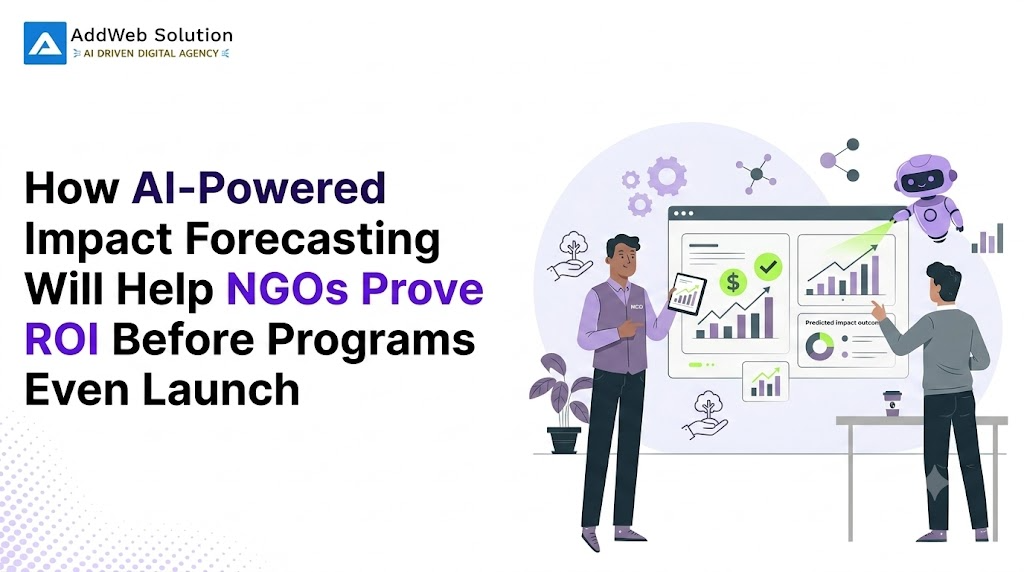
The clearest way to explain impact forecasting is to show how value is distributed across the program lifecycle. Instead of putting all attention on post-launch evaluation, AI moves part of the effort upstream into planning, risk modeling, and funder communication.
That is why many nonprofits are starting to treat forecasting as a strategic asset, not just an analytics add-on.


Conclusion
AI-powered impact forecasting will not replace real-world evaluation, but it can make NGOs far more credible before launch by showing likely ROI, risk, and outcome potential upfront.
For teams that pitch donors, manage grants, or launch pilot programs, that is a serious advantage: less guesswork, better design, and stronger funding conversations from day one.
At AddWeb Solution, this is the kind of practical AI use case that turns data into a fundraising and program strategy asset.
Want to use AI to improve program planning and donor confidence? Discover how AddWeb Solution helps nonprofits build intelligent, data-driven solutions.

Pooja Upadhyay
Director Of People Operations & Client Relations


