


Search is no longer just a list of blue links. Today, users ask AI-powered systems to summarize answers, compare options, and recommend solutions directly, which means Website built on the WordPress platform now need to be easy not only to rank, but also to extract, interpret, and cite.
That shift sounds dramatic, but the fix is surprisingly practical. In most cases, optimizing for AI search means making your content clearer, your site faster, your structure cleaner, and your expertise easier to verify.
Why AI search changes SEO for the WordPress platform
Traditional SEO focused on helping a page rank high in search results. AI search often goes one step further by pulling information from multiple pages, identifying the most useful passages, and generating an answer on the spot, which makes extractability just as important as rank.
That is why vague headings, slow pages, bloated intros, and poorly structured posts are now bigger problems than they used to be. If your article is hard for a machine to scan, segment, and trust, it has fewer chances of being surfaced in AI-generated results.
What AI-friendly content looks like
AI-friendly Content for the WordPress platform usually has a simple pattern: it answers the main question quickly, uses clear heading hierarchy, breaks ideas into manageable chunks, and reinforces credibility with schema and author signals.
WordPress-specific guidance in 2026 repeatedly stresses answer-first formatting, structured sections, and machine-readable context as core preparation steps.
A strong AI-search-ready blog post typically includes:
- A specific H1 and descriptive H2s.
- A direct answer near the top.
- Short paragraphs with minimal fluff.
- Bullets for key takeaways.
- Tables for comparisons.
- Internal links to related pages.
- Relevant schema markup such as Article, FAQ, HowTo, Author, and Organization.
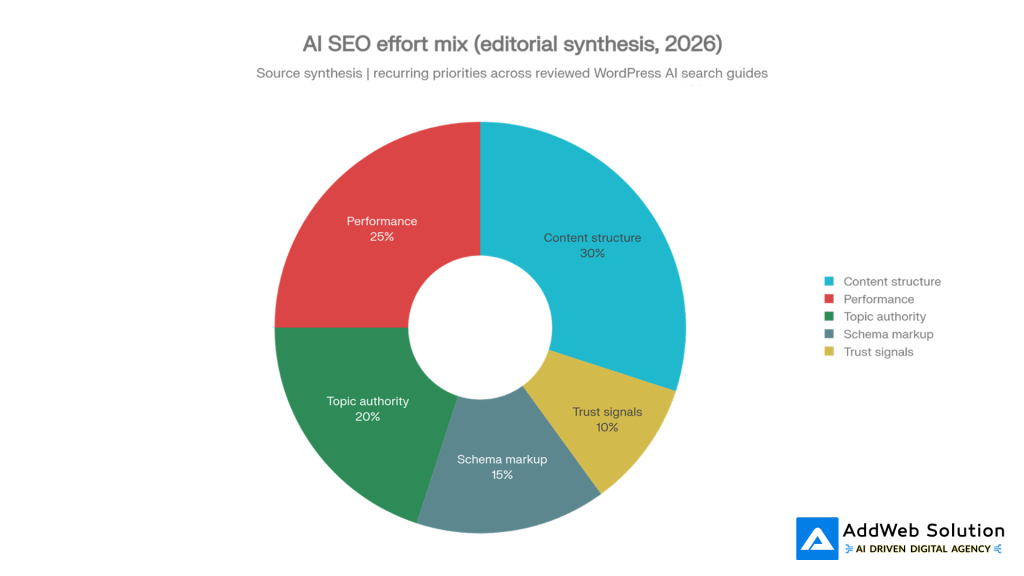
Before diving into tactics, it helps to see where the work usually goes. The chart below reflects the recurring emphasis across the WordPress AI search sources reviewed for this article, so treat it as an editorial synthesis rather than a universal benchmark.
The biggest share of effort usually goes into content structure and answer formatting, followed by performance improvements and topical authority work. Schema matters, but it tends to work best when the page is already fast, well-organized, and genuinely helpful.
The WordPress optimization checklist
Here is the practical core of AI search optimization for WordPress. The table below shows what to work on and why each area matters.
| Area | What to optimize | Why it matters |
| Site speed | Improve Core Web Vitals, compress images, enable caching, reduce unused CSS and JS | Faster pages are easier to crawl, render, and use. |
| Content structure | Use H1-H2-H3 hierarchy, short sections, and answer-first formatting | AI systems often extract sections, not full pages. |
| Internal linking | Link related posts with descriptive anchor text | It helps search systems understand topic relationships. |
| Schema markup | Add Article, FAQ, HowTo, Author, and Organization schema when appropriate | Structured data improves machine understanding. |
| Trust signals | Add author bios, examples, references, case studies, and updated dates | Credibility increases citation potential. |
| Crawl access | Maintain sitemaps and avoid blocking important bots or resources | Content must be discoverable to be cited. |
| Freshness | Refresh important pages with current examples and data | Updated content appears to matter more in AI citation environments. |
9 ways to optimize your Site built on the WordPress platform for AI search
1. Speed up your site before anything else
A slow Site built on the WordPress platform creates friction for both users and crawlers. Recent WordPress AI search guidance consistently recommends performance improvements such as image compression, caching, cleaner code, and mobile optimization as foundational work.
Focus on:
- Compressing images and using modern formats.
- Enabling caching and CDN support.
- Removing plugin bloat and unused scripts.
- Improving mobile responsiveness and Core Web Vitals.
2. Use answer-first formatting
Do not make users or AI systems dig for the point. Start each major section with a short, direct answer, then expand with examples or steps, because that format is easier to quote, easier to understand, and easier to trust.
For example, instead of opening with a generic paragraph, say:
To optimize a Site built on the WordPress platform for AI search, improve speed, use clear headings, add schema, strengthen internal links, and publish evidence-backed content.
That kind of sentence does real work immediately.
3. Make headings specific
A heading like “Some useful tips” tells neither humans nor machines much of anything. A heading like “How to improve WordPress page speed for AI search visibility” carries context, intent, and topical clarity.
Clear headings help AI systems identify what a section is about, which increases the chance that a useful passage can be extracted in response to a query.
4. Add schema markup carefully
Schema markup gives machines explicit clues about what a page contains and who published it. Current WordPress schema guidance highlights Article, FAQPage, HowTo, Organization, and Person-related markup as especially helpful when they accurately match visible content.
Use schema to clarify, not to decorate. If the markup says one thing and the page says another, trust goes down instead of up.
5. Strengthen internal linking
Internal links help define your content universe. They show how your posts connect, which pages are central, and which topics support one another, making it easier for crawlers and AI systems to understand your topical depth.
Use descriptive anchor text like “WordPress schema markup guide” or “how to improve Core Web Vitals,” rather than vague anchors such as “read more” or “click here.”
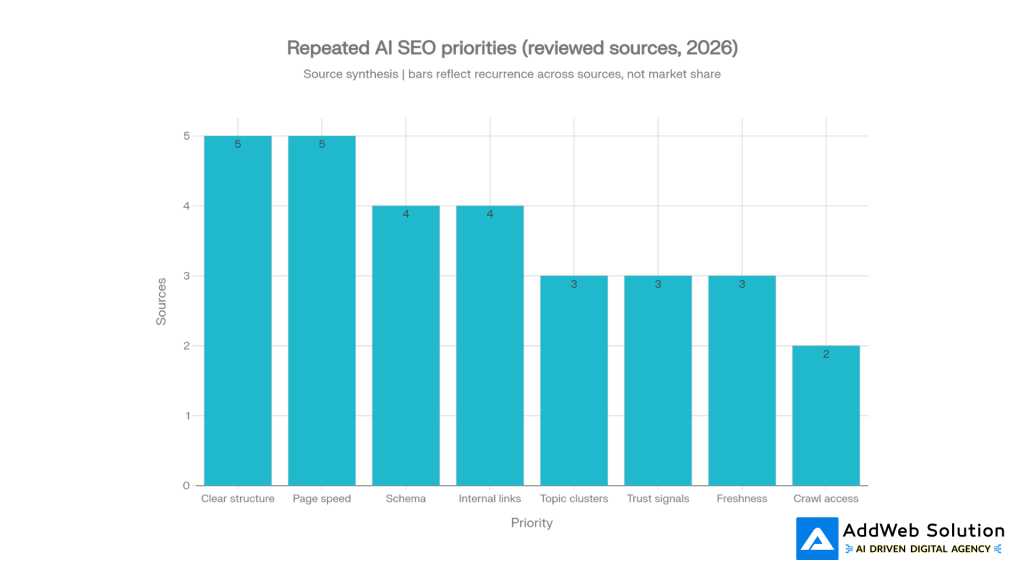
If you scan current guidance, a few priorities keep surfacing again and again. The chart below visualizes the themes most repeatedly emphasized across the reviewed sources.
The pattern is clear: structure, speed, schema, and internal linking dominate the conversation because they directly affect how well AI systems can parse and rely on your content. Freshness and trust signals matter too, but they work best when the page fundamentals are already strong.


6. Build topic clusters, not one-off posts
A single article can rank, but a connected topic cluster is more persuasive. Sources covering WordPress AI search repeatedly recommend organizing content into hubs and supporting articles because topic depth helps establish authority and context.
For example, a pillar page on AI search optimization could link to supporting posts on:
- WordPress schema markup
- Core Web Vitals
- FAQ optimization
- Internal linking strategy
- Refreshing old blog posts
7. Show real expertise
AI systems are more likely to surface content that looks attributable and grounded. Guidance reviewed for this article repeatedly points to author bios, evidence, test results, examples, and clear publishing context as useful trust signals.
That means your blog should not sound like a stitched-together summary of generic SEO advice. Add screenshots, examples from real websites, lessons from client work, or practical dos and don’ts that a reader can actually apply.
8. Keep your site crawlable
A beautifully written article cannot help if it is hard to access. AI-readiness recommendations for WordPress include keeping XML sitemaps updated, avoiding accidental blocking in robots files, and making sure important content is not hidden behind problematic rendering patterns.
At a minimum:
- Keep key pages public.
- Maintain a clean XML sitemap.
- Avoid blocking essential crawlers or assets.
- Make sure important text is visible in the rendered page.
9. Refresh your best content regularly
One of the more practical insights from recent WordPress AI search guidance is that updated content appears more likely to be cited. One benchmark highlighted in a 2026 WordPress optimization article reported that 89.7% of ChatGPT’s 1,000 most-cited pages had been updated in 2025.
A useful refresh means more than changing the date. It means tightening the intro, improving headings, adding better examples, updating screenshots, refining FAQs, and replacing stale references with current ones.
Write for humans, structure for machines
This is where many blogs get it wrong. Some writers panic and start producing stiff, over-optimized copy that sounds like it was written for a checklist instead of a person, but that is not what strong AI-search-ready content looks like. The better approach is to keep the writing conversational while making the structure clean and extractable.
Here is a simple way to think about it:
- Voice should feel human.
- Structure should feel organized.
- Claims should feel supported.
- Navigation should feel obvious.
A practical rollout plan
Most teams will not fix everything in one day, and they do not need to. A phased implementation usually works better because technical cleanup, content restructuring, schema, and linking all build on one another.
The chart below shows a sample 12-week improvement curve for a Site built on the WordPress platform working through AI search readiness in stages. It is an illustrative roadmap rather than an external benchmark, but it reflects the order of operations recommended in the reviewed guidance.
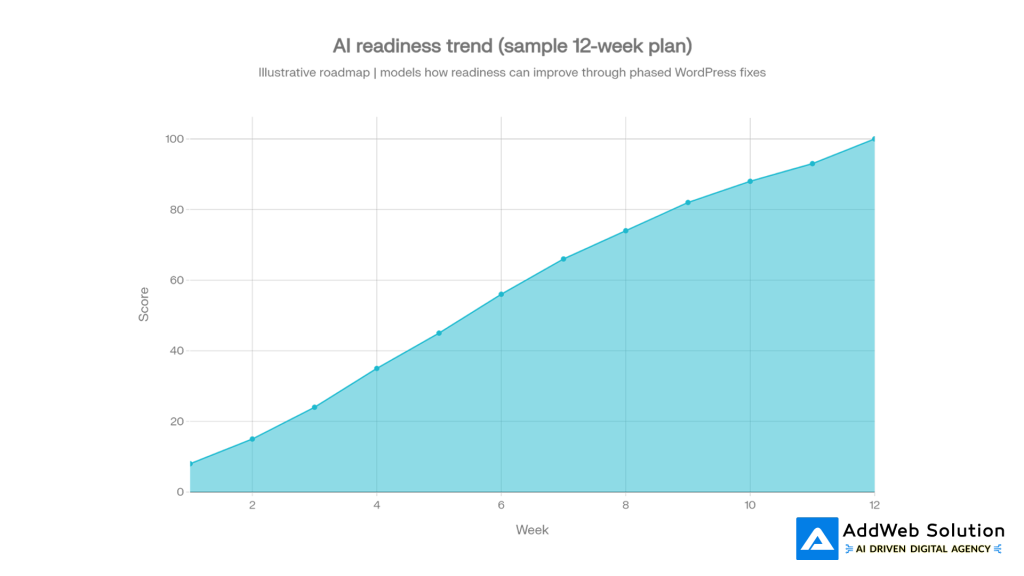
A realistic sequence is to start with performance fixes, move into heading and content rewrites, then roll out schema, tighten internal linking, and finally refresh older high-value pages. That order tends to produce cleaner implementation and stronger compounding gains over time.
Quick checklist before publishing
Before you hit publish on a WordPress post you want AI systems to notice, run through this short checklist:
- Does the article answer the main question in the opening lines?
- Are the headings specific and descriptive?
- Is the page fast and mobile-friendly?
- Did you add relevant internal links?
- Is schema markup present where it honestly fits?
- Does the piece show real authorship or expertise?
- Has the content been updated with current examples or statistics?
- Can crawlers access the important content easily?
Final thought
Optimizing WordPress for AI search is not about chasing a trick. It is about publishing pages that are fast, clear, trustworthy, and well-structured enough that both people and machines can understand them without friction.
The websites most likely to earn visibility in AI-generated answers are usually the ones that explain things clearly, prove what they know, and organize information in ways that are easy to extract and cite.
That is good news, because it means the future of search still rewards useful content; it just rewards better structure along with it.
Turn your website built on the WordPress platform into an AI-ready digital experience with faster performance, structured content, and technical SEO improvements.

Pooja Upadhyay
Director Of People Operations & Client Relations
Source URLs:
https://wordpress.com/blog/2026/02/16/ai-search-engine-optimization-wordpress/
https://wordpress.com/plugins/searchoptimizerai
https://www.pepper.inc/blog/how-to-rank-in-google-ai-overviews-the-2026-playbook
