


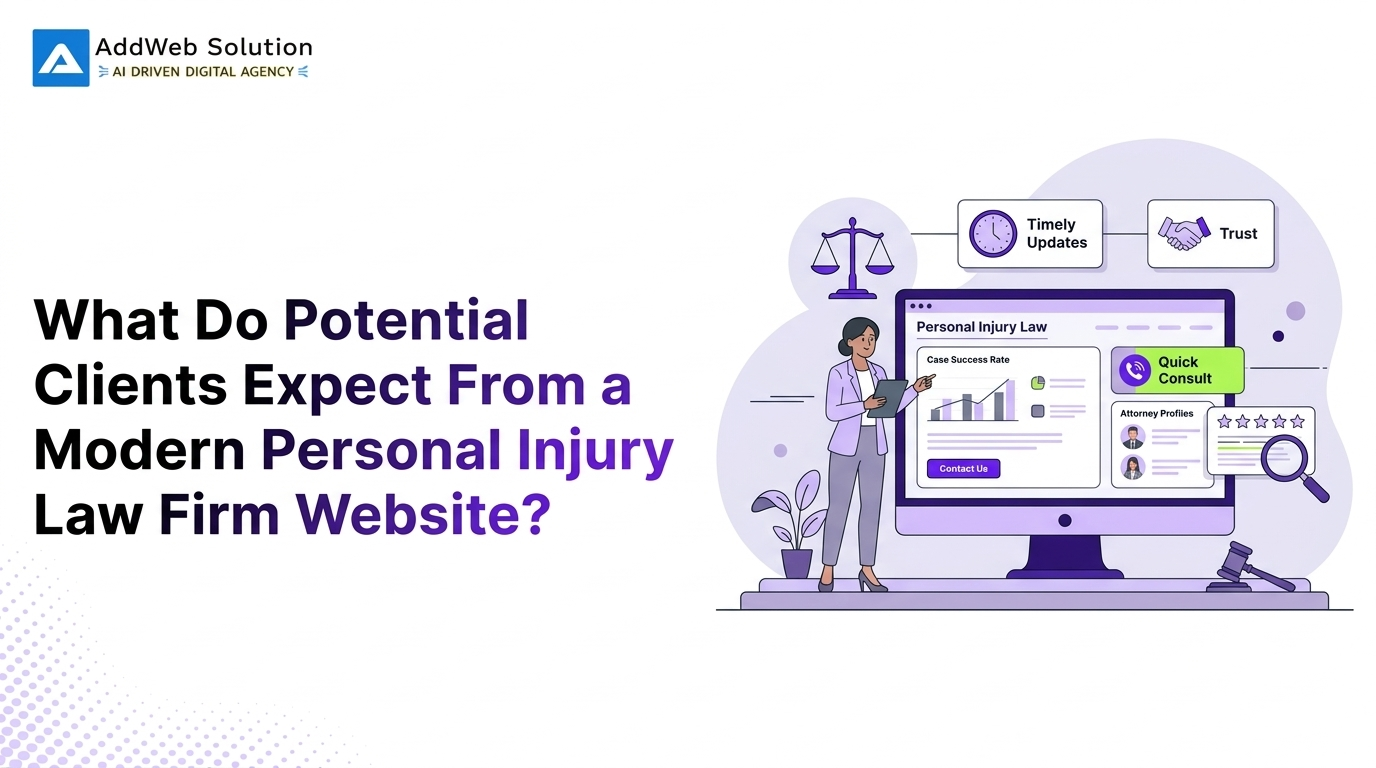
When someone visits a personal injury law firm’s website, they may be dealing with an unfamiliar and stressful situation.
They could have been injured in a car accident, suffered an injury at work, or be trying to understand what options are available after an incident.
They are not necessarily looking for an impressive website design. They want answers.
They may want to know whether the firm handles their type of case, who the attorneys are, what the legal process involves, whether the firm serves their location, and how they can speak with someone.
A website that fails to answer these basic questions creates unnecessary uncertainty.
Even if the firm has experienced attorneys and a strong reputation, visitors may leave without making contact if the website does not communicate the information they need.
A modern personal injury law firm website should do more than establish an online presence.
It should help prospective clients understand the firm, feel comfortable exploring their options, and identify a clear next step.
Here are the elements that matter most.
Key Takeaways
- Visitors need clear information about the firm’s practice areas and the types of cases it handles.
- Attorney profiles should communicate relevant experience and professional credibility.
- Explaining the legal process can help reduce uncertainty.
- Frequently asked questions should address genuine concerns rather than simply fill website space.
- Mobile usability and accessible contact options are essential to a practical website experience.
- Contact forms and intake journeys should make it easy to take the next step without creating unrealistic expectations.
1. Clear Practice-Area Information
One of the first things a prospective client wants to understand is whether the law firm handles their particular situation.
A general statement such as “We fight for injured people” communicates the firm’s broad purpose, but it does not provide much practical information.
A visitor looking for help after a motorcycle accident should not have to search through several pages to determine whether the firm handles motorcycle accident cases.
Practice-area pages should explain the types of cases the firm accepts, the circumstances in which its services may be relevant, and the kind of assistance prospective clients can discuss with the legal team.
For example, a personal injury firm might organize its website around:
- Car and truck accidents
- Motorcycle accidents
- Pedestrian accidents
- Workplace injuries
- Premises liability
- Wrongful death claims
The exact categories should reflect the firm’s actual services.
Each page should contain useful information about the relevant subject rather than simply repeating the same marketing language with a different heading.
The business consideration: Clear practice-area information helps visitors determine whether they are in the right place. It also helps the firm attract inquiries that are more closely aligned with its services.
2. Attorney Profiles That Establish Credibility
Choosing a law firm involves trust. Prospective clients want to understand who they may be working with.
Attorney biographies are therefore more than formal introductions.
A useful attorney profile should explain the lawyer’s professional background, areas of practice, relevant experience, education, bar admissions and other verifiable credentials.
Where appropriate, the profile can also communicate the attorney’s approach to client communication and legal representation.
A photograph and a short biography are a starting point, but they may not answer the questions visitors have.
Compare these two descriptions:
“John Smith is an experienced personal injury attorney dedicated to helping clients.”
And:
“John Smith represents individuals involved in motor vehicle accidents and other personal injury matters. His practice focuses on helping clients understand their legal options and navigate the claims process.”
The second provides more context without relying on exaggerated language.
Firms should also keep attorney profiles current. Outdated professional information, missing team members or inconsistent biographies can undermine confidence.
3. An Understandable Explanation of the Legal Process
People unfamiliar with personal injury law may not know what happens after contacting an attorney.
They might wonder whether an initial consultation is required, what information they should prepare, how an investigation works, or what happens if a claim cannot be resolved through negotiation.
A website does not need to provide a complete legal education. However, it should offer a general explanation of what prospective clients can expect.
A simple process section could cover:
- Initial contact: Explain how someone can reach the firm and what information may be useful.
- Initial discussion: Describe how the firm considers the circumstances of a potential case.
- Case evaluation: Explain, in general terms, how relevant information and documentation may be reviewed.
- Next steps: Describe how the firm communicates possible options and the process moving forward.
The explanation should be accurate and reflect the firm’s actual procedures.
Avoid suggesting that every case follows an identical timeline or produces a particular result. Legal matters differ, and the website should acknowledge that.
A clear explanation can make the first conversation feel less intimidating.
4. Frequently Asked Questions That Address Real Concerns
FAQ sections are often treated as an SEO exercise. Their greater value is helping visitors find answers without having to search through multiple pages.
Potential clients may have questions such as:
- What should I do after a car accident?
- When should I contact a personal injury attorney?
- What information should I bring to an initial consultation?
- How does a personal injury claim generally work?
- Does the firm handle cases involving serious injuries?
- What happens if the other party disputes responsibility?
Answers should be straightforward, useful and appropriately qualified.
For example, a question about how long someone has to file a claim should not receive a generic answer that assumes every state has the same deadline.
The relevant limitation periods can depend on jurisdiction and the circumstances of the matter. Where such information is included, it should be reviewed by the firm’s legal team.
The goal is not to answer every possible legal question. It is to help visitors understand the subject and recognize when they should speak with a qualified attorney.


5. Mobile Usability Should Not Be an Afterthought
A website may look excellent on a desktop monitor but become frustrating on a smartphone.
Potential clients should be able to navigate the website, read important information and contact the firm without constantly zooming, scrolling sideways or struggling with small buttons.
A mobile-friendly website should provide:
- Readable text without unnecessary zooming.
- Navigation that works on smaller screens.
- Clearly visible contact information.
- Buttons with enough space to tap comfortably.
- Forms that are easy to complete on a phone.
- Images that do not unnecessarily slow down page loading.
Mobile usability is not simply a design preference. It affects whether someone can complete the task they came to the website to perform.
A useful test is to open the website on an actual smartphone and try to complete the entire contact journey.
If finding the phone number or submitting an inquiry becomes difficult, the experience needs attention.
6. Contact Options Should Be Easy to Find
A visitor who decides to contact a firm should not have to investigate how to do it.
Contact information should be visible and consistent throughout the website.
Useful options may include:
- A clearly displayed phone number.
- A straightforward contact form.
- An appropriate consultation request option.
- Office locations and relevant service-area information.
- Clear information about when and how the firm responds, if available.
The contact form itself should request only information that is necessary at that stage.
A long form containing numerous mandatory fields may discourage someone from completing it.
On the other hand, a form that collects too little information may make it difficult for the firm to understand the inquiry.
The objective is to find a sensible balance.
Firms should also consider how submitted inquiries are handled. A contact form is only one part of the client intake process. Someone must receive the submission, review it and follow up appropriately.
7. Privacy and Responsible Information Collection
Personal injury inquiries can involve sensitive information about injuries, medical treatment, accidents and financial circumstances.
A firm’s website should therefore communicate clearly about the information it collects and how visitors can contact the firm regarding privacy concerns.
Practical considerations include:
- Providing an accessible privacy policy.
- Collecting only information needed for the intended purpose.
- Restricting access to submitted inquiries.
- Using appropriate technical safeguards.
- Reviewing how website forms transmit and store information.
- Avoiding requests for extensive sensitive documentation through an ordinary contact form.
Firms should also be careful about how their websites describe confidentiality and attorney-client relationships.
Submitting an online inquiry should not automatically be represented as establishing an attorney-client relationship.
The firm’s legal team should review the wording of its forms, privacy notices and disclaimers.
8. The Website Should Reflect the Firm’s Actual Identity
A polished website can still feel generic if every law firm appears to offer the same services using the same language.
Prospective clients should be able to understand what makes a particular firm relevant to their needs.
This does not require exaggerated claims or unsupported statements about success rates.
Instead, the website can communicate the firm’s genuine characteristics through:
- Its attorneys and professional backgrounds.
- The types of matters it handles.
- Its office locations and service areas.
- Its approach to client communication.
- Verifiable testimonials and reviews, where appropriate.
- Relevant educational resources.
Consistency matters too. The firm’s website, attorney profiles, office information and contact details should present an accurate picture of the organization.
A Practical Website Evaluation Checklist
Law firm owners can use these questions to assess their current website.
| Area | Evaluation question |
| Practice areas | Can visitors quickly identify whether the firm handles their type of case? |
| Attorney profiles | Are professional backgrounds and credentials current? |
| Legal process | Is the general process explained clearly? |
| FAQs | Does the website address common prospective-client concerns? |
| Mobile experience | Can visitors navigate and contact the firm comfortably on a phone? |
| Contact options | Are phone numbers and forms easy to find and use? |
| Privacy | Are information collection and privacy practices clearly explained? |
| Consistency | Does the website accurately represent the firm’s current services and identity? |
Frequently Asked Questions
1. What are the most important pages on a personal injury law firm’s website?
Typically, these include the homepage, practice-area pages, attorney profiles, about page, contact page and useful educational resources. The exact structure should reflect the firm’s services and prospective clients’ information needs.
2. Should a personal injury law firm have a separate page for every accident type?
Not necessarily. Separate pages are useful when they provide genuinely distinct and relevant information. Creating numerous nearly identical pages simply to target keywords can make the website repetitive and less useful.
3. Why is mobile usability important for law firm websites?
Visitors should be able to access information, navigate the website and contact the firm using their smartphones. Poor mobile usability can create unnecessary barriers during an important decision-making moment.
4. Should a law firm collect detailed case information through its website?
It depends on the firm’s intake process and the sensitivity of the information. An initial contact form should generally collect only the information necessary to facilitate appropriate follow-up. More detailed information can be requested through suitable channels.
5. How often should a law firm update its website?
The website should be reviewed regularly and whenever there are meaningful changes to attorneys, services, locations, contact information, legal information or technology. Periodic usability and performance reviews are also worthwhile.
Build a Better Law Firm Website

Pooja Upadhyay
Director Of People Operations & Client Relations
Conclusion: Build a Website Around the Visitor’s Next Step
A modern personal injury law firm website should help prospective clients move from uncertainty toward an informed next step.
That requires more than attractive design. It requires clear practice-area information, credible attorney profiles, understandable explanations, useful answers, reliable mobile experiences and accessible contact options.
For law firm owners, the most useful starting point is to review the website from the perspective of someone who has never contacted the firm before.
Can that person understand what the firm does, determine whether it may be relevant to their situation, learn what to expect and find an appropriate way to get in touch?
If the answer to any of these questions is unclear, there may be an opportunity to improve the website.
The objective is not to make unrealistic promises or pressure visitors into contacting the firm. It is to remove unnecessary friction and make the next step easier to understand.
A good law firm website does not need to answer every question. It needs to help visitors find the right answers and know where to go next.
