


Introduction
For years, an enterprise website had one primary job: tell people who you are and what you do.
There was a homepage, an About Us page, a product section, a Contact page, maybe a resource center if the marketing team was feeling ambitious.
That model is wearing thin.
Today’s customers don’t want to spend ten minutes navigating a corporate website to find an answer that should have taken ten seconds. Employees don’t want to search across six internal systems for a document.
Partners don’t want to email a sales representative every time they need an update.
And increasingly, people expect digital experiences to understand what they are trying to accomplish.
That’s the difference between a website and an intelligent portal.
A website presents information.
A portal helps someone do something with it.
That shift is changing how enterprises think about their digital front doors. Instead of building static destinations filled with content, organizations are creating personalized, connected experiences that bring together content, data, workflows, search, identity, automation, and AI.
The result is less like a digital brochure and more like a front desk that already knows why you’ve arrived.
1. The Enterprise Website Has Outgrown Its Original Job
The traditional enterprise website was designed around the organization.
Its navigation usually reflected the company’s internal structure:
Products | Services | Industries | About | Resources | Contact
But customers don’t necessarily think in those categories.
A customer might arrive with a very different question:
“I already use your platform. How do I upgrade?”
An employee might ask:
“Where is the latest travel policy for international trips?”
A partner might need:
“Which products are currently available in my region?”
A prospective buyer could simply want:
“Which solution is right for a company with 500 employees?”
These are not really navigation problems.
They’re intent problems.
And that is why enterprises are beginning to rethink the digital front door.
Instead of asking visitors to figure out where information lives, intelligent portals increasingly try to understand why the visitor is there and surface the appropriate information, tools, and next action.

It means the website is becoming the entry point to something much more useful.
2. What Makes a Portal “Intelligent”?
The word “intelligent” gets attached to almost everything these days.
So let’s make it practical.
An intelligent portal isn’t simply a website with a chatbot floating in the bottom-right corner.
It typically brings together several capabilities:
Identity
The portal knows who the user is, where appropriate, and what they are authorized to access.
A customer shouldn’t have to see the same experience as an anonymous visitor if the organization already knows they are an existing customer.
Context
The system can use information such as:
- User role
- Organization
- Location
- Products owned
- Previous interactions
- Account status
- Preferences
- Relevant business data
Search and discovery
Instead of matching only exact keywords, modern search can understand concepts, relationships, and intent.
Personalization
Different users can receive different content, recommendations, actions, and shortcuts.
Workflow
The portal doesn’t stop at displaying information.
It can help users submit, request, approve, renew, purchase, update, or track something.
AI
AI can sit across these capabilities to summarize information, answer questions, recommend next actions, or help users navigate complex processes.
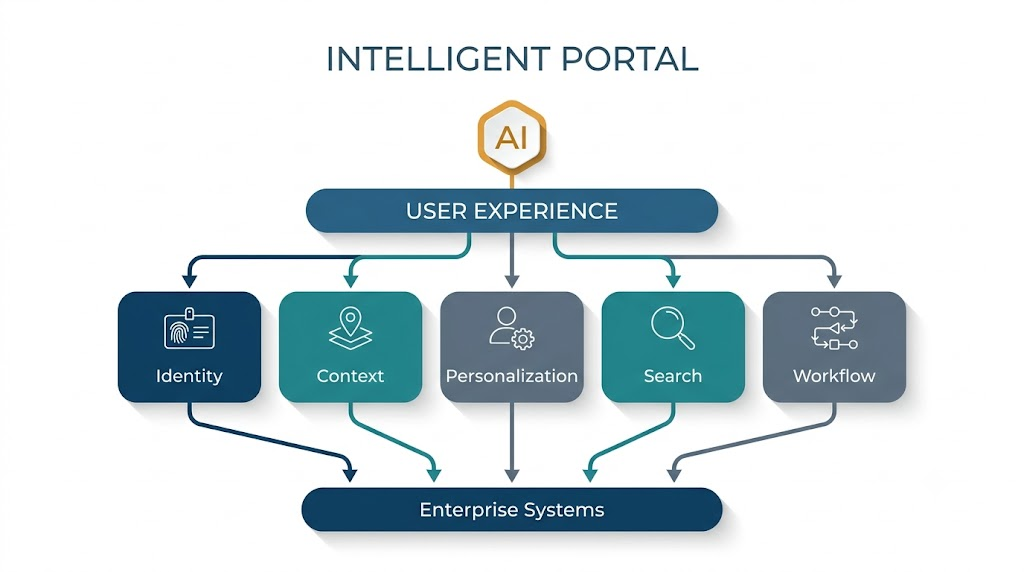
The intelligence isn’t in one feature.
It’s in how these pieces work together.
3. Personalization Is Moving From Nice-to-Have to Experience Infrastructure
Personalization used to mean something fairly basic:
“Hello, Rashmit.”
Then perhaps:
“You may also like…”
That isn’t enough for complex enterprise experiences.
True personalization is increasingly about relevance.
Imagine two visitors arriving at the same technology company’s website.
One is a new prospect.
The other has been a customer for three years.
Showing both people the same homepage isn’t necessarily a great experience.
The prospect may need:
- Product comparisons
- Pricing information
- Case studies
- Implementation guidance
The existing customer may need:
- Support resources
- Product updates
- Documentation
- Account information
- Renewal information
The content doesn’t have to be completely different.
But the priority of the experience can be.
This is where first-party data becomes particularly valuable.
The organization already knows something about its users through CRM systems, account platforms, customer portals, subscriptions, and previous interactions. Connecting that information responsibly to the digital experience can make the front door much more useful.
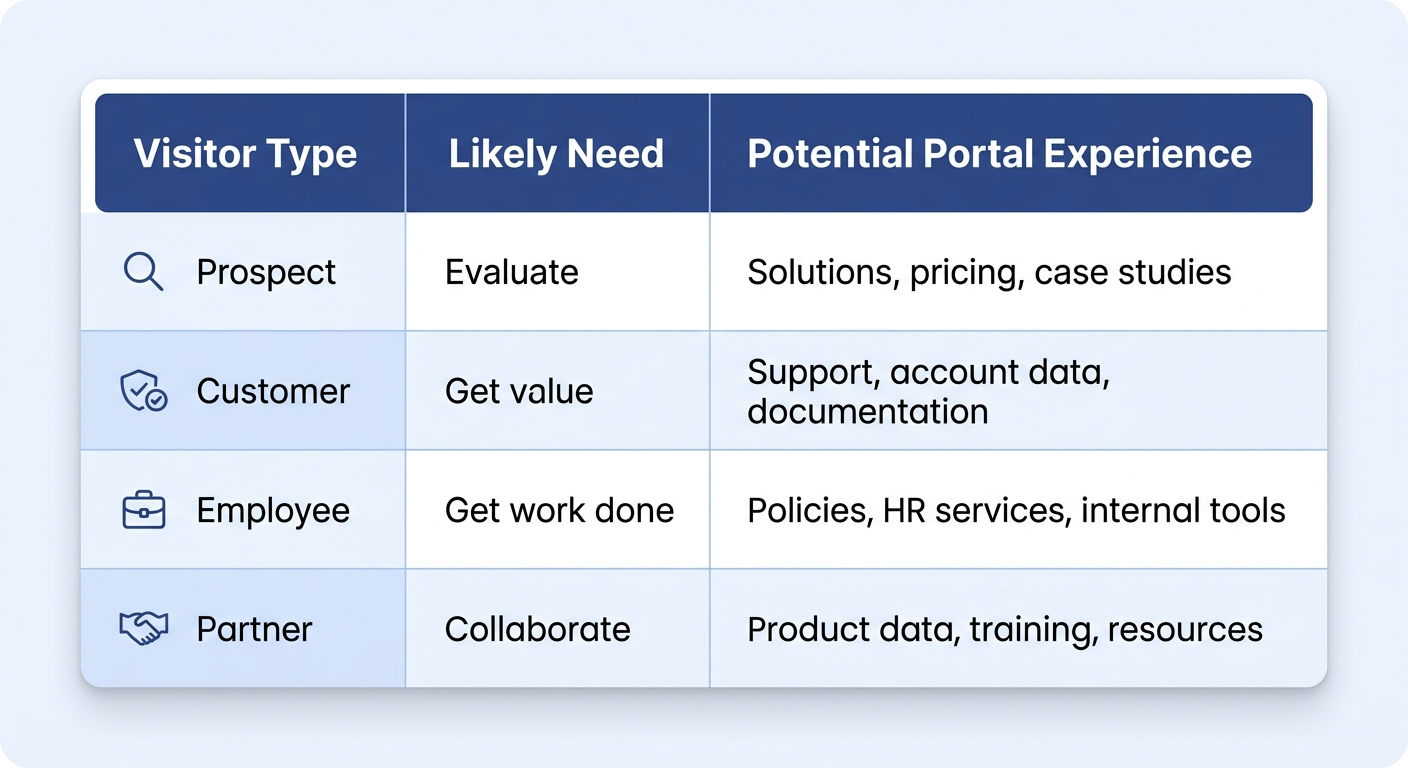
The important point is that personalization shouldn’t become a collection of creepy guesses.
Good personalization answers a simple question:
“What would be most useful to this person right now?”


4. AI Is Turning Search Into a Conversation
Enterprise search has a reputation for being the place where useful information goes to hide.
You know the experience.
You search for something obvious.
The system returns 47 results.
None quite answer the question.
So you change the wording.
Now you have 83 results.
AI is changing the expectations around this interaction.
Instead of searching for:
“international travel policy”
an employee might ask:
“I’m traveling from India to Germany for five days. What do I need to do before booking my trip?”
A conventional search engine returns documents.
An AI-assisted experience can potentially identify the relevant policy, summarize the requirements, point to the appropriate forms, and guide the employee toward the next action.
That’s a fundamentally different interaction.
The portal becomes less like a library catalog and more like a guide.
But there is a catch.
Enterprise AI needs trustworthy information.
If the underlying content is outdated, poorly structured, duplicated, or inaccessible, an AI layer doesn’t magically fix it.
It can actually make the problem harder to see.
This is why content architecture, metadata, permissions, governance, and APIs become increasingly important in AI-powered portals.
Interesting Fact Box 📌
McKinsey’s 2024 global survey found that 65% of respondents said their organizations were regularly using generative AI, nearly double the proportion reported in its previous survey.
Gartner predicted that by 2025, 80% of enterprise software applications would have embedded generative AI capabilities.
The exact technology will continue to evolve.
The expectation it creates is already here:
People increasingly expect digital systems to understand questions, not just keywords.
5. The Portal Is Becoming a Gateway to Enterprise Systems
Here’s perhaps the biggest difference between a modern portal and a conventional website.
A website tells you something.
A portal can do something.
Consider an enterprise customer portal.
A customer might be able to:
- View their account
- Check an order
- Download invoices
- Open a support request
- Review product documentation
- Renew a subscription
- Change account information
- Speak with an AI assistant
None of those functions necessarily belong to the CMS itself.
They may live across ERP, CRM, commerce, support, identity, and other enterprise systems.
The portal becomes the experience layer sitting across them.
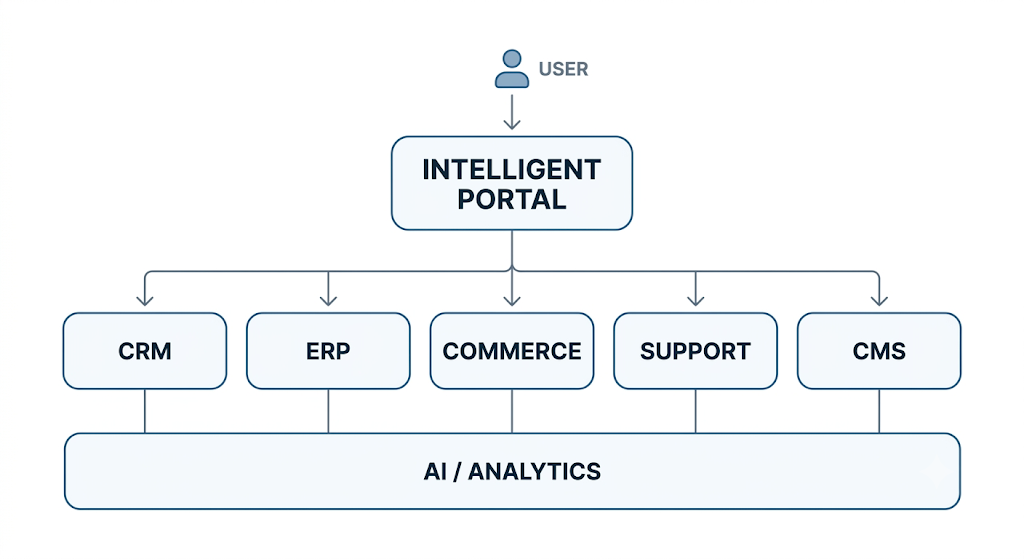
This is why portal projects are often less about designing another beautiful frontend and more about connecting fragmented backend capabilities.
The interface may be the visible part.
The integration architecture is where much of the real work happens.
6. Where Intelligent Portals Create the Most Value
The opportunity isn’t limited to customer-facing websites.
Three use cases stand out.
Customer Portals
For companies with complex products, subscriptions, services, or account relationships, the portal can become the primary customer destination.
Instead of sending customers to separate systems for documentation, billing, support, product information, and account management, organizations can create one experience that brings the relevant pieces together.
The benefit isn’t just convenience.
It can reduce unnecessary support interactions and make self-service much more practical.
Employee Portals
Large enterprises often have the opposite problem from public websites.
They have too much information.
HR policies sit in one system.
IT support sits somewhere else.
Learning resources live in another platform.
Benefits information has its own destination.
The employee portal can become a unified layer across those systems.
Add AI to that environment and an employee could ask:
“What’s the process for adding my spouse to my benefits?”
Instead of searching multiple systems, the portal can guide the employee to the relevant information and action.
Partner Portals
Partners often need access to a different subset of enterprise information.
They may need:
- Product catalogs
- Pricing
- Training
- Marketing materials
- Documentation
- Deal registration
- Order information
- Certification resources
A well-designed partner portal can bring those experiences together while respecting role-based access.
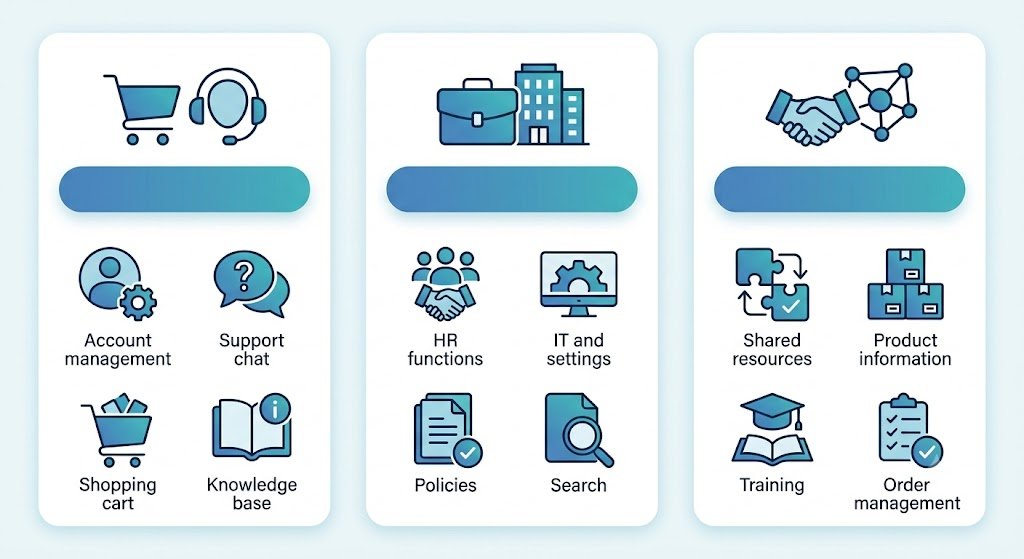
The common thread is self-service with context.
7. How Enterprises Should Approach the Transformation
The biggest mistake is treating an intelligent portal as a redesign project.
A prettier homepage won’t solve fragmented data.
A chatbot won’t fix bad enterprise search.
And adding personalization to a disconnected architecture usually creates another layer of complexity.
A better approach starts with the user’s journey.
Step 1: Identify the highest-friction journeys
Don’t redesign everything at once.
Find the moments where users repeatedly struggle.
Examples:
- Finding product documentation
- Checking order status
- Submitting an HR request
- Finding internal policies
- Renewing a service
- Registering a partner deal
Step 2: Map the systems behind those journeys
Once you understand the journey, identify where the required information actually lives.
This usually reveals a surprising number of systems.
Step 3: Establish a reliable content and data foundation
AI and personalization are only as good as the information underneath them.
Clean up duplicates.
Define ownership.
Structure important content.
Establish permissions.
Make APIs available where appropriate.
Step 4: Add intelligence where it solves a real problem
AI doesn’t need to be everywhere.
Use it where it removes friction.
For example:
Search → conversational answers
Large document → concise summary
Complex process → guided workflow
Many choices → contextual recommendation
Step 5: Measure outcomes, not just traffic
Traditional websites often obsess over:
- Page views
- Sessions
- Bounce rate
Portals should also measure:
- Task completion
- Search success
- Self-service resolution
- Time to complete a task
- Support deflection
- Conversion
- Repeat usage
- User satisfaction
The metric that matters most may be surprisingly simple:
Did the person accomplish what they came to do?
Conclusion
The enterprise website is entering a new phase.
It is no longer enough to publish information and hope visitors find what they need.
Customers expect relevance.
Employees expect self-service.
Partners expect connected experiences.
And AI is raising the bar further by teaching users to expect digital interfaces that can understand questions and help them move forward.
That doesn’t mean every enterprise needs to turn its website into a giant AI-powered portal overnight.
It means the digital front door deserves to be treated as infrastructure, not decoration.
The strongest portal experiences connect three things:
The right information.
The right systems.
The right action.
When those pieces come together, the website stops being a destination users have to navigate and starts becoming an experience that helps them get somewhere.
That is the real opportunity for enterprises today.
At AddWeb Solutions, we help organizations rethink their digital platforms around that opportunity, connecting content, enterprise systems, APIs, personalization, and emerging AI capabilities into experiences designed around what users actually need to accomplish.
Because the next generation of enterprise websites won’t simply answer:
“Who are we?”
They’ll answer a much more useful question:
“What are you here to get done?”
Explore Intelligent Portal Development

Pooja Upadhyay
Director Of People Operations & Client Relations
Sources & Further Reading:
https://www.mckinsey.com/capabilities/quantumblack/our-insights/the-state-of-ai-in-early-2024
https://www.gartner.com/en/information-technology/glossary/digital-experience-platform-dxp
