


AI-powered threat detection is becoming an important part of enterprise cybersecurity in India. Instead of relying only on predefined rules and manual monitoring, modern security systems can use artificial intelligence and machine learning to identify unusual behavior, prioritize alerts, detect suspicious patterns, and support faster incident response.
For Indian enterprises, this shift is becoming increasingly relevant as businesses adopt cloud platforms, digital payments, remote work, APIs, SaaS applications, connected devices, and generative AI tools.
IBM’s 2026 Cost of a Data Breach research reported that the average cost of a data breach in India reached ₹255 million, or ₹25.5 crore, up from ₹220 million in 2025. The same research found that 26% of malicious breaches in India were AI-generated.
This makes AI a two-sided cybersecurity technology. Businesses can use AI to detect threats faster, while attackers can also use AI to make cyberattacks more scalable and sophisticated.
Quick Answer: How Is AI Used in Threat Detection?
AI is used in threat detection by analyzing large volumes of security data, learning normal patterns, identifying anomalies, detecting suspicious behavior, correlating security events, prioritizing alerts, and helping security teams respond to potential attacks.
AI can analyze data from:
- Network traffic
- Endpoints and laptops
- Cloud environments
- User accounts
- Applications
- Authentication systems
- Security logs
- APIs
- Identity systems
- Threat intelligence feeds
Instead of asking only, “Does this activity match a known attack signature?”, AI-based security systems can also ask, “Is this behavior unusual for this user, device, application, or network?”
That behavioral approach is particularly useful for detecting previously unseen or rapidly changing threats.
Why AI-Based Threat Detection Matters for Indian Enterprises
Indian businesses are dealing with a rapidly changing digital attack surface.
Enterprises increasingly operate across:
- Public and private cloud
- Hybrid infrastructure
- SaaS platforms
- Mobile applications
- APIs
- Digital payment systems
- Remote employee devices
- Third-party vendors
- Customer portals
- AI applications
Every additional connection can create another security monitoring requirement.
CERT-In has highlighted ransomware, DDoS attacks, website defacement, data breaches, and malware infections as significant cybersecurity threats affecting organizations in India.
The challenge is not simply collecting security data.
The bigger challenge is identifying which events actually require immediate attention.
A large enterprise can generate thousands or millions of security events. Human analysts cannot investigate every event manually.
AI can help reduce this workload by identifying patterns and prioritizing potentially important events.
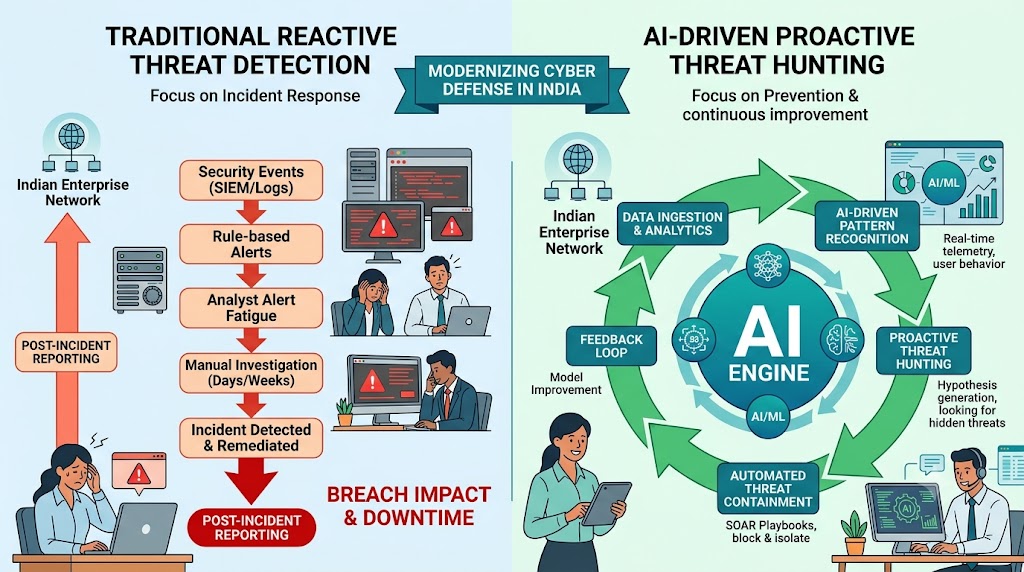
AI Threat Detection vs Traditional Threat Detection
Traditional cybersecurity systems often depend heavily on predefined rules, signatures, indicators, and known attack patterns.
For example:
If an IP address is associated with known malicious activity, block the connection.
This approach remains useful, especially for known threats.
AI adds another layer.
For example:
A normally inactive account suddenly logs in from an unusual location, accesses several sensitive systems, downloads an unusually large amount of data, and begins performing actions outside its normal working pattern.
Individually, some of these activities may not look malicious.
AI can analyze them together and identify the combination as potentially suspicious.
Simple comparison
| Traditional Detection | AI-Assisted Detection |
|---|---|
| Rule-based | Behavior-based and data-driven |
| Strong for known threats | Can identify unusual patterns |
| Depends heavily on predefined signatures | Learns patterns from security data |
| Can generate many alerts | Can help prioritize alerts |
| Mostly deterministic | Can identify statistical anomalies |
| Requires frequent rule updates | Can adapt to changing patterns, depending on the system |
AI does not replace traditional security controls.
The more practical approach is to combine AI with established technologies such as endpoint detection and response, SIEM, identity security, firewalls, vulnerability management, and human security operations.
How AI Detects Cyber Threats
AI-based threat detection typically works through several connected stages.
1. Data Collection
The first step is collecting security telemetry.
Data may come from:
- Firewalls
- Servers
- Endpoints
- Cloud services
- Applications
- Identity providers
- VPN systems
- Email systems
- DNS
- Network traffic
- Authentication logs
The quality of the AI system depends heavily on the quality and coverage of this data.
Poor or incomplete telemetry can lead to missed threats or inaccurate alerts.
2. Establishing Normal Behavior
Machine learning models can analyze historical activity to understand normal patterns.
For example, an enterprise may normally see:
- An employee logging in between 9 AM and 7 PM
- A finance user accessing accounting applications
- A server communicating with a defined set of services
- A database receiving predictable application requests
AI can establish statistical patterns around this activity.
When behavior changes significantly, the system can generate an anomaly signal.
3. Anomaly Detection
Anomaly detection is one of the most important AI applications in cybersecurity.
Suppose an employee normally downloads 50 to 100 MB of files per day.
One evening, the same account suddenly downloads several gigabytes of sensitive files.
The activity does not necessarily prove that an attack has occurred.
However, it is unusual enough to deserve investigation.
AI can flag the behavior for a security analyst.
4. Behavioral Analysis
AI can analyze behavior across users, devices, applications, and networks.
This is often called User and Entity Behavior Analytics, or UEBA.
For example:
Normal pattern:
Employee → Office laptop → VPN → ERP → Finance database
Suspicious pattern:
Employee account → New device → Unusual location → Multiple failed logins → Privileged system → Large data transfer
The individual events may appear harmless.
The combined behavior may indicate account compromise.
5. Threat Detection Through Event Correlation
Modern enterprises generate security events from many different systems.
AI can help correlate these events.
For example:
- An employee receives a suspicious email.
- A link is opened.
- A new process starts on the endpoint.
- The device communicates with an unusual domain.
- Credentials are used against another system.
- Large amounts of data are accessed.
Looking at these events separately can make detection difficult.
Correlating them can reveal a potential attack chain.
6. AI-Powered Phishing Detection
Phishing remains an important problem for Indian organizations.
IBM’s 2026 India data identified phishing, including voice and SMS phishing, as the most common initial attack vector, accounting for 19% of breaches in the report’s Indian dataset.
AI can examine signals such as:
- Sender behavior
- Email language
- Domain reputation
- URL characteristics
- Message structure
- Historical communication patterns
- Attachment behavior
- Login activity after a message is opened
AI can also help identify unusual communication patterns that traditional filters may miss.
However, organizations should not rely on AI alone.
Email authentication, employee awareness, MFA, endpoint protection, and secure access controls remain important.
7. AI for Malware Detection
Traditional antivirus systems commonly rely on signatures and known indicators.
AI-assisted malware detection can add behavioral analysis.
For example, an endpoint may suddenly:
- Modify large numbers of files
- Create unusual processes
- Attempt privilege escalation
- Access sensitive directories
- Communicate with suspicious infrastructure
- Disable security services
A behavioral model can identify combinations of activity that resemble malicious behavior.
This can be particularly useful against new or modified malware variants.
8. AI for Ransomware Detection
Ransomware can cause significant operational disruption.
AI can monitor for behavioral indicators such as:
- Rapid file modification
- Unusual encryption activity
- Abnormal process execution
- Sudden privilege changes
- Suspicious network communication
- Attempts to disable security controls
If the system detects a high-risk pattern, automated security controls may be able to isolate the endpoint or trigger an investigation.
CERT-In has published guidance addressing ransomware and other cybersecurity threats affecting Indian organizations.
AI should therefore be viewed as an additional detection and response capability, not as a replacement for backups, segmentation, patching, identity controls, and incident response planning.
9. AI for Insider Threat Detection
Not every security incident starts with an external attacker.
An account may be compromised, misused, or behave abnormally.
AI can establish behavioral profiles for users and entities.
It can analyze factors such as:
- Login frequency
- Device usage
- Application access
- Data downloads
- Geographic patterns
- Privilege changes
- Access to sensitive systems
A sudden change can trigger additional investigation.
Importantly, an anomaly should not automatically be interpreted as malicious behavior.
Security teams need appropriate investigation and context before taking action against an employee or account.
10. AI for Cloud Threat Detection
Indian enterprises increasingly use cloud infrastructure.
Cloud environments create large amounts of security telemetry.
AI can help identify:
- Unusual API calls
- Abnormal cloud logins
- Suspicious privilege escalation
- Unexpected resource creation
- Unusual data transfers
- Misconfigured services
- Abnormal access patterns
For organizations running hybrid infrastructure, AI can potentially correlate events across on-premise systems and cloud environments.
This can give security teams a broader view of an attack.
11. AI and Security Information and Event Management
A Security Information and Event Management, or SIEM, platform collects and analyzes security events.
AI can enhance SIEM capabilities by helping with:
- Alert prioritization
- Event correlation
- Anomaly detection
- Threat classification
- Investigation assistance
- Natural-language security queries
- Automated summaries
Instead of forcing analysts to manually inspect thousands of alerts, AI can help identify which events deserve closer attention.
This is especially relevant for enterprises with limited security operations staff.
12. AI and Security Operations Centers
A Security Operations Center, or SOC, continuously monitors an organization’s security environment.
AI can support SOC analysts by helping with:
Detection
Identify potentially suspicious activity.
Investigation
Connect related security events.
Prioritization
Rank alerts according to potential risk.
Summarization
Convert large volumes of technical information into a shorter incident summary.
Response
Trigger predefined actions when appropriate.
Threat Hunting
Search large datasets for suspicious patterns.
The objective is not to remove humans from the SOC.
The objective is to reduce repetitive work and give analysts better information for decision-making.
AI Threat Detection Statistics Relevant to India
The current data shows why this area deserves attention from Indian enterprises.
₹25.5 crore average breach cost
IBM reported an average data breach cost of ₹255 million in India in 2026.
26% of malicious breaches were AI-generated
IBM reported that 26% of malicious breaches in its 2026 India research were AI-generated.
32% extensive AI and security automation
Only 32% of organizations surveyed in India reported extensive use of AI and security automation in IBM’s 2026 research. Another 36% reported limited use and 32% reported no use.
₹10.3 crore difference in average breach cost
IBM reported an average breach cost of ₹316 million for organizations with no AI and security automation compared with ₹213 million for organizations with extensive use. These figures are observational research findings and should not be interpreted as proof that AI alone caused the cost difference.
Phishing accounted for 19%
Phishing, including voice and SMS phishing, represented 19% of the initial attack vectors in IBM’s 2026 India research.
Expert Perspective on AI Security in India
IBM India and South Asia’s Vice President of Technology, Viswanath Ramaswamy, said:
“India’s accelerating AI adoption brings immense opportunity, but it’s also exposing enterprises to new and complex cyber threats.”
This highlights an important point for Indian businesses.
AI security should not be considered separately from the broader cybersecurity strategy.
Organizations need to secure both:
- AI systems used by the business
- AI systems used to defend the business
AI Threat Detection Use Cases by Industry
Different Indian industries can apply AI-based detection differently.
Banking and Financial Services
Potential applications include:
- Fraud detection
- Account takeover detection
- Transaction anomaly detection
- Identity monitoring
- Phishing detection
- Insider threat monitoring
CERT-In, CSIRT-Fin, and SISA have also published the Digital Threat Report 2025-26 focusing on cybersecurity resilience in India’s BFSI sector.
Healthcare
Potential applications include:
- Medical system monitoring
- Identity security
- Endpoint monitoring
- Unauthorized access detection
- Ransomware detection
Manufacturing
AI can monitor:
- Industrial networks
- Connected devices
- Operational technology
- Network anomalies
- Unusual device communication
IT and SaaS Companies
Common use cases include:
- Cloud monitoring
- API security
- Account takeover detection
- Endpoint protection
- Application security
E-commerce
AI can assist with:
- Account takeover detection
- Payment fraud detection
- Bot detection
- API abuse monitoring
- Credential attack detection
How Indian Enterprises Can Implement AI Threat Detection
Organizations do not need to deploy every AI security technology at once.
A practical roadmap can be divided into stages.
Step 1: Identify Critical Assets
Create an inventory of:
- Customer data
- Financial information
- Employee information
- Intellectual property
- Cloud resources
- Business applications
- APIs
- Critical infrastructure
Step 2: Improve Visibility
Collect logs from critical systems.
Start with:
- Identity systems
- Endpoints
- Firewalls
- Cloud infrastructure
- Critical applications
- Servers
AI cannot detect what the organization cannot observe.
Step 3: Strengthen Identity Security
Implement:
- Multi-factor authentication
- Role-based access control
- Least privilege
- Privileged access management
- Strong password policies
CERT-In specifically recommends strong authentication, MFA, role-based access control, and regular patching as important cybersecurity measures.
Step 4: Deploy Detection Technologies
Depending on business requirements, enterprises can evaluate:
- SIEM
- EDR
- XDR
- UEBA
- Network Detection and Response
- Cloud security platforms
- Security orchestration and automation
AI capabilities can be incorporated into these platforms.
Step 5: Establish a Baseline
Before relying heavily on anomaly detection, understand normal organizational behavior.
For example:
- Normal login locations
- Normal access times
- Normal data transfers
- Normal application activity
- Normal administrative behavior
This helps security teams investigate meaningful deviations.
Step 6: Integrate Threat Intelligence
Threat intelligence can provide information about:
- Malicious IP addresses
- Domains
- Malware indicators
- Attack techniques
- Vulnerabilities
- Emerging campaigns
CERT-In advises organizations to monitor its threat intelligence feeds, alerts, and advisories as part of strengthening cyber resilience.
Step 7: Keep Humans in the Loop
AI-generated alerts require context.
Security analysts should validate important incidents before taking high-impact actions.
This is especially important when an automated system may block:
- A legitimate employee
- A customer
- A business partner
- A production service
Human oversight remains an important part of responsible security operations.


What Are the Limitations of AI Threat Detection?
AI is not a perfect cybersecurity solution.
False Positives
An unusual event does not always mean an attack.
False Negatives
AI can also fail to identify sophisticated threats.
Poor Training Data
Bad or incomplete data can reduce detection quality.
Model Manipulation
Attackers may attempt to manipulate AI systems or their data.
Explainability
Security teams may need to understand why a model produced a particular alert.
Privacy Concerns
Behavioral monitoring can involve sensitive employee or customer information.
AI-Specific Attacks
AI systems themselves can become attack targets.
CERT-In has warned about risks such as data poisoning and vulnerabilities in AI design, training, and interaction mechanisms.
NIST also notes that AI introduces cybersecurity and privacy risks that organizations need to manage as AI adoption expands.
AI Threat Detection in 2027: What Indian Enterprises Should Prepare For
By 2027, enterprises should expect cybersecurity operations to become increasingly automated.
One important development is the growth of AI agents.
AI agents can potentially perform multi-step tasks rather than simply generate text or classify information.
NIST’s 2026 analysis of AI agent security found broad agreement among respondents that AI agents create new security threats and that existing cybersecurity practices will need adaptation for agent security.
CERT-In’s 2026 advisory on frontier AI-driven cyber risks also describes capabilities such as automated reconnaissance, vulnerability analysis, credential harvesting, AI-generated phishing, and multi-stage attack planning.
For Indian enterprises, this means security monitoring will increasingly need to look for:
- Automated reconnaissance
- Abnormally fast activity
- Automated credential abuse
- Unusual API activity
- AI-generated phishing
- Rapid exploitation attempts
- Abnormal scripts and commands
- Suspicious agent activity
CERT-In’s 2026 blueprint recommends adaptive security, continuous control validation, security automation, AI-assisted defensive operations, adversarial AI testing, and continuous reassessment of organizational exposure.
AI Threat Detection Best Practices for Indian Businesses
A practical security strategy should combine AI with established cybersecurity fundamentals.
Recommended checklist
Identity
- Enable MFA
- Apply least privilege
- Monitor privileged accounts
Endpoints
- Deploy EDR or equivalent protection
- Monitor abnormal processes
- Keep operating systems patched
Network
- Monitor unusual traffic
- Segment critical systems
- Reduce unnecessary internet exposure
Cloud
- Monitor identity and API activity
- Review cloud permissions
- Detect abnormal data transfers
AI
- Maintain an AI inventory
- Control access to AI tools
- Monitor shadow AI
- Protect AI data
- Test AI applications for security risks
SOC
- Prioritize alerts
- Automate repetitive investigations
- Maintain human review
- Conduct threat hunting
- Test incident response procedures
AI Threat Detection vs AI-Powered Cyberattacks
The cybersecurity environment is becoming an AI-versus-AI landscape.
| Defensive AI | Offensive AI |
|---|---|
| Detects anomalies | Automates reconnaissance |
| Identifies suspicious behavior | Generates phishing content |
| Prioritizes alerts | Automates attack workflows |
| Supports threat hunting | Accelerates vulnerability discovery |
| Assists incident response | Scales social engineering |
| Detects malware behavior | Can assist malware development |
CERT-In’s 2026 guidance specifically warns that frontier AI capabilities may accelerate reconnaissance, vulnerability exploitation, credential compromise, and social engineering.
This is why simply purchasing an AI-powered security product is not enough.
The organization also needs strong identity controls, patch management, visibility, incident response, governance, and employee awareness.
Frequently Asked Questions About AI Threat Detection
What is AI threat detection?
AI threat detection uses artificial intelligence and machine learning to analyze cybersecurity data and identify suspicious patterns, anomalies, malicious behavior, and potential attacks.
How does AI detect cyber threats?
AI can analyze security logs, network traffic, endpoint activity, identity events, application behavior, and threat intelligence to identify patterns that may indicate malicious activity.
Can AI detect zero-day attacks?
AI may help identify previously unseen attacks through behavioral and anomaly-based detection. However, no AI system can guarantee detection of every zero-day attack.
Is AI better than traditional cybersecurity?
AI and traditional cybersecurity serve different purposes. AI can improve detection and analysis, while established controls such as MFA, patching, firewalls, backups, access management, and endpoint protection remain essential.
How is AI used in SOC operations?
AI can help SOC teams prioritize alerts, correlate events, summarize incidents, detect anomalies, search security data, and automate selected response actions.
Is AI threat detection suitable for Indian MSMEs?
It can be, but the technology should match the organization’s size, risk profile, budget, infrastructure, and security maturity. Smaller organizations can begin with managed security services, endpoint protection, MFA, secure backups, and centralized monitoring before introducing more advanced AI capabilities.
What are the risks of AI in cybersecurity?
Key risks include false positives, false negatives, biased or poor-quality training data, privacy concerns, model manipulation, insufficient explainability, and attacks targeting AI systems themselves.
What should Indian enterprises do first?
Start with visibility, asset inventory, identity security, MFA, patch management, centralized logging, endpoint protection, and incident response. AI can then be introduced where it provides measurable value.
Final Takeaway
AI is changing how enterprises detect and respond to cyber threats.
For Indian organizations, the opportunity is significant because AI can help security teams process large amounts of telemetry, identify unusual behavior, correlate events, prioritize alerts, and accelerate parts of the investigation process.
But AI should not be treated as a standalone cybersecurity solution.
The strongest approach combines AI-powered detection with identity security, endpoint protection, network monitoring, cloud security, threat intelligence, vulnerability management, employee awareness, incident response, and human oversight.
As AI-powered attacks become more capable, Indian enterprises should focus on building security systems that can continuously observe, detect, investigate, and adapt.
For 2027, the key question is not simply whether an organization uses AI for cybersecurity. The more important question is whether its entire security operation is prepared for an environment where both defenders and attackers can use AI.
Ready to strengthen your enterprise cybersecurity with AI?

Pooja Upadhyay
Director Of People Operations & Client Relations
