


Cybersecurity is becoming a business priority, not just an IT responsibility. Indian organizations are dealing with phishing, ransomware, credential theft, supply-chain attacks, cloud vulnerabilities and increasingly sophisticated AI-enabled threats.
The scale is significant. According to data reported by the Government of India, CERT-In tracked 29,44,248 cybersecurity incidents in 2025, compared with 20,41,360 in 2024.
The financial impact is also increasing. IBM’s 2026 Cost of a Data Breach research found that the average organizational cost of a data breach in India reached ₹25.5 crore, up from ₹22 crore in 2025. The research also found that 26% of malicious breaches in its India findings were AI-generated.
This is where AI-powered cybersecurity solutions are becoming increasingly relevant.
AI can help security teams analyze large volumes of security data, identify unusual behavior, prioritize alerts and support incident response. However, AI is not a replacement for security professionals, governance or fundamental security controls.
This guide explains how Indian businesses can use AI-powered cybersecurity solutions in 2027, where they provide value, what risks to consider and how to approach implementation.
What Is AI-Powered Cybersecurity?
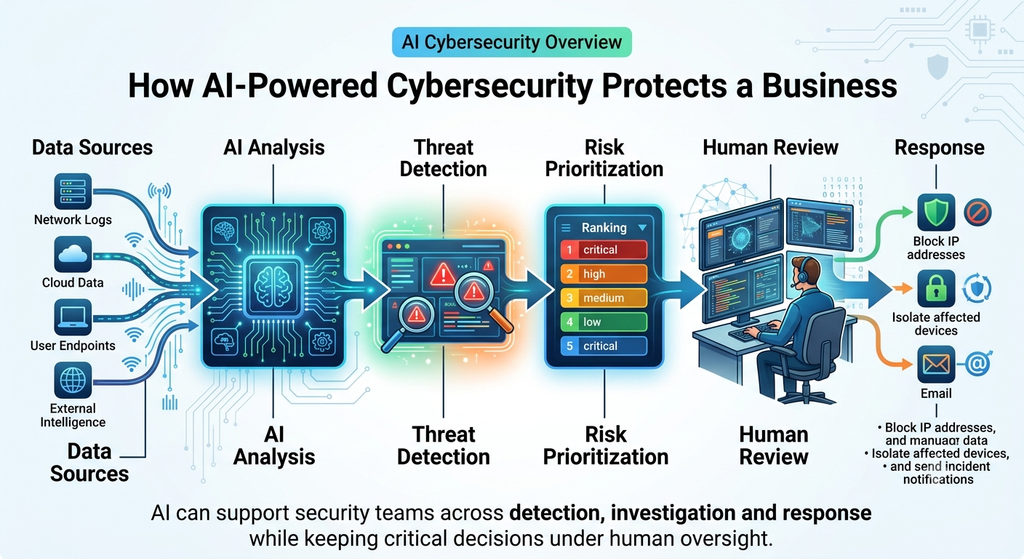
AI-powered cybersecurity uses artificial intelligence, machine learning, behavioral analytics and automation to identify, analyze, prioritize and respond to potential security threats.
Traditional security systems often rely heavily on predefined rules, signatures and manually configured alerts. AI-assisted security can analyze patterns across much larger datasets and identify behavior that may not match previously defined rules.
For example, an employee normally logging in from one location during business hours may suddenly access a sensitive database from an unfamiliar device at an unusual time.
AI-based behavioral analysis can flag that activity for investigation.
It does not automatically mean the account has been compromised. The security team still needs to investigate the context.
Traditional Cybersecurity vs AI-Assisted Cybersecurity
| Traditional Approach | AI-Assisted Approach |
|---|---|
| Rule-based detection | Behavioral and pattern analysis |
| Manual alert review | AI-assisted alert prioritization |
| Known threat signatures | Known and anomalous behavior |
| Manual correlation | Automated data correlation |
| Static detection rules | Adaptive analysis |
| Manual investigation | AI-assisted investigation |
| Human-led response | Human-controlled automation |
The most practical approach for many businesses is not replacing traditional security with AI. It is combining established security controls with AI-assisted detection, investigation and automation.
Why Are Indian Businesses Looking at AI Cybersecurity?
The cybersecurity environment is becoming more complex.
CERT-In data reported by the Government of India shows that tracked cybersecurity incidents increased from 13,91,457 in 2022 to 29,44,248 in 2025.
At the same time, businesses are managing more:
- Cloud applications
- SaaS platforms
- APIs
- Connected devices
- Remote access
- Customer data
- Digital payments
- Third-party integrations
- AI applications
Each additional system can create another security signal that needs to be monitored.
AI can help security teams process these signals at scale.
IBM’s 2026 India findings illustrate the potential gap. Only 32% of organizations surveyed reported extensive use of AI and security automation, while 36% reported limited use and another 32% reported no use.
That does not mean every business needs an AI security platform immediately. It means organizations should understand where AI can improve their existing security processes.
10 AI-Powered Cybersecurity Solutions for Businesses in 2027
1. AI-Powered Threat Detection
AI can analyze security events and identify patterns that may indicate malicious activity.
Instead of looking at individual events independently, AI-assisted systems can correlate signals from endpoints, networks, identities, applications and cloud environments.
For example:
- Multiple failed login attempts
- A successful login from an unusual location
- Access to sensitive files
- Suspicious process activity
- Unusual outbound network traffic
Individually, these events may not be conclusive.
Together, they may justify investigation.
Why it matters
AI-powered threat detection can help security teams focus attention on suspicious activity instead of manually reviewing every security event.
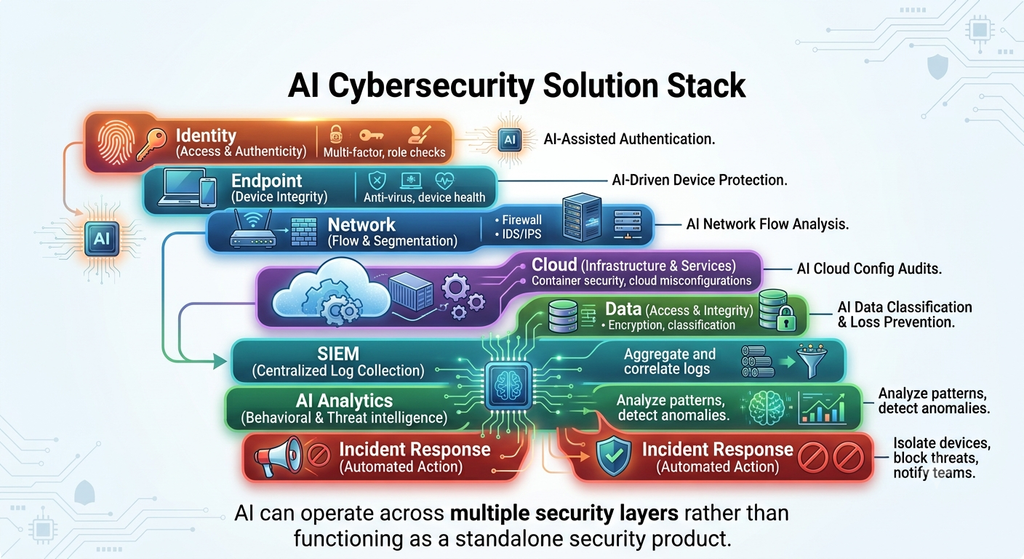
2. AI-Powered SIEM and Security Analytics
Security Information and Event Management platforms collect and analyze security logs from multiple systems.
AI can assist by:
- Correlating events
- Detecting unusual patterns
- Grouping related alerts
- Summarizing incidents
- Prioritizing potentially serious events
- Supporting investigation
This can be particularly useful for organizations managing large and complex IT environments.
The objective should not be to let AI automatically close every alert.
The objective is to help security teams determine which alerts require attention.
3. AI-Powered Phishing and Email Security
Phishing remains an important attack vector.
IBM’s 2026 India findings identified phishing, including voice and SMS phishing, as the most common initial attack vector in its study, accounting for 19% of breaches examined in India.
AI can analyze email and communication signals such as:
- Sender behavior
- Message content
- Suspicious links
- Domain characteristics
- Unusual communication patterns
- Impersonation indicators
AI can also assist with detecting social engineering patterns that traditional rule-based filters may miss.
However, employee awareness remains important because phishing attacks can involve increasingly convincing messages.
4. AI-Powered Endpoint Detection and Response
Endpoints include laptops, desktops, servers and other connected systems.
AI-assisted endpoint security can monitor behavior rather than relying only on known malware signatures.
Potential signals include:
- Unexpected process execution
- Suspicious command activity
- Abnormal file changes
- Unusual network connections
- Privilege escalation
- Rapid file modification
For example, if a process suddenly begins modifying a large number of files in an unusual pattern, the activity could trigger an investigation.
AI can help identify the pattern, while security policies determine the appropriate response.
5. AI-Powered Network Security
Networks generate enormous amounts of activity.
AI can analyze traffic patterns and identify anomalies such as:
- Unusual connections
- Unexpected traffic spikes
- Suspicious communication between systems
- Lateral movement indicators
- Abnormal outbound traffic
This can help security teams identify activity that may otherwise be difficult to spot manually.
For businesses with hybrid cloud infrastructure, network analytics can become particularly important because workloads may be distributed across multiple environments.
6. AI-Powered Identity and Access Security
Identity is increasingly central to cybersecurity.
An attacker does not always need to exploit a software vulnerability if they can obtain legitimate credentials.
AI can support identity security by analyzing:
- Login behavior
- Device information
- Geographic patterns
- Access frequency
- Privilege usage
- Authentication behavior
For example, an account accessing sensitive resources from an unfamiliar device immediately after a suspicious authentication event could receive a higher risk score.
Security teams can then investigate the activity and take appropriate action.
7. AI-Powered Ransomware Detection
Ransomware can cause serious operational disruption.
AI-assisted systems can look for behavioral indicators such as:
- Rapid file modifications
- Unusual encryption activity
- Suspicious process behavior
- Unexpected privilege changes
- Abnormal access to shared storage
The important distinction is that AI detection is not the same as guaranteed ransomware prevention.
Businesses still need:
- Tested backups
- Access controls
- Endpoint protection
- Network segmentation where appropriate
- Patch management
- Incident response plans
AI should strengthen these controls, not replace them.
8. AI-Powered Vulnerability Management
Organizations can have thousands of vulnerabilities across applications, operating systems, cloud infrastructure and third-party software.
The challenge is deciding which issues should receive attention first.
AI can assist vulnerability prioritization by considering factors such as:
- Vulnerability severity
- Asset importance
- Exposure
- Exploitability
- Business context
- Threat intelligence
This can help teams move beyond simply sorting vulnerabilities by severity.
A critical vulnerability on an isolated test system may require different treatment from a high-risk vulnerability affecting an internet-facing production application.
9. AI Security Copilots
Generative AI is also being applied to security operations.
An AI security copilot can help analysts:
- Summarize alerts
- Explain security events
- Query logs using natural language
- Draft incident reports
- Identify investigation steps
- Summarize threat intelligence
- Generate security documentation
NIST is actively examining practical ways AI can support cybersecurity framework analysis and reporting. Its 2026 draft guidance describes AI-assisted approaches for analyzing, planning, implementing and monitoring cybersecurity outcomes.
The important principle is human validation.
An AI-generated explanation should be treated as assistance, not unquestionable security evidence.
10. AI-Powered Incident Response
AI can support incident response by helping teams move from detection to investigation more efficiently.
A typical workflow could look like:
Detect → Analyze → Prioritize → Investigate → Contain → Recover → Review
AI can assist with alert correlation, incident summaries and recommended response steps.
Some response actions can potentially be automated when they are low risk and well tested.
High-impact decisions should generally include appropriate human approval.
How Does AI Detect Cyber Threats?
AI detects potential cyber threats by analyzing security data, identifying unusual behavior, recognizing known patterns and prioritizing activity that may indicate risk.
A simplified AI security workflow looks like this:
1. Collect
Security systems collect data from endpoints, applications, networks, identities, cloud infrastructure and other sources.
2. Analyze
AI models analyze the collected information for patterns, relationships and anomalies.
3. Detect
The system identifies activity that may indicate a security issue.
4. Prioritize
Potentially serious events can receive greater attention based on risk signals and context.
5. Investigate
Security analysts review the evidence and determine whether the event is legitimate or malicious.
6. Respond
Security teams can take appropriate containment or remediation actions.
7. Learn and Improve
Organizations can refine security rules, processes and models based on incidents and new threats.
This approach illustrates an important point: AI cybersecurity is not simply about detecting threats. It is about improving the entire security workflow.
How AI Can Help Detect Common Cyber Threats
| Cyber Threat | AI Capability | Potential Signal |
|---|---|---|
| Phishing | Content and behavior analysis | Suspicious message or link |
| Ransomware | Behavioral detection | Abnormal file activity |
| Account takeover | Identity analytics | Unusual login behavior |
| Malware | Process analysis | Suspicious execution |
| Insider risk | User behavior analytics | Abnormal data access |
| Data exfiltration | Traffic and data analysis | Unusual outbound activity |
| Lateral movement | Network behavior analysis | Unexpected internal connections |
| Vulnerability exploitation | Event correlation | Suspicious activity following exposure |
These capabilities vary between security platforms and implementations.
No AI model can guarantee detection of every cyberattack.


AI Cybersecurity Use Cases Across Industries
Financial Services
AI can support:
- Account security
- Fraud detection
- Identity analytics
- Transaction monitoring
- Threat detection
- Incident response
IBM reported the highest average breach cost among the Indian sectors covered in its 2026 research for financial services, at ₹40.9 crore.
Healthcare
Healthcare organizations can use AI-assisted security for:
- Access monitoring
- Endpoint protection
- Identity security
- Network monitoring
- Sensitive data protection
The objective is to strengthen security around systems that handle sensitive information.
Ecommerce
Ecommerce businesses can consider AI security for:
- Account takeover detection
- Payment-related fraud signals
- Bot activity
- API security
- Credential abuse
- Unusual customer activity
SaaS Businesses
SaaS organizations can use AI-assisted security across:
- Cloud infrastructure
- Identity
- APIs
- Application logs
- Customer environments
- Endpoint systems
Because SaaS platforms often integrate with multiple third-party systems, monitoring relationships between services can also be important.
Manufacturing
Connected manufacturing environments can require security across both IT and operational technology.
AI-assisted monitoring can help identify:
- Abnormal network behavior
- Suspicious device activity
- Unexpected access
- Communication anomalies
Implementation should account for operational safety and system availability.
AI Cybersecurity and Data Protection
AI security systems may process significant amounts of business and security data.
That makes governance important.
India’s Digital Personal Data Protection Rules, 2025 provide the implementation framework associated with the Digital Personal Data Protection Act. MeitY published the Rules in November 2025.
Businesses should consider:
- What data is collected
- Why it is processed
- Who can access it
- How long it is retained
- How security data is protected
- How AI systems use organizational information
- How access is monitored
- How incidents are handled
Organizations should also assess whether AI tools introduce additional privacy or data-sharing risks.
Cybersecurity and privacy should therefore be considered together.
Businesses should obtain professional legal or compliance advice for requirements specific to their activities.
What Does AI Cybersecurity Cost in 2027?
There is no single price for AI cybersecurity.
The cost depends on the organization’s size, infrastructure, security requirements and selected technologies.
Key factors include:
- Number of employees
- Number of endpoints
- Cloud infrastructure
- Security data volume
- SIEM requirements
- EDR or XDR requirements
- Identity infrastructure
- Number of integrations
- Managed security requirements
- Compliance requirements
- Incident response needs
A practical way to think about implementation is:
Basic AI-Assisted Security
Endpoint protection, identity monitoring and selected automated detection capabilities.
Mid-Level Security Automation
SIEM, endpoint detection, threat analytics and automated security workflows.
Enterprise Security Architecture
Integrated identity, endpoint, cloud, network, data, SIEM, incident response, governance and AI security capabilities.
Organizations should evaluate total security requirements rather than choosing a solution based only on its AI features.
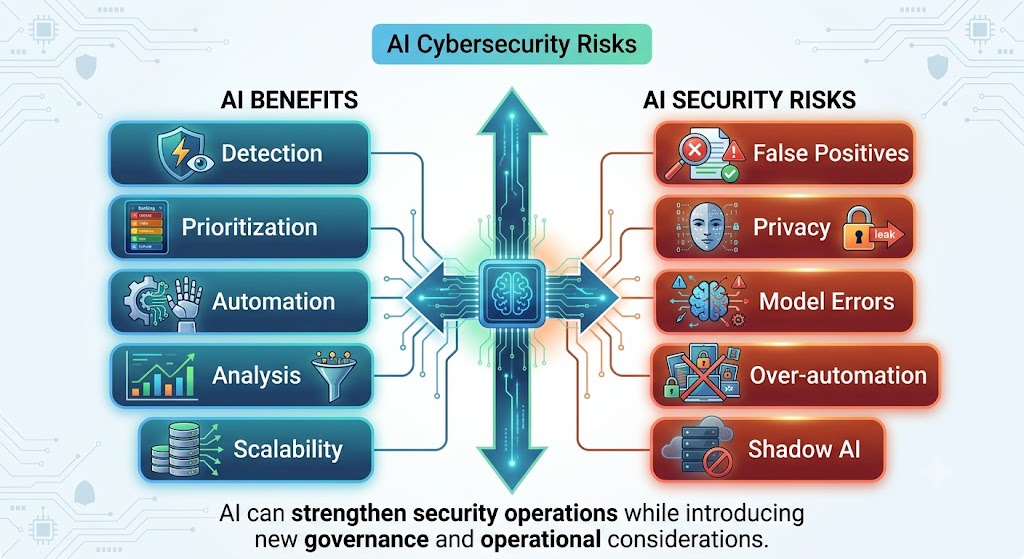
Benefits of AI-Powered Cybersecurity
When properly implemented, AI can support organizations in several ways.
Faster Security Analysis
AI can process large volumes of security information much faster than manual review.
Better Alert Prioritization
Security teams can focus on events that require investigation.
Continuous Monitoring
AI-assisted systems can analyze activity continuously.
Reduced Manual Work
Security analysts can spend less time on repetitive investigation tasks.
Behavioral Detection
AI can identify unusual behavior that may not match traditional signatures.
Faster Incident Investigation
AI can correlate information from multiple sources and summarize relevant evidence.
Security Scalability
AI can help organizations handle growing security data volumes without relying entirely on additional manual analysis.
IBM’s 2026 India findings reported lower average breach costs among organizations with extensive AI and security automation compared with organizations reporting no use, although these findings should be understood as an association from that study rather than a guarantee for every organization.
What Are the Risks and Limitations of AI Cybersecurity?
AI can improve cybersecurity, but it introduces its own challenges.
False Positives
AI may flag legitimate behavior as suspicious.
Too many false positives can create alert fatigue.
False Negatives
AI may also miss sophisticated or previously unseen activity.
No security technology should be treated as infallible.
Data Quality
Poor-quality security data can reduce the usefulness of AI analysis.
Model Risk
AI systems can produce incorrect or incomplete conclusions.
Privacy Concerns
Security data may contain sensitive information that requires appropriate protection.
Over-Automation
Automatically taking high-impact actions without adequate controls can create operational risks.
Adversarial Attacks
Attackers can also use AI and attempt to manipulate AI-based security systems.
Shadow AI
Employees may use unauthorized AI tools to process company information.
IBM’s 2026 India research found that shadow AI was associated with an average additional breach cost of ₹1.79 crore in cases where it was present.
The answer is not to avoid AI altogether.
It is to establish appropriate governance, visibility and security controls around its use.
How to Choose an AI Cybersecurity Solution
Before selecting a platform, businesses should ask practical questions.
1. What threats does it detect?
Understand the specific detection capabilities rather than choosing a platform because it uses the word “AI.”
2. Can it integrate with existing systems?
Check compatibility with:
- SIEM
- EDR/XDR
- IAM
- Cloud platforms
- Firewalls
- APIs
- Ticketing systems
3. Can security teams understand its decisions?
Security analysts should be able to investigate why an alert was generated.
4. What can it automate?
Determine which actions can happen automatically and which require approval.
5. How is security data handled?
Review data storage, access controls, retention and processing practices.
6. Does it support auditability?
Security teams should be able to review important actions and decisions.
7. Can it scale?
The platform should accommodate changing users, applications, infrastructure and data volumes.
8. What human oversight is available?
AI should support security professionals rather than remove accountability from critical decisions.
AI Cybersecurity Implementation Roadmap for Indian Businesses
Businesses do not need to deploy every AI security capability at once.
A phased approach can be more practical.
Step 1: Assess Your Current Security
Identify existing tools, vulnerabilities, security processes and major risks.
Step 2: Identify High-Risk Assets
Determine which applications, systems and data would create the greatest business impact if compromised.
Step 3: Define Security Objectives
Decide what you want AI to improve.
For example:
- Reduce alert volume
- Improve threat detection
- Accelerate investigation
- Improve identity monitoring
- Automate repetitive workflows
Step 4: Select Priority AI Use Cases
Start with use cases that address clear business problems.
Step 5: Integrate Security Data
Connect relevant sources so AI has sufficient context for analysis.
Step 6: Start With Human-in-the-Loop Automation
Use AI recommendations while allowing security professionals to validate important actions.
Step 7: Measure and Improve
Track metrics such as:
- Mean time to detect
- Mean time to respond
- Alert volume
- False-positive rate
- Critical vulnerabilities
- Incident response time
- Automation coverage
NIST’s Cybersecurity Framework 2.0 is designed to help organizations manage cybersecurity risk, and its 2026 AI-focused guidance explores how AI can support analysis and reporting against CSF outcomes.
AI Cybersecurity Best Practices for 2027
Businesses preparing for 2027 should consider the following practices:
- Keep humans involved in high-impact security decisions.
- Establish governance for employee use of AI tools.
- Monitor unauthorized or shadow AI applications.
- Protect APIs and cloud environments.
- Apply least-privilege access principles.
- Continuously monitor identity activity.
- Test automated security workflows before production deployment.
- Maintain reliable backup and recovery processes.
- Regularly test incident response plans.
- Train employees to recognize phishing and social engineering.
- Review AI security models and rules periodically.
- Measure security outcomes instead of AI adoption alone.
NIST’s emerging Cyber AI work frames the challenge around three areas: securing AI systems, using AI for cyber defense and addressing AI-enabled cyberattacks.
That is a useful way for businesses to think about AI security in 2027.
What Will AI Cybersecurity Look Like in 2027?
The 2027 cybersecurity environment is likely to involve AI on both sides of the security equation.
Attackers can use AI to automate parts of reconnaissance, social engineering and malicious activity.
Defenders can use AI for detection, analysis, prioritization and response.
Several areas deserve particular attention:
AI Security Copilots
Security analysts are likely to increasingly use natural-language interfaces to investigate alerts and security data.
AI Agent Security
Organizations adopting autonomous or semi-autonomous AI agents will need controls around permissions, data access, tool usage and actions.
Identity-Centric Security
As applications and AI agents gain access to business systems, identity and authorization become increasingly important.
Cloud and API Security
Growing numbers of APIs and cloud services create more activity for security teams to monitor.
Shadow AI Governance
Businesses will need visibility into how employees use external AI services and what organizational information is shared with them.
Security for AI Applications
Organizations will increasingly need to protect AI models, prompts, data pipelines, APIs and connected tools.
These are areas to prepare for, not guaranteed outcomes.
NIST’s Cyber AI Profile work similarly recognizes both the opportunity to use AI for cyber defense and the need to address cybersecurity risks created by AI systems themselves.
Frequently Asked Questions
What is AI-powered cybersecurity?
AI-powered cybersecurity uses artificial intelligence and machine learning to analyze security data, identify unusual behavior, prioritize potential threats and assist with security response. It can support traditional security controls but does not eliminate the need for cybersecurity professionals, governance or established security practices.
How does AI detect cyber threats?
AI detects potential threats by analyzing security events, identifying patterns and looking for behavior that differs from expected activity. It can combine signals from endpoints, networks, identities, applications and cloud environments to help security teams investigate suspicious activity.
Can AI prevent ransomware?
AI can help detect behavioral indicators associated with ransomware, such as unusual file activity or suspicious processes. However, AI cannot guarantee ransomware prevention. Businesses still need backups, endpoint security, access controls, patch management and tested incident response procedures.
Can AI detect phishing attacks?
AI can analyze email content, sender behavior, links, domains and other signals to identify potential phishing attempts. It can improve detection, but employees still need security awareness because attackers can create highly convincing messages.
Is AI cybersecurity suitable for small businesses?
AI-assisted cybersecurity can be useful for small businesses, particularly where internal security teams have limited resources. The appropriate solution depends on the organization’s systems, data, risk profile and budget. Smaller businesses may benefit from managed security services that combine technology with human monitoring.
How much does AI cybersecurity cost?
There is no universal price. Cost depends on factors such as endpoints, users, security data volume, integrations, cloud infrastructure, SIEM requirements, managed services and compliance needs. Businesses should compare total implementation and operating costs rather than evaluating AI features alone.
Can AI replace cybersecurity professionals?
AI can automate or assist with repetitive security tasks, but it does not eliminate the need for skilled security professionals. Human expertise remains important for investigation, risk decisions, governance, incident response and validating AI-generated recommendations.
What are the biggest risks of AI cybersecurity?
Key risks include false positives, false negatives, incorrect AI recommendations, privacy concerns, poor-quality data, over-automation, adversarial manipulation and unauthorized use of AI tools. These risks should be addressed through governance, testing, monitoring and human oversight.
How can Indian businesses start using AI for cybersecurity?
Start by assessing the existing security environment and identifying high-risk problems. Then select one or two practical use cases, such as alert prioritization, endpoint detection or phishing analysis. Integrate relevant data, keep humans involved in important decisions and measure the results before expanding.
Does AI cybersecurity help with compliance?
AI can support security monitoring, detection, logging and incident response processes that may contribute to an organization’s broader compliance program. However, AI adoption itself does not make an organization compliant. Applicable legal and regulatory requirements should be assessed separately.
What cybersecurity areas should businesses prioritize in 2027?
Organizations should consider identity security, endpoint protection, cloud and API security, AI application security, threat detection, incident response and governance for employee and business use of AI. Priorities should be based on the organization’s actual risk exposure rather than technology trends alone.
Final Takeaway
AI-powered cybersecurity is becoming an important part of the security conversation for Indian businesses.
The opportunity is not simply to add an AI tool to an existing security stack.
The bigger opportunity is to use AI where it can reduce repetitive analysis, identify suspicious patterns, prioritize security events and help teams respond more efficiently.
At the same time, businesses need to recognize the limits of AI.
AI can produce incorrect conclusions. Attackers can also use AI. Security data requires protection. And high-impact decisions still require appropriate human oversight.
For organizations preparing for 2027, the practical approach is to start with measurable security problems, select targeted AI use cases, integrate them with existing controls and continuously evaluate their effectiveness.
The goal should not be “more AI.” The goal should be better security outcomes with AI used where it provides meaningful value.
Ready to Strengthen Your Cybersecurity With AI?
Your business does not need to automate everything at once.
Start by identifying your security gaps, evaluating suitable AI use cases and building a practical roadmap for detection, monitoring and response.
Talk to an AI & Cybersecurity Expert

Pooja Upadhyay
Director Of People Operations & Client Relations
References
- IBM, Cost of a Data Breach Report 2026, India findings: IBM India: Cost of a Data Breach Report 2026
- Government of India, CERT-In cybersecurity incident statistics: Government of India: CERT-In Cybersecurity Incident Data
- Ministry of Electronics and Information Technology, Digital Personal Data Protection Rules 2025: MeitY: Digital Personal Data Protection Rules 2025
- NIST, Cybersecurity Framework 2.0 and AI-related guidance: NIST Cybersecurity Framework
