


The official updates for the security and compatibility of Drupal 7 ceased on January 5, 2025. By now, some organizations are still working on it.
According to W3Techs statistics from the end of August 2026, Drupal 7 is used on 29.6% of websites built on the platform. This is slightly less than Drupal 10, which stands at 30.6% of all sites.
This is no longer a question of the ability to use only an older version. Drupal 10 will also stop getting updates beginning December 9, 2026, while Drupal 12 is expected to be released the same week.
The most logical path for organizations still on Drupal 7 is to upgrade to Drupal 11, which is currently reliably supported and provides a clear path to a future upgrade to Drupal 12.
This guide aims to explain what the end of life means for your business, what transition from Drupal 7 to Drupal 11.
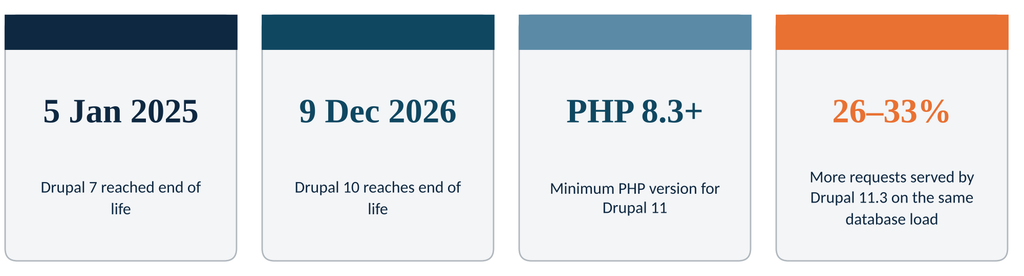
Sources: Drupal.org core release schedule; Drupal.org Drupal 11 requirements announcement; Heise report on Drupal 11.3.
Where Drupal 7 stands in late 2026
Drupal continues to be a widely used software. According to data from Wikipedia, Drupal accounts for about 14% of the top 10,000 websites in the world.
The concern is not whether Drupal is alive and well, but how many websites are still using outdated versions of the software that has been out of support for some time.
The last version of the software, Drupal 7, was released on January 5, 2011, and supported for 14 years.
After having been postponed several times, its end-of-life date was set for January 5, 2025. The table below shows a comparison of its life cycle with the life cycles of the newer versions of the software.
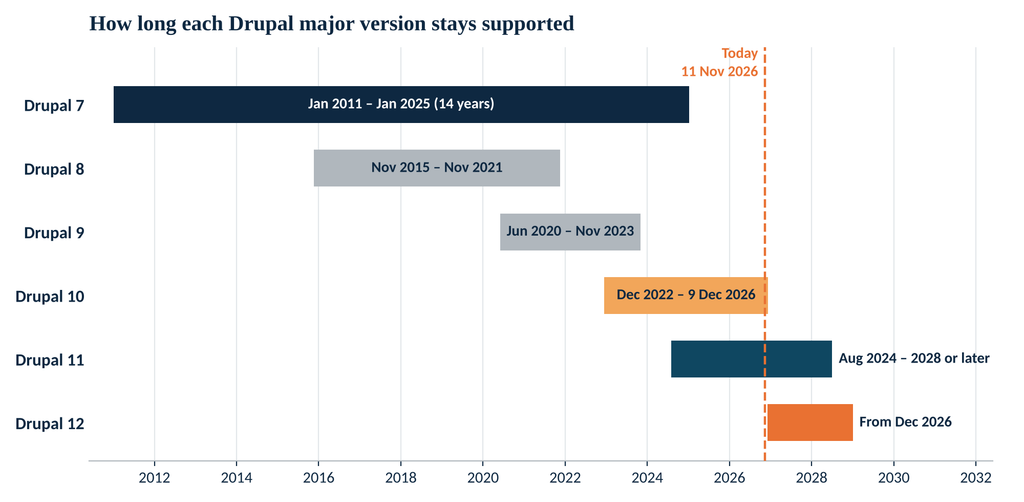
Source: Drupal.org core release schedule and Drupal 12 platform requirements announcement. Drupal 11 is supported until at least mid-to-late 2028; Drupal 12 dates are scheduled, not final.
Which versions are people still running?
Both datasets present different perceptions of Drupal adoption, thus, it is advisable to look at them side by side without merging them.
W3Techs outlines the technologies employed on public websites while Drupal.org keeps track of websites indicating their core version with the help of the Update Status module.

Source: W3Techs data dated 25 August 2026, as reported by TheDropTimes. “Drupal 6 and older” combines Drupal 6 (2%), Drupal 5 (0.1%) and Drupal 4 (under 0.1%).
Approximately 50.2% of the Drupal websites that W3Techs can detect are using outdated versions. Some Drupal 7 sites get paid extended security support from consulting companies, but it is worth noting that this does not mean that this version has been officially supported.
| Version | Share of detected sites | Status as of 11 November 2026 |
|---|---|---|
| Drupal 11 | 19.2% | Supported |
| Drupal 10 | 30.6% | Supported until 9 December 2026 |
| Drupal 9 | 10.0% | End of life since 1 November 2023 |
| Drupal 8 | 8.5% | End of life since 17 November 2021 |
| Drupal 7 | 29.6% | End of life since 5 January 2025 |
| Drupal 6 and older | About 2.1% | End of life (Drupal 6 ended 24 February 2016) |
What the Drupal.org counts add
According to this week’s report, 640,801 websites sent their Drupal core version to Drupal.org, with the following information about the different versions in use: 173,488 websites were powered by Drupal 7 while Drupal 11 was in use on 161,765 websites.
The report also stated that 42.8% of the sites surveyed were using versions that had already reached their end of life.
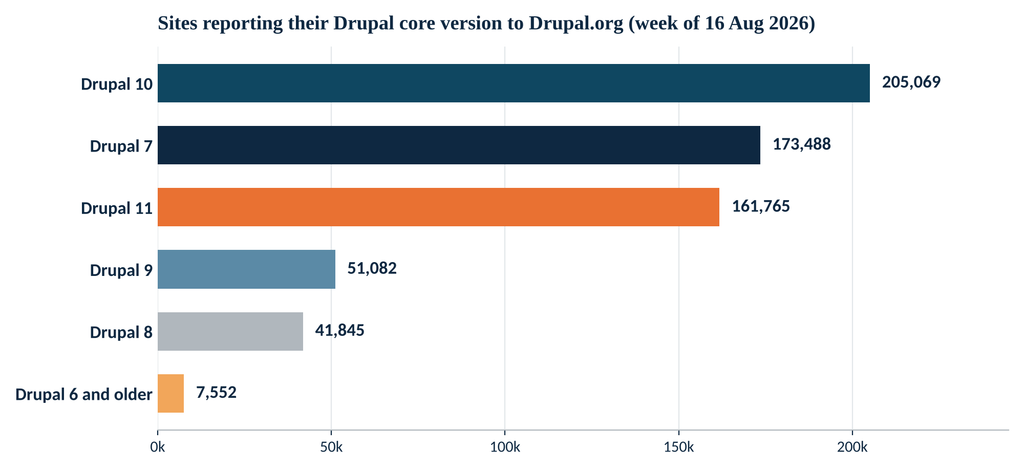
Source: Drupal.org usage statistics, as reported by TheDropTimes. “Drupal 6 and older” is derived: the reported end-of-life total (273,967) minus Drupal 7, 8 and 9.
The direction is right; the pace is slow
Although it is a gradual process, there is still progress made in these changes. From August 2025 until August 2026, there was an increase observed from 5.3% to 19.2% for the Drupal 11 software and there was a decrease in the number of websites using Drupal 7 – from 35.1% to 29.6%.
The total share of all the outdated versions decreased from 60.4% in August 2025 to 50.2% in August 2026. However, many websites still remain that will require upgrading.

Source: W3Techs historical series, as reported by TheDropTimes.
What end of life means for your business
A Drupal 7 website continues to operate; it does not stop working abruptly. Pages still open and the editors are able to log in. What is gone is the support: the official security fixes, compatibility updates and new releases will no longer be produced.
The main risks
- Security: A flaw in the core of Drupal 7 has been discovered and will no longer receive security updates from the Drupal Security Team. Drupal.org states quite plainly that unsupported sites are left open to security threats.
- Compliance: An unsupported version could pull a website out of alignment with FedRAMP, PCI, HIPAA, and SOC 2 standards, according to Drupal.org. This becomes especially relevant if you are processing payments or storing sensitive data.
- Compatibility: Added support for PHP 8.3 in Drupal 7.103 is expected to begin in December 2024. From there, you have reached the end of compatibility updates in Drupal, and the new PHP version and hosting have become your responsibility.
- Working towards Drupal 10: “The Drupal Association previously announced that its resources would now be targeting Drupal 10, Drupal 11, and beyond. Module maintainers and documentation writers tend to follow these natural rhythms.”
Your realistic options
There are three paths. Only one of them ends the problem.
| Option | What it means | Makes sense when | Trade-off |
|---|---|---|---|
| Extended security support | Paid security patches for Drupal 7 from a certified vendor. The Drupal Association’s programme lists HeroDevs and Tag1 Consulting. | A migration is funded but not finished and you need time. | Ongoing cost, and the site itself doesn’t move forward. |
| Migrate to Drupal 11 | Build a new Drupal 11 site and migrate content and configuration into it. | The site is a long-term business asset. | Real project effort up front. |
| Move to another CMS | Re-platform and migrate content to a different system. | Drupal’s flexibility is no longer needed. | Content still has to be migrated, and teams need retraining. |
Choosing your target: Drupal 11 now, Drupal 12 next
It hardly makes sense to upgrade to Drupal 10 because support lasts until 9 December 2026. Furthermore, Drupal 12 is set to appear during the week of 7 December and will require PHP 8.5.
On the other hand, Drupal 11 is expected to be supported until at least the middle to the end of 2028. Therefore, for any business moving away from Drupal 7 now, the reasonable choice is Drupal 11.
There is yet another reason that speaks in favor of starting with Drupal 11. As The Drop Times specify in their Drupal 12 upgrade guide, the next major upgrade requires Drupal 11.3 or latter. Thus, by migrating to Drupal 11 now, you will keep your website on track for future releases.
Platform requirements at a glance
| Requirement | Drupal 11 | Drupal 12 (scheduled week of 7 Dec 2026) |
|---|---|---|
| Release | 2 August 2024 | Week of 7 December 2026 |
| PHP | 8.3 | 8.5 |
| MySQL | 8.0 | 8.0 |
| MariaDB | 10.6 | 10.11 |
| PostgreSQL | 16 | 18 |
| SQLite | 3.45 | 3.45 |
| Composer | 2.7.0 or newer | Latest secure release (2.9.3 recommended) |
| Web server | Apache 2.4.7+ or nginx 1.1+ | Unchanged |
What actually changes between Drupal 7 and Drupal 11
Transitioning from Drupal 7 to 11 is a migration rather than a standard upgrade. The shift from Drupal 7 to 8 transformed how content and configurations are stored. As a result, Drupal encourages clients to create an entirely new site and then migrate their data into it.
Despite this, the official migration process allows moving directly from Drupal 6 or 7 to Drupal 10 or higher without installing intermediate versions.
What carries over, and what gets rebuilt
| Area | What happens | Effort |
|---|---|---|
| Content (nodes, users, taxonomy terms) | Migrated with the Migrate and Migrate Drupal modules in Drupal core. | Mostly automated |
| Configuration (content types, fields, user roles) | Migrated the same way. | Mostly automated |
| Drupal 7 core modules | Core provides an upgrade path for every module that shipped in Drupal 7 core. | Mostly automated |
| Contributed modules | Not all have automatic upgrade paths. Some need a custom migration or a replacement. | Case by case |
| Views | Some need to be rebuilt by hand. | Case by case |
| Custom modules | Rewritten against Drupal 11’s object-oriented APIs. | Manual |
| Theme | Can’t be migrated. Rebuilt using Twig templates. | Manual |
According to Drupal’s documentation, it might be faster to manually rebuild a smaller site that has little content and less customised than it would take to set up migration tools. However, bigger or more complicated sites could gain from the Migrate API and Drush.


What you get in return
The argument for migration is easier to put forward if one concentrates on business improvements rather than the mere version number.
Speed
Among the benefits, performance is one of the more measurable arguments. Upon launch, it was stated that Drupal 11 is up to 50% faster with PHP 8.3.
Furthermore, the introduction of Drupal 11.3 resulted in a lot of upgrades, for the Drupal Association called that a decennial breakthrough in performance.
| Reported gain | Release | Reported by |
|---|---|---|
| Up to 50% faster on PHP 8.3 | Drupal 11.0 | Drupal 11 launch announcement |
| 26–33% more requests processed on the same database load | Drupal 11.3 | Drupal Association, via Heise |
| About 31% fewer SQL queries on cold caches; nearly 50% fewer on partly warmed caches | 11.3 compared with 11.2 | ImageX analysis, via TheDropTimes |
These are vendor and community benchmarks, not a guarantee for your site. Your results will vary based on hosting, caching and how much custom code executes on each request.
Easier editing and site building
- Drupal Canvas is a page builder that provides live previewing options and follows a drag and drop model. It was released in December 2025 and has now become the editing interface to use in Drupal CMS 2.0.
- Recipes are packaged configurations used to activate a feature in one click. They emerged together with Drupal 11.
- Project Browser is a feature that performs searching for modules and themes in the admin area.
- Navigation modules are now stable on Drupal 11.3 and used to be Toolbar.
- AI features in Drupal CMS: pages are being generated by prompts, alt-texts for images are suggested, and some tasks are performed by human agents.
Easier maintenance and a clearer runway
- Support runway: Drupal 11 will continue to be supported at least until mid- and late-2028.
- Regular release schedule: Small updates are published on a semi-annual basis. For instance, 11.4 was launched in the week of 29 June 2026, while 11.5 is already rolling out in Drupal 12 by December. Core security releases take place on the third Wednesday of the month although this may not necessarily happen on every such occasion.
- Contemporary stack: supported by PHP 8.3 or higher, Symfony based core architecture, HTMX is in the core since 11.3, Single Directory Components pack together Twig, CSS and JavaScript of a particular component into one directory.
- Reach: The materials that showcase Drupal emphasize its suitability and support for over 100 languages.
- Community: The creation of core Drupal 11 was implemented by 1,858 individuals from 590 companies.
How to plan the migration
The transition from Drupal 7 to Drupal 11 requires rebuilding the website and relocating its content. An explicit sequence is essential, and not just rushing through stages. Most projects observe the six steps indicated below, although it is possible for some jobs to occur simultaneously.
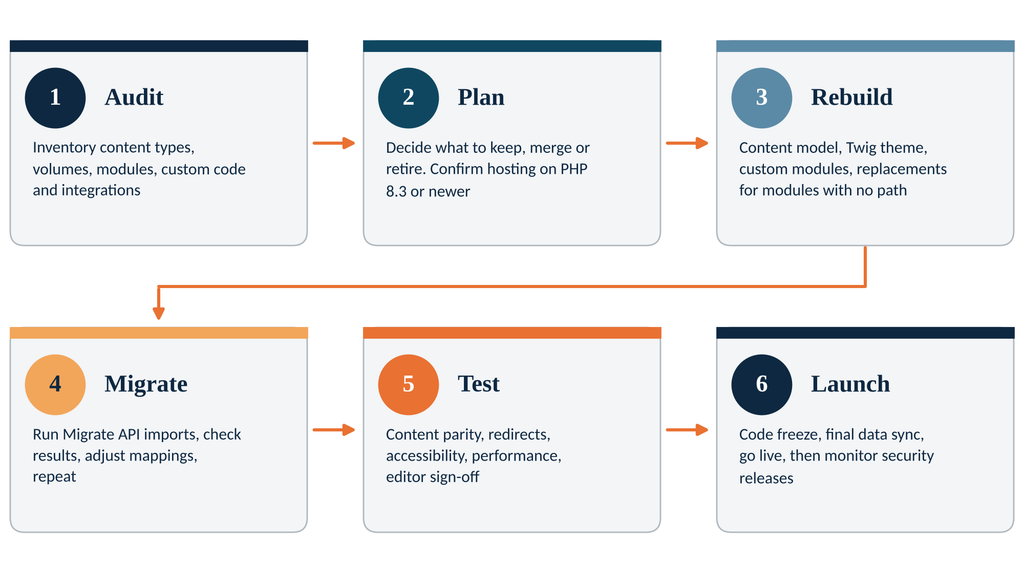
A typical sequence for a Drupal 7 to Drupal 11 migration.
The six phases in detail
1. Audit what you have
- Make a list of various types of content, fields, and content.
- Identify each contributed module that has a corresponding Drupal 11 version. This is where the Upgrade Status modules come in handy.
- Check the custom modules, themes and integrations (including CRM, payments, search, and analytics).
- Keep in mind the number of multisite instances, database size, and the current version of PHP.
2. Plan scope and hosting
- Determine what is worth migrating, merging or retiring. Old content that nobody reads would be more cost effective to archive than to migrate.
- Make sure hosting runs PHP 8.3 or later and has an up-to-date database.
- Before migrating, upgrade your Drupal 7 core and contributed modules to their most recent versions to reduce the number of compatibility surprises.
- Set the redirect list now, not in the final week of the competition.
3. Rebuild the foundation
- Generate various types of content, media items, menus, and forms in Drupal 11.
- Reconstruct the theme using the Twig templating engine and convert custom modules to the new APIs.
- Substitute the modules that lack the route for updating.
- Stay away from the obsolete APIs in the newly developed code, allowing for a seamless transition to the next version of Drupal.
4. Migrate the data
Employ the Migrate API to transport your content and configurations, as well as create custom migration plugins to migrate custom entities.
With the help of Drush commands like migrate:status and migrate:import, users can supervise and manage the migration process. Conduct tests on a replica website and adjust mappings until the migrated data is correctly represented.
5. Test like a user and like an auditor
- Uniformity of content is produced as a result of inspections and calculation of numbers.
- Redirecting of URLs is an essential and crucial aspect of search engine ranking.
- Payment, integration as well as form.
- Check the accessibility performance of the website based on the best user roles and permissions.
- A tour of the admin experience for the users by the members of the team who will be using it on a daily basis.
6. Launch and stay current
Prior to launch, make sure that changes are put on hold and that Drupal 7 data synchronization has been accomplished.
As soon as the website is put live, implement a process that can guarantee basic security updates. Security update for Drupal core releases are usually on the third Wednesday of every month, so it is important for your team to be ready for the task.
What drives cost and timeline
| Factor | Why it matters |
|---|---|
| Content volume and structure | More content types, fields and relationships mean more mapping and more validation. |
| Number of contributed modules | Each needs a Drupal 11 equivalent, a custom migration or a replacement. |
| Custom code | Custom modules are rewritten for Drupal 11, not converted. |
| Theme and design | Themes are rebuilt in Twig. A design refresh adds scope on top. |
| Multisite setups and database size | Both appear among the factors Acquia lists for Drupal upgrades. |
| Integrations | CRM, payment, search and sign-in connections each need testing. |
| Hosting and PHP version | Moving to PHP 8.3 or newer can mean infrastructure changes. |
No specific price is capable of accurately estimating every move. A straightforward brochure site and a large multisite site with many custom codes will require considerably different budgets. The best approach in preparing a realistic estimate is through an audit.
Mistakes worth avoiding
- Treating it as an upgrade: There is no straight path. Factor in a rebuild plus migration costs.
- Migrating without checking: Old pages and useless content come with the territory, if no one has made other arrangements.
- Putting off URL mapping until the end: URL mapping should be integrated into the planning and testing phases, NOT left until the last week.
- Waiting for Drupal 12: It is due for release in the week of December 7, 2026, and requires PHP 8.5. Building on Drupal 11 now means that you won’t be using Drupal 7 for too long, and Drupal 12 supports Drupal 11.3 and beyond.
- Skipping training for editors: The Drupal 11 experience is different from the one provided by Drupal 7, and the editors will notice this as soon as they start working.
- Allowing extended support to last indefinitely: It should only be used as a way of delaying migration.
Frequently asked questions
Can we go from Drupal 7 straight to Drupal 11?
Yes. Drupal’s official guide covers upgrading from Drupal 6 or 7 to Drupal 10 or later through migration. You build a new site and move content and configuration into it.
Is Drupal 7 safe with extended support?
Safer than running it unsupported, but not a long-term plan. Certified vendors provide security fixes, while the site stays on an older platform and keeps its older constraints.
Should we choose Drupal 11 or wait for Drupal 12?
Choose Drupal 11. Drupal 12 isn’t out yet, it requires PHP 8.5, and moving from Drupal 11 to Drupal 12 later is the normal major-version path.
How long will Drupal 11 be supported?
At least until mid-to-late 2028, according to Drupal.org’s platform requirements announcement for Drupal 12.
Will our current theme carry over?
No, Drupal’s documentation says themes can’t be migrated and must be rebuilt for Drupal 10 and later. Treat the theme as a build task.
Do we need to migrate all of our content?
Not necessarily. Auditing first lets you archive or drop content that no longer earns its place, which usually shortens the project.
The bottom line
While Drupal 7 installation may still be operative, the inherent risks of employing an unsupported platform are increasing.
Given that it has now been nearly two years since its end-of-life and that the end-of-support date for Drupal 10 is December 2026, there is no reason to delay starting planning.
Managing this migration is easier when approached as a carefully planned project instead of a hurried software update.
The next version, Drupal 11, offers a supported environment and is expected to remain current until at least 2028.
The project starts with an audit to gather the necessary information to proceed with the agreements on the project scope, timelines, and budget.
Ready to Move Your Website from Drupal 7 to Drupal 11?

Pooja Upadhyay
Director Of People Operations & Client Relations
Sources
https://www.drupal.org/node/3375636
https://www.drupal.org/blog/drupal-11-released
https://drupal.org/upgrade/migrate
https://www.drupal.org/docs/upgrading-drupal/upgrading-from-drupal-6-or-drupal-7/overview
https://drupal.org/requirements/php
https://en.wikipedia.org/wiki/Drupal
https://www.thedroptimes.com/72977/drupal-12-upgrade-guide-requirements-removed-modules
https://www.thedroptimes.com/node/66711
https://www.thedroptimes.com/41977/drupal-11-available-now
