


Introduction
There was a time when choosing a CMS was mostly a website decision.
You picked a platform, built your pages, added your content, connected a few plugins, and published. The CMS was the center of gravity because the website was the center of the digital experience.
That world has changed.
Today, a single piece of content might need to appear on a corporate website, mobile application, customer portal, commerce platform, search experience, digital display, or AI-powered assistant.
Behind those experiences sit CRMs, analytics platforms, identity systems, marketing automation tools, commerce engines, and increasingly, AI services.
The CMS now has a different job.
It needs to help these systems understand, manage, govern, and distribute content consistently.
This is where Drupal’s evolution becomes particularly interesting. Rather than thinking of Drupal only as a system for managing webpages, organizations are increasingly using its structured content, APIs, workflows, permissions, and integrations as part of a broader digital experience architecture.
Drupal isn’t simply moving beyond pages. It’s moving toward orchestration.
1. Drupal Is No Longer Just a Content Repository
The traditional CMS model was straightforward:
Create content → publish content → display content
For many organizations, that model still works perfectly well.
But consider a global organization managing hundreds of products across multiple markets. The same product information may need to appear on its website, mobile application, sales portal, product finder, search engine, and marketing campaigns.
Creating separate versions for every channel quickly creates a maintenance problem.
This is where structured content changes the conversation.
Instead of treating content as something that belongs to a particular webpage, Drupal can treat it as reusable information with defined relationships, fields, permissions, and workflows.
A product isn’t simply a page.
It can have:
- Product name
- Description
- Images
- Specifications
- Categories
- Regions
- Related products
- Availability
- Supporting documents
That information can then be consumed by different digital experiences.

Traditional model
Content → CMS → Website
Modern model
Structured Content → Drupal → APIs → Multiple Digital Experiences
The important distinction isn’t that Drupal suddenly does everything.
It doesn’t.
The value is that Drupal can become the organized middle layer connecting the things that do.
2. What Makes Drupal an Orchestration Layer?
Calling a CMS an “orchestration layer” sounds impressive. But what does it actually mean?
In Drupal’s case, the answer comes down to several capabilities that have become increasingly important as digital ecosystems become more complicated.
Structured content
Drupal’s content modeling capabilities allow organizations to define different types of information and the relationships between them.
That’s particularly useful when content has a life beyond one webpage.
A university, for example, may need to connect a degree program to courses, faculty members, campuses, application requirements, and related research. Those relationships can become part of the content model instead of being manually recreated across pages.
APIs and decoupled delivery
Drupal can expose structured content to external applications through APIs, allowing presentation and content management to evolve independently.
A frontend can change without necessarily forcing the organization to rebuild its entire content foundation.
Workflows and governance
Enterprise content rarely goes directly from an author’s keyboard to the public internet.
It may require review, legal approval, translation, regional approval, scheduling, or compliance checks.
Drupal’s permissions and editorial workflows help organizations manage that complexity.
Integrations
Modern digital experiences rarely live inside one platform.
Drupal can integrate with external systems for commerce, search, identity, CRM, analytics, marketing automation, and other services.
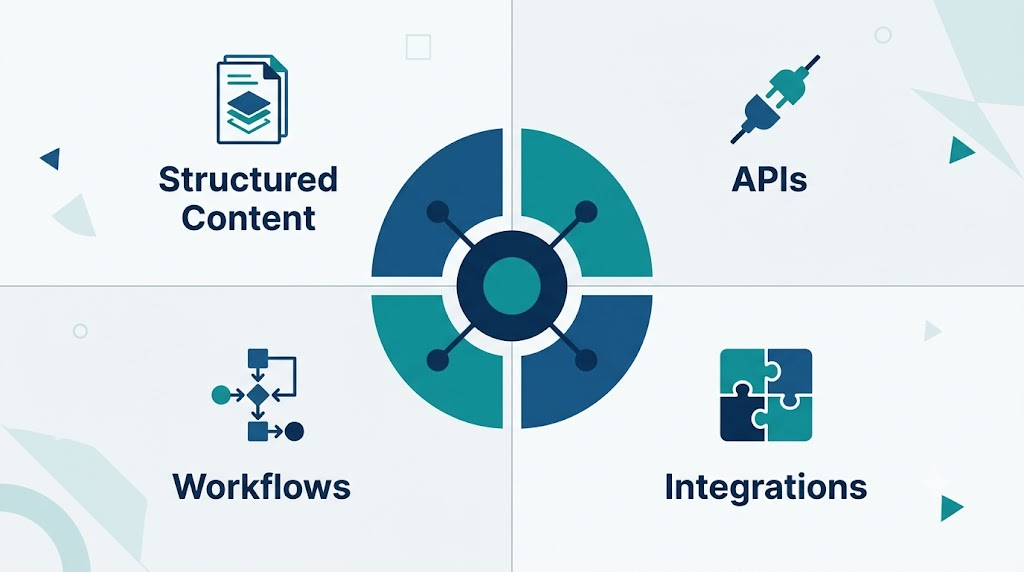
The common thread is simple:
Drupal can manage the context around content, not just the content itself.
That distinction becomes increasingly valuable as the number of digital touchpoints grows.
3. From Monolithic CMS to Composable Architecture
The phrase “composable architecture” has become popular for a reason.
Businesses no longer want every digital capability locked inside one enormous platform.
They want specialized systems that can do specific jobs well.
A commerce platform can handle transactions.
A CRM can manage customer relationships.
A search platform can specialize in discovery.
An identity provider can manage authentication.
An analytics platform can measure behavior.
And Drupal can manage structured content, editorial workflows, governance, and the business context surrounding that content.
Instead of asking one platform to do everything, organizations can connect these capabilities.

There is an important caveat here.
Using Drupal does not automatically create a composable architecture.
A Drupal implementation can still become tightly coupled if it is designed that way.
The real advantage comes from making deliberate architectural decisions about what Drupal should own, what other systems should own, and how those systems communicate.
That is architecture work, not a checkbox in the CMS settings.


4. APIs Are Changing What a CMS Can Be
APIs aren’t particularly glamorous.
Nobody puts “REST endpoint” on a conference banner and expects a standing ovation.
But APIs are one of the reasons the role of the CMS is changing so dramatically.
They allow content to travel.
Imagine a manufacturer launches a new product.
The marketing team creates the product content in Drupal. After the content goes through its editorial workflow, that information can be made available to other systems.
The same structured product data could feed:
Drupal → API → Website
Drupal → API → Mobile App
Drupal → API → Customer Portal
Drupal → API → Search
Drupal → API → AI Experience
The team doesn’t have to manually recreate the same information five times.
Drupal’s JSON:API module provides standardized ways for applications to interact with Drupal’s content entities.
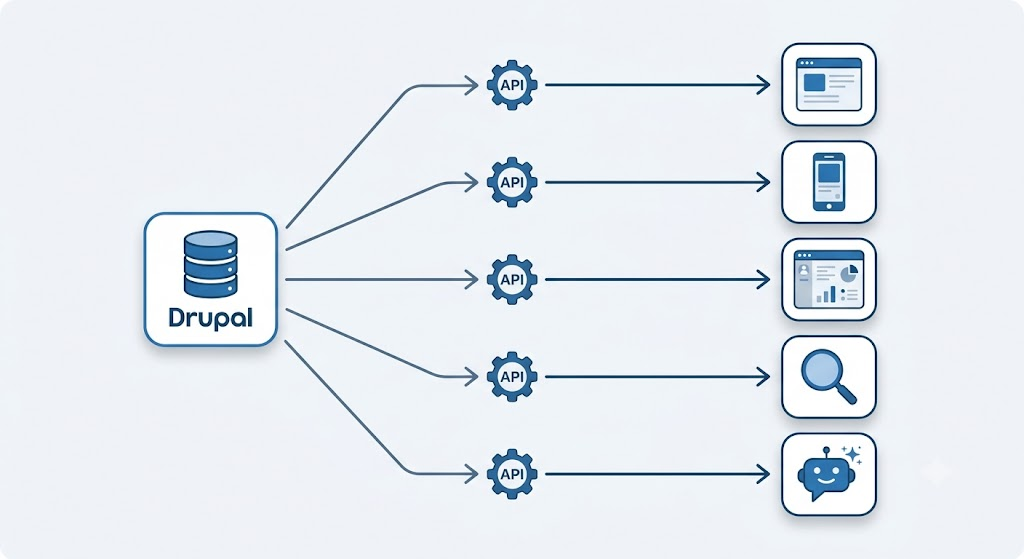
This separation also creates another advantage: future flexibility.
If an organization replaces its frontend framework three years from now, it doesn’t necessarily have to throw away the content architecture that supports it.
The presentation layer can change while the content foundation remains.
That is one of the strongest arguments for thinking about Drupal as infrastructure rather than simply a webpage editor.
5. Drupal’s Role in the AI-Driven Experience
AI introduces an interesting twist to the CMS conversation.
A large language model can generate an answer. But it still needs access to reliable information if that answer is going to be useful to a customer, employee, student, or citizen.
Consider a customer asking:
“Which of your products are available in California, and what warranty applies to them?”
AI needs more than general language knowledge.
It needs current product information, regional availability, warranty policies, potentially customer permissions, and other business context.
That information may come from several systems.
Drupal can be part of that information layer by maintaining structured, governed content that can be exposed to AI-powered experiences through APIs and integrations.
This leads to an important shift in thinking:
AI doesn’t make structured content less important. It makes reliable structured content more valuable.
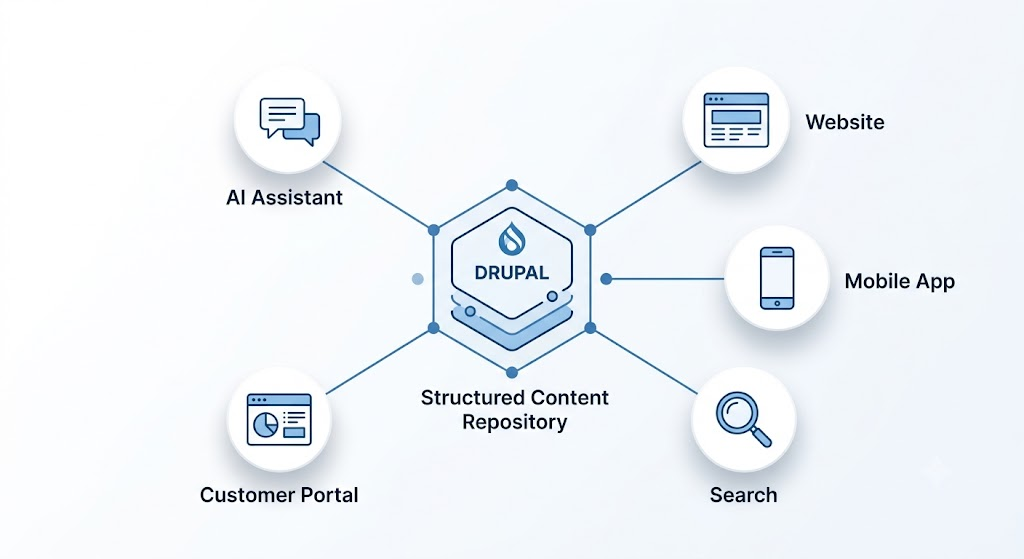
There is also a governance angle.
AI systems need to know more than what information exists. In many enterprise environments, they also need to know whether information is approved, current, regional, restricted, or appropriate for a particular audience.
That makes the CMS’s traditional strengths, content governance and structured information, surprisingly relevant to the AI era.
6. Where This Architecture Actually Makes Sense
Not every business needs a sophisticated orchestration architecture.
If your organization has a five-page website and one content editor, there is probably no reason to build a digital spaceship.
The value becomes clearer when the organization has content complexity, multiple audiences, multiple channels, or multiple backend systems.
Higher Education
Universities manage enormous networks of connected information.
A degree program can connect to courses, departments, faculty, campuses, admissions requirements, tuition information, research, and student resources.
Drupal’s structured content and editorial workflows can help turn those relationships into reusable digital information rather than disconnected pages.
Government
Government organizations have another challenge: governance.
Content may need multiple levels of approval while remaining accessible, multilingual, secure, and easy for citizens to find.
Drupal’s granular permissions, workflows, structured content, and extensibility make it a strong fit for these environments.
Enterprise Commerce
Commerce organizations often need to separate content management from transaction management.
Drupal can manage rich product storytelling, editorial content, campaign experiences, regional information, and structured product data while specialized commerce systems handle checkout, payments, inventory, and orders.
That division of responsibilities can make the architecture easier to evolve.
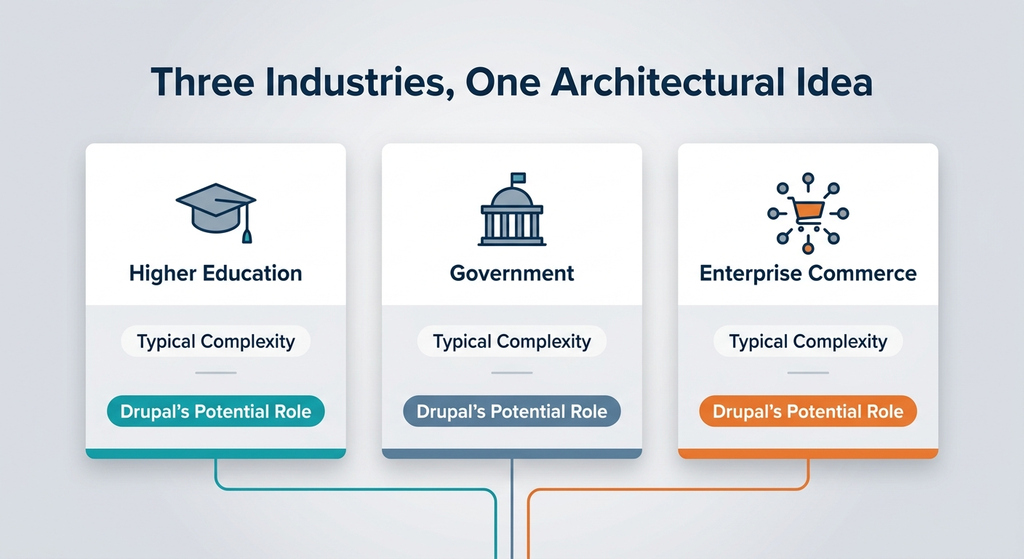
The industries are different.
The architectural challenge is remarkably similar:
Lots of information. Lots of relationships. Lots of places where that information needs to go.
7. What Businesses Should Do Next
The temptation when discussing modern Drupal is to jump straight into technology.
“Should we go headless?”
“Should we use Next.js?”
“Should we rebuild the frontend?”
Those questions matter, but they shouldn’t be the starting point.
Start with the business architecture.
Ask these five questions:
1. How many digital experiences consume our content?
If content goes to a website, app, portal, marketplace, and internal platform, a page-centric approach may already be limiting you.
2. Where are we duplicating information?
If three teams maintain three versions of the same product, service, or policy information, that’s an architectural smell.
3. What should Drupal actually own?
Content? Workflows? Permissions? Business rules? Personalization?
Define the boundaries.
4. Which capabilities should remain specialized?
Commerce, identity, analytics, search, and payment processing may be better handled by dedicated platforms.
5. Can we change one part without rebuilding everything?
This may be the most important question of all.
Technology will keep changing.
Today’s frontend framework won’t necessarily be tomorrow’s. Today’s AI service may look very different in three years.
A resilient architecture allows those components to change without forcing the entire digital platform back onto the drawing board.
Conclusion: The Future of Drupal Is Bigger Than the CMS
Drupal’s evolution isn’t really about becoming a CMS with more features.
It’s about the role a CMS plays in the first place.
Digital experiences are becoming increasingly fragmented across websites, applications, portals, commerce platforms, AI interfaces, and emerging channels. The customer doesn’t care which system owns which piece of the experience.
They simply expect everything to work together.
That puts more pressure on the architecture sitting underneath the experience.
Drupal is well positioned for that conversation because its strengths, structured content, governance, workflows, APIs, permissions, and extensibility, are not limited to rendering webpages.
The smarter question is no longer:
“Can Drupal power our website?”
It’s:
“What role can Drupal play in the digital ecosystem we’re building?”
For some organizations, the answer will still be a traditional CMS.
For others, Drupal can become something considerably more strategic: a structured content and business-context layer connecting specialized technologies into one coherent digital experience.
At AddWeb Solutions, we approach Drupal modernization from that architectural perspective. The objective isn’t to add technology for the sake of adding technology. It’s to build a digital foundation that can evolve as your channels, customers, and technology landscape change.
Because the best digital architecture isn’t the one with the most components.
It’s the one where the right components know how to work together.
Build a Future-Ready Drupal Architecture

Pooja Upadhyay
Director Of People Operations & Client Relations
Sources URLs:
https://www.drupal.org/about/announcements/drupal-cms-1-0-0-is-here
https://www.drupal.org/docs/core-modules-and-themes/core-modules/jsonapi-module
https://www.drupal.org/case-study
https://www.drupal.org/government
