


“Virtual and hybrid volunteering opportunities improve access for those who may not be able to volunteer otherwise… These volunteers are more likely to belong to organizations and donate to charity compared to in‑person volunteers.”
Introduction
Community-building used to start at the front desk, the church hall, or the town square. Today, it often starts on a homepage. Someone hears about your cause, lands on your website, scrolls for a minute, and makes a quiet decision: “Is this for me… or not?” That moment is where visitors either bounce – or become volunteers, donors, and long-term advocates.
Between September 2022 and September 2023, 28.3% of Americans aged 16+ formally volunteered, and almost 1 in 5 of those volunteers served partly or fully online, according to the U.S. Census Bureau and AmeriCorps Civic Engagement and Volunteering supplement. At the same time, nonprofit websites now average around 12,708 visitors per month – yet still see bounce rates of 60–70%, meaning most people leave after one page.
If your website is still treated as a digital brochure instead of a mobilization engine, you’re leaving a lot of potential community energy on the table. Let’s fix that.
Why Your Website Is the New Volunteer Welcome Desk
For many supporters, your website is the first human interaction with your organization – even if no human is technically involved yet. It’s where people silently ask:
- Do I trust these people?
- Can I see myself here?
- Is it easy to take a first step?
Digital behavior backs this up. Research from NPTech for Good shows nonprofits average 12,708 website visitors per month, with 44% of visits coming from organic (unpaid) search – people actively looking for information, causes, or ways to act. If your “Get Involved” or “Volunteer” pathways are unclear, slow, or buried, you’re wasting high‑intent traffic.
Volunteer behavior is shifting online as well. The Civic Engagement and Volunteering supplement (AmeriCorps + U.S. Census) found that 18% of formal volunteers now serve partially or fully online, representing more than 13.4 million people contributing over 1.2 billion service hours, valued at roughly 41.5 billion USD in 2023. This isn’t a niche side-channel anymore; your website is central to how those people decide where and how to help.
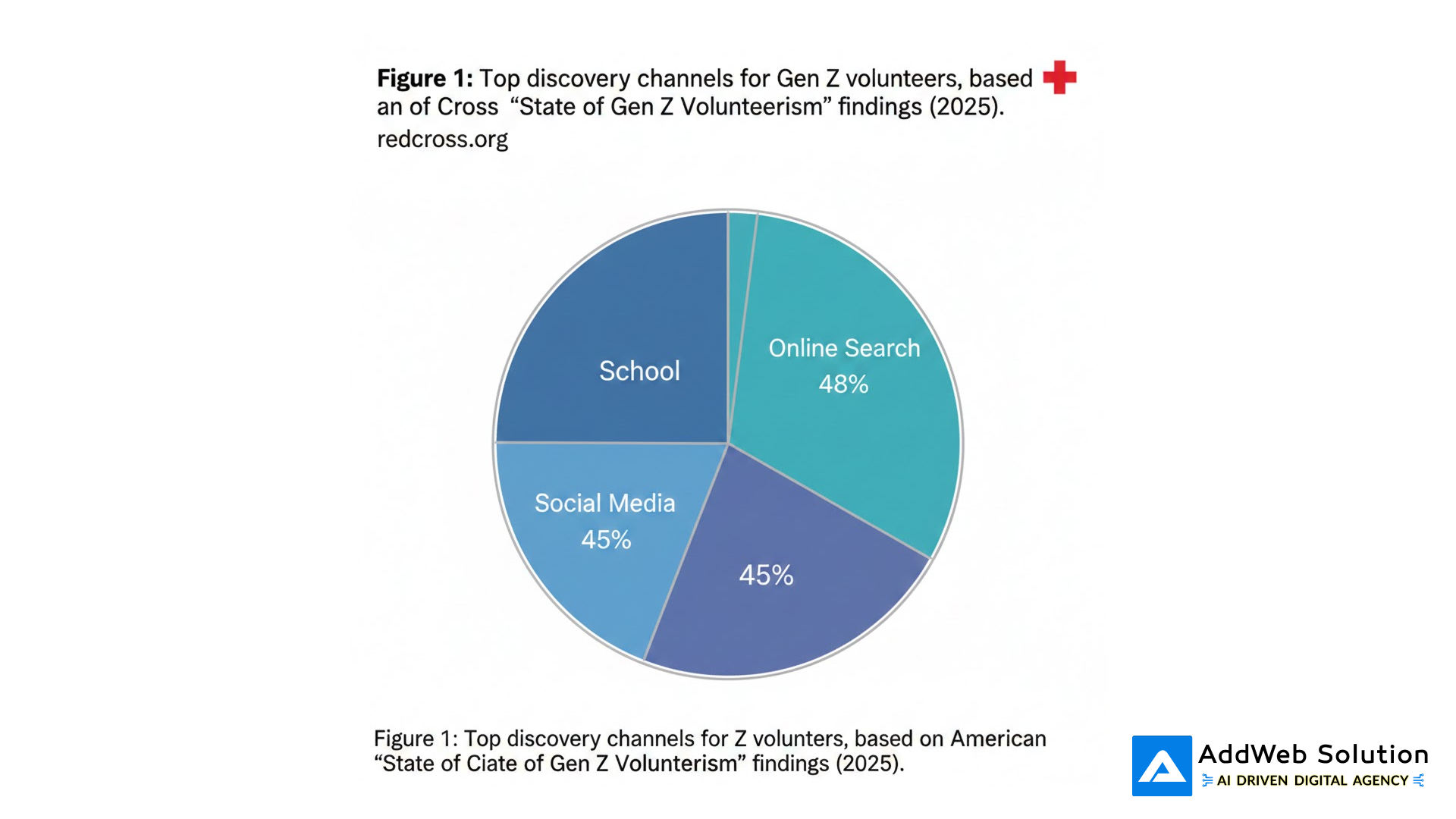
Gen Z is pushing this shift even further. A 2025 American Red Cross study on Gen Z volunteerism found that nearly 60% of young respondents discovered volunteering opportunities at school, 48% through online search, and 45% via social media. In other words: your cause gets evaluated on Google and Instagram long before anyone fills out a form.
Turning Clicks into Commitments: UX and Content That Move People
A “nice” website is not the goal. A mobilizing website is. When AddWeb works with nonprofits and community organizations, the shift usually comes from aligning three layers:
- Clarity of pathways (what you want people to do)
- Emotional resonance (why it matters, to them)
- Frictionless execution (how easy it is to act now)
Let’s ground that in what the data is telling us and how to translate it into practical design choices.


What’s Going Wrong on Many Nonprofit Sites
Morweb and NPTech for Good both highlight a persistent issue: nonprofits tend to have 60–70% bounce rates, where the majority of visitors leave after one page – far above the “healthy” benchmark of 40% or below. Add to that the fact that 25% of users abandon a site that takes more than four seconds to load, and you can see why “pretty but heavy” sites often fail.
At the same time, around 52–53% of nonprofit site traffic now comes from mobile devices. A beautiful desktop hero image doesn’t help if your volunteer form is a pain to complete on a small screen.
Designing the Journey: From Visitor Types to Volunteer Pathways
Below is a simple way to think about the types of visitors you’re serving and how your website should respond.
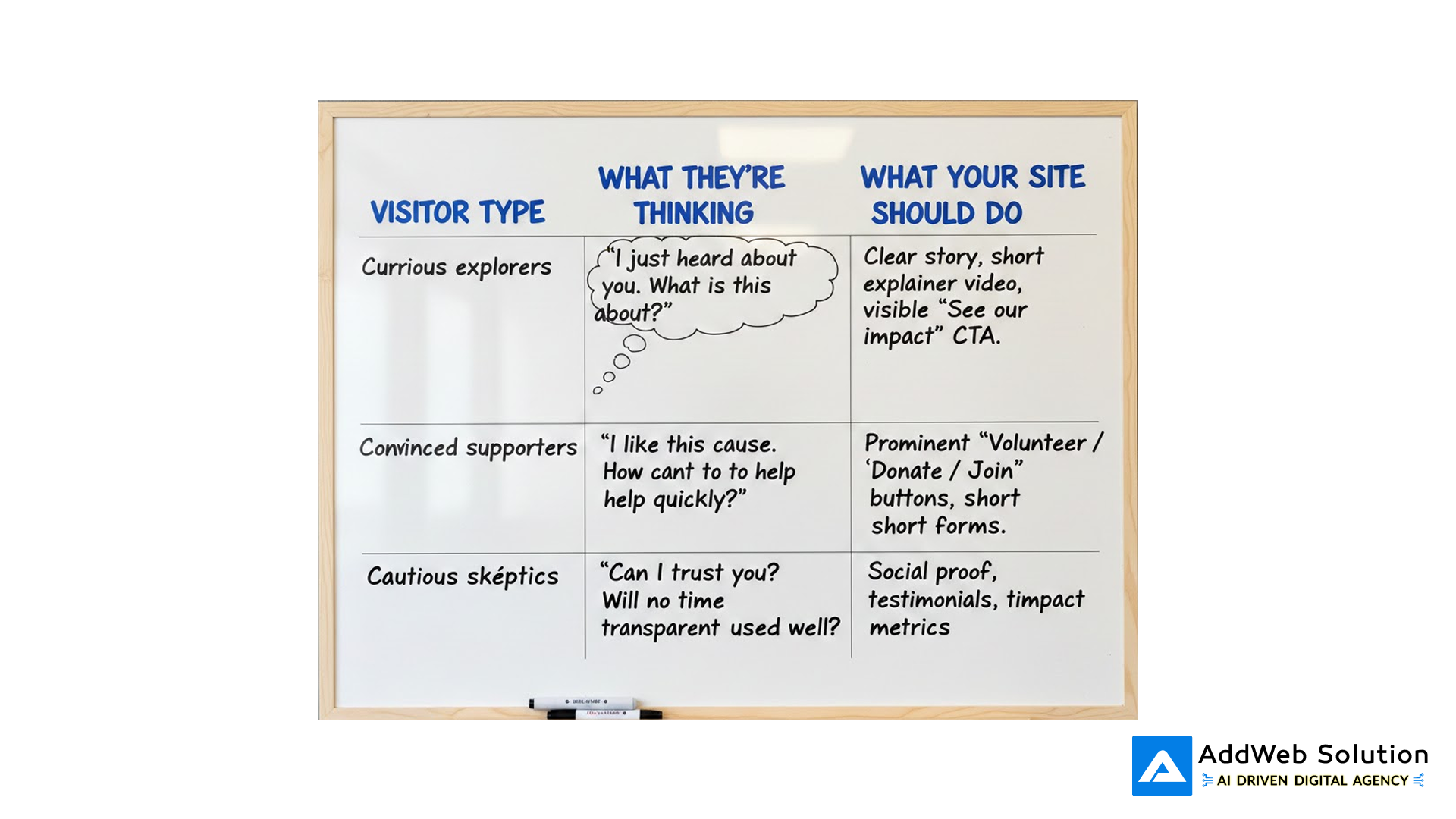
In practice, this translates to:
- Single, obvious primary CTA per page
“Volunteer with us”, “Join a community clean‑up”, or “Mentor a student” should dominate the page more than vague buttons like “Learn more”. - Micro‑commitments instead of big leaps
Not everyone is ready to commit to a weekly shift. Offer lighter starts:- “Register for an info session”
- “Sign up for a one‑time event”
- “Download a starter guide to volunteering in your city”
- Story‑driven impact, not just statistics
Yes, numbers matter. But pairing “1,200 volunteers” with “Here’s Ananya, who started as a weekend mentor and now leads our youth council” builds emotional permission to take that first step.
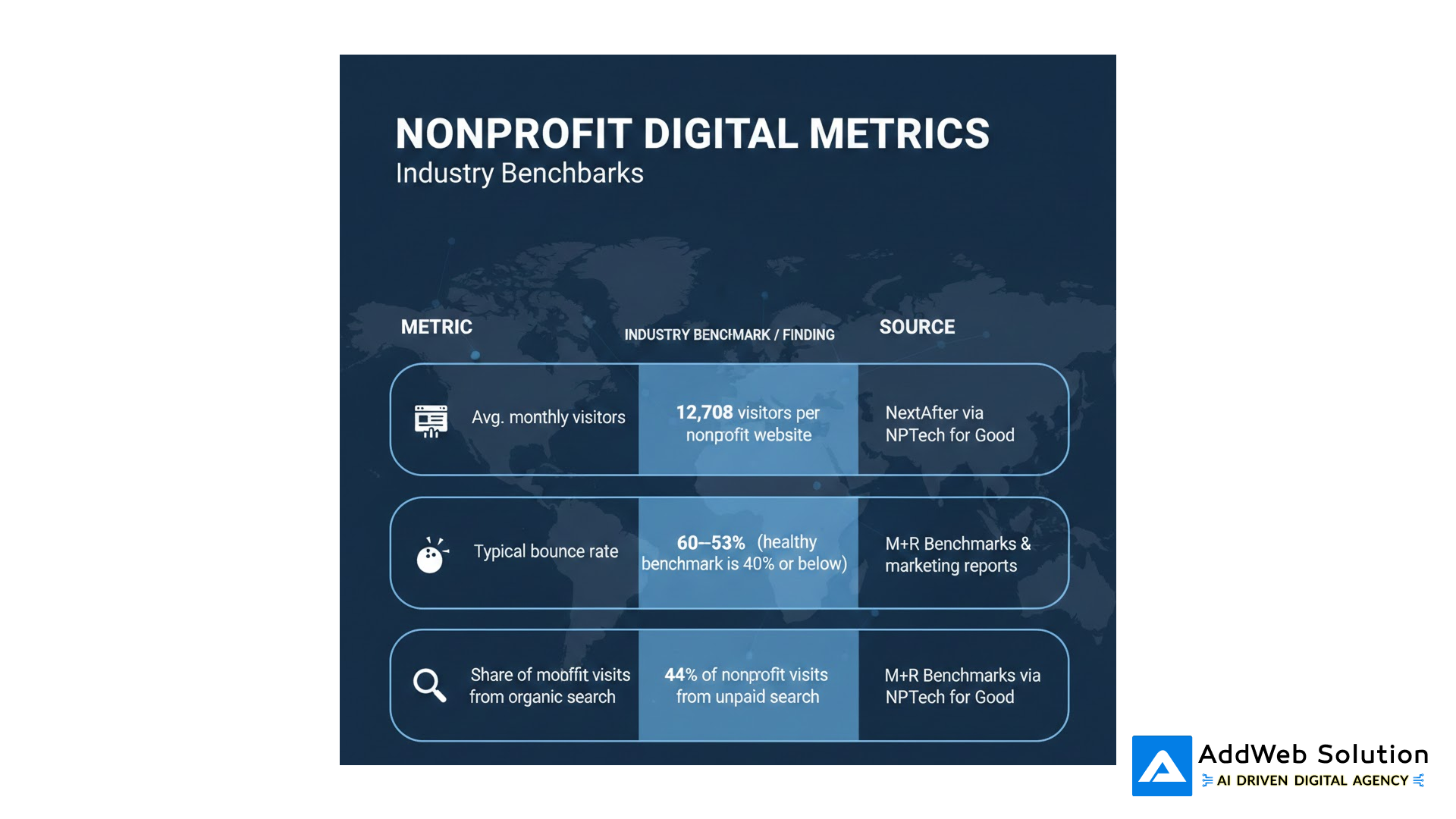
Looking at this table, a mobilization‑ready website focuses on three things immediately:
- Reducing bounce with clear navigation and fast load times.
- Respecting mobile users with short, thumb‑friendly forms and tap targets.
- Meeting search intent by matching high‑traffic keywords (“volunteer in [city]”, “[cause] near me”) with targeted landing pages and straightforward calls to act.
Reading the Data: What the Numbers Say About Digital Engagement
Let’s shift from “what good looks like” to how people are actually engaging in 2024–2025 – and what that implies for your website strategy.
Channels That Drive Action (Not Just Awareness)
The 2025 Nonprofit Communications Trends Report, cited by Activate Good, found that nonprofits rate several channels as especially effective for engagement and recruitment:
- 80% say email is somewhat or very effective for recruiting volunteers.
- 73% highlight in‑person events.
- 71% say their organization website plays a significant role.
This is where strategy matters:
- Email and social media push people toward something.
- Your website is where they decide and act.
When visitors follow an email, QR code, or Instagram link to your site and land on a generic homepage, the momentum dies. When they land on a page that continues the story and ends in a specific, low‑friction action, conversions rise.
The Rise of Virtual and Hybrid Volunteering
Remember the AmeriCorps finding that 18% of formal volunteers now serve partially or fully online, representing 13.4 million people in 2023? A University of Maine brief on virtual volunteering reinforces that these volunteers tend to log more hours per year (95 hours vs. 64 for in‑person volunteers) and contribute significant economic value.census+1
That shift has clear website implications:
- Your volunteer page shouldn’t only list physical roles. Create a distinct section for virtual / hybrid opportunities (e.g., mentoring via video calls, digital advocacy, design or content support, remote admin help).
- Application and onboarding workflows need to work end‑to‑end online: discovery → interest → application form → automated confirmation → onboarding resources.
- Impact stories should include remote and hybrid roles, so people understand that volunteering doesn’t always mean “show up every Saturday at 9 AM”.
3.3 How Younger Volunteers Actually Find and Evaluate You
The Red Cross Gen Z volunteerism study shows that online search (48%) and social media (45%) are nearly as important as school (about 60%) as discovery channels for young people.
Combine that with social media data from NPTech for Good:
- 96% of nonprofits have a Facebook Page,
- 73% use Instagram,
- and social media, especially Facebook and Instagram, significantly influences giving behavior.
The pattern is clear:
- Discover via search or social.
- Click through to the website.
- Decide whether to engage, subscribe, volunteer, or donate.
If your landing experience doesn’t feel cohesive – same visual identity, same tone, same level of energy – you lose trust quickly.
Conclusion
Turning visitors into volunteers isn’t about tricking people with clever CTAs. It’s about removing friction between intent and action. The data is on your side: people are already looking for ways to help, already searching, already clicking through from social media and email. The question is whether your website catches that momentum or lets it dissipate.
A mobilization‑ready website typically does four things well:
- Makes the first step obvious. Every key page has a clear, prominent, human‑sounding CTA (“Host a neighborhood meal”, “Join our next clean‑up”, “Mentor a teen for 2 hours/month”).
- Shows real humans and real impact. Photos, short videos, and stories that mirror the visitor (“People like me volunteer here, and it matters.”).
- Supports different levels of commitment. From one‑time micro‑actions to recurring shifts and digital roles, mapped to simple forms and automated follow‑ups.
- Keeps listening to the data. Tracking where volunteers come from, which pages they convert on, and where they drop off – and continuously tweaking copy, layout, and flows.
If you’re at the “we just need a new site” stage, it’s worth pausing and asking a different question:
“What would this website look like if its primary job was to turn interested strangers into active community members?”
That’s the kind of question the AddWeb Solution team loves to unpack with nonprofits, social enterprises, and community organizations. From UX audits and analytics‑driven redesigns to building volunteer portals and integrating CRM and email automation, the goal is always the same: turn digital traffic into real‑world impact.
If your current site feels more like a static leaflet than a living volunteer engine, this is the moment to rethink it – before your next wave of potential volunteers quietly drifts to the “back” button.
Empower your NGO with digital transformation strategies for 2026 success

Pooja Upadhyay
Director Of People Operations & Client Relations
Source URLs
- https://umaine.edu/news/blog/2024/12/09/more-volunteers-are-logging-in-online-study-finds/
- https://www.redcross.org/content/dam/redcross/red-cross-youth/news/GenZ_Volunteerism_Study_ARC_X_DSS.pdf
- https://www.census.gov/library/stories/2024/11/civic-engagement-and-volunteerism.html
- https://www.volunteeringaustralia.org/wp-content/uploads/Volunteering-Australia-Key-Volunteering-Statistics-2024-Update.pdf
- https://en.wikipedia.org/wiki/Virtual_volunteering
- https://teamstage.io/volunteering-statistics/
- https://volunteerhub.com/blog/40-volunteer-statistics/
