


Node.js is emerging as the core component of digital ecosystems within enterprises due to its combination of scalable, event-driven architecture along with a uniform JavaScript/TypeScript stack that makes it suitable for API-first, microservices, and real-time architectures.
Node.js has become the preferred technology for critical backend services as more businesses modernize their platform architectures with cloud-native and composable architecture approaches.
The Enterprise Shift Toward Node.js
Node.js is no longer an experimental framework used by companies around the edges of their technology stacks but is now fully embedded into core systems.
The latest industry publications indicate that 48.7% of developers in the world actively use Node.js, making it one of the most popular backend runtimes.
According to surveys, more than 40% of large corporations deploy Node.js for at least one critical business application, with Node.js adoption increasing over 25% since 2023.
Moreover, Node.js has become popular in large organizations, where the Linux Foundation and corresponding market analyses indicate that 80-90% of Fortune 500 companies include Node.js in their tech stacks.
This change in the trend is not only a matter of choice but also a matter of architecture, as today’s digital ecosystems were designed to integrate well with Node.js.
What Do We Mean by “Digital Ecosystem”?
In a business environment, a digital ecosystem refers to the complex web of applications used by customers, portals accessed by partners, internal applications, data solutions, and automation systems which combine together to create value. Digital ecosystems are usually:
- API‑first: Every capability is exposed as a service or API, internally and externally.
- Distributed: Multiple systems across clouds, on‑prem, and edge devices coordinate in real time.
- Composable: Business teams assemble capabilities from reusable services and micro‑frontends.
Node.js fits this model because it was designed for networked, I/O‑heavy workloads and integrates naturally with modern API, event, and messaging patterns.
The Technical Backbone: Event‑Driven, Non‑Blocking Architecture
The underlying framework in Node.js is based on a single-threaded model of event-driven programming and non-blocking I/O.
This means that instead of creating threads for each request that the server gets, the event loop within the Node.js server is capable of handling thousands of connections at once without much resource utilization.
This model has several concrete benefits for enterprises:
- High concurrency with low infrastructure footprint: Node.js can serve large numbers of simultaneous users without needing a proportional increase in server instances.
- Faster response times: Benchmarks and case studies show up to 30–35% faster response times compared to traditional synchronous environments like legacy Java or PHP stacks.
- Efficient resource usage: Non‑blocking I/O overlaps business logic and network calls, reducing memory consumption and CPU context switches.
For digital ecosystems that must support real‑time dashboards, streaming data, or chat‑like interactions across many touchpoints, this architecture becomes a strategic advantage.
Unified Language Across the Stack
One of the most underrated reasons Node.js becomes the backbone in enterprises is language consolidation. With Node.js, teams can use JavaScript or TypeScript across:
- Frontend (web, mobile web, SPA frameworks).
- Backend (APIs, microservices, BFFs).
- Infrastructure scripts, CLIs, and automation.
Industry studies show that 85% of developers using Node.js rely on it primarily for web application development, and roughly 43% explicitly use it for enterprise applications.
TypeScript adoption in Node.js professional environments has also crossed 70% in recent years, making the stack safer and more maintainable for complex enterprise codebases.
Practically, this means:
- Easier hiring and onboarding: One language, many roles.
- Shared libraries and patterns across teams: Fewer duplicated solutions.
- Faster experimentation: Frontend and backend engineers can collaborate without a steep learning curve.
Ecosystem Depth: npm and Cloud‑Native Alignment
Node.js ships with access to npm, one of the largest package ecosystems in the world, covering everything from observability and logging to AI integrations and payment gateways. For enterprise digital ecosystems, this unlocks:
- Ready‑made connectors to SaaS platforms (CRM, ERP, marketing clouds, payment providers).
- Mature frameworks for API development, microservices, and real‑time apps (Express, Fastify, NestJS, Socket.io).
- DevOps‑friendly tooling that works well in containerized and serverless environments (Node.js with Docker, Kubernetes, AWS Lambda, Azure Functions).
Surveys show strong usage of Node.js with containers and microservices; for example, around 45–60% of developers in some reports use Node.js with Docker to deploy microservices and API gateways.
This deep alignment with cloud‑native patterns makes Node.js a natural backbone for distributed digital ecosystems.
Productivity and Time‑to‑Market Gains
Digital transformation leaders rarely adopt technology just because it’s trendy, they adopt it because it moves the needle on productivity and time‑to‑market. Multiple studies highlight significant productivity gains from Node.js:
- IDC and other reports have measured developer productivity improvements of around 60–68% when teams move to Node.js for server‑side development, thanks to reduced context switching and abundant tooling.
- Enterprises report that using Node.js allows them to serve the same traffic with fewer servers, cutting infrastructure costs by up to 30–58% in some cases.
Because Node.js supports rapid prototyping and incremental rollout, teams can ship MVPs quickly, validate business hypotheses, and evolve services without rewriting entire stacks.
For digital ecosystems that constantly grow – new partner integrations, new channels, new automation flows – this agility is crucial.
Where Node.js Shows Up in Enterprise Ecosystems
Node.js tends to “take over” certain parts of the ecosystem first, then spread. Common backbone roles include:
- API Layer & API Gateways
Enterprises increasingly use Node.js to build REST and GraphQL APIs, as well as API gateways that route, authenticate, and transform requests. Studies suggest more than 50% of enterprise APIs are now built or maintained with Node.js. - Microservices & BFFs (Backend‑for‑Frontend)
Node.js excels at small, single‑purpose services that respond quickly and scale horizontally. Over 60% of enterprises in certain surveys use Node.js specifically for microservices or API gateway workloads. - Real‑Time Experience Layer
Streaming dashboards, alerts, collaborative tools, and in‑app messaging often rely on Node.js and WebSocket‑based frameworks to deliver low‑latency experiences. - Serverless Functions & Automation
Node.js is one of the most common runtimes in serverless platforms, powering background jobs, ETL tasks, and event‑driven integrations.
In practice, once Node.js anchors the API and experience layers, it becomes the “glue” connecting legacy systems, modern data platforms, and external SaaS.


Visual Snapshot: Enterprise Node.js Adoption
Below is a visual representation of how dominant Node.js has become across enterprises, based on aggregated industry data that report around 80% of enterprises using Node.js somewhere in their stack.

This view reinforces that Node.js is no longer a niche choice; it’s a mainstream backbone technology that most digital‑ready organizations rely on alongside Java, .NET, and Python.
Visual: Node.js Across Key Workloads
Node.js isn’t just widely adopted, it’s especially strong in specific workload categories critical to digital ecosystems, such as APIs, real‑time applications, and microservices.
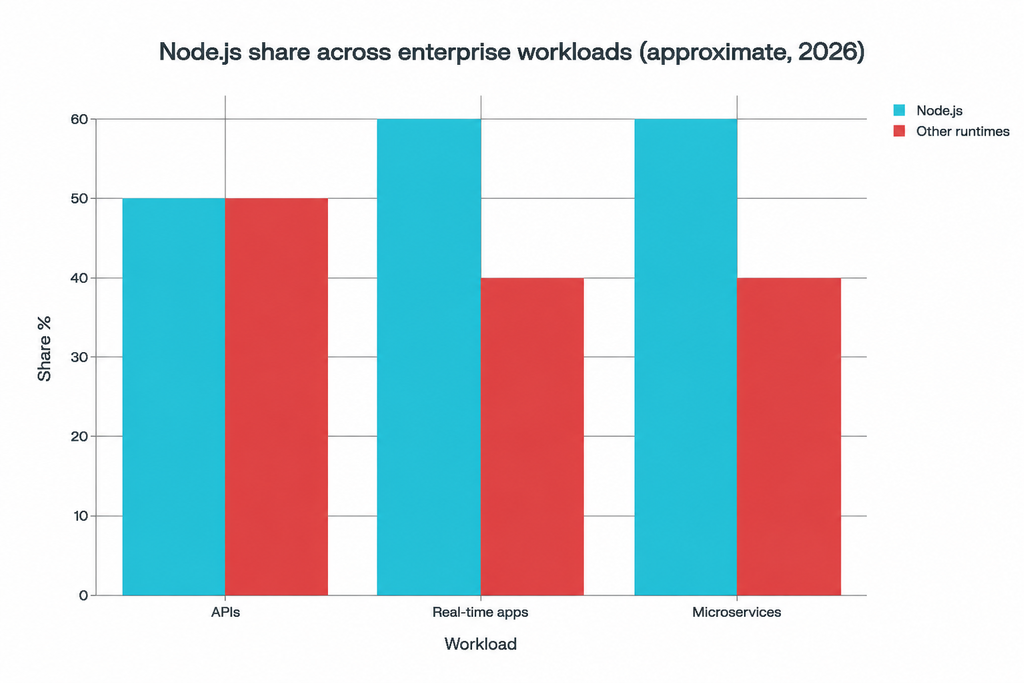
Industry statistics show Node.js holding a large share of API development, with more than 50% of enterprise APIs using it, and over 60% of enterprises leveraging it for microservices or API gateway roles.
Real‑time web apps (chat, notifications, live dashboards) are also typically built on Node.js due to its event‑driven model and WebSocket ecosystem.
Table: Node.js vs Traditional Enterprise Backends
To see why Node.js is becoming the backbone, it helps to compare it against traditional synchronous stacks often found in legacy enterprise environments.
| Dimension | Traditional Synchronous Stack (e.g., legacy Java/PHP) | Node.js‑Centric Digital Ecosystem |
| Concurrency model | Thread‑per‑request; higher memory usage and context switching. | Single‑threaded event loop with non‑blocking I/O; handles thousands of connections efficiently. |
| Performance under load | Degrades as active sessions grow; scaling requires more heavyweight instances. | Maintains low latency under high load; scaling via lightweight horizontal instances or containers. |
| Language fragmentation | Different languages across frontend, backend, scripts; more silos. | Unified JavaScript/TypeScript across frontend, backend, and tooling. |
| Ecosystem and packages | Strong but often specialized; less overlap with JS tooling. | Massive npm ecosystem for APIs, real‑time, DevOps, AI integrations, and SaaS connectors. |
| Cloud‑native fit | Works, but often requires more adaptation for containers and serverless. | Widely used with Docker, Kubernetes, and serverless; many runtimes optimized for Node.js first. |
| Developer productivity | Good, but hindered by multi‑language stacks and slower feedback cycles. | Reported productivity gains of 60–68% and faster iteration cycles. |
| Cost and resource efficiency | Higher server counts and resource overhead for peak loads. | Lower infrastructure footprint; some organizations report 30–58% cost reductions. |
| Real‑time capabilities | Possible but often more complex to implement at scale. | First‑class support for WebSockets and event streaming; ideal for real‑time experiences. |
Human Impact: How Teams Experience Node.js
From a human perspective, Node.js changes how teams work day to day:
- Developers feel more confident moving between frontend, backend, and automation tasks because they’re using the same language and often the same libraries.
- Architects and CTOs find it easier to standardize on patterns – API gateways, microservices, BFFs – backed by a common runtime.
- Ops and Platform teams appreciate the lightweight nature of Node.js services, which makes containerization, autoscaling, and observability workflows smoother.
Surveys suggest that around 78–79% of Node.js users say they would choose it again, indicating not just adoption but sustained satisfaction with the runtime. In other words, teams don’t just migrate to Node.js – they tend to stick with it.
Typical Enterprise Use Cases You’ll See
If you look at digital initiatives in banks, retailers, SaaS providers, or manufacturing firms, you’ll often find Node.js in roles like:
- Customer experience APIs
Aggregating data from CRM, ERP, and legacy systems into clean APIs for web and mobile apps. - Partner and developer portals
Node.js‑based portals expose APIs, SDKs, and documentation to partners and third‑party developers. - Data ingestion and streaming
Event‑driven Node.js services capture telemetry, clickstream, or IoT data and push it into data lakes or analytics platforms. - Marketing and personalization engines
Real‑time rules engines and personalization layers use Node.js to react instantly to user behavior and campaign triggers.
Each of these use cases sits at a critical junction in the ecosystem – exactly the places where a “backbone” technology must be reliable, scalable, and easy to evolve.
Keeping It Real: Where Node.js Isn’t a Silver Bullet
Node.js is powerful, but it’s not the answer to every problem. CPU‑heavy workloads like complex numerical simulations or large‑scale ML training are often better served by languages such as Java, C++, or Python modules.
Many enterprises end up with a polyglot environment where Node.js owns the networked, event‑driven parts of the ecosystem, and other runtimes handle specialized heavy computation.
The important observation is this: when you map out the “nervous system” of modern digital platforms – the APIs, webhooks, microservices, and event flows – Node.js shows up repeatedly as the connective tissue.
That’s why it’s increasingly fair to call Node.js the backbone of enterprise digital ecosystems rather than just another backend framework.
Ready for Your Next Traffic Surge?

Pooja Upadhyay
Director Of People Operations & Client Relations
Source URLs:
https://www.w3schools.com/nodejs/nodejs_architecture.asp
https://dev.to/okrahul/understanding-nodejs-event-driven-architecture-and-non-blocking-io-model-3358
https://www.programming-helper.com/tech/node-js-2026-runtime-adoption-deno-bun-python
https://electroiq.com/stats/node-js-statistics/
https://www.esparkinfo.com/software-development/technologies/nodejs/statistics
