



Node.js is the preferred platform for high-growth brand storefronts as it ensures rapid loading speeds, robust performance in times of traffic spikes, and a development ecosystem that can handle the rapid pace of experimentation and omnichannel commerce.
Why Node.js Wins For Modern Storefronts
Over the last few years, Node.js has transformed itself from being the “startup runtime” into the natural platform to use for the backend of eCommerce and retail applications worldwide.
According to statistics, there are more than 30 million sites powered by Node.js globally, and millions of highly loaded commerce and payment systems powered by Node.js such as Amazon, eBay, Walmart, PayPal, and Netflix.
Core facts for choosing Node.js storefronts from high growth companies:
- The storefront must be fast during promotions, flash sales, and holidays.
- The company’s team must roll out new features once a week, not once a quarter.
- It covers web, mobile, marketplace, kiosk, and partner API systems.
- The budget demands performance with less cross-functional team members.
Decision Drivers At A Glance
For context on this discussion, here is one way to look at why digital leaders choose Node.js for redesigning or creating storefronts.
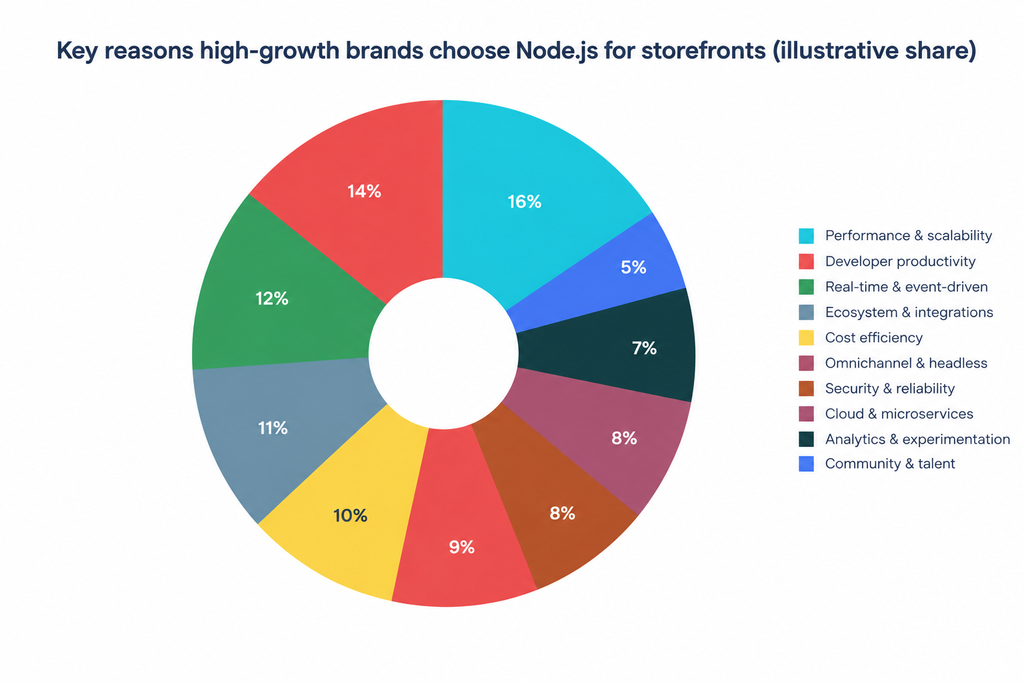
Decision factors that drive the choices are mostly associated with the following:
- Performance and scalability in the real world.
- Developer productivity because of the single stack of JavaScript.
- Real-time event-driven experiences (inventory, pricing, personalization).
- Fit in ecosystem with new headless commerce and cloud architectures.
Reason 1: Proven Performance And Scalability
The most common first hurdle for rapid growth brands is typically performance – pages loading slowly, timeouts during checkouts, and backend systems failing to cope with bursts.
Node.js was created with an event-driven and non-blocking design model that is especially good at executing multiple I/O tasks concurrently – which is exactly what a busy storefront requires.
Independent performance tests have proven the superiority of Node.js compared to older backend technologies like PHP at high concurrency levels:
- In a test case involving 1,000 concurrent connections, Node.js managed 100% of the load, while PHP was able to process just 48.7% of the traffic in the same environment.
- In another test case, Node.js was able to handle 250 times more requests than Python within 30 seconds of time, with the average latency of 1.04 ms compared to 7,187 ms of Python’s.

These outcomes have been mirrored by real-world case studies as well:
- In one instance, Walmart rewrote core functionality using Node.js, resulting in about 40% reduction in CPU utilization during peak traffic times and effectively managing about 500 million page views on Black Friday.
- The mobile backend rewrite done by LinkedIn by moving from Ruby on Rails to Node.js increased application speed by a factor of 20.
This is what it means for fast-growing brands:
- Resilience during flash sales: Node.js storefronts can withstand large amounts of traffic during the campaigns.
- Efficiency of infrastructure: Improved CPU/server usage during load.
- Greater revenue security: Reduced incidents of cart/search/checkout failures.
Reason 2: Faster Storefronts And Better UX
Customers have zero tolerance for slow-loading web pages, especially mobile pages. Node.js has been proven to deliver actual results when it comes to reducing load and response times in production systems.
Among the many facts mentioned in various reports we find:
- Node.js played a role in reducing web page loading time by 50–60% in some cases.
- Node.js helped to lower development costs by 12–58% by allowing for quicker delivery and simpler architectures.
Here is what PayPal experienced:
- A 35% reduction in response time with critical flows moved to Node.js.
- An increase in the number of requests processed per second without sacrificing the UX.
Impact on User Experience of your Brand
- Speedier category and product pages, especially during campaigns.
- Faster carts and checkouts with fewer abandoned purchases.
- Better Core Web Vitals and SEO signals due to fast response times.
Reason 3: Real‑Time, Event‑Driven Commerce Experiences
Today’s stores are not catalogs but rather dynamic, real-time systems – where stock, prices, recommendations, loyalty, and promotions change in real time.
The event-driven, non-blocking architecture of Node.js makes it especially suited to real-time applications.
Some of the most common real-time storefront patterns in Node.js are:
- Real-time inventory and pricing updates in multiple channels.
- Real-time cart, wish list, and notification streams (such as low stock alerts).
- Real-time dashboard for merchandising, operations, and marketing teams.
- Easy integration with customer support, chatbots, and chat channels.
Industry statistics state that Node.js is behind more than 60% of real-time web applications like chat, collaboration platforms, and streaming solutions, which easily translate into commerce contexts.
Why high‑growth brands care
- Real-time personalization increases conversions and order values.
- Real-time inventory prevents overbooking and customer disappointment.
- Real-time insights for your teams allow you to tweak your campaigns on the fly.
Reason 4: Unified JavaScript Stack And Developer Productivity
Being able to run JavaScript in the frontend as well as the backend is one of the most valuable benefits of Node.js: the same models, tools, and even pieces of business logic can be reused in the browser and on the server side.
Big companies have mentioned increased productivity because of unification of the stack:
- Netflix pointed out the ability to hire more easily and switch contexts less due to using JavaScript end-to-end.
- PayPal noted reduced complexity of development and fast deliveries with Node.js being used.
For fast-growing businesses, this translates into:
- Squadrons that own entire flows front-to-back (search, checkout etc.).
- Shared component libraries and validation logic between UI and backend.
- Easier hiring: a big talent pool of JS developers instead of several narrow stacks.
Productivity benefits
- Faster delivery of features and iteration loops.
- Less coordination efforts between frontend and backend teams.
- Cleaner code base when there is only one language to adhere to the patterns in.


Reason 5: Perfect Fit For Headless And Omnichannel Commerce
Headless commerce and composable architecture have become common among brands who require omnichannel presence through web, mobile, marketplaces, in-store screens, and partner networks. Node.js integrates seamlessly into such an API-driven ecosystem.
Data and industry insights reveal:
- Over 45% of modern eCommerce backends use Node.js in many cases for the API layer of headless commerce.
- Primary use-cases in many deployments include eCommerce, crowdfunding, IoT-enabled, and payments applications, where heavy use of API and microservices is expected.
Common Node.js usage in omnichannel architectures:
- API gateway such as GraphQL or REST that aggregates multiple systems (ERP, PIM, CRM, Payments).
- Server-side rendering (SSR) of fast and SEO-friendly storefronts using frameworks such as Next.js or Nuxt through Node runtimes.
- Webhooks and events hubs for third-party systems integration (marketplaces, loyalty platforms, shipping services).
Brand advantages
- Flexible reskinning of storefront without altering backend business logic.
- Simplification of channel integration (for example, kiosks, in-store applications, marketplaces).
- Separation of experience layer from transactional systems.
Reason 6: Rich Ecosystem And Integration Readiness
The Node.js package management system (npm) is among the biggest ones in terms of software development, providing libraries to solve almost any business-related problems.
From payment systems to search engines and marketing clouds, you can be sure that a proven Node.js SDK exists.
In the case of storefronts, this means:
- Fast integration with payment solutions (e.g., Stripe, PayPal, Adyen, etc.).
- Using ready-made connectors for CMS, PIM, DAM, and marketing automation software.
- Ready-made solutions for logging, monitoring, security, and optimization.
There are reports that Node.js is popular in many different industries, such as finance, eCommerce, healthcare, and enterprises, proving the maturity of Node.js in integration with various systems.
Benefits of integration
- Quicker delivery of new features and channels.
- Fewer custom integration code and fragile integrations.
- More access to the community modules.
Reason 7: Cost Efficiency And Time‑To‑Market
A high-growth brand is always trying to find the right balance between aspirations and budget. In terms of both, Node.js can come in handy: it has a tendency to be cost-efficient when it comes to infrastructure and development speed.
The following facts, cited in different studies and market reports, prove that:
- Node.js may save on development expenses, up to 12-58%, mostly because of faster delivery and code reuse in front-end and back-end.
- Many businesses employing Node.js belong to smaller employee segments (0-9 and 20-49 employees). Therefore, Node.js can be considered to have a high adoption rate among start-ups and lean teams.
Cost-efficiency is demonstrated by:
- Need for fewer servers to handle the same amount of load due to Node.js’ concurrency.
- Necessity for smaller teams to run and enhance the platform.
- Quicker experimentation cycles, having direct influence on revenue and margins optimization.
For high‑growth brands
- Higher number of experiments done per quarter without spending too much on infrastructure.
- Possibility to reallocate resources from basic infrastructure to growth areas (marketing, product).
- Technical fit to the business strategy.
Reason 8: Cloud‑Native, Microservices, And Serverless Alignment
Most high‑growth brands either are already in the cloud or actively migrating. Node.js aligns well with cloud‑native practices, microservices, and serverless functions.
Typical Node.js cloud patterns:
- Containerized microservices (Docker + Kubernetes) for specific commerce capabilities like inventory, pricing, promotions, search, or checkout.
- Serverless functions on platforms like AWS Lambda, Azure Functions, and Google Cloud Functions for event‑driven tasks (e.g., sending order emails, updating loyalty balances, syncing inventory).
- Horizontal scaling under load: stateless Node.js services can be replicated quickly in response to traffic spikes.
Node.js enjoys strong usage in SaaS and startup ecosystems: estimates suggest that over half of startups launched since 2023 chose Node.js as their primary backend runtime.
This ecosystem pressure ensures continuous improvement in tooling, observability, and deployment practices.
Cloud benefits
- Easier scaling strategies during marketing pushes and seasonal peaks.
- Clear microservice boundaries for complex commerce logic.
- Compatibility with modern DevOps, CI/CD, and observability stacks.
Reason 9: Reliability, Security, And Operational Maturity
Node.js today is far from a “bleeding‑edge” experiment; it runs inside mission‑critical systems at top enterprises and financial institutions.
NASA, Uber, PayPal, LinkedIn, Walmart, eBay, and many others use Node.js in production workloads where failure is not an option.
Examples:
- NASA moved important systems for astronaut data to Node.js, prioritizing reliability in complex, interconnected cloud services.
- Uber’s massive real‑time matching system uses Node.js to process millions of RPCs per second under demanding conditions.
- Groupon’s migration from Ruby on Rails to Node.js cut page load times by about 50%, improving user experience and operational performance.
Security and reliability benefits include:
- A mature ecosystem of security libraries, scanners, and dev‑sec‑ops tools.
- Frequent updates and long‑term support (LTS) releases for stable production deployments.
- Well‑documented best practices for securing APIs, handling authentication, and managing secrets.
Why this matters to brands
- Confidence that the runtime is battle‑tested at global scale.
- Access to patterns and playbooks from industry leaders.
- Easier compliance conversations when referencing widely adopted technologies.
Reason 10: Community, Talent Pool, And Future‑Proofing
Finally, high‑growth brands think beyond the next release – they consider hiring, long‑term maintainability, and technology direction. Node.js benefits from a large, active community and strong developer interest.
Key data points:
- Node.js ranks among the top web technologies in developer surveys, with around 40–45% of respondents reporting active use.
- Millions of websites and a large number of companies across 85+ countries use Node.js.
- Adoption is particularly strong in software, web development, eCommerce, and payment‑related activities.
For brands, this translates to:
- Easier hiring across regions: Node.js and JavaScript skills are widely available.
- Lower risk of ending up “stuck” on an obscure or shrinking stack.
- Continual ecosystem innovation, including new frameworks, tools, and best practices.
Strategic upside
- Technology decisions remain aligned with where the developer market is going.
- Access to community knowledge, events, and open‑source projects.
- Strong support from major cloud providers and tooling vendors.
Runtime Snapshot: Node.js vs Alternatives For Storefronts
A simplified comparison can help contextualize why Node.js often wins in high‑growth storefront scenarios.
| Aspect | Node.js | PHP | Python | Java |
| Concurrency model | Event‑driven, non‑blocking I/O (strong at many requests) | Thread/process‑based; less efficient under high concurrency | Threaded; good for CPU work, weaker at high I/O concurrency | Strong but heavier stack; good for large, structured systems |
| Real‑time capabilities | Excellent (websockets, streaming, real‑time APIs) | Possible but less natural; more boilerplate | Good with frameworks, but often more setup | Good but typically used for batch and enterprise apps |
| Ecosystem for eCommerce | Strong: many headless/commerce frameworks and SDKs | Mature legacy platforms, especially monolithic CMS | Good data/ML ecosystem; fewer commerce‑specific stacks | Strong enterprise platforms, heavier learning curve |
| Performance under load | Excellent; benchmarked with 100% throughput in some tests | Lower throughput in concurrency tests (48.7% in one study) | Good but higher latency increase under heavy load | High performance but needs more resources and tuning |
| Developer availability | Very high; JavaScript is ubiquitous globally | High but more focused on legacy/web agencies | High; strong in data and backend engineering | High; strong in enterprise and financial institutions |
| Fit for headless/omnichannel | Excellent; widely used as API and SSR layer | Moderate; more suited to traditional monolithic sites | Moderate; strong backends with custom frontend stacks | Good; often used with enterprise commerce platforms |
Turning Reasons Into A Roadmap
In sum, node.js is the right choice for storefronts in high growth brands because it fits the true nature of modern commerce: real-time, API-first, cloud-native, and highly experimental.
Node.js performance, scalability, productivity, and maturity make it the right technology for both scaling with your growing business and being able to innovate constantly.
In practice, it often means:
- Implementing Node.js as the underlying API and orchestration layer for headless storefronts.
- Using modern node.js frameworks (Express, NestJS, Fastify, Next.js) and modern architectures (microservices, serverless functions).
- Ensuring standardized logging, monitoring and security for Node.js services.
For high growth brands, it means having not just a “new tech stack” but a storefront platform which is performant now and scalable tomorrow, and at the same time comfortable to iterate.
Build a Scalable Node.js Storefront

Pooja Upadhyay
Director Of People Operations & Client Relations
Source URLs:
https://www.programming-helper.com/tech/node-js-2026-runtime-adoption-deno-bun-python
https://electroiq.com/stats/node-js-statistics/
https://codeless.co/node-js-statistics/
https://brainhub.eu/library/famous-apps-built-with-nodejs
https://iacis.org/iis/2023/1_iis_2023_328-341.pdf
https://sanmarksolutions.com/real-world-success-stiries-of-nodejs-imlementation/
https://w3techs.com/technologies/details/ws-nodejs
https://w3techs.com/technologies/breakdown/ws-nodejs/ranking
