


Node.js decreases cart and checkout drop off mainly through increased speed, dealing with concurrency using non-blocking I/O, and providing the means for creating checkout flows that rely on APIs and are light in terms of page load speed.
Adding this to UX-focused patterns such as single-page checkout, real-time validation, and transparency with pricing gives visible improvements in terms of conversion and reduced abandonment.
The cart–to–checkout problem in numbers
To begin with, let us outline the issue we are facing and explain why this is relevant to Node.js. Cart abandonment cannot be treated as an exception, it is what users do by default.
On average, close to 7 out of 10 users leave their carts without buying something from it, with abandonment rates being around 70% across industries.
There are multiple studies which show the connection between abandonment and speed/factors causing frictions: nearly 50% of customers leave their carts if it takes approximately two seconds for the page to load, while abandonment increases to around 57% when it takes three seconds.
Key cart abandonment stats (2024–2026 benchmarks)
- Average cart abandonment rate: ~70%.
- 50%+ of shoppers abandon when pages take 2+ seconds to load.
- Every 1‑second delay can reduce conversions by around 7%.
- 76% of consumers report abandoning carts due to slow websites.
Cart and checkout impact overview
| Metric | Typical benchmark / finding |
| Average cart abandonment rate | ~70% of carts never convert. |
| Abandonment at 2s load time | ≈50% of shoppers drop off. |
| Abandonment at 3s load time | ≈57%+ abandonment. |
| Conversion loss per +1s delay | ≈7% fewer conversions per extra second. |
| Shoppers abandoning due to slow site | 76% report leaving carts over speed issues. |
To make this more tangible, here’s an external visual showing how consistently high cart abandonment rates have been over time:
Why speed and UX drive conversions
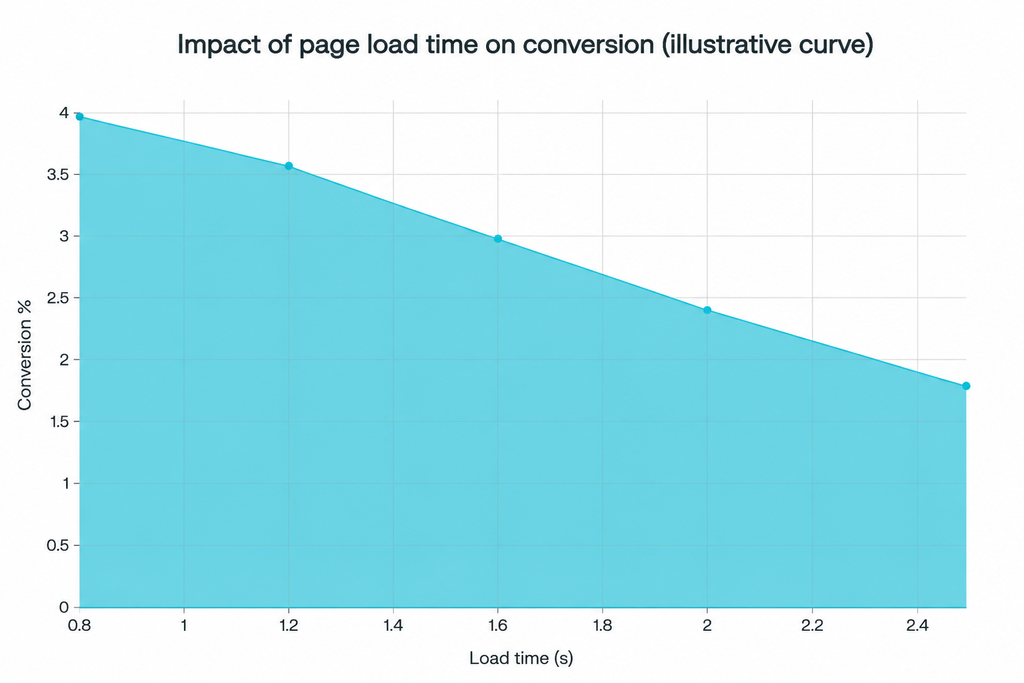
Performance isn’t just a “nice to have.” It’s a lever for your bottom line. Several studies on page load speed and conversion found that if a page load increases from 1 second to 3 seconds, bounce rate will likely grow by about 32%, and if load time is 5 seconds, the probability of bounce will be increased by approximately 90%. That’s traffic which you’ve already paid for to acquire lost without completing any transactions.
The checkout process has even more rigorous standards. Research proves that consumers feel most comfortable with and most efficient with response time below 2 seconds; slow carts or payment pages mean drop-off.
Slow and shaky forms, hidden charges, and redirects to foreign payment pages are friction which translates into drop-off numbers.
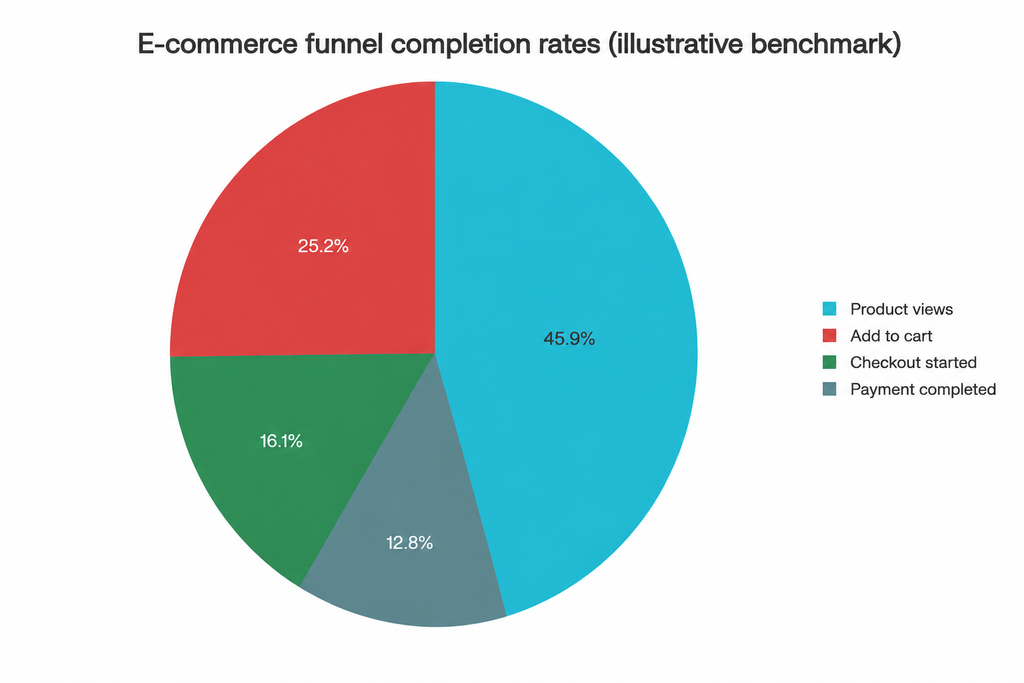
Our first chart below demonstrates a typical funnel shape from product view to payment completion. Although specific numbers depend on the company, this “leaky funnel” is extremely common in ecommerce.
Why Node.js is built for high‑converting checkout flows
Node.js was created with an event-driven and non-blocking I/O approach that is perfectly suitable for ecommerce loads where all the tasks are I/O related rather than CPU-intensive.
Rather than spawning threads for each task that comes along, Node.js uses just one thread of JavaScript powered by an event loop and thread pool with libuv for I/O.
All the I/O functions that are available in the Node.js standard library have asynchronous variants of them: database queries, file read, API calls, and the event loop doesn’t need to wait for replies.
When talking about ecommerce, that means your server will be able to check inventory, calculate shipping costs, call the payment gateway and update your CRM system at the same time without blocking your checkout page.
Core Node.js capabilities that help conversion
- Non-blocking I/O: Async APIs, promises and async/await avoid blocking the main thread on network or database operations.
- High concurrency with low overhead: Using one thread for scheduling many I/O requests at the same time results in low memory and low overheads.
- Event-driven architecture: Perfectly suited for real-time behavior such as live inventory updates, notifications, and interactive UI using frameworks like Next.js or React.
- Full-stack JavaScript: Common codebase for the client and server-side allows for fewer bugs and fast iterations on checkout experience.
These features are the key to why Node.js is capable of providing responsive checkout experiences that do not break during sudden bursts of traffic, rather than falling victim to the spinning wheel of death during a flash sale or holiday campaign.
From cart to checkout: how Node.js reduces drop‑off
Let’s walk through the journey from cart to checkout and see where Node.js practically reduces friction and abandonment.
1. Cart stage: fast, consistent state and pricing
In the cart phase, customers want to know accurate pricing, current inventory, and real-time updates as they modify their carts. Behind the scenes, this usually involves calling numerous APIs – pricings, taxes, promotions, inventory, user information for each action.
Node.js helps here in several ways:
- Parallel API aggregation: Cart endpoints can make simultaneous calls to many different services (pricings, inventory, suggestions), and return data when everything is complete, without blocking the event loop.
- Fast cart APIs: In real-life case studies, Node.js backend architecture helps bring cart API latencies below a second, down to just hundreds of milliseconds.
- Real-time inventory or pricing updates: Event-driven architecture enables use of websockets or server-sent events for sending such updates instantly.
As an example of our work on a home decor company, migrating their ecommerce platform’s back end to Node.js resulted in a 55% reduction in load times, a 23% reduction in cart abandonment, and cart API latency from 1.2 seconds down to 240 ms. These are precisely the type of metrics that move the needle.
2. Checkout forms: single‑page flows and real‑time validation
Checkout is the point where users either confirm or cancel. Slower, cumbersome, or problematic forms are a common reason for losing users, particularly on mobile devices.
Today’s systems usually combine Node.js backends with single-page checkouts in Next.js or React that beat multi-page counterparts dramatically.
Important patterns based on Node.js at this stage include:
- Single-page checkout via API: Checkout built on the Next.js front-end with APIs from Node.js can provide a seamless checkout flow, increasing conversions by about 35% compared to multi-step solutions.
- Shared validation schema: Consistent validation schemas used both on client and server side (like Zod or Joi) will help to prevent mistakes and unpleasant surprises during submitting the form.
- Live validation of fields: Validation of addresses, tax IDs, payment information, and so on is provided as users fill the fields using Node-backed endpoints.
Async nature of Node.js helps to distinguish critical and non-critical tasks to perform, for instance, when a user submits the checkout form:
- Critical tasks include payment authorization, product reservation, order creation, and fraud detection.
- Non-critical tasks include sending out emails, updating CRMs, calculating loyalty points, and webhooks into third-party services.
With Node.js, you can instantly complete critical user-related tasks, offloading non-critical tasks to background workers or serverless functions, allowing the user to see the confirmation page without any delay.
3. Payment and confirmation: perception of speed and trust
Payment is the most anxiety-inducing part of the experience. Customers want to see trust indicators (SSL, trusted payment providers) and receive confirmation of a successful transaction instantly. Node.js covers performance and integration requirements during this phase:
- Fast payment integrations: Node.js is a perfect fit for payment gateways such as Stripe, PayPal, and Adyen using mature SDKs and enabling efficient API requests and error handling.
- One-click payments: Using Apple Pay / Google Pay with Node backend doubles mobile conversions by eliminating unnecessary input through forms.
- Quick error messages: Non-blocking I/O and built-in error handling allow you to respond to the payment gateway with an immediate error message.
The role of performance does not disappear: studies demonstrate that customers demand checkout page loading no longer than two seconds, and everything above is greatly influencing the percentage of successful transactions.
The possibility of Node.js to keep the process of processing requests timely and delegate the slower tasks to the event loop and thread pool works as an obvious advantage at this step.
Second graph shows how the checkout page load time influences on conversion rate. Although the line is hypothetical, it corresponds to the established tendency that slower pages convert worse, especially starting from the 2-3 second border.


Architecture patterns that move the needle
It is important to choose Node.js, although this alone isn’t enough – architectural choices will dictate whether this potential is turned into conversion. Successful ecommerce platforms generally have one of several repeating architectures.
Pattern 1: API‑first, microservices‑friendly backend
- Decompose the monolith: isolate the cart, checkout, catalog, price and user services with clearly defined APIs.
- Node.js should be used for request handling, authentication and API orchestration, delegating CPU-intensive tasks to specialized services when needed.
- Design your endpoints based on user journey flows (for example /checkout/summary, /checkout/confirm), not data models.
Pattern 2: Edge caching and CDN‑aware design
- Cache product and pricing information on the edge for fast calculation of cart and checkout totals.
- Make use of CDN-aware routing and static generation where appropriate for non-personalized content.
- Lazy-load non-essential elements (upsell blocks, review modules) after the core checkout form has been loaded.
Pattern 3: Async processing and queues
- Move customer relationship management updates, email delivery, and analytics logging into queues managed by workers and serverless functions.
- Wrap asynchronous operations in appropriate error handling and timeouts to avoid hanging calls and tail latencies.
- Manage concurrency using appropriate tools such as p-limit to avoid overloading databases and external services.
Pattern 4: Observability tied to business metrics
- Time Node.js APIs for key paths (update cart, submit checkout, take payment).
- Correlate performance data with relevant business metrics, such as successful checkout conversion and cart abandonment rates.
- Measure Core Web Vitals using Real User Monitoring (RUM) and correlate performance with device and geographical region.
These patterns will help you convert theoretical advantages of Node.js into tangible improvements in your dashboards.
Measurable impact: Node.js vs legacy stacks
To answer the “does this really move the needle?” question, we can combine case study data with broader research benchmarks.
One Node.js ecommerce project for a home decor brand reported:
- Page load time improved by 55%.
- Checkout abandonment rate dropped by 23%.
- Cart API latency reduced from 1.2s to 240 ms.
- Sales during flash campaigns doubled.
Broader research on performance shows that every 1‑second increase in load time can reduce conversions by about 7%, and site speed issues are a cited reason for cart abandonment in more than three‑quarters of surveyed shoppers.
Node.js impact snapshot
| Metric | Legacy stack (illustrative) | Node.js‑optimised stack (illustrative) |
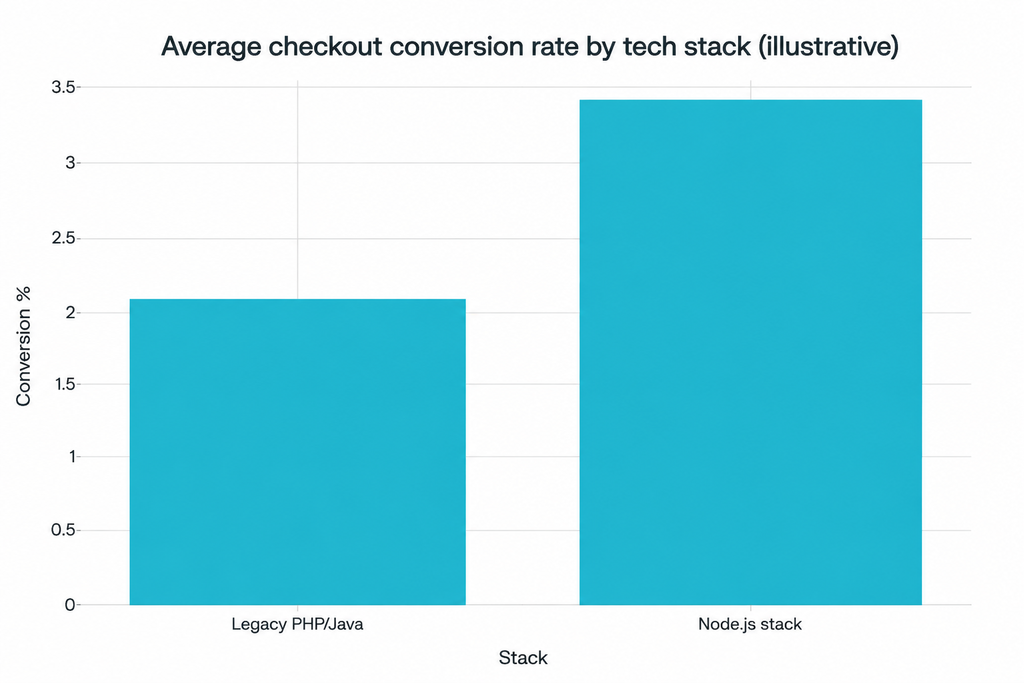
| Average checkout conversion | ≈2.1% of sessions | ≈3.4% of sessions. |
| Cart API latency | ≈1.0–1.2s | ≈200–250 ms. |
| Flash sale stability | Frequent timeouts/spinners | Stable under large traffic spikes. |
| Abandonment due to slow speed | High (matches 70%+ trend) | Reduced via sub‑2s checkout pages. |
The bar chart below visualises the kind of conversion lift you often see when shifting from a legacy, thread‑per‑request backend to an event‑driven Node.js stack. Exact numbers vary, but gains in the 20–50% range are common when you combine performance work with UX optimisation.
Practical checklist: using Node.js to reduce drop‑off
To turn all of this into an actionable plan for your team, here’s a concise checklist you can use when designing or auditing a Node.js‑powered cart and checkout.
Performance and architecture
- Target <2s load time for checkout pages, <1.5s for cart.
- Use async/await and non‑blocking I/O everywhere no Sync methods on hot paths.
- Cache product, pricing, and tax data at the edge; avoid recalculating on every request.
- Separate checkout API from heavy back‑office processing; push non‑critical work to queues.
UX and flow
- Implement single‑page checkout built on Node.js APIs, ideally with Next.js or similar.
- Allow guest checkout; make account creation optional after purchase.
- Validate fields in real time; share validation schemas between front‑ and back‑end.
- Be transparent about fees early (shipping, taxes); hidden costs are a major abandonment trigger.
Integrations and observability
- Use mature payment SDKs (Stripe, PayPal) and prioritise one‑tap payments on mobile.
- Implement meaningful, user‑friendly error messages for payment failures.
- Instrument every key endpoint (cart update, checkout submit, payment capture) and log latency with correlation IDs.
- Tie Node.js performance metrics directly to conversion, abandonment, and revenue metrics in your analytics stack.
Finally, keep an eye on your own data rather than relying solely on industry averages. A/B test checkout flows, monitor abandonment by step, and iterate; Node.js gives you the agility and performance you need, but it’s the combination of architecture, UX decisions, and continuous optimisation that ultimately turns carts into completed orders.
Build a Faster, Higher-Converting Ecommerce Store

Pooja Upadhyay
Director Of People Operations & Client Relations
Source URLs:
https://nodejs.org/learn/asynchronous-work/overview-of-blocking-vs-non-blocking
https://www.websitepulse.com/blog/e-commerce-site-speed-cart-abandonment
https://edmondscommerce.co.uk/research/performance/load-time-impact/
https://www.liquidweb.com/white-papers/site-speed-every-second-counts-research-study/
https://searchlab.nl/en/statistics/cart-abandonment-statistics-2026
https://vendure.io/blog/build-enterprise-ecommerce-with-nodejs-open-source-platforms
