


At first glance, all-in-one website builders look like the perfect answer. They promise everything under one roof: hosting, templates, drag-and-drop design, built-in marketing tools, eCommerce features, analytics, forms, and support. For a business owner who wants to move fast, that sounds ideal.
And in fairness, that promise is not completely empty. These platforms are often genuinely good at helping people launch quickly, especially when the goal is a simple brochure website or a lightweight online presence. But once a business starts thinking beyond “getting online” and starts asking how the website can support traffic, leads, conversions, and long-term growth, the conversation changes. That is where WordPress still pulls ahead.
The appeal
The rise of all-in-one builders makes sense because simplicity sells. A business can choose a template, edit a few sections, connect a domain, and publish without dealing with hosting decisions, plugin research, or much technical setup. That convenience is real, and for many early-stage businesses, it removes a lot of friction.
The problem is that convenience at launch often gets mistaken for capability at scale. Those are not the same thing. A platform that makes the first week easier is not automatically the platform that will make the next two years easier.
That difference matters more than most people expect. In the beginning, most websites need only a few pages and a contact form. A few months later, the same business may need SEO landing pages, lead magnets, gated content, advanced analytics, custom workflows, better page speed, email automation, and more control over how the whole customer journey works.
What “all-in-one” really means
The phrase “all-in-one” sounds efficient, but in practice, it often means a closed ecosystem. You get a curated set of tools chosen by the platform, and those tools work the way the platform wants them to work. That can feel clean and beginner-friendly, but it also means your website grows within someone else’s boundaries.
That trade-off is easy to ignore when the site is small. It becomes much harder to ignore when you need something the platform was not really built to support. Suddenly, what once felt streamlined starts to feel restrictive.
Some of the most common pain points show up in familiar ways:
- The templates look polished, but customization gets harder once you want something unique.
- Built-in SEO settings cover the basics, but advanced control is limited.
- Integrations exist, but not always in the depth or flexibility a growing business needs.
- eCommerce works, until you need more complex product logic, subscriptions, or tailored checkout experiences.
- Costs that looked manageable at the start begin to rise as more features, add-ons, or transaction-related limitations appear.
This is the quiet truth behind many all-in-one platforms: they are optimized for simplicity, not for elasticity.
Why does WordPress still win?
WordPress still wins because it is not trying to force every business into the same shape. It gives companies room to build around their own goals, workflows, customers, and revenue models instead of relying only on what a platform has prepackaged.
That freedom changes the role of the website. Instead of becoming a fixed digital asset, the site becomes something more dynamic — a platform that can evolve as the business grows.
With WordPress, businesses can control:
- Site structure and content architecture.
- Technical SEO setup and on-page optimization.
- Hosting environment and performance stack.
- Plugin selection and third-party integrations.
- eCommerce functionality through WooCommerce and related extensions.
- Lead generation, forms, CRM connections, and email workflows.
- Memberships, gated content, courses, directories, booking systems, and custom user journeys.
That level of control is why the WordPress platform tends to become more valuable over time rather than less. It may ask for a bit more thought upfront, but it gives back much more freedom later.
Visual: first impression vs long-term value
Use this graph to show how all-in-one builders often win the first impression, while WordPress wins the longer race.
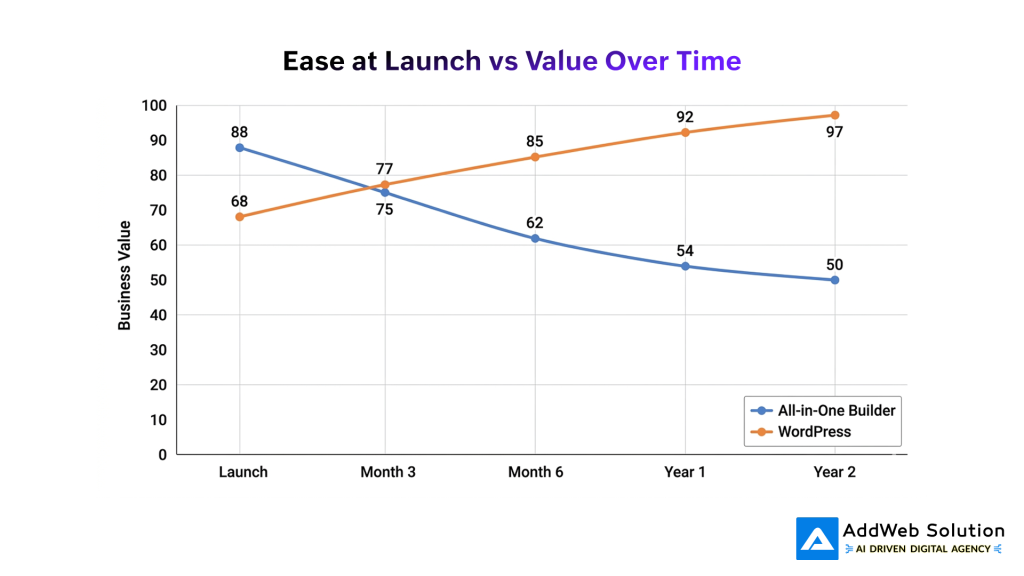
This visual works because it reflects a common business reality. The easier path at the beginning is not always the stronger platform later.
Where all-in-one builders usually start to feel small
Most businesses do not outgrow a platform all at once. They outgrow it in moments.
It happens when marketing asks for landing page variations that the builder cannot handle elegantly. It happens when SEO needs cleaner control over content hierarchy and metadata. It happens when a store wants advanced filtering, regional pricing, or better product bundling. It happens when analytics need to go deeper than the built-in dashboard.
That is usually the tipping point. The website stops being just a design project and becomes an operational part of the business. Once that happens, flexibility matters a lot more than convenience.
A simple builder can help you launch a site. A more open platform can help you turn that site into a growth system.
SEO is where the gap becomes obvious
A lot of platform comparisons focus on design because design is visible. SEO is less visible at first, but it is often where long-term winners separate themselves.
WordPress remains powerful for SEO because it supports search-friendly site structures, customizable URLs, metadata controls, schema support, blog architecture, category organization, internal linking strategies, and plugin-based optimization. That gives marketers, content teams, and SEO specialists more room to build pages that are not only attractive but also discoverable.
This is especially important for businesses that rely on content to drive leads. A site with strong SEO control can publish comparison pages, service pages, local landing pages, thought-leadership content, guides, and solution-based articles that compound traffic over time.
That compounding effect matters. Paid ads can stop the moment a budget pauses. Organic content keeps working. And WordPress is one of the strongest environments for building that kind of search-driven engine.
Visual: what actually drives growth
This pie chart helps explain that website value is not just about visual design. Growth usually comes from a mix of content, SEO, conversions, performance, and commerce.
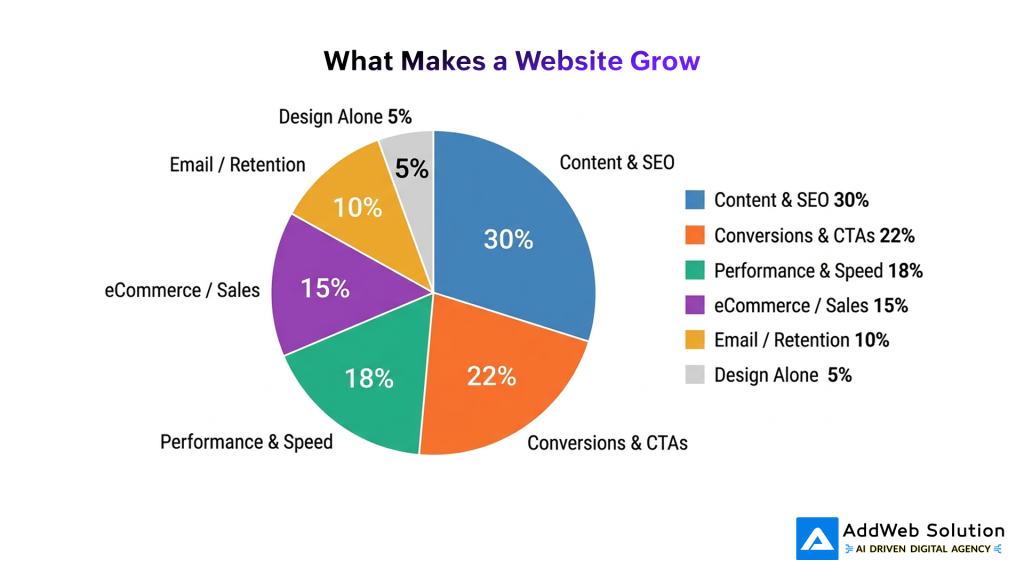
That final slice is intentional. Design matters, but by itself, it rarely turns a site into a business asset.
Performance is not a small detail
One of the most underestimated differences between platforms is performance control. Many businesses only start paying attention to site speed once rankings or conversions begin to suffer.
That is a mistake, because performance directly affects user behavior. One source highlights that pages loading in 1 second can see conversion rates near 39%, while 5-second pages may drop closer to 22%, with bounce rates also rising sharply as load time increases. That means site speed is not just a technical metric. It is a business metric.
WordPress gives businesses more flexibility here because they can make smarter decisions about hosting, caching, image optimization, CDNs, theme weight, and plugin discipline. In other words, businesses are not locked into one default setup. They can improve the stack as performance expectations rise.
WordPress and commerce grow together
This is one of the biggest reasons WordPress continues to outperform many closed platforms for serious businesses. With WooCommerce, WordPress is not just a publishing system. It becomes a commerce engine that works alongside content, SEO, and customer experience.
That matters because buying journeys rarely begin on a product page anymore. Many customers start with a question, a comparison, a review, a guide, or a problem they are trying to solve. WordPress allows businesses to meet that user early through content, then guide them toward conversion inside the same ecosystem.
For example, a brand can publish educational content, rank for relevant search intent, capture an email subscriber, retarget that visitor, and eventually convert them through a product page or offer page. That whole journey can live inside WordPress.
That connected experience is a major reason WooCommerce remains such a serious force in eCommerce. Estimates in 2025–2026 commonly place WooCommerce at roughly 33.4% of tracked eCommerce sites globally, with some broader studies reporting even larger shares. Whether you look at the lower or higher estimate, the message is the same: this is not a niche setup for hobby sites. It is a major commerce ecosystem.


Table: where the difference really shows
| Area | All-in-One Builders | WordPress |
| Launch speed | Fast and beginner-friendly | Slower at first, but more adaptable |
| Design setup | Easy with templates | Flexible with themes, builders, and custom development |
| SEO control | Usually enough for basics | Stronger control for serious content strategy |
| Performance tuning | Limited by platform defaults | More control over hosting, caching, and optimization |
| eCommerce depth | Good for simple stores | Strong for stores that need to grow |
| Integrations | Convenient but narrower | Broad ecosystem and custom workflows |
| Ownership and portability | More platform-dependent | Greater control over future direction |
| Long-term scalability | Can become restrictive | Better suited for evolving business needs |
This is where the conversation becomes practical. The question is not “Which platform is easier today?” The smarter question is “Which platform will still make sense when the business becomes more demanding?”
A fair argument, not a biased one
To be fair, all-in-one builders are not bad products. In the right context, they are useful. A freelancer, local business, event microsite, or temporary campaign site may genuinely benefit from fast setup and lower complexity.
But businesses that depend on content marketing, SEO, lead generation, serious eCommerce, or future flexibility usually need more than a polished template and a few built-in features. They need room to expand without rebuilding the site every time strategy changes.
That is why the company behind WordPress still wins. Not because it is always the easiest option, but because it is often the most strategic one.
A more honest way to think about platform choice
Here is the most useful way to frame it:
- If your main goal is speed and simplicity, an all-in-one builder may be enough.
- If your main goal is growth, control, and adaptability, WordPress is usually the stronger investment.
- If your website is expected to generate leads, support SEO, sell products, publish content regularly, and evolve with the business, WordPress gives you more room to do all of that well.
That distinction matters because websites are no longer just online placeholders. For many businesses, they are central to visibility, trust, customer acquisition, and revenue generation. Choosing a platform, then, is not just a design decision. It is a growth decision.
Work with Experts Who Build for Growth

Pooja Upadhyay
Director Of People Operations & Client Relations
Source URLs:
https://www.wpzoom.com/blog/benefits-of-wordpress/
https://wordpressprofessionals.com.au/top-benefits-of-choosing-wordpress-for-website-development-in-2026/
