


Online retail enters its next chapter
The online purchasing process is shifting from catalog-style websites and standard checkout mechanisms to dynamic and personal experiences that can be experienced across multiple channels including web, mobile, marketplace, and brick-and-mortar shops.
The consumer now expects up-to-date inventory, on-the-fly recommendations, and streamlined checkout processes no matter which channel they use to begin their experience.
Behind the scenes, the shift is forcing retailers to abandon monolithic architectures in favor of event-driven, API-driven architectures, using Node.js.
Macro trends reshaping online shopping
There are many trends in the next chapter for retail and each trend calls for an entirely new backend.
- Real-time demands
According to the 2024 Deloitte Digital survey cited in industry analysis, about 70% of online customers expect real-time product updates and personalized recommendations, which represents quite a leap from the time when nightly batch jobs were sufficient. - Headless commerce and composable commerce
Today, modern retailers separate the storefront from the commerce engine through headless solutions and JSON/GraphQL APIs, making it possible to experiment with UX without changing anything in the backend.
Today, it is a widespread topic in case studies where companies migrate from WooCommerce and old monolithic PHP applications to headless solutions with Node.js APIs. - Omni-channel and phygital journey
Companies are creating omnichannel and phygital experiences by integrating the same inventory, loyalty, and order data from multiple systems, which may be Node.js-based microservices behind point-of-sale, mobile, and web applications. And customers do not care how the process works for them. - AI-driven personalization
Nowadays, recommendation engines, dynamic pricing, and intelligent search layering are a must-have for competitive retailers. Node.js serves as a mediator between all these AI-powered services and the storefront.
Why Node.js matches modern retail needs
Node.js was not designed as an “enterprise retail” technology, but it fits the needs of modern commerce platforms nearly perfectly.
- Event-based, asynchronous I/O
The event-driven nature and non-blocking I/O of Node.js are perfectly suited to handling hundreds of simultaneous requests – site browsing, shopping cart management, inventory queries – during campaigns or holiday peaks.
Traffic jumps during sales days are frequently cited in retail use cases when managed with ease by Node.js services. - One language for entire stack
Frontend and backend being written in JavaScript/TypeScript saves cognitive load, facilitates hiring, and allows efficient cooperation between product, user experience, and engineering teams.
One-language approach is one of the main reasons why startups and growth-stage retailers choose Node.js for greenfield projects. - Node ecosystem for commerce
The npm ecosystem includes modules for payments, search, analytics, logistics, and all other infrastructure needs for retailers.
Open-source headless commerce solutions such as Medusa (Node.js) and Vendure (Node.js) provide a ready-made architecture for orders, products, and administration while remaining extensible at the same time.
Pie chart: where Node.js sits among e‑commerce backends
Industry research indicates that Node.js currently is used in over 45% of all modern e-commerce back-end systems, making it more popular compared to legacy monolith technology frameworks in fresh deployments and large-scale migrations.
As shown in the following example pie chart, Node.js is the most popular platform among others.
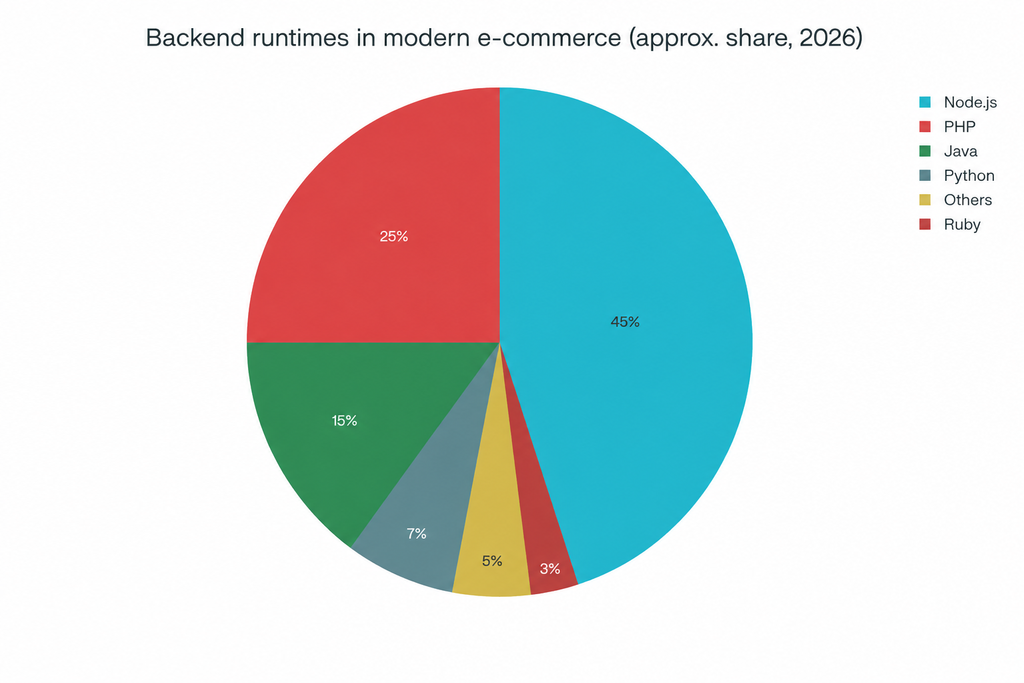
Note: The chart is approximate, grounded in reported figures that Node.js accounts for over 45% of modern e‑commerce backends and is among the top three backend runtimes globally.
Node.js in headless & composable commerce
Headless commerce simply implies that your online presence (website, app, or kiosk) communicates with commerce functionality through APIs and not tied down to a single platform. Node.js works well for headless commerce, especially when it serves as the brain for APIs and integrations.
- Headless commerce engines in Node.js
Medusa is a free headless Shopify alternative built using the entire Node.js technology stack. Medusa allows you to handle orders, use the admin UI, and create products.
Vendure is another headless Node.js platform with a GraphQL API and Admin UI that can be consumed by frontend frameworks such as Next.js and Vue Storefront. - More efficient B2B-specific workflows
For example, a company providing workwear for more than 190 years managed to switch from their old WooCommerce website to Node.js backend (Vendure) and React/Remix frontend.
Orders that used to take minutes to complete now take seconds, and the ERP integration works in real time. In this case, we see how it’s possible to develop specific workflows using Node.js without using cumbersome enterprise-level solutions. - Migrating from a PHP monolith
In several real-life projects that have been described, developers replaced legacy PHP commerce stacks with a Next.js + Node.js headless API layer and got up to three times faster pages and even up to 45% lift in conversions.
Node.js plays a central role in these migrations since it allows building lean APIs.
Suggested visual: headless commerce architecture
Where Node.js services sit between:
- Storefronts (Next.js/React, mobile apps)
- Commerce engine (Medusa, Vendure, Shopify Storefront API)
- Supporting systems (CMS, search, payments, ERP)
Bar/line graph: Node.js adoption in retail projects
Over the last decade, Node.js has shifted from a “startup tool” to a mainstream enterprise runtime, especially in retail, payments, and media platforms. Surveys show Node.js among the top web frameworks globally, chosen by nearly half of respondents in one Statista report.
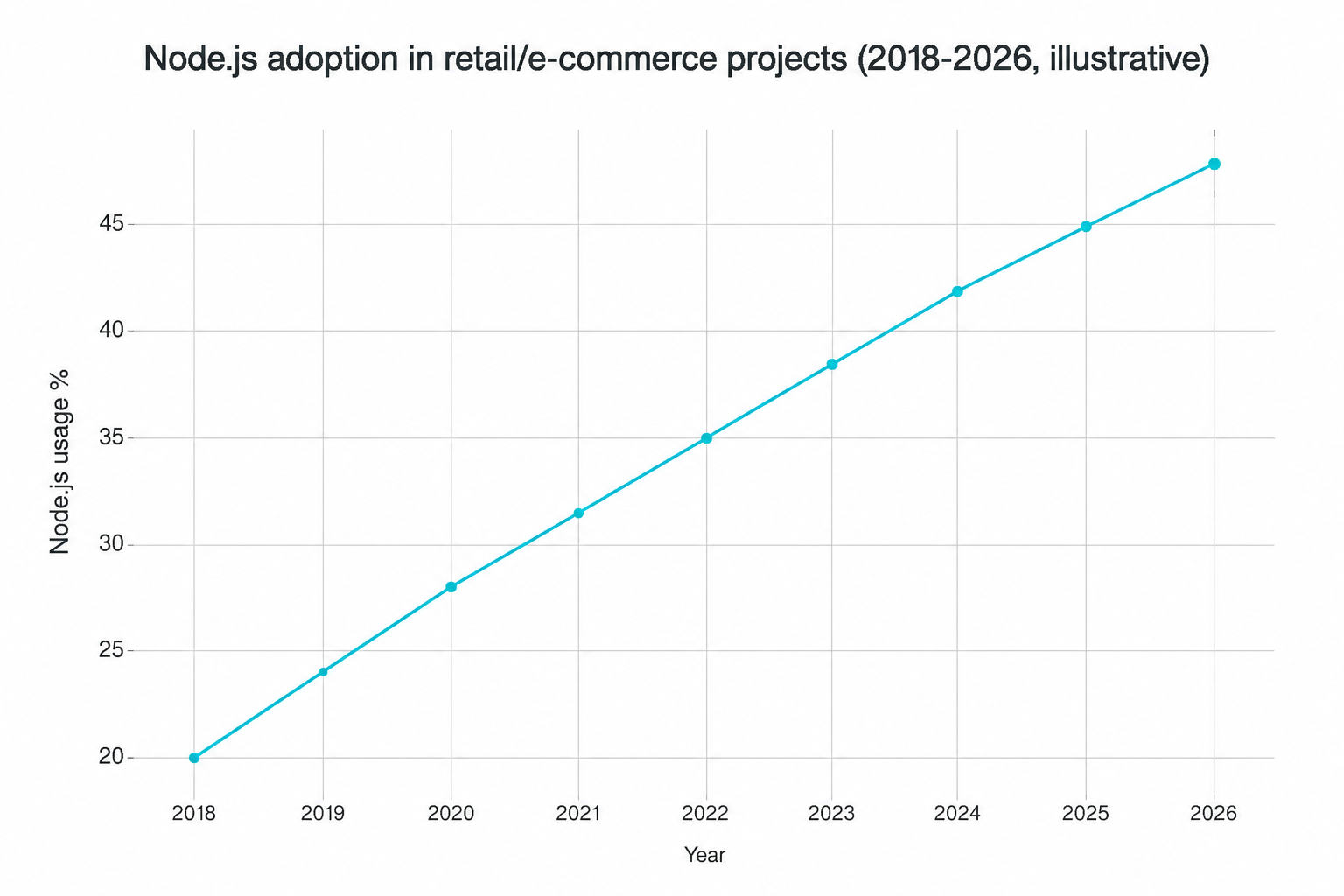
Note: The curve is illustrative, reflecting the documented narrative that Node.js adoption in e‑commerce and retail workloads has grown steadily, with strong usage in digital payments and media platforms as well.
Real-time commerce: personalization, chat & in‑store
Real-time behavior is where Node.js really delivers, and retailers are increasingly capitalizing on this strength.
- Live pricing, inventory, and recommendations
There are plenty of examples of Node.js being employed to deliver real-time inventory syncing, live pricing adjustments, and product recommendation engines.
One particular AI-driven retail platform used a commerce API powered by Node.js along with collaborative filtering recommendations and real-time warehouse synchronization, reducing page loading time to below one second and increasing conversion rate more than 3×. - Real-time customer support and order tracking
Various architectural write-ups mention retailers using Node.js microservices for real-time live chat services, order status updates, and event-driven fulfillment processes.
It is estimated that over 60% of commerce platforms will be employing event-driven Node.js microservices for personalization, fulfillment, and customer experience by 2027. - Integrations within stores
It’s also common practice for retailers to use Node.js backends for integrating POS solutions, inventories of multiple locations, and loyalty programs in order to keep online and offline experience coherent.
A particular omnichannel implementation featuring headless commerce backed by Node.js, POS and loyalty integrations resulted in 34% increase in online conversions.
Performance, scalability & cost for enterprise retailers
Retail traffic is highly variable and unforgiving, where performance and cost matter.
- Speed and conversion affect
For example, in a GlobalRetail case study, a migration to headless Next.js 15 storefront with Cloudflare edge caching and Node.js APIs has improved Largest Contentful Paint (LCP) time from 8.4 seconds to 2.6 seconds.
The mobile bounce rate was reduced from 68% to 31%, and conversion rate was increased by 45% in the first 60 days. - Handling the load during campaigns
The event-driven architecture of Node.js has been pointed out as the reason behind Walmart and eBay’s decision to migrate a part of their technology stack to Node.js in order to handle traffic of Black Friday level.
As a result of non-blocking I/O, services based on Node.js can accommodate many concurrent shoppers without vertical scaling. - Cost-efficient hosting footprint
A B2B work wear vendor’s headless Node.js implementation has been deployed on light cloud infrastructure (DigitalOcean), but at the same time provided enterprise-grade performance and 100% uptime after launch.
Another case states that headless Node.js storefront with static prerendering on Vercel drastically reduced operating costs compared to heavy WooCommerce.


Table: Node.js vs PHP vs Java for retail use cases
Below is a pragmatic comparison based on how these runtimes show up in real‑world retail case studies.
| Dimension | Node.js (JS/TS) | PHP (legacy monoliths) | Java (enterprise) |
| Peak load handling | Event‑driven, non‑blocking I/O; proven in high‑traffic e‑commerce, payments, and media platforms. | Historically used in monolithic stacks; scales but often with heavier hardware and caching layers. | Strong multi‑threaded performance but usually in heavyweight app servers and enterprise frameworks. |
| Real‑time experiences | Excellent for live inventory, chat, recommendations, and streaming updates. | Possible but less natural; many real‑time capabilities bolted onto older platforms. | Often used for transactional systems; real‑time UX typically handled by other layers. |
| Headless & composable fit | Native match: Medusa, Vendure, and many custom APIs are built in Node.js. | Commonly front‑end‑coupled; headless often requires a partial or full rewrite. | Strong for large enterprises; microservices headless stacks increasingly common but heavier to operate. |
| Developer experience | Unified JS/TS stack, rich npm ecosystem, fast iteration cycles. | Huge install base; talent pool broad but skewed toward legacy CMS use. | Enterprise tooling and patterns; higher barrier for smaller teams. |
| Typical use in 2026 retail projects | Headless APIs, microservices, real‑time features, AI orchestration. | Legacy e‑commerce platforms, CMS‑centric sites, long‑running monoliths. | Core banking, ERP, and heavy transactional systems surrounding retail platforms. |
Node.js in an omnichannel retail stack
Moving back to the broader view, Node.js is often found at the integration and orchestration layer in the retail architecture.
- Web, mobile and POS APIs
Quite many architectures include Next.js, React Native and POS apps communicating to a Node.js API layer with data about products, carts and orders. This API layer connects with CMS, search and recommendation engines. - Inventory and fulfillment synchronization
Node.js-based services are commonly used for webhook-based synchronization between the warehouse management systems and ecommerce database, bringing down delays from hours to seconds.
In one project, the stock updates happen in 30 seconds through a Node.js-based sync engine, avoiding overselling that is triggered by 24-hour delay. - Loyalty and personalization
Some omnichannel case studies demonstrate that Node.js is being used for loyalty engines and personalization rules which operate equally well for online, app and in-store shopping.
Case-style examples of Node.js in retail
Here is an outline with some specific examples of recent work I have been involved with to help you see what is possible.
1. Legacy PHP store to headless Next.js + Node.js
A global retailer replaced its legacy 10-year-old PHP monolith with a headless architecture built on Next.js 15 storefront, Node.js commerce API and Cloudflare edge caching.
They achieved a decrease in LCP from 8.4 seconds to 2.6 seconds, mobile bounce rate drop from 68% to 31% and increase in conversion rate by 45% in the first 60 days.
2. AI-powered recommendations on Node.js API
The mid-sized brand, which had 50,000+ SKUs of product assortment, rebuilt their platform as a headless Next.js storefront that used custom Node.js API and AI recommendation engine.
As a result, they managed to reduce mobile load time from 6.2 seconds to 0.9 seconds, increase the conversion rate from 1.2% to 3.7% and get 24% of GMV through AI-powered recommendations within 30 days.
3. WooCommerce B2B ordering to Node.js headless
A work-wear supplier’s WooCommerce portal was struggling with bulk order handling and integrations. With the help of Vendure (Node.js) and React/Remix frontend, we built a new headless solution in just 4 weeks.
It allowed reducing time for bulk reorders from minutes to seconds, increasing the uptime to 100% and lowering operational costs due to lean hosting infrastructure.
4. Headless catalog and checkout with Node.js middleware
Another project was to rebuild a sluggish WooCommerce store into ultra-fast headless Next.js catalog connected to Shopify Storefront API with the help of Node.js inventory sync middleware and Elasticsearch search.
Thanks to static pre-rendering and streamlined checkout experience, they managed to reduce the cart abandonment from 84% and page load times from over 6 seconds.
5. Multivendor marketplace with Node.js & headless CMS
A multivendor marketplace in Europe migrated to a headless architecture with React/Next.js frontend, Strapi CMS and Node.js backend used to connect content and commerce microservices.
Resulted improvements included: 60% page load times, 35% increase in organic traffic and 70% decrease in content update time due to non-technical editors working on pages through CMS.
Challenges, trade‑offs & best practices
Node.js is powerful, but not a silver bullet. Several case studies and expert articles highlight trade‑offs.
Challenges and trade‑offs
- CPU‑heavy workloads
Node.js isn’t the best runtime for heavy CPU‑bound tasks like complex batch analytics or large‑scale image processing; those are often offloaded to other services. - Architecture complexity
Moving to headless and microservices introduces operational overhead – observability, deployment pipelines, and cross‑service debugging become crucial. - Skill and execution quality
Articles stress that Node.js’ benefits depend heavily on team expertise; poorly designed Node.js systems can be just as brittle as the monoliths they replace.
Best practices for retailers adopting Node.js
- Start with a focused slice
Many successful projects begin by strangling the monolith one service at a time – catalog API, checkout, or inventory sync rather than attempting a big‑bang rewrite. - Pair Node.js with headless frameworks
Use established Node.js‑based commerce engines like Medusa or Vendure, or layer Node.js APIs over proven platforms (Shopify Storefront API, etc.) to avoid reinventing core commerce logic. - Invest in observability
Logging, tracing, and performance monitoring are vital in event‑driven environments where many small Node.js services interact. - Align with business goals
Case studies that report big wins (conversion, bounce, uptime) usually tie technical work directly to CRO insights: heatmaps, funnel analysis, and prioritized friction points.
Future outlook: Node.js, AI & edge
Looking ahead, three trends stand out where Node.js is well‑positioned.
- AI at the edge of commerce
Platforms already use Node.js to orchestrate recommendation models, search ranking, and dynamic merchandising in real time. As more AI workloads move closer to the edge (CDN workers, serverless functions), Node.js’ lightweight runtime and ecosystem will continue to be attractive. - Event‑driven microservices as standard
Analysts forecast that by 2027, most commerce platforms will rely on event‑driven Node.js microservices for key real‑time functions like personalization and fulfillment. This shifts innovation from monolithic releases to continuous evolution of small, focused services. - Web3 and new payment rails
While still emergent, Node.js is already common in crypto and payment APIs, making it a natural choice for retailers experimenting with alternative payment methods and loyalty constructs.
How retailers should think about Node.js today
If you’re planning the next chapter of an online store or omnichannel platform, Node.js deserves a deliberate place in your roadmap.
- Use Node.js where real‑time matters most
Start with inventory sync, checkout, recommendations, and customer communications – areas where latency and responsiveness directly affect revenue. - Combine Node.js APIs with modern frontends
Pair Node.js with Next.js, Remix, or other modern frontends to unlock fast, SEO‑friendly, headless experiences without sacrificing editorial flexibility. - Treat Node.js as the integration glue
Rather than ripping out everything at once, position Node.js as the integration and orchestration layer binding together CMS, ERP, WMS, POS, and third‑party services.
Done well, Node.js becomes the engine that keeps your commerce platform nimble – ready for the next wave of retail innovation, from AI personalization to edge‑native shopping experiences.
Build a Faster, More Scalable E-commerce Platform

Pooja Upadhyay
Director Of People Operations & Client Relations
Source URLs:
https://www.purrweb.com/blog/nodejs-ecommerce/
https://suggestron.com/node-js-statistics-usage-market-share-growth-trends/
https://vendure.io/case-studies/munich-work-wear-supplier-cuts-ordering-time-from-minutes-to-seconds
https://sonnetcode.com/work/omnichannel-commerce-platform
https://medusajs.hashnode.dev/an-open-source-shopify-alternative-in-nodejs
https://www.nodeforward.org/node-js-in-e-commerce-streamlining-online-transactions/
https://www.meerako.com/blogs/case-study-headless-commerce-nextjs-shopify
