


Executive Summary
Putting both a $28 candle and a $28,000 watch on the same shopping cart software sounds ludicrous until you consider what the most established brands use as their online storefronts: Victoria Beckham, Rihanna’s Fenty Beauty, Michael Kors’ vintage collection and a multitude of designer boutiques all sell on Cettire, Hirshleifers, and other platforms using Shopify’s platform.
Shopify was never supposed to be the factor that would differentiate a heritage brand; rather, it was what brands did with it that was important.
It is the central conundrum for any luxury brand selling high-end items, precious jewelry, luxury watches, designer clothing, premium furniture, or bespoke experiences: how does one ensure that a mere checkout button deserves a five-figure purchase? It can be done, according to the data, and increasingly, it has to be done online.
Bain & Company predicts that soon online and monobrand digital sales will take up close to a third of the total revenue from personal luxury goods. The wealthy customers, once snubbing e-commerce in favor of a flagship store experience, have become some of its most devoted users.
What makes a luxury store different from a discount store on Shopify comes out in this playbook: architectural choices, checkout psychology, clienteling software, and metrics worth measuring. Less talk, more data.
The Market Case for Luxury Ecommerce
For ten years, luxury industry players have treated digital media like a marketing platform and not a sales platform. This attitude can no longer be justified. The statistics tell us that the high-spending consumer is now found on digital media, while those that have lagged behind are losing market share.
The macro picture
- Luxury goods spending is set to rise to €365–373 billion in 2026 after growing 2–4% in 2025, following the Bain & Altagamma Luxury Goods Worldwide Market Study. Online and mono-brand digital distribution channels will be responsible for about 28–30% of the global personal luxury goods industry, with e-commerce accounting for more sales than physical mono-brand boutiques.
- High net worth individuals, which were once a marginal group of luxury goods purchasers, are now estimated to represent 46–47% of all luxury spending, having grown from only 30% back in 2019.
- The leading categories include watches and jewelry, generating a combined 2024 sales of $152.95 billion, while jewelry alone is set to grow 4–6% in 2024 due to customization trends.

Fig. 1 – Illustrative global sales-channel mix for personal luxury goods, based on Bain & Company forecasts. Figures are directional, not brand-specific.
Growth is regional, not uniform
A single global rollout plan is the wrong instinct for luxury ecommerce right now. Growth is diverging sharply by geography, and a Shopify Markets or headless localization strategy should be built around this divergence rather than smoothed over it.
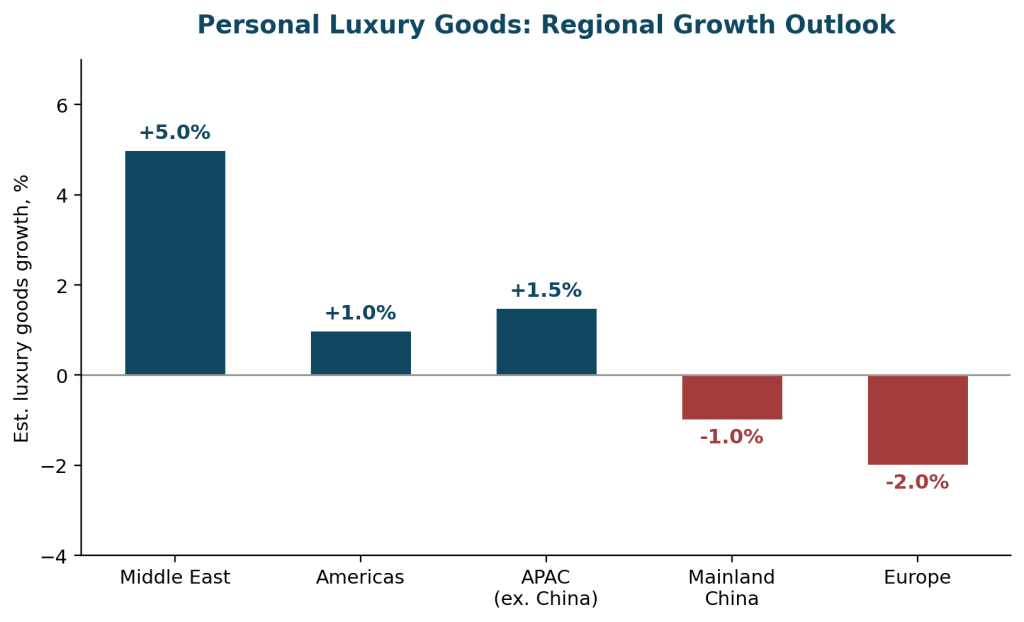
Fig. 2 – Estimated 2025 luxury goods growth by region, midpoints of Bain-Altagamma ranges. The Middle East and Americas are the clear bright spots; mainland China and Europe remain under pressure.
- Middle East: strong demand fueled by tourism from Dubai, Abu Dhabi, and Saudi Arabia; most robust region in the world.
- Americas: staying strong due to resilient US demand and growing presence in Mexico and Brazil.
- China Mainland: suffering from weak consumer confidence but showing some stability in late 2025.
- Europe: weakening with weakening tourist arrivals amid a strong euro and fatigue from tourism.

Fig. 3 – The affluent buyer now anchors luxury growth, a structural shift that rewards clienteling and personalization over broad-reach discounting.
Why Luxury Brands Keep Choosing Shopify
The speed and simplicity of Shopify seem to be antithetical to anything close to a white-glove retail experience.
However, thanks to the front-end flexibility of the platform and its enterprise controls via Shopify Plus, it is now the de facto go-to platform for businesses looking for a lightning-fast, secure, and infinitely customizable playground without building their own custom infrastructure.
Evidence from the field
This is not mere theory. Here are some of the best-known players in the luxury and premium retail industry who have production storefronts on Shopify Plus:
| Brand | Category | What the storefront demonstrates |
|---|---|---|
| Victoria Beckham | Luxury fashion | Editorial-grade design and bespoke customization on Shopify’s Prestige theme |
| Michael Kors (pre-loved) | Luxury fashion/resale | Circularity and resale commerce run natively on Shopify Plus |
| Cettire | Multi-brand luxury (500+ designers) | Marketplace-scale catalog with a premium, minimal front end |
| Fenty Beauty | Prestige beauty | Global DTC operations plus emerging commerce in immersive channels |
| Hirshleifers | Multi-brand luxury fashion (est. 1910) | A century-old retailer’s heritage translated into a modern storefront |
| Magda Butrym | Luxury fashion | Headless architecture delivering a 40% online sales lift post-migration |
Table 1 – Selected luxury and premium brands operating on Shopify/Shopify Plus.
The structural advantages
- Front-end freedom: Liquid templating and headless capabilities (Hydrogen + Storefront API) allow for the creation of a unique editorial experience versus another generic grid layout.
- Checkout extensibility: Shopify Functions and Checkout UI extensions make it possible to enforce specific brand logic, gifting policies, and even authentication all while avoiding fragile scripting.
- Infrastructure on a global scale without the bloat: Shopify Markets brings together currency, tax, and localization into a single admin, thereby sidestepping the vendor complexity that previously hindered luxury migration.
- Cheaper overall TCO: Enterprise-grade studies have pegged the equivalent Salesforce Commerce Cloud solution to be around 40-60% more costly yearly than a Shopify Plus counterpart when taking into account the license and integration costs.
- Scale proven by numbers: Shopify processed $14.6 billion in Black Friday/Cyber Monday 2025 sales on its own, a load scenario that can be trusted for luxury launch events and flash drops.


Core Strategic Pillars for High-Ticket Storefronts
A luxury storefront succeeds or fails on details a mass-market DTC brand can safely ignore. The five pillars below are where the highest-performing high-ticket brands concentrate their Shopify investment.
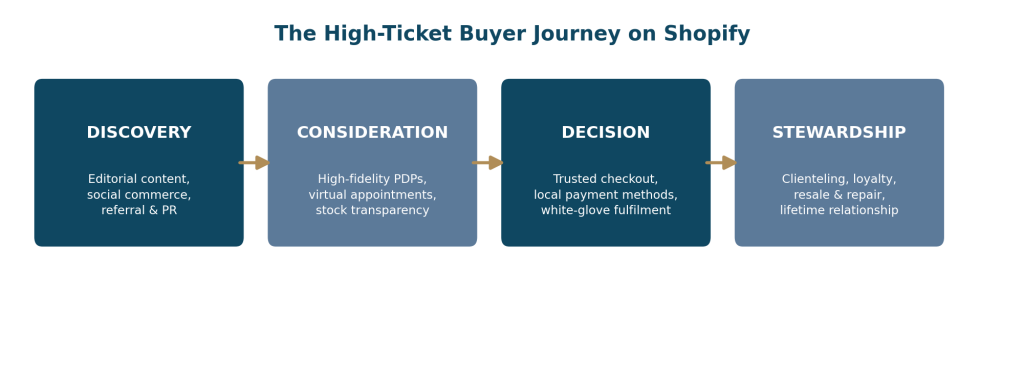
Fig. 4 — The high-ticket buyer journey rewards different tactics at each stage; checkout is a trust event, not a formality.
Editorial-grade brand storytelling
The high-end buyer is no longer comparison shopping for price but is being persuaded of how worthy the item and its brand are to spend on.
- In-depth narratives on the product page around heritage, raw materials, and quality of craftsmanship, not just technical specifications.
- Filmic visuals along with 360-degree or video views of the product, especially for jewelry, watches, and leather goods for whom tactile value matters.
- Use of custom Liquid templates and metafields to mimic the aesthetic of a high-end retail boutique, not simply a generic template.
Trust infrastructure at checkout
More hesitation will come from a $5 figure than a $50 figure, but that hesitation is revealed as cart abandonment if the checkout process does not provide some level of assurance.
According to Baymard Institute’s meta-analysis of numerous studies, the average ecommerce cart abandonment rate is around 70%. This is further increased rather than decreased with thoughtful, high-end purchases.
- Authenticity signals: certification, provenance information, and serial number validation within the order confirmation process.
- Flexible payment method: Shop Pay, installment payments (Shop Pay Installments, Klarna, Affirm), and appropriate regional/local payment systems can make the purchase psychologically less painful.
- White-glove fulfillment messaging: secure shipping, sign-for-delivery, and concierge order tracking all pre-announced before the customer completes the transaction.
- Checkout extensions sandboxed: Checkout UI extensions run in an isolated environment with no access to the checkout DOM or payment information, an important factor for merchants with premium gifting, engraving, or white-glove delivery rules without breaking their PCI compliance status.
Personalization and digital clienteling
The most consistent theme across 2026 luxury retail commentary is that hyperpersonalization is the single largest opportunity area, precisely because affluent shoppers expect the same one-to-one attention online that they receive in a flagship boutique.
- Unified customer profile based on online behavior, in-store purchasing, and stylist observations.
- Appointment setting for virtual visits right from the product page.
- AI-powered product suggestions based on tastes and purchases, not just based on bestsellers.
- Clienteling campaigns (alerts about restocks, special previews on birthdays, invitation to private sales) triggered by customer segments in Shopify & Flow.
Global reach without losing exclusivity
Luxury brands have been resistant to expansion internationally because controlled distribution is an integral part of the brand.
Shopify Markets and Shopify Plus internationalization tools allow the luxury brand to expand to growth markets such as the Middle East, Southeast Asia, and Latin America without compromising its controlled, invitation-only distribution system.
- Price and currency localisation: region-specific price lists versus a universal price point.
- Regional payment processing: Early access to Shopify Payments in the UAE and other regional launches limit the need for credit card payments where digital wallets reign supreme.
- Compliance and tax automation: Duties, VAT, and import taxes calculated at checkout time rather than after purchase, which creates a lot of friction in high-end orders.
Retention, resale, and lifetime value
As price hikes stop being a sufficient lever for growth in themselves, McKinsey currently sees luxury fashion growing by only 1-3% per year until 2027. That is why, in turn, retention becomes a more resilient growth engine than customer acquisition alone.
- Resale and circularity initiatives: brands like Michael Kors, Balenciaga, and Oscar de la Renta operate an authenticated resale service built right into the Shopify platform, reaching out to customers even after the initial purchase.
- Services such as repair, maintenance, and authentication become a long-term business relationship rather than a single transaction.
- Loyalty built on access (early access drops, appointment-based purchases, exclusive capsule collections), not discounts.
Benchmarks Worth Tracking
The metrics below are the ones worth putting in front of a leadership team building the business case for a Shopify Plus investment in a luxury storefront.
| Metric | Reported figure | Why it matters for high-ticket ecommerce |
|---|---|---|
| Global personal luxury goods market, 2026 | €365–373B (2–4% growth) | Sets the size of the addressable opportunity after a flat 2025 |
| Online / monobrand digital share of the market | ~28–30% | Confirms ecommerce is now a primary channel, not a secondary one |
| Affluent share of luxury spend, 2026 vs. 2019 | ~46–47% vs. 30% | Justifies investment in clienteling over broad discount-led acquisition |
| Watches & jewelry category revenue, 2024 | $152.95B | The single largest category opportunity for high-AOV storefronts |
| Average ecommerce cart abandonment | ~70.2% (Baymard meta-analysis) | The baseline friction every checkout experience must actively fight |
| Luxury fashion projected growth through 2027 | 1–3% annually (McKinsey) | Signals that retention and clienteling now matter more than price hikes |
| Shopify Plus vs. equivalent SFCC stack, annual cost | ~40–60% lower | A concrete TCO argument for platform migration |
Table 2 — Board-ready benchmarks for luxury and high-ticket ecommerce strategy on Shopify.
A Practical Rollout Sequence
Luxury brands rarely need a full replatform on day one. The sequence below reflects how most successful high-ticket migrations to Shopify Plus have actually been staged.
| Phase | Focus | Typical output |
|---|---|---|
| Phase 1 – Foundation | Theme architecture, brand system, PDP storytelling | A flagship-quality storefront reflecting brand tone and craftsmanship |
| Phase 2 – Trust & checkout | Payment mix, installment options, authenticity messaging | A checkout that reduces hesitation on five- and six-figure baskets |
| Phase 3 – Personalization | Unified customer profiles, clienteling tools, AI recommendations | One-to-one digital service that mirrors the in-boutique experience |
| Phase 4 – Global expansion | Shopify Markets, localized payments, compliance automation | Controlled entry into high-growth regions without diluting exclusivity |
| Phase 5 – Retention economy | Resale, repair, loyalty-by-access programs | A revenue stream and brand touchpoint that extends past first purchase |
Table 3 – A phased approach to building a high-ticket storefront on Shopify Plus.
The Bottom Line
Shopify never was the bottleneck for luxury e-commerce, and their list of partners is the proof: Victoria Beckham, Fenty Beauty, Michael Kors, Cettire, and Magda Butrym are not going for an off-the-shelf platform; they’re taking advantage of its flexibility to create something that looks like anything but that.
What we’re seeing from brands succeeding in luxury e-commerce today has a common thread: editorial storytelling rather than template-based design, a checkout designed with trust in mind, clienteling technology that turns everyone who visits the site into a boutique customer, and a customer retention strategy that doesn’t involve discounts to keep them.
None of those things are exclusive to any particular platform. All Shopify can do is provide the underlying infrastructure to deliver all of them without years of redevelopment across multiple vendors that luxury brands have always dreaded.
The key strategic question by 2026 isn’t if luxury needs to be online but if your storefront is doing enough to justify the choice.
Create a luxury ecommerce experience with Shopify Plus, advanced personalization, and enterprise-grade performance.

Pooja Upadhyay
Director Of People Operations & Client Relations
https://www.bain.com/insights/finding-a-new-longevity-for-luxury
https://altagamma.it/en/studi-e-ricerche
https://www.shopify.com/enterprise/blog/luxury-trends
https://www.shopify.com/enterprise/blog/luxury-fashion-ecommerce
https://www.shopify.com/enterprise/blog/global-ecommerce-statistics
