


The Year AI Stopped Being an EdTech Feature and Became a School Subject
From the 2026-27 academic year, a Class 3 student in India will learn computational thinking the same way they learn multiplication tables, as a compulsory part of school, not an elective app their parents bought.
This is the story most coverage of “AI in Indian EdTech” misses. The bigger shift isn’t happening inside a startup’s app. It’s happening inside the National Curriculum Framework.
First, the Reset Nobody Saw Coming: EdTech Had to Break Before It Could Get Smart
You can’t understand where AI is taking Indian EdTech without understanding the crash it’s rebuilding from.
India’s direct-to-consumer online K-12 EdTech market corrected from a venture-fantasy $22 billion valuation down to a real $2 to 3 billion in 2024-26, as BYJU’S collapsed into insolvency and investor money fled pure-play online models.
Physics Wallah, in sharp contrast, went public in November 2025 at a roughly $5 billion first-day market cap by proving a “phygital” model, physical coaching centres backed by digital content, actually works.

The Real Headline: AI Just Became a Government Mandate, Not a Startup Pitch
Most “AI in education” stories are about a company’s product roadmap. This one is about the Ministry of Education’s roadmap, which is a fundamentally different kind of change.
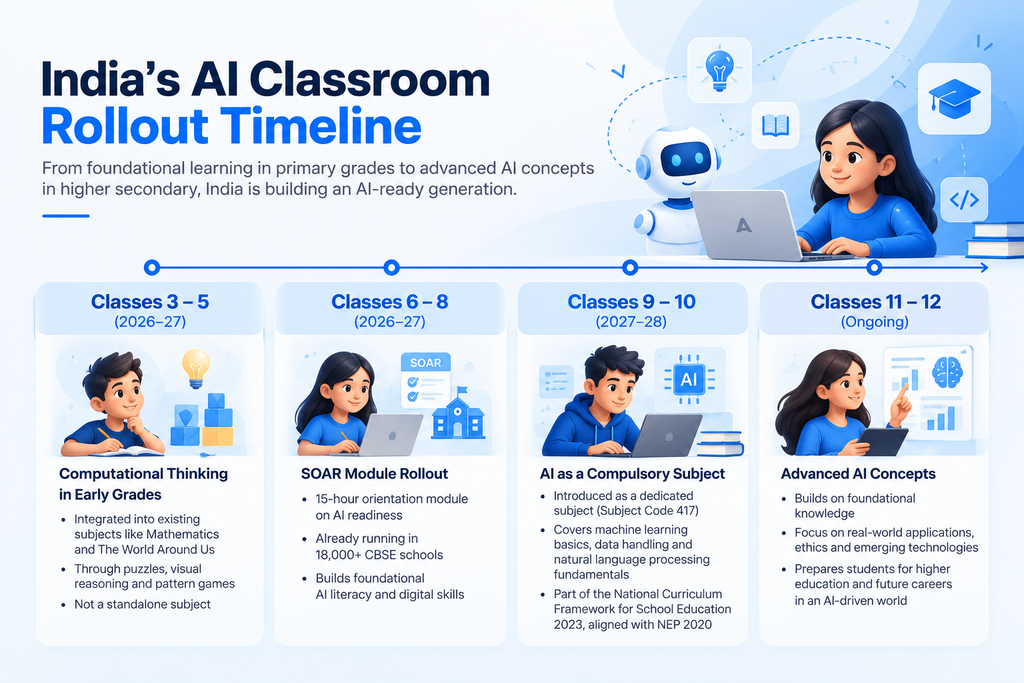
Starting the 2026-27 academic session, Computational Thinking and Artificial Intelligence become part of the school curriculum for Classes 3 to 8 under the National Curriculum Framework for School Education 2023, aligned with NEP 2020. AI becomes a compulsory board subject, Subject Code 417, for Classes 9 and 10 the following year, in 2027-28.
This isn’t a pilot. It’s one of the largest coordinated AI-literacy rollouts attempted by any national school system.
What an 8-Year-Old Actually Learns, and What a Teenager Learns Differently
The curriculum is deliberately paced, and the design choice here is worth understanding before you assume every child is about to start coding.
For Classes 3 to 5, computational thinking is woven into existing subjects like Mathematics and a subject called “The World Around Us,” through puzzles, visual reasoning and pattern games, not taught as a standalone subject.
By the time students reach Classes 9 and 10, AI becomes a dedicated, compulsory subject covering machine learning basics, data handling, and natural language processing fundamentals.
An expert committee chaired by Professor Karthik Raman of IIT Madras built this framework, and CBSE has already run a 15-hour orientation module called SOAR, Skilling for AI Readiness, across more than 18,000 schools ahead of the full rollout.
The Uncomfortable Statistic Every Rollout Story Has to Include
No honest account of this shift skips the infrastructure problem, because it’s the single biggest risk to whether any of this actually works.
About 50% of Indian schools lack basic digital infrastructure such as reliable electricity, internet access or computers, which directly threatens equitable access to the new curriculum. The government’s proposed workaround is “unplugged learning,” teaching AI concepts through physical activities and games that require no devices at all.
Teacher readiness carries the same asterisk. Structured, grade-wise training is being delivered through NISHTHA, but training 18,000-plus schools’ worth of teachers on a subject most of them never studied is not a switch you flip in one summer.
Inside the Classroom: What AI Tutoring Actually Does Differently Now
Step past the curriculum and into the tools themselves, because this is where “AI in EdTech” stops being policy and starts being product.
Google DeepMind’s LearnLM tutoring model demonstrated Socratic questioning and pedagogical feedback that received 76.4% educator approval with minimal edits required, and students working with it outperformed those paired with human tutors in controlled studies.
Separately, AI-generated assessments now show an 84.7% correlation with expert consensus while cutting question-generation time by over 99% compared to manual creation.
Adaptive systems that personalise not just content difficulty but pacing, modality and even the emotional tone of feedback have shown a 42% improvement in learning outcomes compared to static, one-size-fits-all instruction.
Teachers Aren’t Being Replaced, They’re Being Reassigned to the Job Only Humans Can Do
The most persistent fear around AI in education is job displacement for teachers. The pattern actually showing up in classrooms points somewhere else entirely.
By automating repetitive tasks like grading multiple-choice exams, tracking attendance and generating administrative reports, AI is freeing teachers to work as “learning designers” who use predictive dashboards to flag at-risk students before they fail a test, rather than after.
Instead of lecturing to thirty distracted students, a teacher can run a Socratic seminar or give one-on-one emotional support, the kind of work AI still cannot do.
The tradeoff surfacing alongside this: educators are noticing that when a system hands over an answer too quickly, students risk losing the ability to sit with a hard problem, which is why the 2026-27 curriculum leans hard into digital literacy alongside AI literacy, teaching students to verify information and recognise algorithmic bias rather than defer to it.


Where the Market Money Is Actually Going Now
Follow the funding and you can see exactly which bet EdTech investors are making after the BYJU’S correction.
K-12 EdTech remains the sector’s single biggest draw, accounting for 51% of all EdTech funding in India between 2021 and 2026 at $3.6 billion, more than double the next-highest category.
Physics Wallah’s Q3 FY26 revenue of ₹1,082 crore made it India’s largest EdTech company by revenue, built specifically on the phygital, not pure-digital, model.
Consolidation, not fresh funding, defined 2026. Unacademy, having raised $880 million historically, was acquired by upGrad in an all-stock deal cleared by India’s competition regulator in July 2026, a sign that scale now matters more than standalone survival.
What Experts Are Actually Saying About Where This Goes
The optimism about AI in Indian classrooms comes with real caveats from the people closest to the rollout.
The official government framing treats this as foundational literacy, not a technical elective: “Artificial Intelligence and Computational Thinking will reinforce the concept of learning, thinking, and teaching, and will gradually expand towards the idea of ‘AI for Public Good.’”
School Education and Literacy Secretary Sanjay Kumar has confirmed teacher training programmes were scheduled to begin during summer vacation specifically so schools would be ready when classes reopened.
Industry researchers watching adaptive learning platforms describe the technology’s direction plainly: “We’re seeing a 42% improvement in learning outcomes when AI systems personalize not just content difficulty, but also pacing, modality, and even the emotional tone of feedback. It’s like having a world-class tutor for every student.”
At the same time, coverage of the shift has been candid that “the conversation around data sovereignty is more intense than ever,” since adaptive platforms generate large volumes of sensitive student data that schools and regulators are still learning to govern.
People Also Ask
When does AI become a compulsory subject in Indian schools?
Computational Thinking and AI enter the curriculum for Classes 3 to 8 from the 2026-27 academic year. AI becomes a compulsory board subject specifically for Classes 9 and 10 from 2027-28, under Subject Code 417.
Will young children in India be taught to code as part of the new AI curriculum?
No, not initially. For Classes 3 to 5, the curriculum uses puzzles, visual reasoning and pattern-recognition games woven into existing subjects rather than teaching programming directly.
Is India’s EdTech market recovering after the BYJU’S collapse?
Yes, but on different terms. The pure-play online K-12 model that BYJU’S represented has been replaced by “phygital” models combining physical centres with digital content, exemplified by Physics Wallah’s successful November 2025 IPO.
Can AI tutors actually replace human teachers in India?
Current evidence points to augmentation rather than replacement. AI handles grading, assessment generation and administrative work, freeing teachers for mentoring, emotional support and higher-order discussion that AI cannot replicate.
What is the SOAR module in Indian schools?
SOAR, Skilling for AI Readiness, is a 15-hour AI orientation module already running in more than 18,000 CBSE-affiliated schools for Classes 6 to 8, ahead of the full national curriculum rollout.
What is the biggest risk to India’s AI education rollout?
Infrastructure. Roughly half of Indian schools lack the basic electricity, internet access or devices the curriculum assumes, which is why the government is also developing device-free “unplugged learning” activities.
Quick Answers for Voice and Conversational Search
What subject code is AI in CBSE schools?
Subject Code 417 for the compulsory Classes 9-10 course starting 2027-28, and Subject Code 843 for the Classes 11-12 elective, which has already been finalised.
How big is India’s EdTech market in 2026?
Estimates vary by methodology, ranging from about $3.6 billion to $7.5 billion depending on what is counted, with most forecasts projecting 14% to 28% annual growth through the early 2030s.
What grade does AI curriculum start in India?
Class 3, starting the 2026-27 academic year, through the National Curriculum Framework for School Education 2023.
Who leads India’s school AI curriculum design?
An expert committee chaired by Professor Karthik Raman of IIT Madras, working with CBSE and NCERT under the Ministry of Education.
The Part of This Story Still Being Written
Everything above is confirmed policy and live data as of September 2026. What happens next, whether the infrastructure gap closes fast enough, whether teacher training keeps pace with the syllabus, and whether AI-native platforms built for India’s languages and bandwidth constraints out-compete the phygital incumbents, is the genuinely open question heading into the 2027-28 rollout for Classes 9 and 10.
Watch the compute layer too. The same IndiaAI Mission subsidising GPU access for startups and MSMEs is also funding the datasets and application-development work that regional-language AI tutors will need to actually work in Tier 2 and Tier 3 classrooms, not just Delhi and Bengaluru pilot schools.
Ready to Build the Future of AI-Powered Education?

Pooja Upadhyay
Director Of People Operations & Client Relations
The Bottom Line
India isn’t waiting for EdTech companies to bring AI into classrooms. The government got there first, with a curriculum mandate that will make basic AI literacy as universal as reading by the time today’s Class 3 student reaches board exams.
The platforms that win the next phase of Indian EdTech won’t be the ones with the flashiest chatbot. They’ll be the ones that work on a shared tablet in a school with patchy electricity, in a language the curriculum was never originally written in.
