


Unified technology stacks quietly remove friction from product delivery, turning scattered tools into a cohesive system that accelerates every phase of the roadmap from discovery to release and iteration.
When planning speed, forecast accuracy, and engineering capacity actually depend on how unified your stack is, consolidation becomes a strategic lever, not just an IT clean‑up project.
The hidden advantage of unified technology stacks in accelerating product roadmaps
Why fragmented stacks quietly slow your roadmap
Most product teams don’t slow down because they lack ideas; they slow down because work is scattered across too many tools, tabs, and systems. Surveys of DevOps and IT professionals consistently show that tool sprawl is now a primary drag on delivery velocity, not an edge case.
- 75% of IT professionals lose 6–15 hours every week navigating an average of 7.4 DevOps tools just to ship applications.
- 94% are dissatisfied with their current toolsets, and only 22% can resolve engineering issues within one day due to fragmentation.
- Knowledge workers toggle between apps nearly 1,200 times per day, losing close to four hours per week purely to context switching.
Cost of fragmented tooling for product teams
| Metric | Data point | Source | Roadmap impact |
| Time lost to tool sprawl | 6–15 hours/week per developer | Port/Global Surveyz 2025 | Fewer sprint points completed; slipped milestones. |
| Average tools used to build applications | 7.4 DevOps tools | Port/Global Surveyz 2025 | Complex dependencies and coordination overhead. |
| Workers’ deep focus time | 39% of tracked time | Hubstaff 2026 + HBR research | Less sustained work on roadmap‑critical features. |
| Organisations using 20+ security/dev tools | 55% of orgs | Dark Reading, Trend Micro | Alert fatigue, slower risk mitigation. |
| Teams wanting toolchain consolidation | 64% of DevSecOps professionals | GitLab Global DevSecOps Survey 2024 | Strong internal appetite for unified platforms. |
The consequence isn’t just annoyance; it’s a measurable productivity tax that compounds across the roadmap.
One LinkedIn analysis of 250+ teams found developers spending 20.5% of their day on tool switching and information retrieval alone, time that does not move the roadmap forward.
When you multiply that across a year, you see why leaders now call tool fragmentation a multi‑billion‑dollar productivity problem.
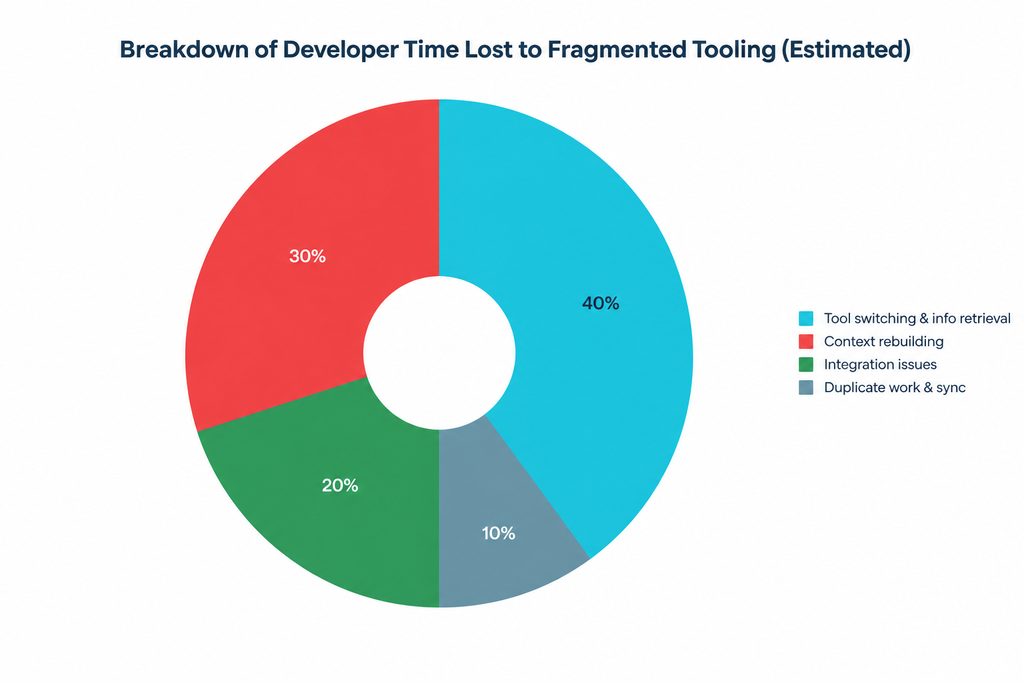
Here’s a simple breakdown of how that wasted time typically shows up inside engineering organisations, based on reported estimates of a $20B annual loss from fragmented developer workflows.
What a unified technology stack actually is
A unified technology stack is not “one tool to rule them all”; it’s a deliberately architected set of platforms that share identity, data models, and workflow context across product, engineering, and go‑to‑market teams.
Instead of stitching together dozens of point solutions with brittle integrations, you design a coherent backbone where roadmap, code, telemetry, customer data, and revenue signals flow through a small number of well‑integrated systems.
Key characteristics of a unified stack:
- End‑to‑end integration across lifecycle. Planning, development, testing, deployment, and customer feedback live on platforms that talk to each other natively.
- Shared source of truth for entities. Accounts, users, features, and events share a consistent identity graph across analytics, CRM, billing, and support.
- Standardised workflows instead of ad‑hoc scripts. Common patterns – feature rollouts, experiments, incident response are codified once and reused, not re‑implemented in each tool.
A technology roadmap itself is a visual representation of how your capabilities evolve to support specific business priorities, whether that’s healthcare, e‑commerce, or SaaS expansion.
When that roadmap is mapped onto a unified stack, you avoid duplication of efforts, reduce integration surprises, and make it easier to align investments with milestones.
The hidden advantage: how unified stacks accelerate product roadmaps
On the surface, unified stacks promise lower licensing costs and fewer tools but the real advantage is how they compress time across the roadmap.
The moment your planning, build, and GTM signals are connected, you start making faster, better decisions about what to ship, in what order, and with which level of risk.
1. Faster decision cycles and clearer priorities
When product analytics, CRM, marketing automation, billing, and support systems are wired into a single revenue engine, leaders can answer roadmap‑critical questions in hours instead of weeks.
- Questions like “Which accounts hit activation this week?” or “What is our renewal risk by cohort?” can surface directly inside Slack or dashboards, anchored in unified data.
- Forecast variance can shrink from ±25–30% down to single‑digit error margins, enabling more confident hiring and investment decisions aligned with roadmap phases.
The practical impact: backlog grooming, prioritisation, and trade‑off discussions stop being speculative and start being grounded in current product and customer behaviour.
2. Reduced integration toil and context rebuilding
Studies show that context switching can consume up to 40% of productive time, with workers taking roughly 23 minutes to fully regain focus after each interruption.
In fragmented toolchains, much of that lost focus is caused by hunting for information across systems that don’t share context.
A unified stack significantly reduces:
- Integration toil. Up to 40% of engineering time in fragmented environments is spent maintaining integrations instead of building features.
- Information archaeology. Workers can spend 30% of their time just looking for information in disconnected systems; unified stacks collapse those searches into a few well‑known interfaces.
Freeing this time translates directly into more roadmap items being completed per quarter without increasing headcount.
3. Better forecast accuracy and risk management
Technology roadmaps work best when they incorporate risk factors and timelines alongside capabilities. Unified stacks make those risk signals visible in real time by connecting monitoring, incident data, customer health scores, and revenue exposure.
- Dark Reading reports that 71% of teams struggle to manage fragmented toolchains, with many unable to act on at least a quarter of their alerts.
- GitLab’s DevSecOps survey found more than 78% of professionals wasting at least a quarter of their day keeping their toolchain running.
By consolidating these signals into a single platform or small set of platforms, you can spot roadmap risks earlier – whether that’s an unstable dependency, a cluster of at‑risk customers, or mounting technical debt in a critical service.
4. Compounding gains in go‑to‑market execution
Unified GTM stacks show similar acceleration benefits: PQL‑driven outreach improves conversion 20–40% compared with cold outreach, churn interventions save 10–20% of at‑risk ARR, and reclaimed RevOps hours further compound ROI.
These improvements feed directly back into the roadmap:
- Stronger product–market fit signals from unified analytics and GTM loops sharpen prioritisation for future releases.
- Reliable expansion and retention metrics justify bolder bets on roadmap initiatives that deepen value for high‑performing cohorts.


Unified vs fragmented stacks: impact on roadmaps
| Area | Fragmented stack | Unified stack |
| Planning | Decisions based on partial, lagging data. | Live product, revenue, and risk signals inform prioritisation. |
| Execution | 6–15 hours/week lost to tool sprawl. | More engineering time available for roadmap items. |
| Risk | 40%+ time on integrations and alerts, low actionability. | Centralised monitoring, faster mitigation of roadmap risks. |
| GTM alignment | Marketing/sales operate on separate data islands. | Single identity graph connects product usage to pipeline. |
| Forecast accuracy | ±25–30% variance in revenue forecasts. | Single‑digit variance via unified revenue intelligence. |
How unified stacks speed up each phase of the roadmap
To see the hidden advantage clearly, it helps to walk through the roadmap end‑to‑end and ask how unified stacks change the dynamics.
Discovery and problem framing
In the discovery phase, fragmented stacks scatter insights across analytics dashboards, support tickets, and CRM notes.
Unified stacks consolidate these into a single view of customer behaviour and feedback, helping teams detect patterns faster and frame more accurate problem statements.
- Product usage events feed directly into account health scores and pipeline views.
- Support trends and NPS data appear alongside feature adoption metrics, reducing blind spots when deciding which problems truly matter.
Prioritisation and roadmap design
Once you start saying “no” to most ideas, prioritisation quality becomes your primary lever. Unified stacks support this by pairing each potential roadmap item with real data on impact, effort, and risk.
- PQLs, churn risk, and expansion signals help rank items by revenue potential and customer value.
- Cost and capacity data from unified engineering and RevOps views keep plans realistic, reducing the chance of over‑committing.
Build and release
During implementation, fragmented toolchains often force teams to jump between issue trackers, CI/CD tools, observability dashboards, and chat platforms.
A unified development stack reduces handoffs by keeping coding, review, testing, and deployment in a single integrated environment.
- GitLab research shows more than half of DevOps teams juggle six or more tools, with 13% managing up to 14; consolidation helps recapture time currently spent on tooling maintenance.
- Full‑stack development approaches, where one team owns frontend, backend, and deployment, streamline collaboration and shorten release cycles.
Post‑release learning and iteration
Roadmaps only accelerate if learnings from each release quickly inform the next iteration. Unified stacks make this feedback loop tight and visible.
- Activation, engagement, and retention metrics update in near real time across analytics and GTM systems.
- Incident and performance data map directly onto features, so you can see which roadmap items improved stability and which introduced risk.
Visual snapshot: where the time really goes
To make the hidden advantage tangible, it helps to visualise how developers’ time is currently allocated in fragmented environments versus where unified stacks reclaim capacity.
Studies combining university research on task switching with industry surveys show that:
- Developers juggle an average of 14 tools daily, costing up to 40% of productive time due to context switching.
- 75% of IT professionals lose 6–15 hours per week to tool sprawl, and workers switch between apps roughly 1,200 times per day.
In fragmented toolchains, one analysis of a $20B productivity loss found the following breakdown:
- 40% of wasted time on tool switching and information retrieval.
- 30% on rebuilding context across systems.
- 20% on integration issues.
- 10% on duplicate work and synchronisation.
This is exactly the overhead unified stacks are designed to remove.
Implementing a unified stack without derailing the roadmap
The challenge is that most teams already have a sprawling toolchain; shutting everything off and starting over is rarely realistic.
Instead, the teams that successfully accelerate their roadmaps through unification follow a phased approach that respects current commitments.
1. Inventory and alignment with roadmap themes
Start with a simple inventory of every tool used for planning, development, operations, analytics, GTM, and support – along with subscription costs and owners.
Map each tool to your major roadmap themes (e.g., reliability, expansion, experimentation) and highlight overlaps and blind spots.
- Many teams discover duplicate tools for analytics, orchestration, or collaboration that can be consolidated quickly for immediate gains.
- This mapping often reveals critical capabilities that have no single owner or system of record – these become prime candidates for unification.
2. Define your spine: identity, data, and workflow
Rather than picking tools first, define the “spine” of your unified stack.
- Identity spine: Decide how users, accounts, and products will be represented consistently across systems.
- Data spine: Choose where event streams and state live (e.g., data warehouse, lakehouse, or unified analytics platform).
- Workflow spine: Establish where work items (epics, issues, campaigns) are created and tracked end‑to‑end.
Once this spine is clear, the roadmap can be updated to include milestone work for migrating key flows, without pausing feature delivery.
3. Consolidate around platforms that reduce cognitive load
Select platforms that responsibly collapse categories of work, not just add more dashboards.
- DevOps teams are increasingly adopting integrated developer platforms to escape DIY toolchains and regain focus on building features.
- RevOps teams are moving toward unified GTM operating systems that connect product usage, pipeline, and revenue signals.
Use explicit exit criteria for existing tools: for example, “we will retire Tool X once 90% of our experiments run through Platform Y and no critical data exists only in X.”
4. Tie unification work directly to roadmap outcomes
Finally, make unification part of the roadmap, not a side project.
- Create roadmap items for “Reduce mean time to detect by 30% via unified monitoring” or “Cut integration toil by half through platform consolidation.”
- Track metrics such as “context switches per day,” “time spent searching for information,” and “number of tools per workflow” as first‑class KPIs.
When unification work is explicitly connected to roadmap acceleration and you have data to prove it – it becomes much easier to secure buy‑in from engineering, product, and go‑to‑market stakeholders.
From a roadmap perspective, the “hidden advantage” of unified technology stacks is simple: they reduce the friction between intent and execution.
By consolidating tools into coherent platforms and connecting data across the lifecycle, you reclaim capacity, sharpen prioritisation, and shorten the distance between strategic themes on a slide and working features in production.
Build an Agency That Clients Choose for More Than Technology

Pooja Upadhyay
Director Of People Operations & Client Relations
Source URLs:
https://www.integrate.io/blog/how-data-teams-are-tackling-tool-sprawl/
https://www.youtube.com/watch?v=WyKKKrMNCO0
