


A multi-tenant eCommerce solution in Node.js is a system that has been built on one code base and deployment but can safely serve multiple merchants while isolating their data and performance.
The challenge is not how to implement CRUD; rather, the challenge lies in the very few initial decisions that cannot restrict you when scaling from tens to thousands of stores.
What “multi-tenant” really means for eCommerce
Multi-tenancy architecture means that one Node.js app is handling multiple tenants, that is, multiple customers who should not be aware of one another and share infrastructure.
However, every tenant is expected to have his own catalog, order history, users, and settings but the need for one deployment process, monitoring system, and API is felt at the same time.
For a business-to-business eCommerce solution, multi-tenancy architecture will enable cost-sharing of infrastructure and operation on behalf of merchants without setting up a complete system for each merchant individually.
High-level Node.js architecture for multi-tenant eCommerce
The pragmatic approach for a 2026 architecture is a modular Node.js backend (Express, Fastify, or NestJS) exposing REST or GraphQL APIs to multiple clients – web storefronts, mobile applications, and third party integrations.
All these clients call the same API layer, which then takes care of: authentication, tenant identification, tenant-scoped authorization, and routing calls to tenant-aware services and repositories.
It’s common practice today for SaaS startups to begin as a “modular monolith” in Node.js, where clear lines of separation are maintained between modules such as catalog, checkout, users, and billing; rather than directly going with microservices right from the start.
Once certain components become very popular, you may move them out into microservices.
Tenant identification: how the platform knows “who” this store is
Every request needs to have tenant context attached to it and needs to be handled only once in middleware before any business logic is executed. Some common methods that help in eCommerce sites are:
- Subdomains: brandA.yourplatform.com, brandB.yourplatform.com, which map cleanly to tenant records and give instant visual clarity.
- Custom headers: X-Tenant-ID for API clients and back-office tools where subdomains aren’t convenient.
- JWT claims: embedding tenant_id into access tokens so the tenant context travels with the user session.
In Node.js, the middleware needs to find the tenant ID (subdomain, header, or JWT token), check the ID against a master table of tenants, ensure that it is an active tenant, and create a complete tenant object with all details like ID, plan, routing info, feature flags, and limits.
No downstream method should accept a simple tenant ID since everything needs to be found from the context.
The core design decision: data isolation model
Your biggest early choice is how to isolate tenant data at the database layer. Three approaches are widely used:
| Approach | Isolation | Performance | Cost | Operational Complexity |
| Shared DB, shared schema | Low | Moderate | Low | Low |
| Shared DB, separate schema | Medium | Medium | Medium | Medium |
| Separate DB per tenant | High | High | High | High |
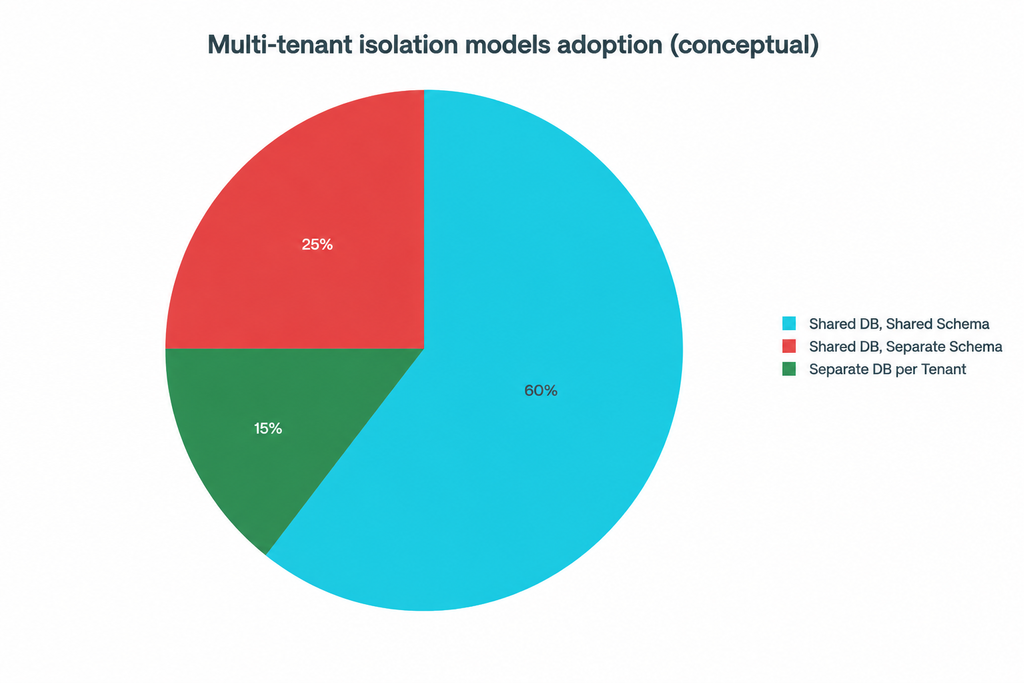
Practically speaking, the vast majority of Node.js-based SaaS systems begin with a shared database, shared schema, where a single PostgreSQL cluster houses tenant-specific data that can be differentiated through a tenant_id field for every row.
When you have more demanding tenants who require stricter compliance or performance, you simply “promote” them to different schemas or different databases.
Visualizing the isolation options
For an understanding of how teams generally strike this balance, a pie chart conceptually illustrating how this is done is shown below, which illustrates that many systems begin with a common schema, some use a separate schema for their mid-sized users, while a few even have separate databases for their high-compliance or very large users.
In the grouped bar chart below, the qualitative aspects of the trade-off have been illustrated: The shared schema approach is better on account of lower cost and ease while the separated databases approach scores better on the aspect of isolation but is costly and complex.
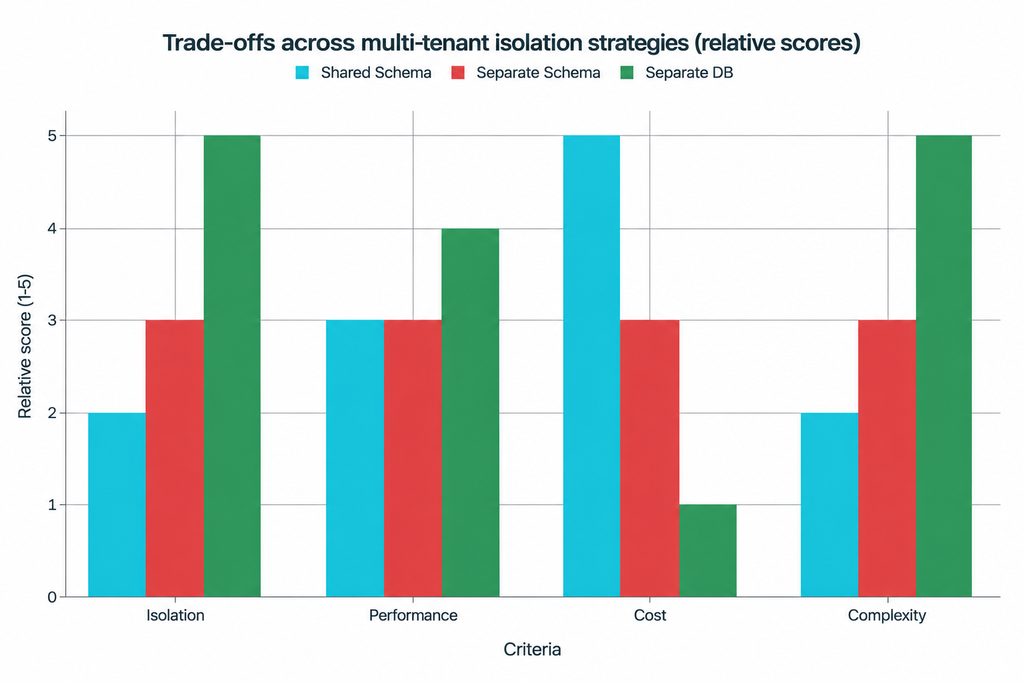
When you’re running a growing B2B eCommerce platform, it’s usually sensible to begin in the “shared schema + RLS” corner and design your tenant routing so you can later move individual merchants to “separate schema” or “separate DB” tiers as their plan and risk profile demand.
Database design: tenant-aware schemas that survive scale
Whatever isolation model you choose, a few schema rules are non-negotiable in a multi-tenant Node.js stack:
- tenant_id everywhere: Every table that holds tenant-specific data – products, categories, carts, orders, users, pricing rules – needs a tenant_id foreign key and it must be NOT NULL.
- Compound indexes: Create indexes on (tenant_id, primary_lookup_field) (for example, (tenant_id, sku) or (tenant_id, order_number)) to keep queries fast even with thousands of tenants.
- Row-level security (PostgreSQL): Enable RLS on all tenant tables, and define policies that only expose rows matching the current tenant context; application-level filtering is necessary but not sufficient.
For PostgreSQL, it’s common to store the current tenant in a session setting such as app.current_tenant_id, and let RLS policies and Prisma/ORM extensions automatically enforce tenant filters.
If you’re using MongoDB, the same principles apply: every document carries tenantId, and all queries add { tenantId: currentTenantId } so no user can see others’ catalog or orders.


Node.js data access: repositories that “see” the tenant
The safest pattern is a tenant-aware repository layer that automatically applies tenant filters, rather than trusting every developer to remember WHERE tenant_id = ? in every query. Popular Node.js stacks approach this in a few ways:
- Prisma client extension: Wrap all findMany, create, update, and delete calls so they transparently append tenant_id = currentTenantId to the underlying query.
- Base repository class: Implement a base repository that reads tenant context from AsyncLocalStorage and always injects it into query predicates.
- ORM instances per tenant: In database-per-tenant setups, create per-tenant Sequelize or Mongoose connections from a central TenantManager, rather than a single global connection.
Whatever you choose, you should also add a cross-tenant access integration test: create two tenants, write data under tenant A, and assert that a tenant B request cannot read it; run that test in CI on every pull request and block merges if it fails.
Request pipeline: routing, auth, and tenant resolution
A typical multi-tenant Node.js request flow for your eCommerce APIs looks like this:
- Routing: Express/Fastify routes match the incoming path (/products, /checkout, /orders) and HTTP verb.
- Authentication: JWT or OAuth 2.0 middleware validates user identity and attaches user roles, permissions, and tenant claims.
- Tenant resolution: Tenant middleware extracts the tenant identifier (subdomain/header/claim), retrieves tenant configuration from a master database, and sets the tenant context.
- Authorization & limits: Role-based access control (RBAC) checks whether the user can perform the requested operation in this tenant, and plan-aware middleware enforces limits like “maximum catalogs” or “monthly order volume.”
- Business logic & persistence: Services handle pricing, inventory, checkout, and fulfillment, using tenant-aware repositories to read and write data.
Designing this pipeline cleanly makes the rest of your platform feel simpler, because every route handler can assume “tenant and user are already resolved and validated” before it runs.
Security, RBAC, and compliance across tenants
Multi-tenancy multiplies the impact of security mistakes: one missing tenant filter can leak another merchant’s orders or customer data. To keep your eCommerce platform trustworthy:
- Strong authentication: Use OAuth 2.0 or JWT-based auth with short-lived access tokens and refresh tokens; embed tenant IDs and roles into JWT claims.
- Tenant-scoped RBAC: Define roles – Owner, Admin, Manager, Viewer – per tenant, and enforce them in middleware before handlers run, using numeric role levels or policy engines like Casbin.
- Audit logging: Write immutable audit logs for all sensitive writes and reads (e.g., refunds, price changes, role changes) with tenant ID, user ID, and timestamp, and let the database enforce append-only behavior.
For enterprise tenants with stricter compliance (PCI, SOC 2, GDPR), you may give them separate databases or schemas, plus dedicated encryption keys and stricter retention policies, while small merchants stay on the shared schema tier.
Performance, noisy neighbors, and scaling strategies
Multi-tenant platforms must avoid “noisy neighbor” scenarios where one high-traffic tenant degrades performance for everyone else. Some practical controls include:
- Per-tenant rate limiting: Use Redis-based counters keyed by tenant ID instead of IP, so a single merchant’s bulk operations don’t exhaust your request pool.
- Per-tenant statement timeouts: Set query timeouts per tenant or per plan in PostgreSQL so slow reports or large exports don’t monopolize database resources.
- Stateless services and caching: Keep your Node.js layer stateless, push file assets (images, PDFs) to S3 or similar, and use tenant-scoped cache keys like cache:${tenantId}:catalog to prevent cross-tenant cache leaks.
You can also design your subscription and usage tracking so that if a tenant repeatedly exceeds thresholds – API calls, database storage, background job volume – the system automatically suggests or triggers promotion to higher isolation tiers (e.g., dedicated schema or database).
Tenant-specific customization: branding, features, and configuration
Modern eCommerce merchants expect your platform to feel “theirs”: logo, color palette, domain, tax rules, payment gateways, and custom workflows.
Store this configuration centrally in a tenants table and related configuration tables – branding, payment_providers, tax_rules, shipping_profiles and load it into the tenant context on every request.
Feature flags per tenant let you roll out capabilities gradually (e.g., new checkout flow, AI-based recommendations) and price plans based on value: standard tenants share feature sets, while enterprise tenants can toggle bespoke modules.
This is also where you attach quotas (max products, max staff accounts, API call limits) and tie them into your plan enforcement middleware.
Observability: logging and monitoring with tenant context
When something breaks for a particular merchant, you need to see what’s happening through a tenant lens, not just at the cluster level.
- Structured logging: Use Pino or Winston to create JSON logs where each log contains tenantId, userId, and correlation ids; this ensures that one can filter logs of an individual tenant easily for troubleshooting.
- Metrics with tenant tags: Add tenant tags to metrics collected using Prometheus or time-series databases (request latency, error rates, db load) so that you know which tenant is creating spikes or degrading performance.
- Alerting and SLOs: Set up per-tenant service level objectives for important flows such as checkout or payment capturing, and alert when a specific tenant exceeds the defined thresholds.
This kind of visibility is crucial when your platform becomes mission-critical for merchants who rely on you for daily revenue.
Visually summarizing the trade-offs for architects
To recap the strategic options for your Node.js multi-tenant eCommerce architecture:
- Common schema & RLS: Quick to construct, inexpensive to operate, best suited for platforms at an early stage of development with numerous tiny tenants, but requires strict query discipline and RLS setup.
- Different schemas: Compromise solution for mid-level vendors; one database, but with better isolation and per-tenant migration/backup possibility, plus harder schema maintenance.
- Different databases: Best isolation and most obvious per-tenant backup/restore solution, for high-value or high-compliance tenants only due to costs.
The markdown table above, combined with the conceptual pie and bar charts, gives your product and engineering teams a common visual language to discuss where each tenant should sit today and how they might move as your platform and their businesses – grow.
Practical checklist for your Node.js multi-tenant eCommerce platform
Here’s a concise, human-friendly checklist you can use during architecture and code reviews:
- Tenant context is solved once within middleware and passed via req or AsyncLocalStorage; no function receives tenant ID directly.
- Each tenant-specific table/document contains tenant_id/tenantId which is NOT NULL with compound indexes on (tenant_id, key).
- PostgreSQL RLS or equivalent is used for shared schema architectures; policies use tenant context and you still add explicit tenant filtering to queries.
- Repositories or ORM extensions automatically apply tenant filters; you have CI tests that prove tenant B cannot access tenant A’s data.
- RBAC and auditing work for each tenant separately, and any critical action (refund, role change) is recorded using tenant and user id.
- Rate limiting and monitoring per tenant prevent problems with noisy neighbor tenants; you can move some tenants to higher isolation tiers without re-architecture.
If you get these design decisions right up front, your Node.js eCommerce platform will feel simple to extend, safe to scale, and credible for both startups and enterprises sharing the same multi-tenant backbone.
Build a Scalable eCommerce Platform with the Right Architecture

Pooja Upadhyay
Director Of People Operations & Client Relations
Source URLs:
https://oneuptime.com/blog/post/2026-01-25-multi-tenant-apis-nodejs/view
https://oneuptime.com/blog/post/2026-01-27-nodejs-multi-tenancy/view
