


“Your website should evolve at the same pace as your business strategy.”
That’s usually where the problem starts. The company grows, the offer becomes sharper, the brand voice matures, the sales process gets more sophisticated — but the website still looks like it belongs to an earlier version of the business. A site that once felt clean and modern can quietly start feeling dated, hard to navigate, or disconnected from the way the company now operates. And when that happens, the website stops supporting growth and starts slowing it down.
That’s why Webflow has become such a relevant conversation for modern businesses. It gives teams a way to redesign with more flexibility, launch faster, and keep the visual experience aligned with the brand without getting trapped in endless development cycles. For companies that care about design quality, speed, and control, that combination is hard to ignore.
Why Your Website Needs to Evolve with Your Business
A website is not a one-time project. It is a living part of your brand, and it should evolve as your positioning, services, audience, and goals evolve.
A startup website and a scale-up website should not feel the same. Neither should a small, service-led brand website and a mature, multi-offering business website. As companies grow, their websites need to communicate more clearly, support more user journeys, and do more than just “look good.” They need to guide visitors toward action, answer buying objections, and reflect the credibility the business has built over time.
This is where many businesses fall behind. They keep adding pages, banners, pop-ups, and content blocks without stepping back to ask a bigger question: does the site still represent who we are today?
That question matters because users notice the disconnect quickly. If the website feels outdated, cluttered, or inconsistent, the brand can feel less trustworthy — even if the business itself has grown stronger.


What Happens When the Website Falls Behind
When design stops matching the business, the impact is usually bigger than people expect.
The first issue is perception. Visitors often judge credibility in seconds, and design quality plays a huge role in that judgment. If the homepage still feels generic, the visual hierarchy is weak, or the mobile experience is frustrating, the user may leave before reading enough to understand your value.
The second issue is internal efficiency. A website that is difficult to update creates bottlenecks for marketing teams. Simple changes require developer time, content takes longer to publish, and campaigns move slower than they should. Over time, the website becomes a source of friction instead of a growth asset.
The third issue is conversion. When users cannot find what they need quickly, or when the site does not guide them naturally toward the next step, leads drop off. The business may still be getting traffic, but the site is not converting that attention into outcomes.
That is why redesigns are rarely just about visual refreshes. They are usually about fixing deeper business problems.
Why Webflow Is a Strong Fit for Modern Teams
Webflow stands out because it bridges design freedom and execution speed.
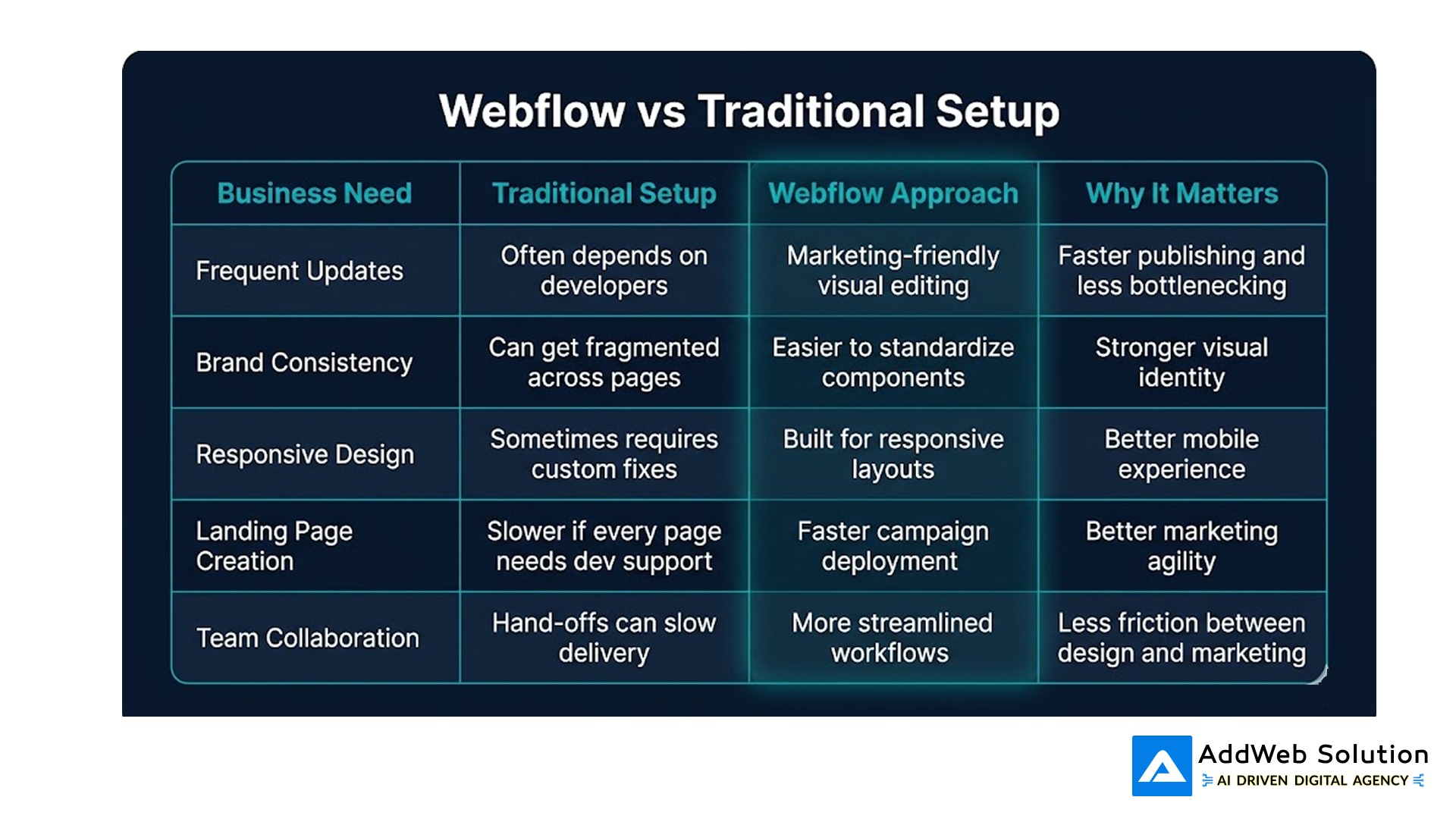
Traditional website workflows often force teams to choose between flexibility and control. Webflow reduces that tradeoff. It allows teams to build visually rich, responsive websites while keeping the structure organized enough for long-term management. For businesses that want to move quickly without sacrificing quality, that is a major advantage.
Here are the biggest reasons teams choose Webflow:
- It supports high-quality visual design without heavy dependence on custom development for every change.
- It makes responsive behavior easier to manage across devices.
- It helps marketing teams ship updates faster.
- It supports cleaner content workflows for landing pages, campaign pages, and brand updates.
- It gives businesses more control over presentation, which is especially useful when design consistency matters.
For growing brands, that matters because the website is often the first place where brand maturity becomes visible. If the business has evolved but the site still looks template-driven or outdated, the mismatch weakens the overall impression.
Webflow helps close that gap.
Why Teams Reconsider Their Website Stack
Why Redesigns Matter: The Data Angle
There is a practical reason website redesigns keep coming up in 2024 and 2025: they can improve results.
Responsive design continues to matter because users expect smooth experiences across desktop, tablet, and mobile. Search engines also prioritize mobile usability heavily, which means a site that does not perform well on mobile is likely hurting both visibility and conversion potential.
Industry research consistently shows that better website experiences are linked to better business outcomes. Businesses that redesign with a stronger user experience, clearer messaging, and better visual hierarchy often see improvements in engagement, lead generation, and conversion. That is why redesigns should be planned as business decisions, not just creative ones.
A good redesign should aim to improve:
- Bounce rate.
- Time on page.
- Conversion rate.
- Mobile usability.
- Content discoverability.
- Brand trust.
If your current website is underperforming in even two or three of these areas, a redesign may offer more value than small ongoing fixes.
Why Businesses Redesign

This is one of the clearest patterns in web strategy: companies rarely redesign because they are bored with the old look. They redesign because the site no longer supports the business at the level it needs to.
Website Platform Adoption
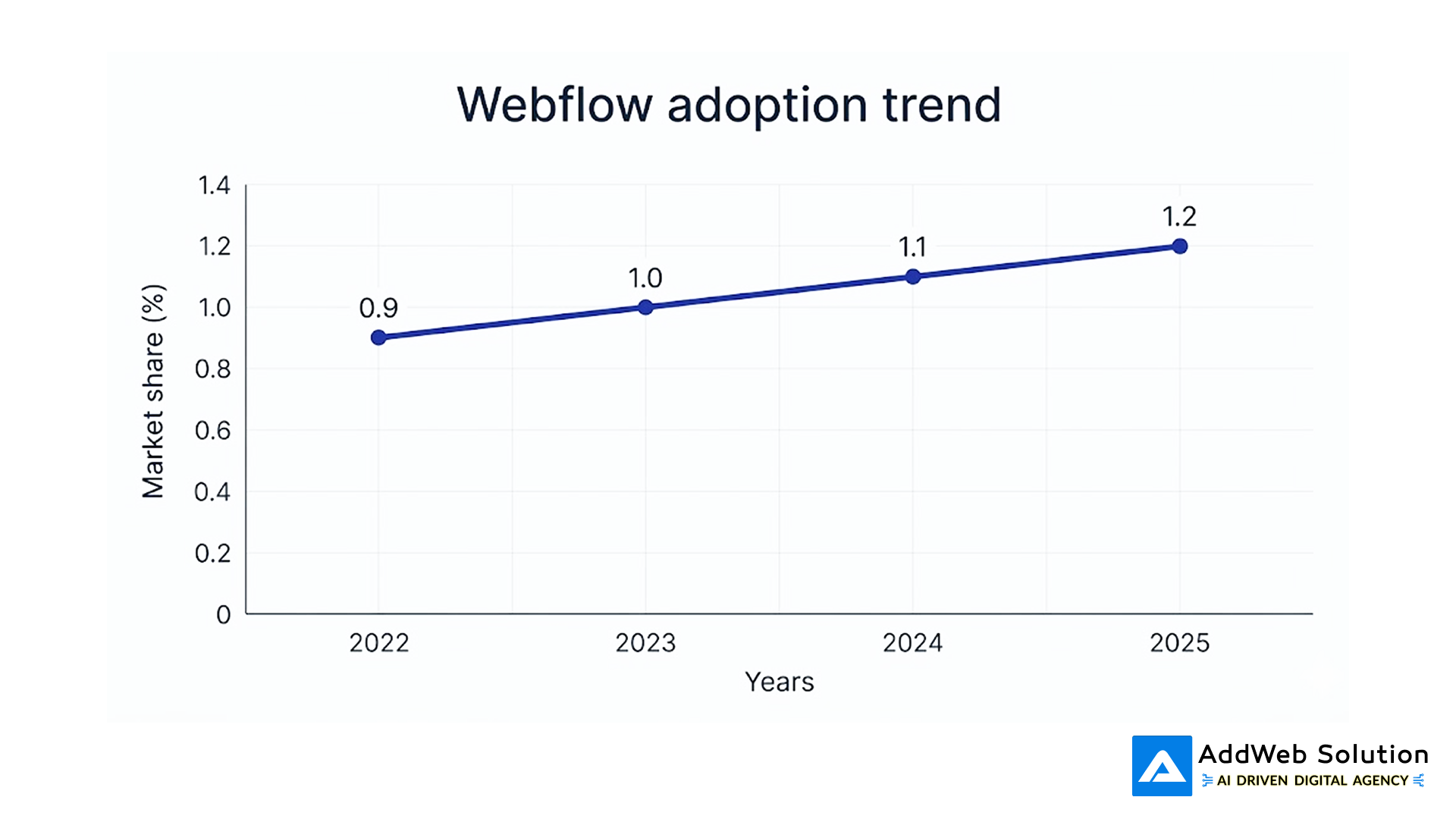
The growth pattern matters because it suggests Webflow is not a short-lived trend. It is becoming part of a broader shift toward more agile, design-led website creation.
Tools and Trends Shaping 2025
Several trends are shaping how businesses think about website design right now:
- Mobile-first behavior is no longer optional.
- AI-assisted content workflows are changing how quickly pages can be planned and updated.
- Faster campaign launches are becoming a competitive advantage.
- Design systems are increasingly used to keep websites consistent at scale.
- Businesses want fewer hand-offs and more direct control over content changes.
Webflow fits naturally into that environment because it allows design, content, and marketing teams to work closer together. That reduces delays and makes it easier to keep the website aligned with current business priorities.
For companies managing multiple campaigns, service pages, or brand refreshes, that efficiency can be a real advantage.
What a Good Webflow Redesign Should Do
A successful redesign should not stop at a new homepage.
It should improve the full user journey. That means cleaner navigation, stronger messaging, better page structure, improved responsiveness, faster load performance, and content that reflects the business as it exists today. If the site looks fresh but still fails to guide users clearly, the redesign is only half-done.
A strong Webflow project should help with:
- Brand alignment.
- Better storytelling.
- Stronger lead generation.
- Easier content updates.
- Better mobile usability.
- Faster campaign execution.
This is the real value of using Webflow for a business that has grown. It is not just about keeping up with design trends. It is about creating a website that matches the level of the company behind it.
Unlock the Power of Webflow Today

Pooja Upadhyay
Director Of People Operations & Client Relations
Conclusion
If your business has evolved, your website should not still be speaking in an older visual language. The best websites grow with the company, support the sales process, and make the brand feel current, credible, and easy to trust.
Webflow is especially useful for brands that want more design freedom, faster execution, and a website experience that feels modern without becoming difficult to manage. For teams that are ready to move beyond patchwork fixes, that can be the difference between a website that simply exists and one that actually helps the business grow.
At AddWeb Solution, that is the kind of website we value most — practical, strategic, and built to support the next stage of the business, not the last one.
Source URLs
- https://webflow.com
- https://webflow.com/resources/report/2025-state-of-the-website
- https://webflow.com/blog/webflow-conf-2025-keynote-recap
- https://webflow.com/blog/webflow-conf-2025-an-invitation-to-play
- https://developers.google.com/search/docs/crawling-indexing/mobile/mobile-sites-mobile-first-indexing
- https://w3techs.com/technologies/details/cm-webflow
- https://w3techs.com/technologies/report/ho-webflow
