


As you develop an AI product in 2023, someone from the team will likely come up with the idea of “let’s do it in Python.”
This suggestion is usually correct, but there is always more than meets the eye, in a lot of cases, Python is not enough for actual production, and there are other programming languages that may fit better.
In this article, we discuss the state of Python in 2026, its advantages and disadvantages, as well as compare it to such languages as Java, TypeScript, C++, Rust, Go, R, Julia, and Mojo.
All statistics are provided by a specific source with a date. Links to all sources are available at the end of the article.
Why the language decision still matters
The choice of a programming language for your AI project will not make or break it. According to a McKinsey 2025 survey, 88% of companies already apply AI in one of their business functions.
However, only 39% of those companies report earning profit throughout their entire organization. This is more about switching from experimentation to scalability. Yet, choosing a programming language is important in terms of six money-related criteria:
- Recruiting: the number of engineers and their wages.
- The time needed to build a working prototype: the existing software infrastructure, documentation, and framework.
- Compatibility of the ecosystem: the availability of models, vector databases, evaluation tools, and native SDK.
- The cost of operations: the number of CPU/GPU/RAM per second.
- Integration: ease of integration with the existing technology stack.
- Maintenance: who will debug it in three years?
Python in 2026: the numbers
To start off, let’s look at a brief overview first. These numbers have been taken from five different sources that have been tracking five different things.
| Measure | Latest reading | Source |
|---|---|---|
| TIOBE Index, Nov 2026 | #1 at 20.86%, down 2.51 points year on year | TIOBE, via TechRepublic and BestHub |
| PYPL Index, Nov 2026 | 52.04% of tutorial-search interest | PYPL, via TechRepublic |
| Stack Overflow 2026 survey | 58% use Python; 39.0% use it with AI tools or agents | Stack Overflow, via IT Brief and Codecademy |
| GitHub AI-tagged repos, Aug 2025 | 582,000 Python repos, up 50.7% year on year | GitHub Octoverse 2025 |
| PyTorch on Hugging Face Hub, Sep 2026 | 248,163 tagged models vs 17,342 for TensorFlow | Second Talent analysis |
What the popularity indices say
It tops both indices. As per the TIOBE index of November 2026, the position of Python is 20.86%, followed by C (11.48%), Java (8.89%), and C++ (8.35%).
The PYPL index, which considers how frequently people search for tutorials of different programming languages, has Python at 52.04%.
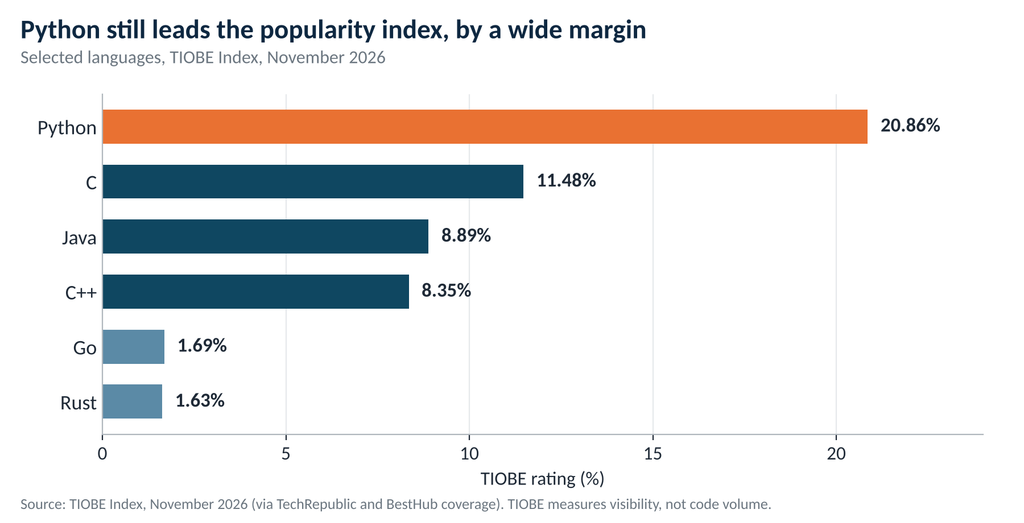
Source: BestHub summary of the TIOBE Index. Python 20.86%, C 11.48%, Java 8.89%, C++ 8.35%, Go 1.69%, Rust 1.63%.
In fact, we have to analyze this trend closely. For instance, the TIOBE index score of Python in July 2025 stood at 26.98%, while in November 2025 it went down to 23.37%. In September 2026, it went even lower to 17.76% only to bounce back again in the last couple of months.
Pay attention to the sudden jump in October, which was caused by TIOBE adding Mandarin searches from that point on (TechRepublic).
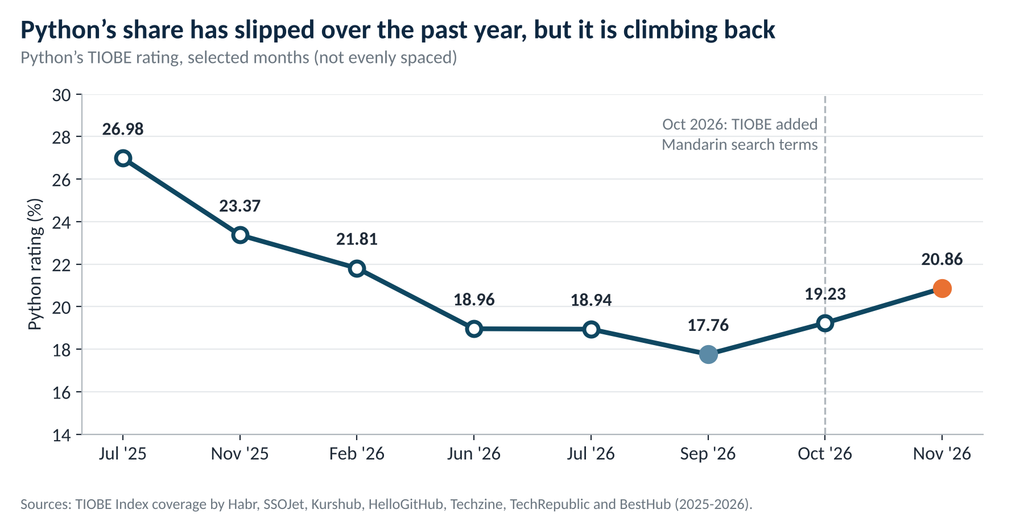
Sources: Habr, SSOJet, Kurshub, HelloGitHub, Techzine, TechRepublic, BestHub.
Two additional considerations worth mentioning. First of all, the TIOBE Index measures language visibility and not popularity in terms of use.
Secondly, according to an article at TechRepublic, the PYPL index does not measure usage and demand for a particular programming language, but rather the learning interest towards it. This data is important, but alone is not sufficient.
What developers actually use
The picture is painted in quite a different manner by Stack Overflow’s Developer Survey 2026 (which surveyed more than 30,000 people in 169 countries in October). The number one is still JavaScript with 62%, as it has been for the twelfth year in a row.
Python, taking second place with 58%, is just slightly ahead of SQL and HTML/CSS. When it comes to the field of AI, the picture changes; Python, taking second place behind JavaScript, becomes a preferred programming language when dealing with AI agents.
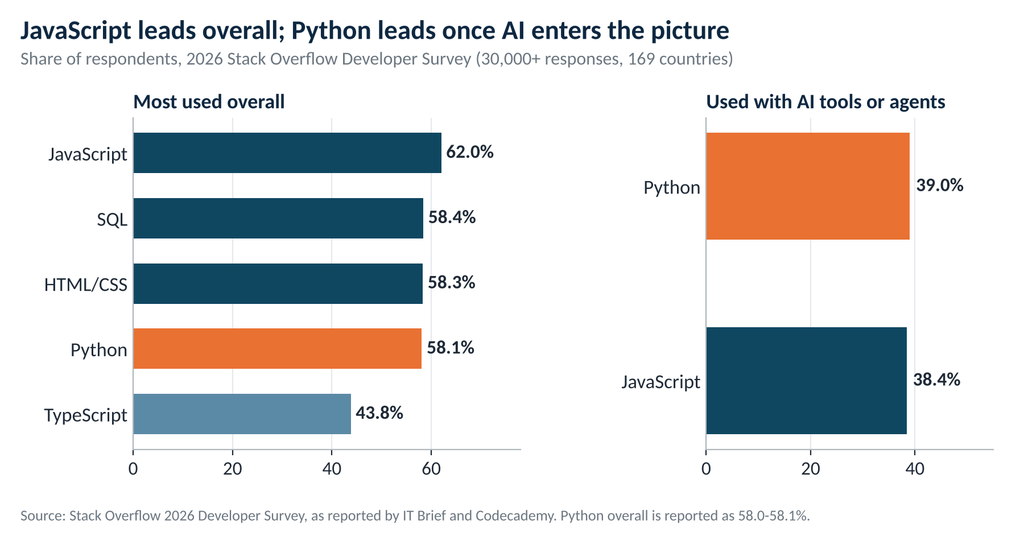
Sources: IT Brief, Codecademy, SSOJet (TypeScript 43.8%).
Where AI projects are actually built
The document, entitled the “GitHub Octoverse 2025,” presents the state of affairs in artificial intelligence clearly. When it comes to AI-tagged repositories, Python is at the helm with 582,000 projects, representing a 50.7% increase compared to last year’s 384,000.
Next in line is JavaScript with 88,000, followed by TypeScript with 86,000 projects. Shell and C++ lag far behind.

Source: GitHub Octoverse 2025. Repository counts are GitHub’s; percentages are calculated from them and cover only these five languages (772,800 repositories).
There’s a different perspective on this issue. As of August 2025, TypeScript was the most popular programming language on GitHub with 2,636,006 users per month (an increase of 66.6%), surpassing Python and JavaScript (GitHub, Visual Studio Magazine).
According to GitHub, one of the reasons behind this increase is AI coding because typed languages are capable of identifying mistakes. All of these trends correlate well. On the one hand, Python is the language best suited for AI.
Why Python keeps winning AI work
A framework layer the industry has settled on
Models and training loops, as well as anything associated with that, are made using PyTorch. In Second Talent’s analysis of Hugging Face Hub datasets (as of Sep 21, 2026), there are 248,163 PyTorch models against 17,342 TensorFlow models, 12,125 JAX, and 7,267 Keras.
In terms of downloads on PyPI in August 2026, PyTorch leads with 86.2 million downloads, compared to 16.7 million for TensorFlow.
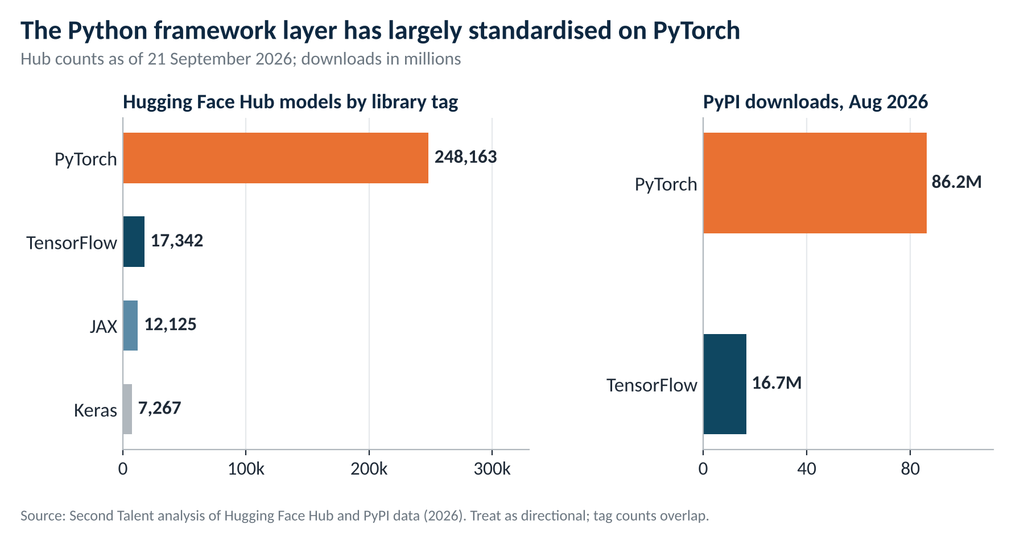
Source: Second Talent. A model can carry more than one tag, so treat the counts as directional.
It is also said that around 80-85% of research papers are coded in PyTorch. These statistics are usually cited by people; however, it should be remembered that the statistics were only obtained from trend charts since there is currently no live data available, as the link Papers with Code was redirected to Hugging Face.
Python is the control layer, not the engine
It is always said that “Python is slow,” and this is true when it comes to a basic Python for loop. However, this is not the case for learning and inference, because all the work is done by the compiled libraries.
While PyTorch attempts to integrate itself better into Python than just a wrapper around an immense C++ system, its increased performance is due to the backend tools.
Talent and time to prototype
Python is fundamentally the fourth most popular programming language and the one used for AI projects in the world, according to Stack Overflow.
This would mean an increase in the number of people you can hire, availability of sample data, and easy prototyping. It also minimizes the chance of being locked out by a handful of professionals.
The interpreter itself is changing
This is what each of these three Python releases has delivered.
| Release | Date | What it means for AI teams |
|---|---|---|
| Python 3.13 | October 2024 | Experimental free-threaded build (no Global Interpreter Lock). Early builds ran roughly 40% slower on single-threaded code. |
| Python 3.14 | October 2025 | Free-threaded build becomes officially supported but stays opt-in; single-thread overhead is down to about 5 to 10%. An experimental JIT ships off by default and cannot yet run together with free-threading. |
| Python 3.15 | 9 October 2026 | Faster JIT (about 7 to 8% geometric-mean gain on x86-64 Linux in published benchmarks), explicit lazy imports, UTF-8 by default, a stable ABI for free-threaded builds, and free-threading support in the macOS installers. |
Sources: InfoWorld, pydevtools on PEP 779, technical review of 3.14, BetaNews, Mynavi, Linuxiac.
That doesn’t mean that Python becomes a system language. Free threading versions are available, but they introduce overhead and require library support. The wise choice for AI teams would be to wait for the three releases and test them with their workloads.


Where Python falls short
It is important to take the constraints into account when assessing the performance of the system. Here are the four most significant constraints in terms of transitioning from prototype to production in a business context.
- Raw performance of the custom code: Pure Python CPU-bound tight loops perform much worse compared to the same logic written in C++, Rust, and Go. The improvements in the 3.15 JIT do not affect the general picture.
- Parallelism: The free-threading feature was introduced in 3.14 although still optional. The technical review states that the free-threading feature adds approximately 20% overhead to the memory usage and requires compatible dependencies.
- Footprint: It can be noted that Python applications tend to have a larger footprint and dependency graph compared to applications created in compiled languages. The company specializing in Rust development (Netrom Software) claims that a smaller runtime means lower cost in terms of CPU and RAM. It is a vendor claim but can be verified on your workload.
- Reliability at scale: Due to dynamic typing in Python, more errors pass unnoticed until runtime. According to GitHub, the trend towards the introduction of typed languages is driven by the necessity to increase reliability at scale.
How the other languages compare
Still, Python takes the crown when it comes to training models, but there is nothing else that competes in this regard. However, some programming languages are preferable for different layers of the system. See the table below and note the TIOBE index ranking of each of them.
| Language | Best fit in AI work | Main strengths | Main trade-offs | TIOBE, Nov 2026 |
|---|---|---|---|---|
| Python | Models, data pipelines, prototyping, orchestration | Largest AI ecosystem; PyTorch and Hugging Face; deep talent pool | Slower raw execution; heavier runtime; parallelism still opt-in | #1 (20.86%) |
| JavaScript / TypeScript | AI features in web apps, API layers, agent front ends | Runs wherever users are; typed code aids reliability; TypeScript #1 on GitHub by contributors | Thin training and research ecosystem | JavaScript #6 |
| Java | Enterprise integration, regulated systems, AI features in existing platforms | Spring AI 1.0; mature security, operations and tooling | Models are usually trained elsewhere and called over an API | #3 (8.89%) |
| C and C++ | Inference engines, GPU kernels, embedded devices | Maximum control and speed; underpin the major frameworks | Slower development; higher skill bar; memory-safety risk | C #2 (11.48%), C++ #4 (8.35%) |
| Rust | Production inference services, edge runtimes, data infrastructure | Memory safety; small footprint; Candle, Burn and ONNX Runtime bindings | Smaller ML ecosystem; steeper learning curve | #11 (1.63%) |
| Go | Services and tooling around models | Simple concurrency; fits cloud-native stacks; in GitHub’s top ten for 2025 | Few ML libraries; model work happens elsewhere | #10 (1.69%) |
| R | Statistics, analytics, reporting | Statistical depth; strong in research-driven teams | Less suited to general production services | #7 |
| Julia | Scientific computing, simulation | High-performance numerical code | Smaller ecosystem and talent pool | #23 after a brief return to the top 20 |
| Mojo | Performance-critical AI kernels (emerging) | Python-like syntax with systems-level control; one source for CPUs and GPUs | 1.0 arrived August 2026; libraries still young | n/a |
Sources: TIOBE ranking summary, Slashdot top-10 list, Spring AI 1.0 (InfoQ), GitHub Octoverse, Netrom Software, The Register on Mojo. Strengths and trade-offs are this guide’s summary of those sources.
JavaScript and TypeScript
The two rules are what the product layer does. According to GitHub, there are 88k repositories with AI and JavaScript, 86k with TypeScript, and more than 1.1 million repositories with LLM SDK.
These have increased 24.8%, 77.9%, and 178% each year on a year-on-year basis, respectively (GitHub). What they do is build the interfaces, including chat fronts, response streaming, agent dashboards, and API integration.
As per GitHub, this stack is known as hybrid, where Python builds the data pipeline, and TypeScript builds the application layer and API (Linuxiac’s overview). There is no model training involved.
Java
Java takes the third spot on TIOBE, beating C++ by 0.54 points in November 2026. The key trend that defines the development path in AI is integration.
Spring AI 1.0 was released in May 2025, including support for multiple models, outputs mapped into Java objects, retrieval-augmented generation, and the Model Context Protocol.
According to VMware Tanzu, many companies continue to rely on Java-based technologies, and the inclusion of AI does not require changes to the entire technology stack (Tanzu). This is usually the fastest way for banks, insurers, and large retailers with vast Spring infrastructures.
C and C++
C and C++ are the languages of choice for this class of programming. C continues to be ranked second in popularity among TIOBE’s top ten languages with a share of 11.48%, 1.80 points higher than the previous year.
C++ has fallen to seventh with a share of 3.24%. The annual increase in usage for C comes from continued demand for systems and embedded programming.
When it comes to AI programming, the core frameworks depend on the compiled backend and libraries provided by the vendors.
There are only 7,800 GitHub projects with AI keywords that use C++ as their main language.
Enterprises generally don’t develop this part themselves; it is done during inference engine development, custom GPU kernels, or hardware resource-constrained solutions.
Rust
In July 2026, Rust entered the TIOBE top ten, but by November it fell back to eleventh with 1.63%, gaining 0.25% year over year, meaning that the movement was caused by tightness rather than by Rust’s decline.
As for the usage of Rust in the sphere of AI, its real power lies in inference services.
According to Netrom Software, while Python is used for model training, inference services, edge runtimes, and data pipelines are implemented with Rust.
The workflow suggested is the following: train in Python, save in ONNX or GGUF, and then deploy a Rust-based service (Netrom Software). There is even a new Candle framework from Hugging Face allowing to run LLaMA, Whisper, and T5 models without Python runtime.
Moreover, Rust is not competing with Python in research (the same source).
Go
The Go programming language took away the position from Rust in the TIOBE index in the month of November, 2026 and ranked tenth, scoring 1.69%. Also, it made an appearance in the list of top ten languages on GitHub in the year 2025.
In AI systems, Go appears in the service layer above the model layer, including API, queuing system, and tooling, but it does not appear within the code of the model itself.
R and Julia
R is still one of the TIOBE top ten programming languages in November 2026. It works well with statistics but is not an optimal choice for customer-oriented services.
Currently, the trendy language is Julia, which made its way back to the TIOBE top twenty languages in October 2026 after being absent for nearly three years and fell down to twenty-third place a month later (Techzine, BestHub).
Mojo
R is still one of the TIOBE top ten programming languages in November 2026. It works well with statistics but is not an optimal choice for customer-oriented services.
Currently, the trendy language is Julia, which made its way back to the TIOBE top twenty languages in October 2026 after being absent for nearly three years and fell down to twenty-third place a month later (Techzine, BestHub).
Matching a language to your situation
Here’s the advice, not the absolute benchmark result. Take it as a starting point and verify against your constraints.
| Your priority | Start with | Add when needed |
|---|---|---|
| Ship an AI product quickly | Python, using PyTorch, Hugging Face or hosted model APIs | TypeScript front end |
| Add AI features to an existing Java platform | Java with Spring AI, calling hosted or Python-served models | A small Python service for custom models |
| Customer-facing web or mobile app with AI features | TypeScript front end with a Python backend | Go or Java services as traffic grows |
| Cut inference cost or latency at scale | Python for training; Rust or C++ for serving | Profile first and move only the hot path |
| Statistics and analytics workloads | R or Python | Julia for heavy numerical work |
| On-device or embedded AI | C++ or Rust for the runtime; Python for training | Export through ONNX or similar formats |
Five situations, five defaults
You are validating your assumption or creating an MVP
Go for Python with the model API hosting or the open model from Hugging Face. At this point, the task is learning whether the product works. Language performance is not yet the bottleneck, and the ecosystem saves you weeks.
You are managing the large Java environment
Maintain AI features within your current infrastructure using Spring AI. Introduce a Python service only in case of specific needs for custom models and data science tasks that require the Java libraries too much. Thus, keep security reviews, deployment pipelines, and the list of supported models in check.
Your product is mostly a web/mobile application
Develop the user interface in TypeScript, while hiding the model and data logic behind the Python API. This division corresponds to what GitHub says about a hybrid stack and allows splitting work of frontend and data teams.
Latency, cost per request, or resource limitations of the device are major concerns
Train the model in Python, then analyze the model serving pipeline carefully. Rust and C++ can be used in such situations as well. Start with measuring; many systems turn out to be constrained by the model or networking, rather than by the language in which they are wrapped.
Your team consists of analysts/statisticians
In case the output of your team is an analysis, R is still a good option. In case of further productization, Python acts as the bridge to engineering teams.
How the main options score
This is my subjective view of the whole process of AI products’ development in general. It is not a benchmark, and it will not fit any particular project. The Python rating depends mostly on the information from the survey and the repositories mentioned above; the rest is the result of our previous discussion.
| Language | AI libraries | Talent pool | Prototype speed | Runtime speed | Enterprise fit |
|---|---|---|---|---|---|
| Python | Strong | Strong | Strong | Moderate | Moderate |
| TypeScript / JS | Moderate | Strong | Strong | Moderate | Strong |
| Java | Moderate | Strong | Moderate | Strong | Strong |
| C++ | Moderate | Moderate | Limited | Strong | Moderate |
| Rust | Limited | Limited | Limited | Strong | Moderate |
| Go | Limited | Moderate | Moderate | Strong | Moderate |
The hybrid stack most teams end up with
When analyzing an AI product developed well enough, you will not see just one programming language used there. What you will see is a hierarchical structure based on the use of various languages for particular purposes.
This structure is shown in the following diagram. Python is in the center; models and data are there. TypeScript/JavaScript/Java go above it; they communicate with users and enterprises. C++/Rust/Mojo go under it because of performance requirements.

Two practices maintain the hybrid stack. Firstly, make sure that models are portable. The common practice is to train using Python and deploy to one of the formats such as ONNX or GGUF. It enables one to choose the serving language later.
Secondly, measure before you refactor. Profile the working application and then only convert the hot path to Rust or C++ rather than replacing some working piece of code.
Language is one decision among several
It is easy to spend many months on making this decision and then get stuck due to some other factors.
McKinsey’s survey conducted in 2025 among 1,993 respondents in 105 countries showed that 62% of businesses were experimenting with agents, while 23% of them were deploying agents in production somewhere.
None of the business functions had more than 10% scaling agents. Approximately 6% of respondents could be defined as “AI high performers,” which means that their income was more than 5% from AI.
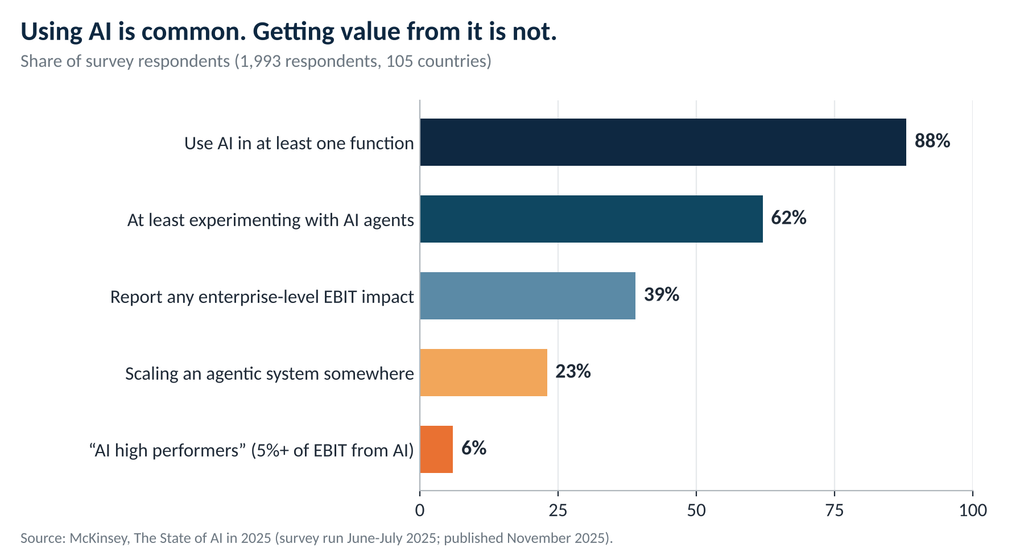
Source: McKinsey, The State of AI in 2025, with figures also reported by IT Brief and Marketing AI Institute.
The development side of things is no different. Only 24% of the participants in Stack Overflow’s 2026 survey said that their company had approved any of the AI tools, and only 6.6% would trust AI to make any decision (IT Brief UK, IT Brief Australia).
Evaluation, preparation of data, and governance require just as much consideration as language selection.
A practical checklist before you commit
- And here are the practical steps:
- Identify the rigid requirements. Consider aspects such as latency requirements, target devices, compliance requirements, and any other systems you need to integrate.
- Count the people you have. Whom do you want to hire? Whom do you already have? The language won’t be the default choice if your employees aren’t able to speak it.
- Create prototypes in Python unless there are some reasons not to. Your development speed will increase, and the ecosystem is richer.
- Make the model portable. Formats like ONNX and GGUF keep the options for the serving language open.
- Measure first. Study your production traffic before rewriting something. Move only the code that is proven to be slow.
- Test new Python capabilities on your workload. Multithreading and JIT compilation are optional in Python builds and aren’t supported by many tools in the ecosystem.
- Establish evaluation and governance processes. The majority of companies are still in the pilot phase, and AI guidelines are almost never written.
- Check your choice annually. The ranking of programming languages changes fast enough. Rust got tenth place in the TIOBE Index in 2026 and then was dropped out after four months.
Frequently asked questions
Is Python too slow for production AI?
For most use cases, no. Training and inference are dominated by compiled libraries, and Python mostly orchestrates those processes. It becomes a bottleneck only in custom CPU-bound logic and in ultra-high throughput production serving. The solution here is usually to shift the hot path to a Rust or C++ codebase.
Is Python falling behind?
According to TIOBE index ratings, Python fell 2.51% points year-to-year, but still maintains a clear lead – almost nine points ahead of C and recovering from September’s 17.76%. On GitHub, TypeScript overtook it in August 2025 by number of contributors, but Python still dominates among AI-tagged repositories. Bottom line: Python loses its share of general-purpose software development efforts while maintaining leadership in AI projects.
Is it time for a move to Mojo yet?
No, for a production product roadmap. Python version 1.0 has been released, and stability guarantees are not great, and the ecosystem is young. But if you have GPU-intensive parts that are hard to implement efficiently in both Python and C++, a small pilot project may be justified.
Can we develop AI functionality in Java or JavaScript?
Yes, if your functionality relies on hosted or separately served models. Spring AI is your library for Java, and LLM SDKs for JavaScript/TypeScript. Python will still be useful for custom training and fine-tuning and data processing.
What about TensorFlow?
TensorFlow is still present in many existing systems. New developments use PyTorch much more actively, judging by the Hub tags and PyPI downloads. If you maintain TensorFlow-based code, make sure that your dependencies are compatible with the planned versions of Python before upgrading.
The bottom line
Python remains the right choice for most businesses building AI in 2026. It has the best ecosystem, the largest talent pool, the most evidence of actual use in AI, and its core team is closing gaps in performance and parallelism.
This is the starting point, not the whole stack. Expect TypeScript or Java around it for product development and integration, and C++ or Rust under it in places where speed, efficiency, or device limitations require.
Select languages layer-by-layer depending on the constraints you know, and reevaluate as evidence updates.
Build Your AI Solution with the Right Technology

Pooja Upadhyay
Director Of People Operations & Client Relations
Sources
https://www.tiobe.com/tiobe-index
https://www.techrepublic.com/article/news-tiobe-november-2026-java-overtakes-cpp
https://www.infoworld.com/article/3975624/the-best-new-features-and-fixes-in-python-3-14.html
https://peps.python.org/pep-0779
https://github.com/pytorch/pytorch
https://www.infoq.com/news/2025/05/spring-ai-1-0-streamlines-apps
