


The Solo Founder Moment
No longer does the solo founder need to think small. In fact, bootstrapped startups are more likely to be founded by a solo founder than those that are funded, at 38% compared to 17% overall, and only 10-12% in the public SaaS world. And yet, one-person companies are beginning to achieve six- and seven-figure revenue numbers through the use of modern SaaS infrastructure, AI, and automation, rather than people counts.
Almost 70% of small businesses are using AI tools regularly, with the SaaS stack costing between 100-500 dollars a month, which is less than the salary of a junior developer in most countries. Add to this the collapse in cloud infrastructure pricing, the rise of low/no code, and it’s clear the world has finally become favorable to the solo builder.
What “enterprise‑grade” really means
So, before we dive into the topic of technology, let me first define what bar we’re trying to hit here. When an enterprise buyer says, “I want enterprise-grade,” they’re usually thinking along these lines:
- Scalability: Will this thing scale with our growing user base, data, and traffic without dying on us?
- Reliability: Will this thing be reliable in terms of uptime, monitoring, and response to incidents?
- Security & compliance: Will this thing be secure and comply with our security posture and regulatory requirements?
- Integrations: Will this thing integrate with our existing ecosystem, such as our CRM, HRIS, SSO, billing, and data warehouse?
- Governance & analytics: Will this thing give us good governance and analytics for our managers and admins?
Ten years ago, if we wanted to build a solution that was enterprise-grade, we’d have to hire specialists in infrastructure, security, DevOps, and integrations, and so on. Today, a huge portion of what we’d call “enterprise-grade” is now provided as a managed service and API, and we can integrate those ourselves. Auth0, for example, provides enterprise-grade auth and SSO through a few config screens and SDK calls, rather than building a custom security solution ourselves.
The five tech shifts that favor solo founders
1. Cloud infrastructure at commodity prices
Cloud storage and compute resources have become significantly less expensive and more powerful over time. For instance, AWS has lowered its prices for Standard storage in Amazon S3 by around 84% from 2010 to 2015, and similar price drops have occurred for Microsoft Azure and Google Cloud Platform for their respective flagship cloud storage offerings. Competition among public cloud providers has resulted in a decrease of around 66% in prices for entry-level compute resources in just two years in the mid-2010s, and new-gen cloud infrastructure continues to follow a declining price and increasing efficiency curve.
The implication for you, as a solo founder, means that you can lease top-class infrastructure in a matter of minutes, scale from a few users to large enterprise deals, and do so without having to plan a thing, all while buying into an economy of scale previously reserved for large companies with large capital expenditures budgets.


2. Low‑code, no‑code, and the rise of “citizen developers”
Low code and no code development platforms are now considered mainstream, and this has a direct impact on a resource-constrained solo founder like myself. The market size for low code development technologies is estimated to be over 30 billion dollars in 2026, and other estimates indicate that the overall low code/no code market size will be around 187 billion dollars by 2030.
Adoption is no longer fringe:
- About 84% of enterprises have already adopted or plan to adopt low‑code/no‑code platforms.
- Up to 80% of low‑code users are non‑developers—business professionals building tools themselves.
- By 2024, an estimated 80% of non‑IT professionals will develop IT products and services, with over 65% using low‑code/no‑code tools.
For a solo founder, this means you can:
- Prototype workflows and admin consoles without writing everything from scratch.
- Hand off certain build tasks to non‑technical collaborators or contractors.
- Integrate complex data flows visually (e.g., through low‑code ETL and automation tools) instead of building custom pipelines.
3. API‑first everything
Payments, identity, messaging, search, analytics—nearly every “hard problem” now has a mature API you can rent instead of rebuild. Stripe, for example, processes roughly 1.4 trillion dollars in annual payment volume and is used by more than 1.5 million websites, including about 92% of Fortune 100 companies as of 2026. For startups, Stripe is widely recognized as a go‑to payment platform because it offers a developer‑friendly API, global coverage, and a pay‑as‑you‑go model that scales from your first customer to millions.
On the security side, identity‑as‑a‑service providers like Auth0 let you support single sign‑on (SSO), multi‑factor authentication, and tenant isolation using a modern, API‑based platform rather than a custom identity stack. For automation, Zapier connects more than 7,000 apps via a no‑code interface, turning manual data flows into “Zaps” that run in the background while you focus on product and customers.
Instead of building infrastructure, you orchestrate it. Your job shifts from “reinvent everything” to “design the right system out of best‑in‑class blocks.”
4. AI as a force multiplier
Generative AI tools are not just a buzzword; they’re a concrete productivity boost for solo founders. Around 70% of small businesses now use AI tools regularly, often across content, support, operations, and analytics. AI copilots can:
- Draft code, tests, and documentation.
- Help with data analysis and reporting.
- Support customer success through AI‑assisted chat.
- Accelerate research, copywriting, and even basic design.
The beauty for a solo founder is that AI doesn’t just save time—it compresses learning curves. You can step into unfamiliar territory (e.g., writing a Terraform module or configuring an identity provider) with AI sitting beside you as a knowledgeable pair‑programmer, then harden what you ship using best‑practice docs and vendor guides.
5. Tooling economics that beat hiring
The economics have flipped. Instead of paying full‑time salaries for ops, infra, and integrations, you pay relatively modest recurring fees for SaaS tools that absorb those functions. Many solo founders now run serious tooling stacks for 100–500 dollars per month, covering cloud, automation, analytics, support, and marketing.
No‑code/low‑code solutions typically consume about 70% fewer resources (time, money, specialist effort) than traditional development approaches. Combined with pay‑as‑you‑go payments, identity, and integration platforms, this lets you “rent” enterprise‑grade capabilities while keeping your fixed costs low and your runway long.
Table: Enterprise‑grade without the enterprise team
Here’s a simplified view of how the build‑vs‑buy landscape has shifted in favor of solo founders.
| Capability | 2010s Typical Approach | 2026 Solo‑Friendly Approach |
| Hosting & compute | Custom servers or manual cloud setup | Managed Kubernetes, serverless, and fully managed PaaS offerings |
| Storage & backups | DIY storage, backup scripts | Highly durable object storage with lifecycle policies out of the box[5] |
| Authentication & SSO | Custom login system, basic passwords | Identity‑as‑a‑service (SSO, MFA, social login, tenant isolation)[6][7] |
| Payments & billing | Bank integrations, bespoke invoicing | Stripe‑style APIs for global cards, subscriptions, payouts[14][15] |
| Integrations & workflows | Custom REST integrations per partner | No‑code automation with thousands of connectors (e.g., Zapier)[16][18] |
| Analytics & reporting | Ad‑hoc SQL, in‑house dashboards | Off‑the‑shelf product analytics, event pipelines, and BI tools |
| AI and automation | Mostly manual processes | AI copilots plus automation replacing large parts of operations[1][2] |
Visual 1: Who is actually building software now?
One of the biggest mental shifts for solo founders is realizing how many non‑developers are already building applications. That’s a strong signal that tools are friendly enough for a single technical founder—or a technical‑enough non‑founder—to do serious work.
Research suggests that up to 80% of low‑code users are non‑developers, with only around 20% being professional developers. That means the platforms themselves are now accessible to business users, not just engineers.
Pie chart data (low‑code/no‑code users by background)

If 80% of low‑code users are already non‑developers, a solo founder with basic technical skills has more than enough leverage to design internal tools, admin portals, and even customer‑facing flows without staffing a full engineering team. Combined with AI assistance, the gap between “idea” and “working software” has never been smaller.
Visual 2: Cloud power is dramatically cheaper
Cloud pricing history is another way to see how founder‑friendly the environment has become. Between 2010 and 2015, AWS reduced the price of S3 Standard storage by about 84%, with similar cuts from Azure and Google Cloud on their storage tiers. That effectively means you can store and serve vastly more data for the same budget your predecessors had.
To visualize this, index AWS S3 storage pricing at 100 in 2010. An 84% reduction leaves the 2015 index at 16.
Line graph data (AWS S3 storage price index)
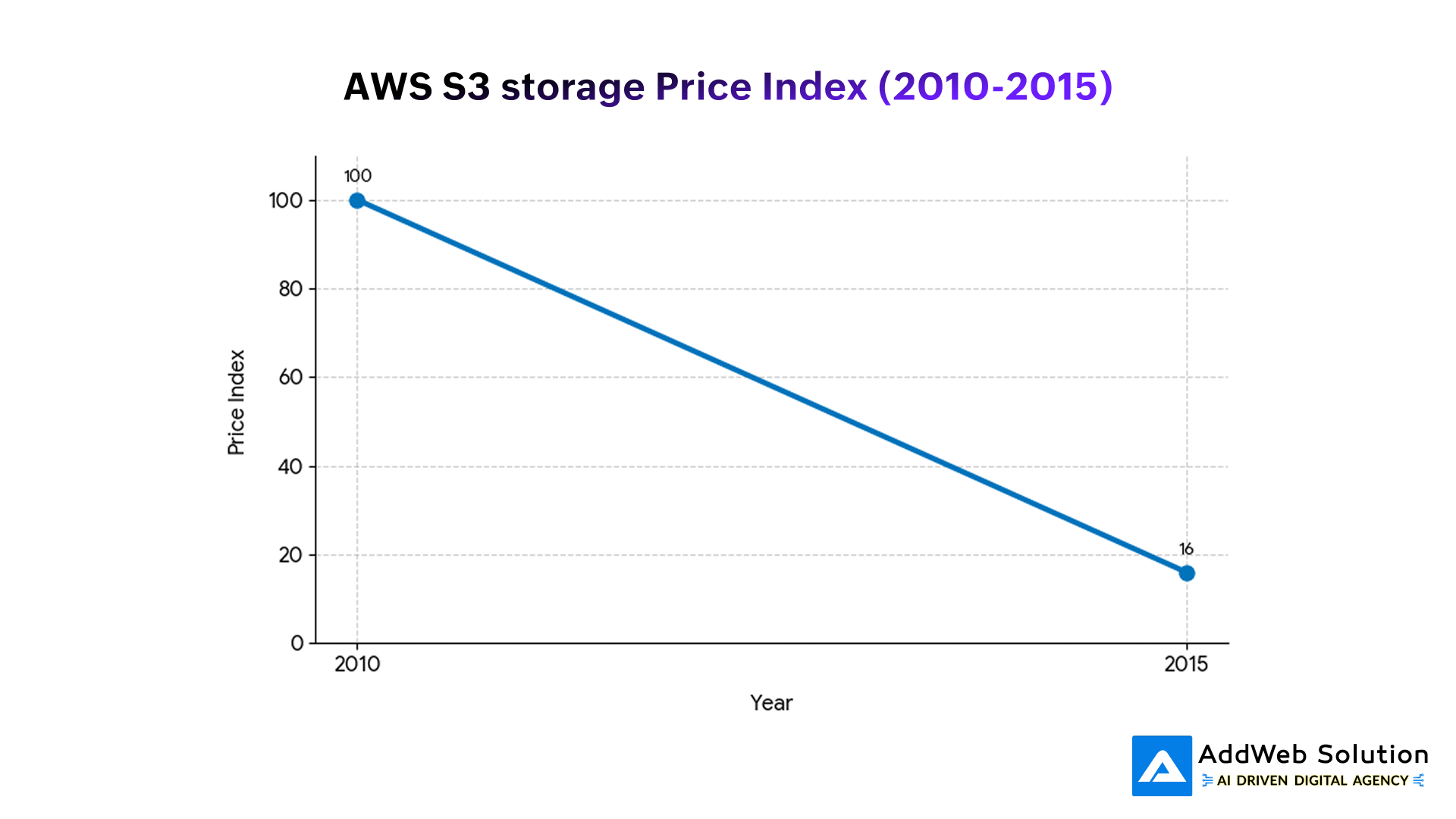
For a solo founder, this isn’t an abstract macro trend—it’s why you can safely design data‑heavy products (logging, analytics, media workflows) without panicking about storage invoices the way a small team would have in 2010. It also underpins modern managed databases, queues, and event‑streaming services that ride on top of this cheaper storage and compute.
How leverage actually shows up in your week
To make this concrete, here’s how founder‑friendly tech changes your actual calendar as a solo entrepreneur.
A week in the life, then vs now
| Day | 2012 Small Team (3–5 people) | 2026 Solo Founder |
| Monday | Infra engineer debugging scaling issues during spike | Auto‑scaling handles spikes; you review metrics and plan experiments |
| Tuesday | Dev tries to bolt on SSO for a new enterprise lead | You configure SSO via identity‑as‑a‑service dashboard[6][7] |
| Wednesday | PM and dev pair on a custom integration for a key CRM | You create a Zapier flow syncing events into the customer’s CRM[16][18] |
| Thursday | Ops team exports CSVs, runs scripts to update reports | Dashboards refresh automatically; you annotate trends in Notion |
| Friday | Everyone scrambles to ship a manual billing workaround | Stripe subscriptions and invoicing handle billing edge cases[14][21][15] |
Instead of context‑switching across infra, billing, and operations, you spend more of the week on:
- Talking to customers.
- Designing better features.
- Refining your onboarding and pricing.
- Closing deals, especially founder‑led enterprise sales.
The “team” that used to handle the rest is now a curated stack of services and workflows you configure once and revisit only when necessary.
A practical solo‑founder tech stack blueprint
The exact stack will depend on your market, but a typical solo‑friendly architecture for an enterprise‑grade SaaS in 2026 might look like this:
- Core platform:
- Managed PaaS or serverless environment on a major cloud provider (to avoid running servers yourself).
- Managed database (Postgres, MySQL, or a serverless database) with automated backups and scaling.
- Security & identity:
- Identity‑as‑a‑service (e.g., Auth0‑style) for authentication, SSO, and tenant isolation.
- Role‑based access control modeled in your app, not hard‑coded per customer.
- Payments & monetization:
- Payment API (Stripe‑class provider) for subscriptions, invoicing, and marketplace payouts.
- Pricing experiments handled by updating plans and coupons rather than rewriting billing logic.
- Integrations & automation:
- No‑code automation platform (like Zapier) to handle CRM syncs, notifications, and back‑office workflows.
- Webhooks from your app to the automation layer, instead of custom per‑customer scripts.
- Analytics & reporting:
- Product analytics tool for usage tracking and funnels.
- BI dashboard connected to your data warehouse or directly to production replicas.
- AI & assistance:
- AI copilots embedded in your developer tools for coding and testing.
- AI‑assisted support workflows (summarizing tickets, drafting replies, suggesting help‑center content).
Notice what’s missing: you don’t see “build a custom payment gateway,” “maintain an SSO stack,” or “write a homegrown integration framework.” Almost every historically heavy lift is now something you can adopt and configure.
Risks and realities to respect
Founder‑friendly doesn’t mean risk‑free. There are still trade‑offs you have to manage deliberately:
- Vendor lock‑in: Using best‑in‑class APIs (for identity, payments, or automation) is usually worth it, but design your own code so it’s not tightly coupled to a single provider’s quirks. Keep boundaries clean and abstracted.
- Security by configuration, not assumption: Third‑party platforms help with security, but mis‑configured identity or cloud resources can still create serious issues. Enterprise customers will evaluate your actual setup, not just your vendor list.
- Operational discipline: Even in a solo setup, you need real incident response basics: monitoring, logging, status pages, and backup policies. Managed services make these easier, not optional.
- Complexity creep: It’s tempting to glue together dozens of tools early. Start with a lean stack and standardize your data flows so you don’t drown in integrations later.
Enterprises increasingly expect “tenancy‑as‑a‑service” style architectures—clear tenant isolation, support for modern SSO protocols (SAML, OIDC), and strong multi‑factor authentication. The good news is that platforms like Auth0 are literally designed to help small teams and solo founders cross this “identity wall” without reinventing the wheel.
What this means for you as a solo founder
If you’re a solo entrepreneur in 2026, you’re operating in a uniquely favorable window. Cloud infrastructure is cheaper and more powerful than ever, low‑code and automation tools are mainstream, and API‑first services give you instant access to capabilities that used to demand specialized teams.
The real differentiators now are your judgment, your taste in product, and your ability to deploy this stack thoughtfully in service of a real customer problem. If you choose your tools well and keep your architecture simple, “enterprise‑grade” is no longer a euphemism for “needs a 20‑person team”—it’s a realistic standard for a single, determined founder.
Build Enterprise-Grade Products With Our Expert Guidance

Pooja Upadhyay
Director Of People Operations & Client Relations
⁂
Sources
- https://www.civo.com/white-papers/cost-of-cloud-report-2024.pdf
- https://www.index.dev/blog/no-code-low-code-statistics
- https://www.saastr.com/carta-38-of-bootstrapped-start-ups-have-solo-founders-but-only-17-of-vc-backed-ones-do-and-10-12-of-ones-that-ipo/
- https://www.integrate.io/blog/no-code-transformations-usage-trends/
- https://wasabi.com/blog/cost-optimization/cloud-storage-fee-inflation
- https://www.computerweekly.com/news/4500270463/Public-cloud-competition-results-in-66-drop-in-prices-since-2013-research-reveals
- https://www.bcg.com/publications/2023/the-four-trends-shaping-the-cloud-industry
- https://www.nber.org/digest/dec18/explosive-growth-and-plummeting-prices-cloud
