


Modern business websites no longer behave like static brochures. They act more like living systems and WordPress is increasingly becoming the layer that keeps those systems running.
There was a time when WordPress was easy to dismiss. It was the platform people associated with blogging, quick company updates, and small business websites that looked fine but rarely felt strategic. That version of WordPress still exists, but it is no longer the whole story.
Today, WordPress powers 41.5% of all websites and 59.3% of websites with a known CMS, which puts it in a very different category from a “simple website builder.” At that scale, WordPress is not just participating in the web economy; it is helping define the environment that a large part of the web runs on.
That is what makes the bigger question interesting. The real conversation is no longer “Is WordPress good for websites?” It is whether WordPress has quietly evolved into something much larger: an operating system for modern business websites.
The website is no longer just a website
A modern business website is doing too much to be treated like a digital brochure. It is expected to attract traffic, convert leads, support SEO, host content, power campaigns, connect to CRM systems, handle commerce, and sometimes even function as a support layer or customer portal.
That shift changes what companies need from their web platform. They no longer need a tool that simply helps them publish pages; they need a system that can coordinate many moving parts without forcing a rebuild every time the business evolves.
WordPress fits this new reality unusually well. It gives teams a stable content core, then lets them extend that core with plugins, ecommerce tools, design systems, integrations, performance layers, multilingual support, analytics tooling, and API-based front ends.
That is exactly why the operating-system metaphor feels less exaggerated than it once did.
Scale makes the argument real
The fastest way to understand WordPress’s role is to look at its footprint. As of June 2026, W3Techs reports that WordPress is used by 41.5% of all websites on the web.
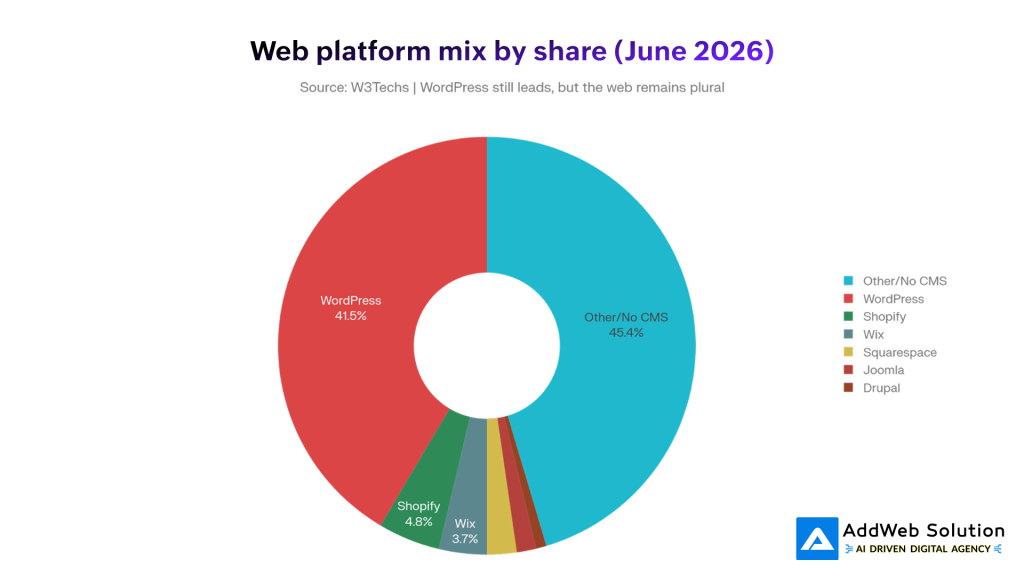
WordPress leads the web by share, but the broader ecosystem remains diverse.
That matters because platforms with that kind of scale stop being niche choices. They become defaults, reference points, and operational foundations. Businesses do not build entire digital systems on top of niche tools unless they have a very specific reason to do so.
WordPress also dominates among sites with a known CMS, where its share rises to 59.3%. That reinforces a simple point: when organizations choose a content management system, WordPress is still the most common answer by a wide margin.
This was not a one-year spike
The story becomes more compelling when you zoom out. WordPress.com’s 2025 market analysis says WordPress grew from 21% of all websites in 2014 to 43.4% in 2025, while sites without a CMS dropped sharply across the same period.

As businesses moved away from hand-coded sites, WordPress gained ground as a long-term content and operations layer.
That trend tells us something bigger than “WordPress is popular.” It suggests that the web itself has been shifting away from isolated site builds and toward platforms that support ongoing publishing, editing, optimization, and integration.
In other words, businesses are not just buying websites anymore. They are investing in environments that can support continuous digital work. WordPress benefits from that shift because it is built for ongoing use rather than one-time launch events.
Why “operating system” is not just hype
Calling WordPress an operating system is not technically literal, but it is strategically useful. An operating system provides a base environment, allows other tools to run within that environment, and helps different functions work together without needing a new foundation each time.
That sounds increasingly close to how WordPress behaves in business settings. It gives companies a central layer for content, structure, permissions, publishing, and integrations, then allows specialized tools to plug in around that core.
This is where WordPress stops looking like a basic CMS and starts looking like infrastructure. A business can use it to manage landing pages, thought-leadership content, case studies, ecommerce, SEO layers, forms, automation triggers, localization, and even headless delivery for modern front ends.
At that point, WordPress is not just “running a website.” It is managing a digital environment.
Additional
Read

What businesses are really buying
The strongest case for WordPress is not that it is trendy. It is that it reduces friction across teams. Marketers can publish faster, SEO specialists can structure content properly, editors can update pages without engineering tickets, and developers can customize the stack when the business needs something more advanced.
That combination of accessibility and extensibility is rare. Closed platforms may feel simpler at first, but they often become restrictive as the business grows. WordPress succeeds because it can start simple and then expand with the organization.
Where WordPress feels strongest
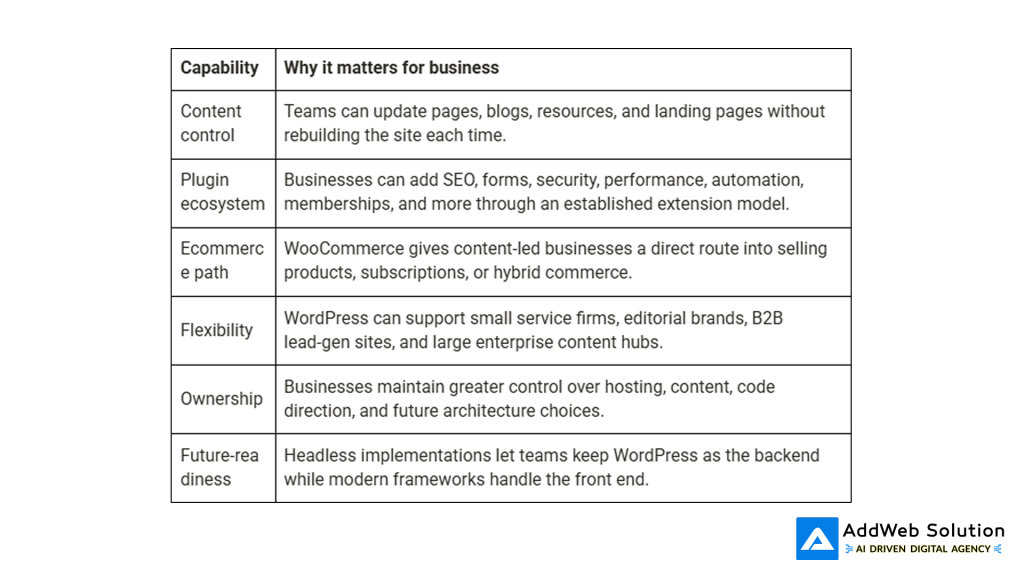
Why decision-makers still trust it
- It is widely adopted and well understood.
- It has a mature ecosystem of plugins, themes, agencies, and developers.
- It can support both editorial and commercial goals in one environment.
- It gives organizations more control than many closed website platforms.
- It evolves without forcing businesses to abandon their existing content foundation.
The ecosystem is the real story
One reason WordPress feels increasingly like an operating system is that it is not just one product. It is a stack. It is an ecosystem. It is a base layer that becomes more valuable as other tools attach to it.
W3Techs data on WordPress subtechnologies shows the breadth of tools operating inside the WordPress environment, including Elementor, WooCommerce, WPBakery, Beaver Builder, and many others.
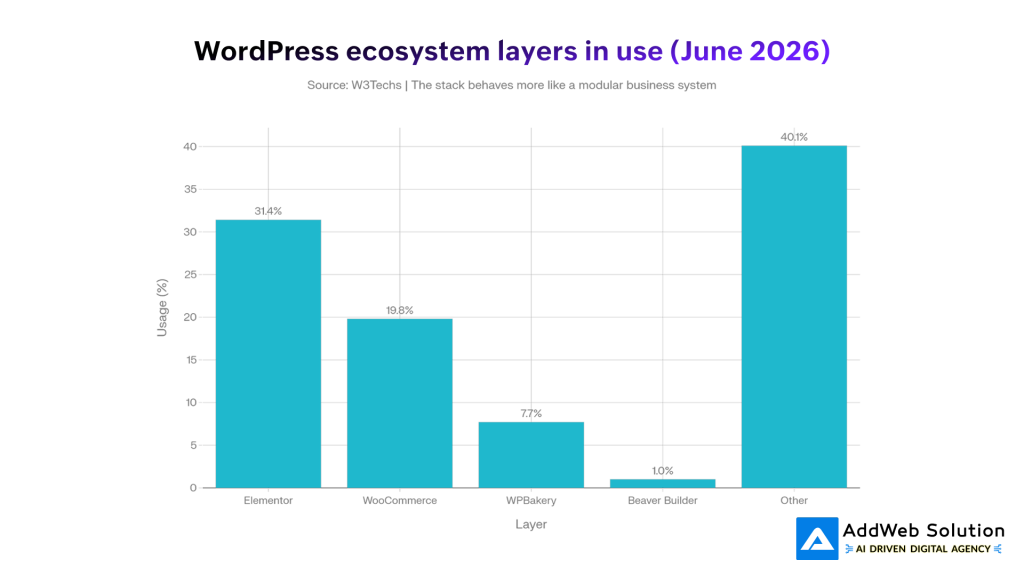
WordPress behaves less like one product and more like a modular business stack.
This matters because modern business websites are built less like monuments and more like systems. One layer handles content. Another handles design flexibility. Another handles sales. Another handles forms, analytics, search visibility, or localization. WordPress works well because it can coordinate all of those layers without insisting that everything live inside one rigid box.
A useful way to think about it
The old business website was a printed brochure placed online. It introduced the company, listed services, and hoped someone would call. The modern business website behaves more like a digital headquarters. It informs, persuades, captures, routes, measures, and sometimes sells.
That is a very different job description.
So maybe the operating-system comparison lands best like this: WordPress is not the website itself. It is the environment that allows the website to become many things at once.
That is why the platform keeps showing up in discussions around publishing, SEO, commerce, headless architecture, content operations, and enterprise digital experience. It is no longer trapped in one category.
But this is where honesty matters
A strong thought-leadership article should not sound like a sales pitch, and the honest answer is that WordPress is not the right solution for every business. Martech has argued that it may not fit every organization, especially when highly specialized governance, very specific WCM requirements, or tightly controlled all-in-one enterprise stacks are the priority.
That criticism is fair. Flexibility can become clutter if teams install too many plugins, neglect governance, or build without a clear architecture. WordPress is powerful, but like any powerful platform, it reflects the quality of the decisions around it.
So the smarter conclusion is not “WordPress wins everywhere.” It is that WordPress is especially strong when a business wants control, adaptability, extensibility, and a content-centered digital foundation.
Best-fit scenarios
- Content-heavy B2B websites.
- Service businesses focused on SEO and lead generation.
- Editorial or publishing-led brands.
- Companies that want to blend content and commerce.
- Teams planning a future move toward headless architecture.
Less ideal scenarios
- Businesses that want an extremely closed, opinionated ecosystem.
- Highly custom application-first products with minimal CMS needs.
- Organizations that prefer narrower vendor dependence over ecosystem flexibility.
Where this goes next
The next phase of the web is being shaped by AI-assisted workflows, faster performance expectations, modular design systems, multilingual experiences, stronger analytics, and more flexible content delivery. WordPress.com’s market analysis points to many of these same forces as part of WordPress’s continuing relevance.
That alignment matters. The platforms that stay important are not always the flashiest ones; they are the ones that adapt without making businesses throw away years of digital investment.
WordPress may never sound as fashionable as newer platforms in marketing decks, but that may be exactly the point. Infrastructure rarely wins by being fashionable. It wins by being reliable, extensible, familiar, and able to support change without collapsing under it.
And that is why the operating-system argument feels more convincing now than ever. WordPress is no longer just helping companies publish pages. For many businesses, it has become the environment their digital presence actually runs on.

Is Your Website Ready to Scale Beyond a Basic CMS?

Pooja Upadhyay
Director Of People Operations & Client Relations
Source Links:
https://wordpress.com/blog/2025/04/17/wordpress-market-share/
https://wpengine.com/resources/the-rise-of-multi-cms-wordpress-and-headless-in-the-enterprise/
