


A site built on WordPress can be far more than a digital brochure. In 2026, the real advantage of WordPress is that it combines content, SEO control, conversion tools, and commerce flexibility in one ecosystem, which is why it powers about 42.5% of all websites and nearly 59.8% of the CMS market.
Introduction
There’s a big difference between having a website and having a website that actually helps a business grow. One sits online like a business card; the other attracts search traffic, captures leads, nurtures trust, sells products, and keeps working long after office hours. WordPress has earned its place because it supports that second version extremely well.
What makes WordPress stand out is not just that it is popular. The platform gives businesses control over the parts that directly influence revenue: content structure, search visibility, site speed, integrations, lead generation, eCommerce, subscriptions, and analytics-led optimization.
Why Does WordPress Feel Different
A lot of website platforms are good at helping you launch. WordPress is good at helping you grow. It gives businesses room to start simple and then layer in monetization without rebuilding everything from scratch.
Here’s where WordPress changes the game:
- It supports SEO-friendly URLs, structured content, and clean, crawlable code.
- It integrates easily with SEO plugins, schema tools, and metadata controls.
- It makes content publishing easy, which matters because consistent content supports topical authority and organic discovery.
- It can turn into an online store, membership site, learning hub, booking platform, or lead-generation machine with plugins and custom workflows.
- It supports recurring revenue models such as memberships and subscriptions.
- It gives businesses more ownership and flexibility than many closed builders.
That flexibility is the reason WordPress often grows with a business instead of holding it back. A startup can begin with service pages and a blog, then add gated content, email funnels, WooCommerce, upsells, and customer segmentation as revenue goals become more ambitious.
The Revenue Engine Mindset
A revenue engine website usually has four jobs:
- Bring in the right visitors.
- Turn some of them into leads.
- Turn qualified leads into customers.
- Increase customer value through repeat purchases, subscriptions, or retention flows.
WordPress is effective here because it does not force businesses to choose between content and commerce. A brand can publish search-focused articles, rank for problem-aware keywords, capture email subscribers, and route those visitors into product pages or service pages on the same platform.
That matters more than it sounds. When content, SEO, forms, analytics, and shopping all live in one connected environment, it becomes much easier to measure what actually drives revenue instead of guessing.
Visual: Where Revenue Usually Comes From
Use this pie chart in the blog to show how WordPress revenue often gets distributed across channels in a modern site setup. The percentages below illustrate a realistic mixed monetization model based on common WordPress monetization approaches like eCommerce, memberships, affiliate income, ads, and digital products.
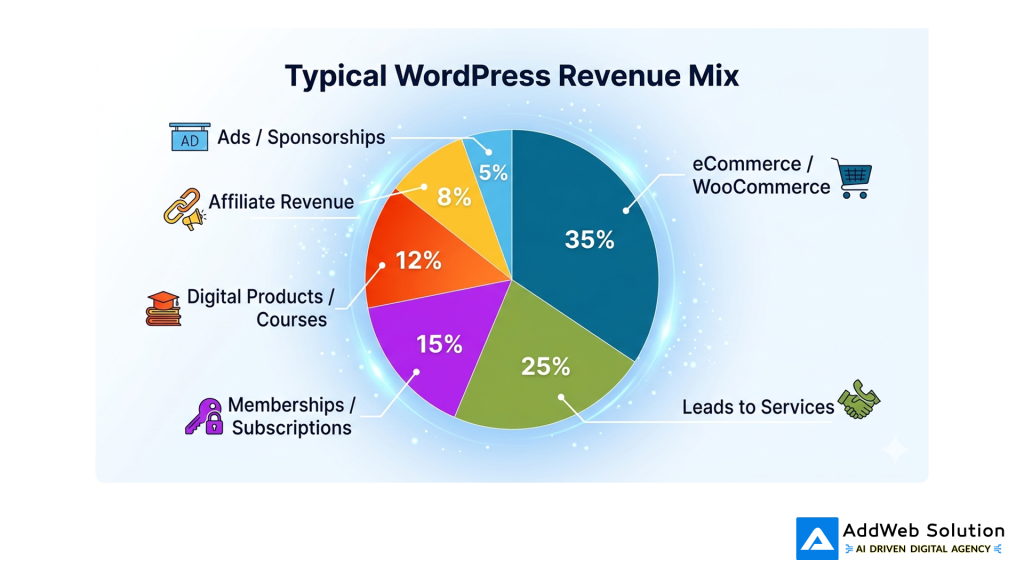
This mix will vary by business model, but the point is simple: support for multiple income streams is available with WordPress. That makes the website more resilient and less dependent on a single sales channel.
Visual: Traffic to Revenue Funnel
A site built with WordPress becomes a revenue engine when it is designed as a funnel, not just a collection of pages. This graph works well to explain the flow.
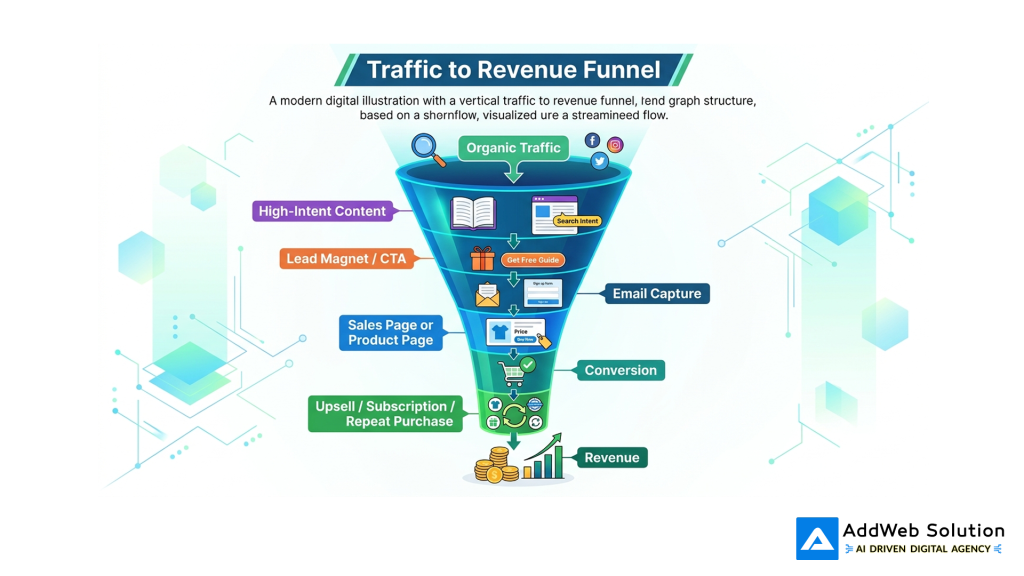
This is where WordPress shines. It lets businesses build each step of this journey with plugins, custom content, SEO structure, and eCommerce extensions instead of patching together disconnected systems.
The SEO Advantage That Actually Impacts Revenue
SEO is not just a traffic play. It is a revenue play when the traffic is relevant.
WordPress helps here because it produces SEO-friendly URLs, supports structured content, and works smoothly with optimization plugins that improve metadata, readability, schema, and internal linking. That means businesses can create content around buyer questions, rank for long-tail keywords, and bring in visitors who are already close to making a decision.
For example, a Shopify development agency using WordPress could publish articles like “Shopify vs WooCommerce for scaling brands” or “When to migrate from a template store to a custom solution.” Those pages are not random blog content. They are commercial-intent assets that attract prospects already comparing solutions.
Speed Is Revenue, Not Just Performance
People often treat speed optimization like a technical cleanup task. It is actually a sales issue.
One source cited that pages loading in 1 second can see conversion rates around 39%, while 5-second loads may drop to 22%, and slower sites also suffer sharply higher bounce rates. Another WordPress-focused CRO source notes that as speed slows by each additional second, conversions can fall significantly.
That is why work on performance for WordPress matters:
- Better hosting improves stability and response times.
- Caching and image optimization reduce load times.
- Lightweight themes and plugin discipline keep pages efficient.
- Faster pages create better lead-gen and sales outcomes.
A useful real-world example comes from Pantheon’s case material, where Salesloft saw a 70% increase in leads after improving performance and site stability.


Visual: Load Time vs Conversion Trend

This chart simplifies the broader point: every extra second creates friction, and friction costs money.
WordPress and eCommerce: The WooCommerce Effect
This is where WordPress becomes especially powerful. With WooCommerce, a content-driven website can also become a sales platform.
Current estimates vary depending on the dataset, but widely cited 2025–2026 figures place WooCommerce at roughly 33.4% of tracked eCommerce sites globally, with some broader studies reporting even higher shares. That range itself tells an important story: WooCommerce is not niche. It is one of the biggest commerce ecosystems in the world.
And because WooCommerce runs inside WordPress, the business gets a major advantage: content and commerce work together naturally. A brand can publish comparison pages, educational content, tutorials, and use cases that rank in search, then move readers into product listings, bundles, and checkout flows without switching platforms.
A practical example comes from WooCommerce’s own case content: Landyachtz attributed around 11% of total revenue to Klaviyo in its first year, while improving campaign and flow open rates through a connected growth setup. That is the revenue-engine model in action: store, email, and customer behavior all feeding each other.
Revenue models supported by WordPress
One of the smartest things about WordPress is that you do not need to rely on one monetization route. You can stack revenue streams based on audience behavior.
| Revenue model | How WordPress supports it | Why it matters |
| Service leads | SEO pages, forms, landing pages, CRM integrations | Great for agencies, consultants, SaaS partners |
| eCommerce | WooCommerce, product pages, payments, upsells | Direct online sales and average order growth |
| Memberships | Subscription plugins, gated content, recurring billing | More predictable monthly revenue |
| Digital products | Downloads, courses, templates, license delivery | High-margin monetization |
| Affiliate income | Content-led recommendations and tracked links | Works well for niche media and review sites |
| Ads / sponsorships | Ad placements and sponsored content workflows | Useful for high-traffic publishers |
This is where WordPress feels commercially mature. A business can begin with one revenue stream, then add another without changing the entire website architecture.
WordPress vs “Just a Website”
Here’s the core difference in plain language:
| “Just a website” | WordPress as a revenue engine |
| Static pages that rarely change | Ongoing content that attracts qualified traffic |
| Few conversion points | Forms, CTAs, landing pages, funnels, email capture |
| Looks good but measures little | Analytics, attribution, and optimization workflows |
| Separate tools for blog and selling | Content and commerce on one platform |
| One-time brochure mindset | Compounding growth mindset |
That last point matters a lot. A brochure site has a launch date. A revenue engine has momentum.
A Realistic Growth Path
Not every business needs an advanced setup on day one. In fact, the best websites built on WordPress often grow in layers.
- Phase 1: Launch a fast, trustworthy site with clear service or product pages.
- Phase 2: Add SEO-focused blog content that targets real customer questions.
- Phase 3: Introduce lead magnets, forms, and email capture.
- Phase 4: Add WooCommerce, subscriptions, or digital product sales if the business model supports it.
- Phase 5: Improve conversion rates through speed, testing, segmentation, and retention flows.
This layered approach works because WordPress is modular. Businesses do not need to overbuild early, but they also do not get boxed in later.
Source URLs:
https://wordpressprofessionals.com.au/top-benefits-of-choosing-wordpress-for-website-development-in-2026/
https://kinsta.com/wordpress-market-share/
