


Introduction: AI adoption is growing, but are businesses seeing the returns?
In recent years, artificial intelligence has become not only innovative but also a popular theme in businesses.
It is used to produce content, help in working with customers, process information, automate routine processes, and make decisions for workers.
Different innovations appear, and the desire to apply them is almost irresistible.
However, one should take into account the following issue: how effective is this process for the business?
The company applies an AI assistant, shows that it can do the task in a few seconds, receives permission to continue the process, and observes good results at first.
However, the implementation of AI technology throughout the team, its connection to other programs, and the processing of customers’ requests result in different outcomes.
The workers have to monitor its work, technical staff has to maintain the connection, and the cost of using such technology rises.
Here the difference between AI implementation and AI profitability is evident.
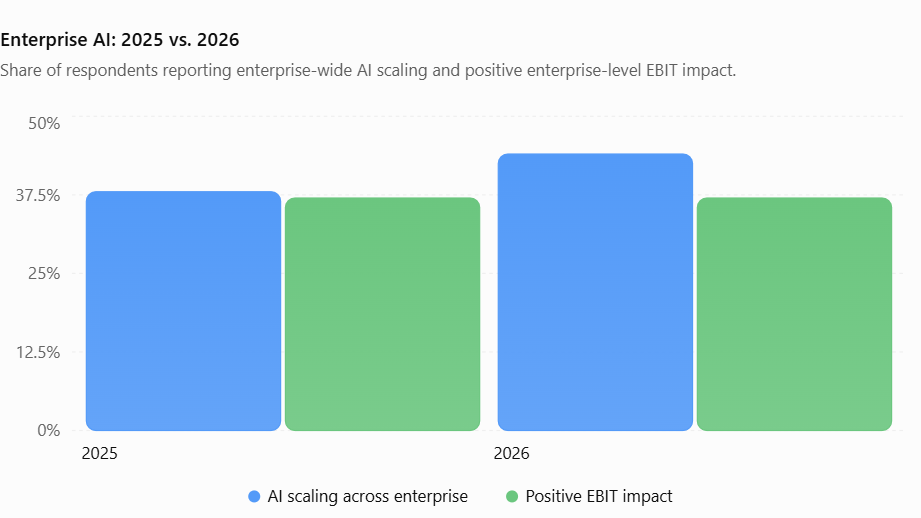
According to McKinsey’s State of AI: Global Survey 2026, almost nine out of ten respondents reported usage of AI regularly in one or more business functions.
On the contrary, only 37% of the survey participants indicated that AI makes any positive contribution to the profits of enterprises excluding interest payments and taxes. The figure remained unchanged since last year.
The above statistics requires attention. Businesses use AI more actively but the influence of AI on the company’s bottom line does not increase in equal proportion.
For those companies, which have decided to invest in the future, the main challenge in 2026 will be not to introduce AI just because there is such technology.
It will be to see where AI can make an effect, to integrate it into the process of working of employees and to verify whether it pays off.
The next phase of AI is less about proving what the technology can do and more about proving what it can deliver.
1. Moving beyond the AI pilot
Most of the times AI development starts with a small pilot project. Marketing department tests this technology in regard to content creation, customer service deploys a chatbot, and finance department tries automatic processing of documents.
Simply put, the objective here is to gain insight into technology before any large-scale investments.
Obviously, such an approach makes sense.
However, the issue is that some people mistakenly believe that a successful test equals a final solution.
The thing is that most of the time demonstrations are conducted in a highly controlled environment.
There is only a small amount of data, the business process is known upfront, and there is always someone to step in case something goes wrong.
In contrast, production environment can be much more complex.
There can be a lack of data, customer requests might not fall under the predetermined categories, and different departments might have incompatible systems.
Take for example a situation when you want to use artificial intelligence to extract data from supplier invoices.
It will extract invoice numbers, date, and amount really quickly. However, people will have to check this data, identify duplicates, approve limits, and handle exceptions.
In case when people have to redo most of the original tasks, your company has automated a minor portion of a much larger problem.
This applies to development, sales, customer service and marketing departments as well. Generating an answer, a report, or writing code is good; however, this doesn’t necessarily make your process better.
The key to success lies in the ability of a business to analyze its workflow from beginning to end.
Which processes can be cut out of the way? Which one can be automated? Where people’s decision-making skills should be used? How should the system deal with mistakes?
It sounds less glamorous than choosing the new AI system but this is what determines the success of your investment.
The difference between a pilot and a scalable solution
| Area | AI pilot | Scaled business solution |
| Objective | Test technical feasibility | Improve a defined business outcome |
| Users | Small group of testers | Employees across the relevant workflow |
| Data | Limited or controlled samples | Real operational data with quality checks |
| Integration | Often standalone | Connected to existing business systems |
| Measurement | Accuracy and task completion | Cost, quality, speed, revenue, and reliability |
| Ownership | Project or innovation team | Named business and technical owners |
| Maintenance | Temporary support | Ongoing monitoring and improvement |
The important change is the measure of success. A pilot asks whether a technology can perform a task. A production solution must demonstrate that it performs the task reliably and improves the way the business operates.
2. What the 2026 AI research tells us
In the current enterprise research, there appears to be a discrepancy between the adoption of AI and the performance of the organization.
The 2026 study by McKinsey included 1,719 respondents in 97 countries and was carried out between May 4 to June 8, 2026.
The findings reveal that organizations are adopting AI in more functions and towards broader deployment, but performance is still inconsistent.
Three key figures are:
- Nearly nine in ten respondents report regular AI use in at least one business function.
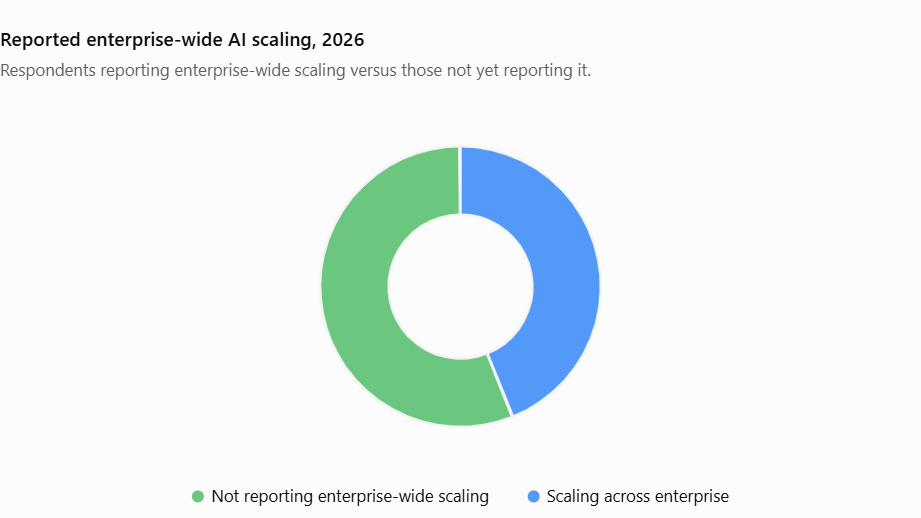
- 44% say AI is scaling across their enterprise, up from 38% in 2025.
- 37% report positive enterprise-level EBIT impact, broadly unchanged from the previous year.
Additionally, McKinsey estimates that about 6% of the survey participants fit the criteria of AI high performers according to its definition, which includes assigning more than 5% of EBIT to the technology and stating that its influence was substantial.
It should be understood that the figures do not reflect audited data for each of the organizations; the numbers come from a survey only.
Besides, there are many differences in the way companies evaluate AI implementations and its benefits and costs.
Nonetheless, the overall picture is valuable because AI is widespread among businesses, and the problem of translating the technology’s benefits into financial gain remains unclear.
A company may say that it helps to save employees’ time. It is a good sign but the important question here is what will be done with the extra time.
Are more clients going to be served? Will it allow reducing overtime? Will it help to avoid hiring? Will the benefit translate into better customer satisfaction or increased revenue?
Without answers, productivity gains can remain difficult to translate into financial results.
3. Where intelligent automation can make a real difference
The most compelling use cases are not necessarily the most sophisticated ones; rather, they are the processes that take up lots of employees’ time, cause recurrent mistakes, or hinder decision-making and customer service.
Customer service: assisting teams with faster problem resolution
Support workers are regularly faced with such challenges as searching for answers in the knowledge base, looking through previous conversations, sorting out customer requests, and formulating responses.
AI can help with all this and provide employees with relevant information and answer suggestions based on company-approved documentation.
While faster response is not a guarantee of success, if a customer receives a wrong answer and contacts the company again, it might turn out that there were no productivity gains.
Companies should evaluate the following metrics: resolution time, repeat-contact rate, frequency of escalation, customer satisfaction, and cost per resolved case.
Finance: reducing manual document processing
The finance team deals with invoices, expense reports, receipts, purchase orders, and other paperwork that typically contains a lot of repetitive data.
AI will be able to pull out data from the documents and classify transactions, while standard software rules can do validation and approvals.
For instance, an invoice processing procedure can use AI to capture supplier information, compare the invoice to a purchase order, mark the duplicate invoice, and divert an unusual transaction to an employee.
The idea is not to eliminate every human review but rather to focus on transactions that require such review.
Measuring the cost of processing per invoice, transaction approval period, error rate, and percentage of transactions needing manual intervention can be useful.
Sales and marketing: connecting activity to revenue
AI can assist in prospect research, summary of sales calls, analyzing campaign effectiveness, audience segmentation, and generating content variations.
One might get carried away by the possibilities of the increased volume of work. However, more emails, reports, and marketing materials do not always lead to more qualified leads.
It is important to find out where AI can have an impact on the business decision-making process.
For example, will it help salespeople prepare for meetings? Will it be able to find qualified leads? Will it be possible to understand what kind of campaigns attract the right type of customers?
The outcomes should be measured based on the number of qualified leads, conversion rate, customer acquisition cost, sales cycle, and revenue generation.
Software development and IT operations: balancing speed with quality
Coding assistants through AI can help software engineers interpret unfamiliar code, write generic functions, generate test cases, and document systems.
The IT help desk can utilize AI to summarize incidents and find the right technical documentation.
Such applications may decrease the amount of mundane tasks, but quicker code generation is not necessarily faster delivery.
Code that has been generated must be reviewed, tested, and analyzed for security risks. Badly reviewed code may introduce defects, which will be more expensive to solve in the long run.
Delivery time must be considered together with rework, defects rate, security results, and maintenance.
Manufacturing and supply chain: acting before problems escalate
Artificial Intelligence and Machine Learning have application in demand forecasting, inventory management, anomaly detection, and predictive maintenance.
Let’s take an example of a manufacturer who uses data from machines to find any potential indication of a possible breakdown of the machine.
The point is that if the system gives a reliable indication in time, preventive maintenance can be done before the machine breaks down.
It all depends on what will happen next: how accurate the prediction is, whether there is a capacity for doing maintenance, and whether the costs of intervention are less than the predicted costs.
Measures may include: downtime, forecast accuracy, inventory turnover, scrap ratio, and on-time delivery.
Comparing opportunities across business functions
| Function | Potential application | Main business objective | What to measure |
| Customer service | Ticket classification and response assistance | Faster, more consistent support | Resolution time, repeat contacts, satisfaction |
| Finance | Invoice extraction and reconciliation support | Lower processing effort | Cost per invoice, error rate, cycle time |
| Sales and marketing | Lead analysis and campaign optimization | Better commercial performance | Conversion, qualified leads, acquisition cost |
| Software development | Coding assistance and test generation | Faster delivery without quality loss | Lead time, defects, rework |
| Manufacturing | Predictive maintenance | Fewer disruptions | Downtime, maintenance cost, output |
| Supply chain | Demand forecasting | Better stock availability | Forecast accuracy, inventory turnover |
Different companies will have different results and figures. While a particular workflow is ready to be automated in one company, in another company the same workflow will not fit for automation purposes due to its variability, risks, and costs.
In any case, the business case should take into account real-world circumstances of a company.


4. Why promising AI projects struggle to deliver ROI
Poor performance of AI initiative does not always come from its model itself but can be caused by the process, the data, the integration, or the company’s approach to measuring success.
The first problem of the process can be in a vague goal. Often, people start working on a project because there is an initiative of introducing some technology and do not have a defined operational problem that should be solved.
This way, there is an experiment with a technical solution for which there is no clearly defined business benefit.
It would be more productive to start by defining a problem that the company faces, like slow approval of invoices, customer inquiries, or unnecessary manual input of data. First, one should find out what is the cost of the current state and only then choose a solution.
Inconsistencies of customer database, old internal documentation, and absence of transaction history can decrease the accuracy of the output provided by the AI. Employees will need to check the data constantly.
Before implementing, companies need to look at data sources, access rights, ownership, and data quality.
There is an automation of the flawed process. When there is unnecessary approval and duplicate data entries in the process, it makes no sense to automate the step, as it will shift the bottleneck to another place.
Even the examination of the process and its improvement may bring value without AI.
Employee adoption is much more important than available tools. The system that does not suit employees may never be used. It is crucial to involve employees into design and testing and to provide the proper training for them.
Lastly, companies underestimate the cost of running AI. Licensing and use of models are just one of several expenses that need to be considered.
These challenges are quite easy to deal with if approached from the very beginning.
5. Calculating the return on an AI investment
A credible AI business case should distinguish between time saved, capacity created, cash costs avoided, and additional revenue earned. These are related, but they are not interchangeable.
A useful starting formula is:
ROI = (Total financial benefits − Total costs) ÷ Total costs × 100
For a first-year calculation, include implementation expenses and operating costs. If the calculation excludes one-time implementation costs, make that distinction clear.
Example: an AI-assisted customer support workflow
Consider a hypothetical support team handling 10,000 tickets per month. An AI-assisted workflow reduces average handling time by three minutes per ticket.
| Input | Assumption |
| Monthly ticket volume | 10,000 |
| Average time saved per ticket | 3 minutes |
| Annual time saved | 6,000 hours |
| Loaded employee cost | $30 per hour |
| Share of saved time converted into productive capacity | 60% |
| Implementation cost | $15,000 |
| Annual operating and monitoring cost | $9,000 |
The annual time saving is:
10,000 tickets × 3 minutes × 12 months = 360,000 minutes = 6,000 hours.
At $30 per hour, 6,000 hours make up for $180,000 potential labor capacity. Not all of that capacity has to be converted into actual monetary gain though.
Assuming that the company is able to productively use 60% of the saved hours, potential capacity gains amount to $108,000 per year.
Total first year expenses are equal to $24,000.
The calculation is as follows:
ROI = ($108,000 − $24,000) ÷ $24,000 × 100 = 350%.
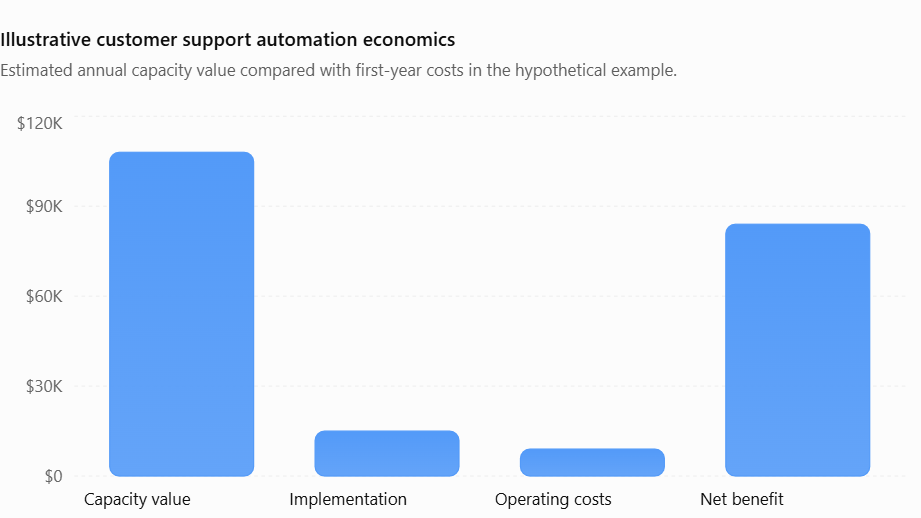
It is just a possible scenario rather than a forecast or any kind of industry standard. It assumes that the company is capable of using saved capacity for processing more tickets, eliminating over-time work, or not hiring new employees at all.
In case the saved time results in no extra advantage, then the actual advantage will be lower. It should include various aspects, such as customer satisfaction, repeat contact, error, usage, and operating cost change.
To do a better analysis, we can consider the most conservative estimate, realistic estimate, and optimistic estimate.
Thus, we can understand how sensitive the project is with respect to ticket volume, time savings, usage, and operating cost change.
6. A sensible approach to scaling AI
Increasing the scale of AI use in an organization does not mean increasing all the successful experiments within the organization. Scaling means selecting those cases which have a valid business case and scaling on that.
Firstly, start with the one process in which the problem has already been identified. Define the baseline, identify the people affected by the problem, and the main deliverables. Then, identify the simplest technology required to solve the problem.
In some situations, simple rule-based automation will do just fine. In some cases, machine learning or generative AI would be great.
In several workflows, using AI for analyzing the data would be ideal while traditional software would take care of validation of the data.
Then, move ahead with testing the solutions using real-life data, even exceptions. The employees should have the freedom to question the output and escalate the issues.
Integration is not to be considered at the last stage. It could be necessary to integrate with CRM system, ERP systems, databases, ticketing systems, or document management systems along the way of producing.
Access control, auditing, error handling, and monitoring should be considered in the process design.
After launching the process, a comparison will be conducted regarding the performance and baseline.
Not only the financial but also the other parameters, such as the quality, reliability, adoption, and customer results should be considered.
In case the results match with the agreed targets, then the process can be scaled by the organization. Otherwise, the reasons of failure should be found out first without further investment.
A failed pilot project still produces good results for the organization. It does not invest more in the unsuitable process.
7. AI agents: more capability, more responsibility
AI agents also represent an important part of such a discussion as they are able to do something more than just answer on the prompt. Within the scope of permissions, they can look for the data, use the allowed tools, and even perform several consecutive actions.
For example, an agent might check the support ticket, collect all necessary information about the user’s account, write an answer, and propose the further actions.
In the case of a regulated environment, it will help to save the time that people spend switching between different systems.
The more actions the agent does, the more relevant control over them becomes.
An agent that has access to customer’s databases and internal systems requires additional security in comparison to an agent that is responsible only for writing an internal message.
Therefore, companies need to decide what actions will be permitted and which will require human approval. It will be possible to start with recommendations and human approval and continue with autonomous actions.
The goal here is not to provide an unlimited independence to AI. The goal is to allow using this independence when it is useful.
8. A 90-day plan for turning a pilot into a business decision
A focused 90-day initiative can help an organization evaluate one promising workflow. More complex or regulated projects may take longer, but the sequence provides a practical starting point.
| Period | Work to complete | Expected result |
| Days 1–15 | Define the problem, map the workflow, establish the baseline | Clear business case and success measures |
| Days 16–30 | Review data, choose the solution, assess risks and integration | Implementation plan |
| Days 31–60 | Build and test using realistic cases | Evaluated pilot |
| Days 61–75 | Compare results with the baseline and assess costs | ROI and quality review |
| Days 76–90 | Refine the workflow and evaluate readiness to expand | Scale, revise, or stop decision |
In the end, management needs to decide if the solution helped improve the metric that was meant to be improved, if the benefits outweigh the costs, and if the system can be trusted to handle larger tasks.
The decision should be made not because of any need to prove success in the project but because of concrete results from the project. Sometimes the correct move is expanding. Other times it is redesigning the workflow or even ending the project.
Conclusion: Profitability is built after the pilot
Whereas the utilization of AI technologies gave rise to the possibilities of testing various innovations concerning how the business could be conducted, creating an income stream from such tests is an entirely different thing.
Those companies which would come on top in this competition would be those who started their way with the problem of business, comprehending the economic context of the technological process and its outcomes after implementation.
Additionally, those firms understand that the quality of data, adoption, security, and maintenance are components of investment.
The results of the 2026 research showed that AI technology is used extensively and that its scalability continues to grow while the financial outcomes achieved from its implementation continue to vary.
The variation stems from the fact that the implementation and investment decisions in the area will yield a return.
The companies do not need to automate anything. They need to understand what can be automated.
The question is no longer simply whether AI can perform a task. It is whether the business can use it reliably, economically, and at scale to produce a result worth paying for.
That is the difference between running an AI pilot and building an AI capability that pays off.
Frequently asked questions
How can businesses tell whether an AI pilot is ready to scale?
Compare its performance with the original process. Review financial benefits, operating costs, error rates, reliability, adoption, and customer outcomes. Expand only when the results justify the investment.
Which business processes are suitable for intelligent automation?
Processes with repeatable steps, measurable outcomes, reliable data, and manageable risk are often good candidates. Examples include document processing, support-ticket classification, knowledge retrieval, and selected forecasting tasks.
Does every AI project require a large budget?
No. A focused solution addressing a well-defined problem may be a better starting point than a large transformation programme. The key is to understand the full cost and validate the expected benefit.
Are AI agents better than traditional automation?
Not in every situation. Rules-based automation is effective for predictable tasks, while AI can help interpret unstructured information and handle more variable inputs. Many useful business solutions combine both approaches with human oversight.
Turn Your AI Ideas into Business Results

Pooja Upadhyay
Director Of People Operations & Client Relations
References
McKinsey & Company — The State of AI: Global Survey 2026
McKinsey & Company — The State of AI: How Organizations Are Rewiring to Capture Value
Editorial note: The ROI example is hypothetical and intended to demonstrate a calculation method. Survey findings reflect respondents’ reported experiences and should not be treated as audited financial results for all businesses.
