


Introduction
Nonprofits are under constant pressure to do more with less. Teams are small, budgets are tight, and every campaign has to prove its worth faster than ever. That is why digital marketing has become such a powerful lever for NGOs: it helps organizations reach supporters, build trust, and drive donations without relying on expensive traditional channels.
The good news is that effective NGO marketing does not depend on big spending. It depends on clarity, consistency, and smart channel selection. A well-planned email campaign, a meaningful social media presence, a donation-friendly website, and a few low-cost tools can deliver results that once required a much larger budget. In 2025, when donor attention is scattered across platforms and short-form content dominates digital behavior, NGOs that master budget-friendly marketing have a real advantage.
Why budget-friendly digital marketing matters for NGOs
For NGOs, marketing is not just about visibility. It is about survival, trust-building, and mission delivery. A donation page that converts well can fund a program. A strong volunteer campaign can extend impact. A well-written story can move someone from passive awareness to active support.
That is why low-cost marketing matters so much. Unlike paid campaigns that can quickly drain a budget, organic digital strategies continue working over time. A blog can bring traffic for months. A strong email list can outperform social algorithms. A simple video can be reshared by supporters far beyond the original audience.
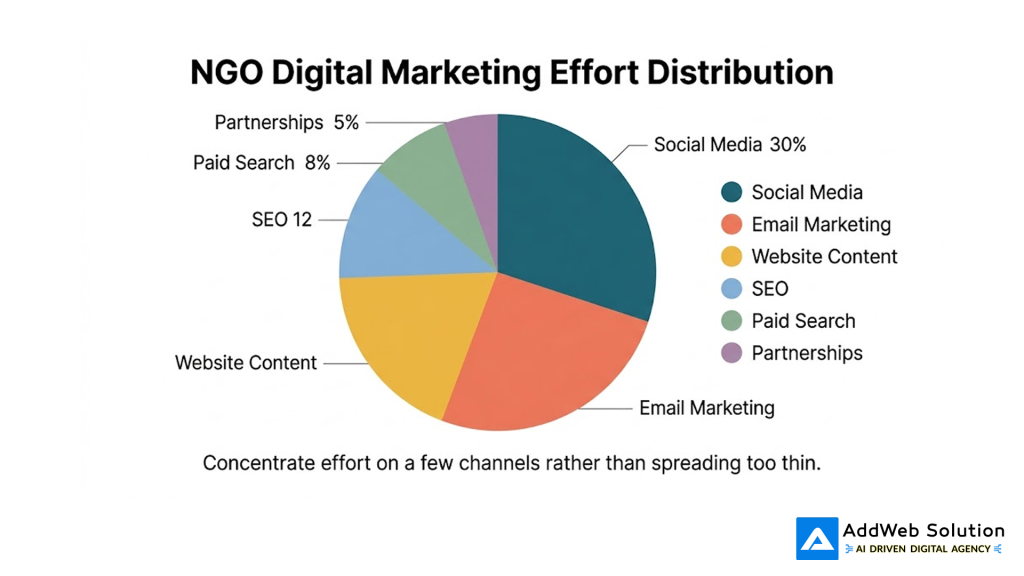
The real challenge is not choosing every available channel. It is choosing the right few and executing them with discipline.
The most effective low-cost channels for nonprofits
1. Email marketing
Email remains one of the most dependable digital channels for NGOs. It is direct, personal, and inexpensive to run. More importantly, it gives nonprofits ownership over their audience, which is something social platforms cannot guarantee.
A well-built email strategy can support donation drives, event reminders, volunteer recruitment, advocacy updates, and recurring donor engagement. The key is not volume. It is relevance. A smaller email list with strong engagement is often more valuable than a huge list that never opens anything.
For NGOs, the best email campaigns usually have one clear goal. Ask for a donation. Invite someone to sign a petition. Encourage registration for an event. Keep the message focused and emotionally grounded.


2. Social media storytelling
Social media is often the first place people discover an NGO’s mission. It is also where they look for proof that the organization is active, credible, and human.
The strongest nonprofit social content is rarely overly polished. It is real. Field photos, short volunteer clips, before-and-after impact stories, and behind-the-scenes updates usually perform better than generic branded posts. Short-form video is especially important right now because it fits how audiences consume content across Instagram, Facebook, LinkedIn, and YouTube Shorts.
For NGOs, social media works best when it is used as a storytelling engine rather than a broadcasting tool. The goal is not to post everything. The goal is to make people feel something and take one next step.
3. SEO and blog content
Search engine optimization is one of the most overlooked tools in nonprofit marketing. Many NGOs focus heavily on fundraising campaigns but forget that people also search for causes, resources, local services, and educational content.
A blog can help an NGO show up in search results for long-tail queries such as:
- how to support children’s education in rural areas
- climate action volunteering opportunities
- mental health support nonprofits in Gujarat
- women empowerment donation programs
That kind of search visibility can be incredibly valuable because it reaches people who are already interested in the cause. It also creates long-term discoverability, which makes SEO one of the smartest low-budget investments for NGOs.
4. Google Ad Grants
Google Ad Grants is one of the most underused opportunities in nonprofit digital marketing. Eligible NGOs can receive search advertising credits, which allows them to appear for relevant queries without paying typical ad costs.
This is especially useful for donation pages, volunteer signups, event registrations, and advocacy campaigns. However, many nonprofits underperform here because they treat grants like a “set it and forget it” channel. To work well, Ad Grants needs search intent, keyword discipline, and conversion tracking.
Used properly, it can be one of the highest-ROI digital assets an NGO has.
5. Free design and content tools
Budget-friendly marketing is much easier today because of the number of free and low-cost tools available. Canva for Nonprofits, scheduling tools, basic analytics platforms, and AI-assisted content workflows can dramatically reduce the cost of production.
The real advantage is speed. Small teams can now create social graphics, impact reports, email headers, donation banners, and campaign visuals without depending on large design departments.
Where NGOs should spend time, not just money
A lot of nonprofit teams ask the wrong question. Instead of asking, “What can we afford?” they should ask, “What will compound over time?”
That shift matters because some digital marketing assets keep working long after they are created.
High-compounding assets for NGOs
- Evergreen blog posts.
- Donation landing pages.
- Volunteer signup pages.
- Email nurture sequences.
- Impact story archives.
- FAQ pages for donors and supporters.
These assets are powerful because they do not disappear after one campaign ends. They keep bringing value.
Low-compounding activities
- One-off posts with no follow-up.
- Random campaign blasts with no landing page.
- Campaigns without tracking.
- Content that is visually attractive but not tied to a goal.
NGOs often feel busy without being effective. The difference is usually structure. A small number of repeatable systems usually beats a constant stream of disconnected activity.
Data table: What works best for NGOs

A few trends NGOs should not ignore
The digital space is moving fast, and nonprofits need to keep pace without chasing every trend.
Short-form video is still rising
People are consuming more short videos than ever. For NGOs, this is a major opportunity because impact stories, field updates, and supporter testimonials are naturally suited to short video formats and tools that produce AI-generated animation from simple text prompts make it even easier for small teams to produce engaging visual content without a production budget.
Mobile-first behavior is now the default
Supporters often discover NGOs on mobile before they ever visit a desktop site. That means donation pages, forms, landing pages, and email layouts must be mobile-friendly.
Personalization matters more than ever
People respond better when messages feel relevant. Even simple personalization, like segmenting by donor type or location, can improve engagement.
Analytics is non-negotiable
If an NGO cannot measure which campaign drove a signup or donation, it cannot improve efficiently. That is why basic analytics is not a technical extra — it is part of campaign strategy.
Real-world example
Imagine a local education NGO launching a back-to-school fundraising campaign.
Instead of spending heavily on ads, the team could:
- publish a blog post explaining the campaign goal,
- create a 30-second student story video,
- send a donation email to existing supporters,
- post impact visuals on Instagram and LinkedIn,
- use Google Ad Grants for search traffic,
- and track conversions through analytics.
That is a complete campaign built on modest resources. More importantly, it is the kind of campaign that can be repeated, improved, and scaled.
This is where digital marketing becomes more than promotion. It becomes a system for mission growth.
Quote section
“For NGOs, consistency beats complexity. A small set of channels used well will almost always outperform a scattered multi-platform approach.”
If you want, I can also adapt this into a version with a more human, editorial Medium style, or a SEO-optimized AddWeb website blog with meta title, meta description, image prompts, and chart captions ready for design.
Conclusion
The most effective digital marketing strategy for NGOs is not the most expensive one. It is the one that is repeatable, measurable, and built around the way real supporters behave online. When an NGO focuses on email, social storytelling, SEO, and a strong website experience, it can build trust steadily without overspending.
At AddWeb Solution, we see this pattern often: organizations that stay focused on clear messaging and practical execution tend to grow faster than those that keep chasing every new platform. That is especially true for NGOs, where every click, signup, and donation matters.
Empower your NGO with digital transformation strategies for 2026 success

Pooja Upadhyay
Director Of People Operations & Client Relations
Source URLs
- https://www.google.com/grants/
- https://support.google.com/google-ads/answer/57772?hl=en
- https://www.google.com/nonprofits/resources/how-to-guide/googleanalytics/
- https://www.google.com/nonprofits/offerings/google-ad-grants/
- https://www.canva.com/en_in/canva-for-nonprofits/
- https://www.canva.com/templates/s/nonprofit/
- https://www.ipsos.com/en-in/state-digital-marketing-india-2025-26
