


Ask three robotics vendors for a quote and you will get three wildly different numbers.
That is not because anyone is padding the bill. It is because “AI robotics solution” can mean a Rs 8 lakh cobot arm or a Rs 2 crore automated welding cell with a full computer vision stack.
This guide breaks down what you are actually paying for, where the real costs hide, and what a realistic 2026 budget looks like for an Indian manufacturer.
The Honest Answer Before The Breakdown
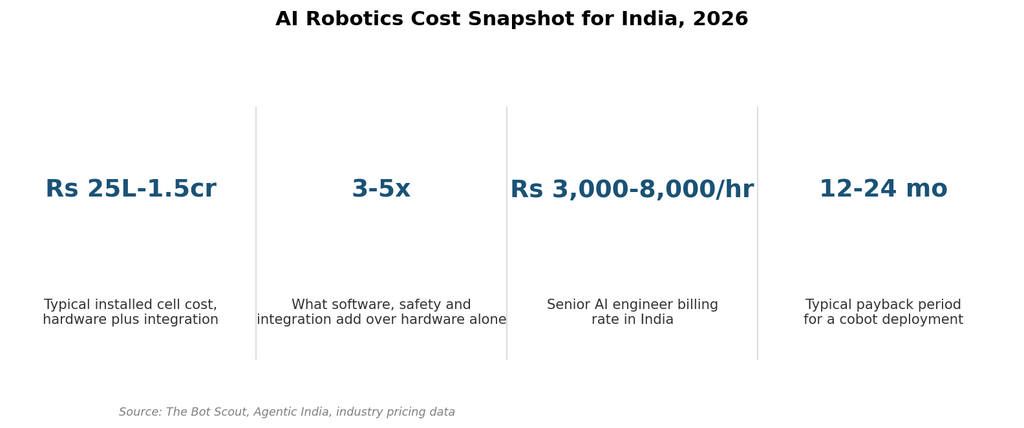
If you want one number, here it is: a working, integrated robotic cell in India typically costs between Rs 25 lakh and Rs 1.5 crore.
Simple pick-and-place cobots sit at the low end. Multi-axis welding or vision guided assembly cells sit at the high end.
The robot arm itself is usually only 30 to 45 percent of that total. Everything else, safety systems, tooling, integration labor, and the AI software layer, makes up the rest.
What You Are Actually Paying For
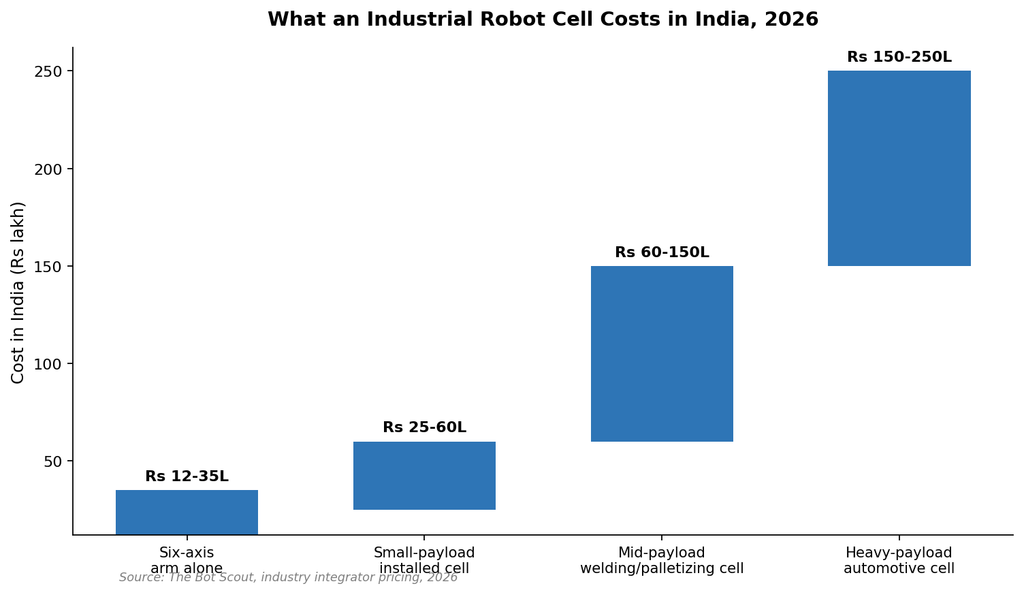
A bare six-axis robot arm in India typically costs Rs 12 to 35 lakh depending on payload and brand.
That number alone is almost meaningless, because the arm rarely ships ready to work.
Nigel Smith, managing director of industrial robot supplier TM Robotics, makes the point plainly: the true cost of deploying a robot goes well beyond its price tag once you add segregated work areas, backup power, and peripheral hardware.
The Boston Consulting Group’s well known rule of thumb backs this up with a number. Budget roughly three times the robot’s sticker price to account for tooling, safety infrastructure, and integration.
End of arm tooling like grippers and welding torches typically adds $3,000 to $40,000. Safety hardware such as fencing, light curtains, and area scanners to meet ISO 10218 standards adds another $8,000 to $40,000.
Fixtures and part presentation systems are usually the biggest budget overrun line, often running $5,000 to $60,000 depending on how complex the assembly process actually is.
Cost By Robot Type, India Specific Numbers
Cobots are the cheapest entry point. A cobot class arm in India runs Rs 18 to 35 lakh, priced 40 to 60 percent below traditional industrial arms because they need less safety infrastructure.
Standard six-axis industrial arms for welding, painting, and machine tending scale from Rs 25 lakh to Rs 1.5 crore once fully installed, according to India specific integrator pricing.
Heavy payload welding and automotive cells regularly exceed Rs 2.5 crore once you factor in vision systems, custom fixtures, and multi-robot coordination.
Autonomous mobile robots for warehousing sit in a different pricing band entirely, but Indian logistics operations running AMR fleets report 30 to 40 percent improvements in pick accuracy and throughput per shift, which is often what justifies the spend.


The AI Software Layer Nobody Budgets For Properly
Here is where most first time buyers get their estimate wrong. They price the hardware and forget the intelligence layer that makes it worth calling “AI powered.”
For a meaningful, production grade AI integration, not a demo, plan for a minimum of Rs 2 to 3 lakh just for the software side. Anything below that typically produces a prototype that cannot handle real world edge cases.
If your robotics project needs custom computer vision or fine tuned models for defect detection or part recognition, the realistic floor climbs to Rs 8 to 10 lakh.
Senior AI engineers in India typically bill Rs 3,000 to 8,000 per hour, which is still 60 to 80 percent cheaper than equivalent talent in Western markets billing $80 to $200 per hour for the same seniority.
This software layer is also where AI integration and MLOps work matters most, since a vision model that works in a demo needs monitoring, retraining pipelines, and uptime guarantees once it is running a live production line.
What Pushes The Price Up Or Down
Sector matters more than most buyers expect. Electronics manufacturers building PLI backed greenfield factories, automotive suppliers running multi shift welding lines, and pharma companies automating cleanroom packaging all carry different compliance and integration overhead.
Automotive alone accounts for roughly 36 percent of India’s industrial robot purchases, with electronics close behind at 28 percent, driven partly by Apple’s supply chain shift into the country.
PLI incentives can offset part of this investment indirectly, since incentive payouts are tied to production efficiency benchmarks that automation helps you hit, though the scheme does not subsidize the robotics purchase directly.
Import duty on foreign robot hardware, local integrator availability, and whether you choose new versus refurbished equipment can each swing your total budget by 20 percent or more.
What Return On Investment Actually Looks Like
The number that ultimately justifies any of this spending is payback period, and the data here is more encouraging than the sticker price suggests.
Cobot deployments typically achieve ROI within 6 to 12 months because of lower upfront costs and the ability to run unattended shifts.
Full industrial cells generally pay back within 12 to 24 months, and two shift operation roughly halves that payback window compared to running a single shift.
One manufacturer case commonly cited in ROI literature saw a 25 percent increase in production output and a 15 percent reduction in labor costs after integrating robotics into an existing line.
People Also Ask
What is the minimum budget for an AI robotics project in India? A basic cobot cell with production grade AI software starts around Rs 25 to 30 lakh all in. Anything significantly below that usually means a prototype, not a working production system.
Is the robot arm the biggest cost in a robotics project? No. The arm is typically only 30 to 45 percent of total project cost. Integration, safety systems, tooling, and the AI software layer usually cost more than the robot itself.
How long does it take to see ROI on a robotics investment in India? Cobots typically pay back within 6 to 12 months. Full industrial cells usually pay back within 12 to 24 months, faster with multi shift operation.
Do PLI incentives cover the cost of robotics equipment? Not directly. PLI payouts are tied to production and sales benchmarks, so automation helps you hit those targets faster, but the scheme does not subsidize robot hardware purchases outright.
Why is a cobot cheaper than a standard industrial robot? Cobots need less safety infrastructure since they are designed to work near humans without full fencing, which cuts both hardware and integration costs by 40 to 60 percent compared to traditional arms.
What is the real cost driver in AI robotics, hardware or software? Increasingly software. As robot arm prices stabilize, the AI vision, integration, and ongoing monitoring layer is becoming the larger and more variable part of the total budget.
Getting A Number You Can Actually Trust
Every generic pricing guide, including this one, gives you a range. Your actual number depends on payload, process complexity, and how much of the AI software layer you need built from scratch versus adapted from existing models.
AddWeb Solution’s AI robotics and manufacturing team scopes projects against your specific line, not a generic template, so you get a number tied to your actual process rather than an industry average.
If you are still deciding whether to automate now or wait, a free AI opportunity assessment will tell you where the fastest payback sits in your operation before you commit any capital.
The vendors worth trusting are the ones who tell you when a simpler, cheaper solution fits your problem. That conversation is usually a better signal than the lowest quote in your inbox.
Talk to our automation and AI experts

Pooja Upadhyay
Director Of People Operations & Client Relations
References
How much do robots cost? 2026 price breakdown, Standard Bots
ABB robot prices in 2026, Standard Bots
Industrial Robot Price 2026, EVST Robot
How Much Does an Industrial Robot Cost, EVS Integration
Buy Robots in India: Complete Marketplace Guide 2026, Roboshy
