


Laravel is no longer just a “nice dev experience” framework; it now sits behind real SaaS products that have exited for 8‑figure amounts, giving founders a concrete proof-point that a Laravel codebase can absolutely be acquisition-grade.
This article walks through two real Laravel-powered SaaS exits in the 8‑figure range, visualizes the numbers, and then extracts practical, technical takeaways you can use if you’re building your own Laravel startup today.
The short list: Laravel apps with 8‑figure exits
Two examples stand out where publicly available data and credible technical commentary tie a significant acquisition directly to a Laravel-based SaaS product:
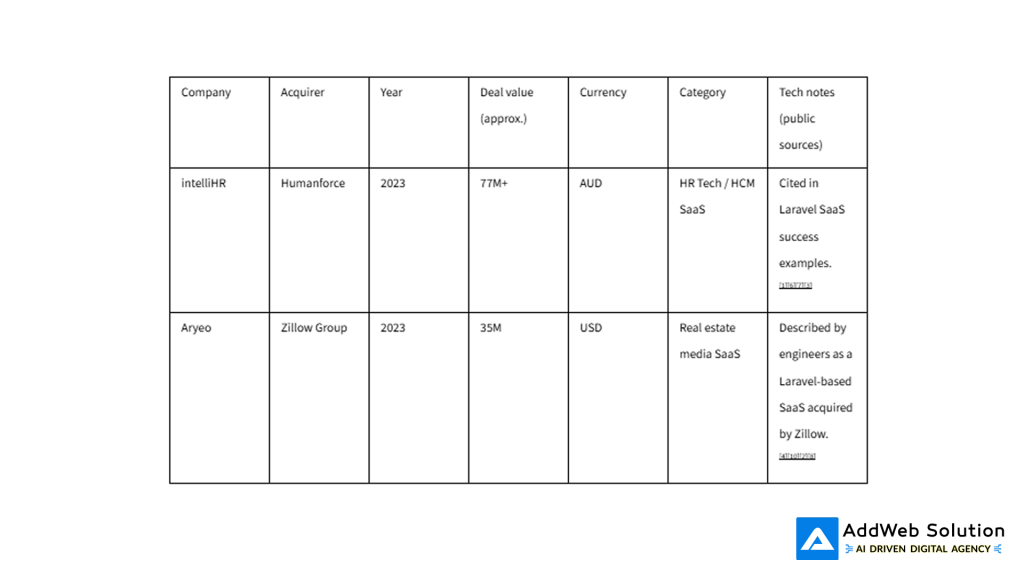
- intelliHR → Humanforce (workforce / HR tech) – Australian-born HR SaaS acquired via a takeover worth over AUD 77M (mid‑8 figures in AUD, solid 8 figures in USD terms).
- Aryeo → Zillow Group (real estate media SaaS) – US real estate photography and media platform acquired for about USD 35M.
Technical community sources and Laravel-focused case studies explicitly cite both intelliHR and Aryeo as Laravel-based SaaS success stories, positioning them as examples of “Laravel startups” that scaled all the way to major strategic exits.
Visual: Laravel 8‑figure SaaS exits by deal value
Here’s a simple table of the two known, well-documented deals:
Now, let’s visualize that. These mermaid snippets can be dropped directly into modern Markdown tooling that supports Mermaid for quick charts.
Pie chart – share of disclosed Laravel exits by deal value

The takeaway here is simple: we don’t have hundreds of disclosed deals yet, but the ones we do see are meaningful mid‑eight‑figure acquisitions, not tiny acqui‑hires.
Bar chart – deal value by company
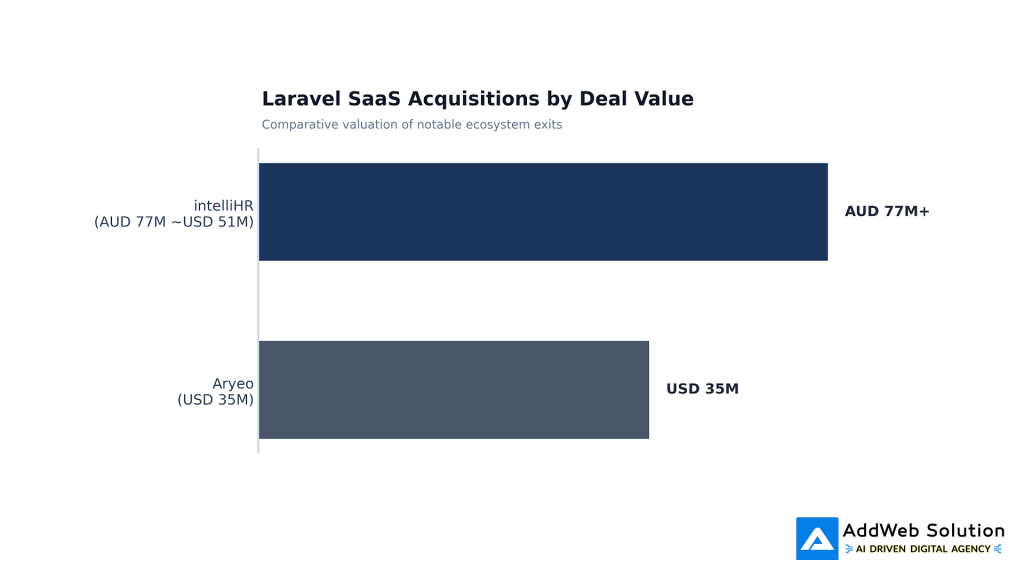
Even with a small sample, this is a useful calibration point if you’re sitting on a Laravel SaaS in the HR, productivity, or vertical‑SaaS space and wondering, “Is this stack taken seriously by strategic buyers?” The answer, empirically, is yes.
Why these exits matter for Laravel founders
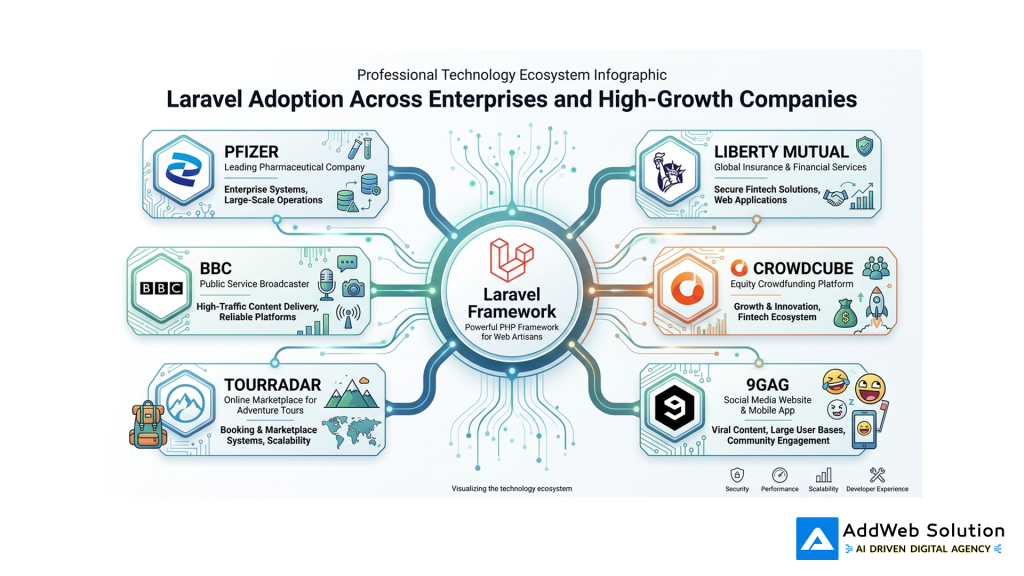
Laravel has quietly become one of the most widely used backend frameworks for web applications and SaaS platforms, with thousands of active employers and tens of thousands of open roles globally. Big, conservative companies like Pfizer, Liberty Mutual, BBC, and Crowdcube run production workloads on Laravel, so buyers are not seeing it as an “indie only” stack.
On top of that, many high‑growth startups and fintechs, from Bitpanda to Razorpay and 9GAG, rely on Laravel for parts of their core platform and APIs, showing that the framework scales into serious B2C/B2B traffic and regulatory environments.
For an acquirer, that translates into three practical benefits:
- Large talent pool – It’s easier (and cheaper) to hire and onboard Laravel developers versus a niche proprietary stack.
- Predictable patterns – Laravel’s conventions, Blade, Eloquent, queues, and testing make the codebase more predictable in due diligence.
- Ecosystem leverage – Tools like Laravel Horizon, Cashier, Forge, and Envoyer reduce operational risk and make post‑acquisition integration less painful.
In other words, these exits validate Laravel not just as a “developer‑friendly” framework but as a commercially safe bet all the way to M&A.
Case Study #1: intelliHR → Humanforce (AUD 77M+)
Quick deal snapshot
- Product: Cloud‑based human capital management (HCM) / HR tech SaaS.
- Founded: 2013, Australia.
- Acquirer: Humanforce, workforce management and payroll provider.
- Deal: On‑market takeover, ultimately worth over AUD 77M, with Humanforce moving to compulsory acquisition once it controlled >90% of shares.
HR tech case studies and Laravel‑focused content position intelliHR as a canonical example of a successful SaaS business built with Laravel that later exited in the mid‑eight‑figure range, often cited alongside other Laravel SaaS tools.
What intelliHR actually sold
If you look at the public messaging, Humanforce didn’t buy “a Laravel app” – they bought:
- A best‑of‑breed HR platform for engagement, performance, compliance, and people analytics.
- A data‑rich system of record for employees that plugs into workforce management and payroll.
- A wedge into moving from point solutions (WFM, payroll) to a broader employee‑centred HCM suite.
But under the hood, Laravel’s strengths map nicely to what a product like this needs: role‑based access, workflow engines, multi‑tenant structures, strong validation, and secure API surfaces.
Technical patterns likely at play
Laravel SaaS best‑practice guides describe exactly the architectural moves you’d expect in a platform like intelliHR:
- Multi‑tenant CRM/HCM style setup – each client has isolated users, data, and dashboards, often implemented via tenant-aware database schemas or separate databases.
- Extensive background processing – queues and workers (often with Horizon) handling analytics, report generation, notifications, and integrations with payroll / SSO providers.
- Subscription / billing automation – Laravel Cashier or similar tools for recurring billing, trials, and metered usage where relevant.
These aren’t exotic techniques; they’re the kind of patterns a good Laravel team can implement quickly – which is precisely what makes a codebase like this attractive to an acquirer that wants to ship features and integrations fast after closing.


Case Study #2: Aryeo → Zillow Group (USD 35M)
Quick deal snapshot
- Product: Real estate media and content management SaaS for photographers and media companies
- Features: Booking workflows, media delivery, property websites, payment processing, and dashboarding for real estate media.
- Acquirer: Zillow Group, folding Aryeo into its ShowingTime+ suite to power richer listing media across the Zillow ecosystem.
- Deal: Reported acquisition price of around USD 35M, disclosed in funding and exit databases and industry commentary.
Engineers familiar with the product and community commentary explicitly describe Aryeo as a Laravel‑based SaaS that was acquired by Zillow, putting it squarely in the “Laravel startup → 8‑figure exit” bucket.
Why Aryeo was valuable
Zillow wasn’t buying a generic project management app; they were buying:
- A vertical, opinionated workflow for real estate photography and media.
- A network of 1,500+ media companies already running on the platform.
- A proven way to streamline creation, distribution, and monetization of listing media.
Laravel fits especially well here because it excels at workflow-heavy, CRUD‑plus‑rules applications – the kind that coordinate bookings, file uploads, asset processing, and notifications while integrating with payment providers and external platforms.
Beyond exits: the wider Laravel SaaS ecosystem
Even if we strictly count only disclosed 8‑figure M&A deals, the sample size is small – but the broader Laravel startup ecosystem is much larger and shows a consistent pattern of serious commercial traction.
Examples:
- SnapShooter – backup SaaS that supports Laravel and other stacks, acquired by DigitalOcean to strengthen its backup and recovery offering; amount undisclosed, but backed by multiple press releases and vendor blogs.
- Funden – investment matchmaking platform built by a solo founder in Laravel, scaled to around USD 100K in monthly revenue within 12 months and sold for a 7‑figure amount in under two years.
- Numerous Laravel-based SaaS products generating robust 6‑ and 7‑figure revenues (e.g., Oh Dear, analytics tools, financial exchanges) are mentioned by contractors and founders, even if their deals or valuations are not public.
This context matters: intelliHR and Aryeo are visible tips of a much larger iceberg of profitable Laravel SaaS businesses, many of which are either quietly compounding or setting up future strategic exits.
What acquirers really buy in a Laravel SaaS
When a strategic buyer evaluates a Laravel startup, they’re not scoring you on how many Eloquent relationships you used. They care about a few concrete dimensions that Laravel happens to support very well.
1. Clean multi‑tenant architecture
Acquirers want to be confident that adding 10x customers or new regions won’t require a full rewrite. Laravel’s database abstraction and middleware patterns make it straightforward to implement:
- Separate tenant databases or schemas.
- Tenant-aware routing and middleware.
- Per‑tenant configuration (branding, feature flags, limits).
That kind of architecture is clearly relevant in HR (intelliHR) and vertical SaaS (Aryeo) where each customer must be logically – and often legally – isolated.
2. Workflow depth in a boring but valuable niche
Both intelliHR and Aryeo live in boring‑but‑lucrative domains: HR compliance, performance reviews, and real estate media operations. Buyers value that more than cutting-edge tech.
Laravel’s batteries‑included approach (auth, validation, queues, notifications) makes it realistic to build deep workflow coverage without a huge team – a pattern echoed across real‑world Laravel SaaS examples.
3. Integration surface area
A Laravel SaaS that integrates deeply with existing systems is more attractive because it’s stickier and slots into a buyer’s platform strategy:
- Payroll & WFM systems in the case of intelliHR.
- Real estate portals, listing tools, and scheduling systems in the case of Aryeo.
Laravel’s routing, API resources, and middleware make building robust REST or webhook-based integrations relatively fast, while security features and rate limiting help keep them safe.
4. Operational maturity
Tools in the Laravel ecosystem directly support the kind of operational maturity buyers look for:
- Queues + Horizon for predictable background processing and monitoring.
- Cashier for recurring billing and subscription lifecycle.
- Forge / Envoyer for automated deployments and zero‑downtime releases.
Case studies of Laravel SaaS platforms highlight these patterns as standard practice for scalable, acquisition‑ready apps rather than “nice to haves.”
Visual: Where Laravel is used in serious companies
Surveys and company roundups highlight that Laravel is already used by large enterprises (Pfizer, Liberty Mutual, BBC) and high‑growth digital product companies (Crowdcube, TourRadar, 9GAG) – often for core web applications and APIs, not just side projects.
For founders, this matters because it de‑risks your stack choice in the eyes of potential acquirers or investors: they’re not betting on a fringe framework.
Practical roadmap: From Laravel MVP to acquisition‑ready
If you’re building a Laravel SaaS today, here’s a pragmatic, acquisition‑oriented progression that mirrors what successful products tend to do.
Phase 1: Zero to problem – solution fit
- Build a narrow, opinionated workflow in a niche where you can become “the default” (think HR workflows, creative operations, logistics, compliance).
- Use Laravel’s auth, policies, and validation to lock down data from day one; retrofitting security later is painful and a red flag in due diligence.
- Don’t over‑engineer multi‑tenancy initially; a simple per‑tenant foreign key design is usually enough if you model it cleanly.
Example: Funden’s journey from a solo Laravel codebase to 100K MRR and acquisition in under two years shows how fast you can move if you focus on one workflow and lean technology.
Phase 2: Product – market fit and early scaling
- Introduce background jobs for reports, imports, and notifications using queues and Horizon.
- Formalize billing with Cashier or equivalent and make subscription state a first‑class concept in your domain model.
- Wrap your core business entities in API resources and start exposing a public or partner API where it strengthens your moat.
At this point, you start resembling the architecture patterns seen in serious Laravel SaaS deployments for HR, analytics, and internal tools.
Phase 3: Exit-ready posture
- Harden multi‑tenancy (schema / DB level, per‑tenant encryption where needed) so you can pass security and data‑separation scrutiny by larger buyers.
- Invest in observability – logs, metrics, and SLOs for key endpoints – so acquirers can understand system behaviour quickly.
- Document the integration landscape: which systems you plug into, where webhooks go, and which partners you power – this was central to both intelliHR and Aryeo’s value propositions.
SnapShooter’s acquisition by DigitalOcean demonstrates how being deeply embedded in an ecosystem (in their case, cloud backups and integrations with platforms like Laravel, databases, and DigitalOcean) can make you an obvious strategic target, even when the deal value stays undisclosed.
Due diligence checklist for a Laravel codebase
If you want your Laravel app to survive an acquirer’s technical deep dive, these are the boxes you’ll almost certainly need to tick:
- Security posture – CSRF protection, input validation, sanitized queries, and proper use of Laravel’s security features (guards, policies, rate limiting).
- Test coverage – at least around critical workflows: onboarding, billing, permissions, and data exports.
- Clear domain boundaries – service classes or modules that map to business concepts (employees, shifts, listings, orders) rather than a tangle of controllers doing everything.
- Migration hygiene – clean migrations and seeders, so an acquirer can spin up the stack and understand the data model quickly.
- Operational documentation – how to deploy (Forge/Envoyer or CI/CD), how queues are configured, and how environments differ.
Laravel best‑practice guides and real‑world SaaS case studies consistently emphasize these areas as the foundation for scalable, maintainable products – which is exactly what a buyer wants to see.
Bringing it together
The data we have today shows that:
- Laravel is already behind multiple 8‑figure SaaS exits, including intelliHR (HR tech) and Aryeo (real estate media), with solid documentation on deal values and credible technical commentary on their Laravel roots.
- The framework’s strengths – multi‑tenant SaaS patterns, strong security defaults, rich ecosystem, and huge developer base – map directly onto what acquirers value in a mature product.
- A growing ecosystem of Laravel SaaS products (SnapShooter, Funden, and many unnamed platforms) shows that turning a Laravel MVP into a serious acquisition candidate is an achievable, repeatable path – not a one‑off anomaly.
If you’re building with Laravel today, you’re not just optimizing for developer happiness – you’re building on a stack with a proven track record of producing assets that strategic buyers are willing to pay 8+ figures for. Your next move is less about switching frameworks and more about picking the right problem, executing ruthlessly on workflow depth, and shaping your product into something that looks irresistible in a data room.
From MVP development to enterprise-grade architecture, we help founders build products that investors and acquirers value.

Pooja Upadhyay
Director Of People Operations & Client Relations
⁂
- https://www.humanforce.com/resources/news/humanforce-acquires-intellihr-cementing-its-position-as-a-best-of-breed-human-capital-platform
- https://announcements.asx.com.au/asxpdf/20230428/pdf/45p5kyy9y7kkq3.pdf
- https://hr.economictimes.indiatimes.com/news/industry/australias-intellihr-soars-14-as-humanforce-sweetens-offer-to-outbit-rival-tag/98611079
- https://www.inman.com/2023/08/02/empowered-with-great-products-zillow-acquires-aryeo/
- https://www.zillow.com/news/real-estate-media-software-platform-aryeo-joins-showingtime-to-help-deliver-richer-home-shopping-experiences/
- https://www.kcapex.com/case-study-89-an-eight-figure-it-staffing-company-exit/
- https://careerkarma.com/blog/companies-that-use-laravel/
- https://laravel-news.com/laravel-raises-57-million-series-a
- https://tech.chrishardie.com/2020/build-launch-saas-app-one-month/
