


Introduction
Most NGO’s start their online channels with a donate button. Fair enough: money is the most urgent demand, and charging a payment is the quickest way to respond.
The problem with a donate button is, it’s a transaction, and it doesn’t explain to the supporter what happened to their money, or find out why that supporter might not come back, or put the people you’re helping in the driver’s seat.
Two years of data reveal the blind spots. So it’s possible that US giving will grow 5.0% in 2025 (its strongest increase in five years), and donor numbers will fall 3.6%. To do more with less is a weak foundation for any organisation.
In this article we look at what digital transformation means for an NGO and how it’s possible for it to deliver the three things a donations page can’t: trust, community and impact that you can measure.
What Digital Transformation Means for an NGO
Too many people believe digital transformation to be a software buy. Actually, it’s a new way of working. It’s how an organisation collects data, makes decisions and engages with people that matter.
A CRM, a payment gateway and a reporting dashboard are tools. The transformation is the degree to which people have ingrained the habit of working with them to answer genuine questions.
Who is the most significant source of support for us? Why do they support us or not? What difference did last year’s grant make in real life?
The five areas it covers
- Fundraising & donating: online donations, recurring donations, mobile-first checkout and payments at the point of sale (POS) using local payment methods such as UPI with cards.
- A single consolidated data file replacing a large number of Excel sheets used for donors, volunteers and programme participants.
- Communications: email, WhatsApp, social media & SMS – on an agreed timetable, not just in bubbles round the appeals.
- Impact report: Supporters can view dashboards, project updates and financial reports.
- Governance & compliance Consent and data protection and management. Compliancy ( India DPDP Rules). Customer identity & access management (CIAM).
Why the pressure is building
You’ve got a couple of lenses on the issue. The 4.8% online giving bump in FEP 2025 is a big deal, but giving and registration have dropped in FEP 2025.
Bottom line: Donor numbers have shrunk every year for three years in a row, but the rate of reduction is shrinking.
Average online revenue was up 15% in 2025, the 180 nonprofits in M+R’s 2026 Benchmarks report, and a big portion of that increase was a result of spikes in crisis-driven giving among sectors that lack the funder network. And fleeting, emergency donors are hard to snag.
Table 1. Key numbers at a glance
| Metric | Figure | Source |
|---|---|---|
| Growth in US charitable giving, 2025 | +5.0% | Fundraising Effectiveness Project, Q4 2025 |
| Change in number of donors, 2025 | −3.6% | Fundraising Effectiveness Project, Q4 2025 |
| Overall US donor retention | 43.3% | Fundraising Effectiveness Project, 2025 |
| Online revenue growth, average nonprofit, 2025 | +15% | M+R Benchmarks 2026 |
| Monthly giving as a share of online revenue | 27% | M+R Benchmarks 2026 |
| Online donations made on a mobile device | 43% | M+R Benchmarks, via Nonprofit Tech for Good |
| UK charities using AI tools, 2026 | 79% | Charity Digital Skills Report 2026 |
Building Trust: Make Transparency a Routine, Not an Annual Report
Nonprofits hold a competitive edge. The very high confidence that Americans expressed in nonprofits, as measured in the independent sector’s 2026 study, was higher than their confidence in any other type of institution. It surpassed confidence in the military, business sector, news media and the federal government.
But that doesn’t mean organisations are necessarily going to use this data ethically. Johnson Center 2025 found that only 31% of those surveyed trusted regional non-profits to hold their data, compared with 26% of local government and 33% of local small business.
This article cited a Giving Tuesday survey to find that people with greater levels of trust in charities were almost twice as likely to give.
What donors say holds them back
You Gov with 1,291 respondents in August 2026, and the results were published in October. Question – What would motivate you to give? The majority (39%) said knowing how the donations are used. The next most popular answers were: supporting a local charity (33%) and how well a charity is regarded (30%).
It even wondered what might put people off-and the list reads like a NGO’s to-do list of digital activities.
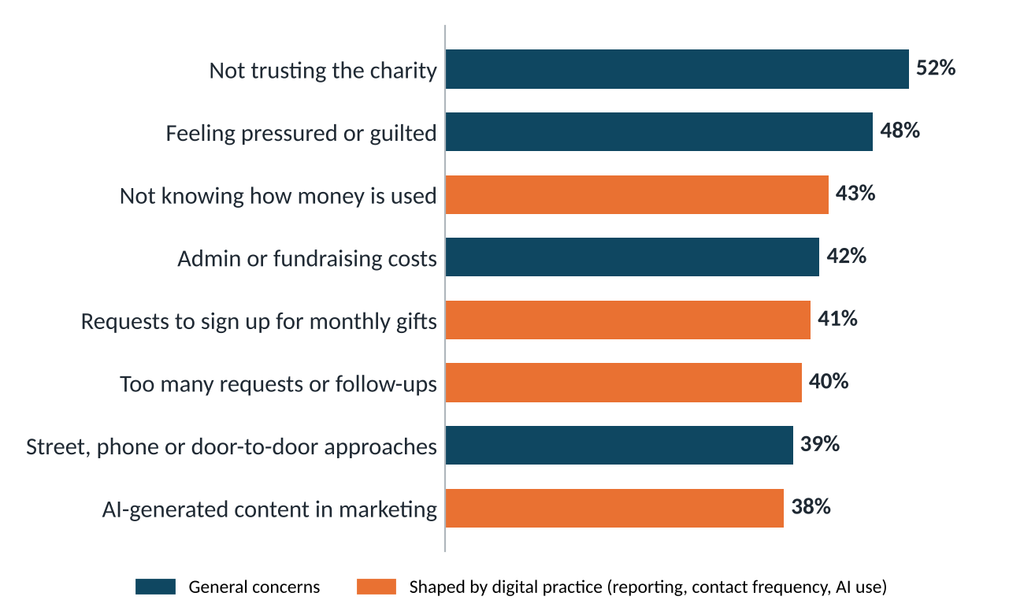
Source: YouGov, October 2026 (n = 1,291).
Many of these elements, including the frequency of your mailing, the notes on the explanation of your spending, and the request for monthly gifts, are not in the brand guidelines – they are in the CRM and content calendar.
Four digital practices that build trust
Publish impact data on a fixed schedule
Those that care will be able to tell the difference between the report and a brochure. Line each line of expenditure to an outcome, give a date and tell what did not happen.
Explain every request for personal data
The Johnson Center found 65 percent of individuals report the most or highly significant thing you tell them is the way you are going to utilize their data. A one-sentence description to reasons you are collecting every form field is only one or two bucks.
Write consent notices people can read
India’s DPDP Rules, 2025 mandate that the demand for consent should be explained the purpose of information being processed. The Rules also state that NGOs working with children should take valid parental consent of under-18s, unless specific reasons such as healthcare apply (check with a lawyer what exemptions are applicable to your programmes).
Control how often you contact people
40% of US adults say repeated requests or follow-up communications would make them less likely to give and 41% report the same of requests to join a monthly gift. A self-selector experience can satisfy both.
What India’s DPDP Rules mean for NGO data practice
India has released the Digital Personal Data Protection Rules, 2025 (DPDP Rules), which has a period of 18 months to come into force, being released in November 2025, and an approximate date of 13 May 2027.
The core requirements (e.g. Relating to consent and those on organisations who process personal data) are going to be enforced from 13 May 2027 – a little over 5 months away from now (late November 2026).
NGOs with donor/volunteer/beneficiary records should start to presuming these will apply and seek legal advice as to whether they can be exempt.
Table 2. DPDP Rules: a planning summary for NGOs
| Area | What the Rules require | Practical step |
|---|---|---|
| Notice and consent | Consent requests must state the purpose of processing in clear terms | Rewrite donation, volunteer and beneficiary forms with a plain-language purpose line |
| Children’s data | Verifiable parental consent for under-18s, with exceptions such as healthcare | Map which programmes collect data on minors and who gives consent |
| Breach response | Affected individuals must be informed, and the Data Protection Board notified, with a 72-hour window for details | Write a one-page incident plan with named owners before you need it |
| Timeline | Core obligations apply from 13 May 2027; the older SPDI Rules, 2011 stay in force until then | Run a data audit now: where records sit, who can access them, how long you keep them |
This table is a planning summary, not legal advice.


Engaging Communities: Retention Is Where the Growth Is
Buy the gift. Keep the file growing. It is apparent in the data from M+R’s 2026 report. Of the 31 percent of online revenue generated in 2025 from new donors, only 24 percent of the previous year’s donors were retained.
Significantly fewer were retained from previously donated through digital, compared with older donors; 66 percent of older donors were retained.
In the case of monthly donors, a few never make it; 10 percent drop out within two months, 81 percent of monthly donors are retained after seven months and 71 percent are retained after 12 months. A little over half (54 percent) of monthly donors are retained after two years.
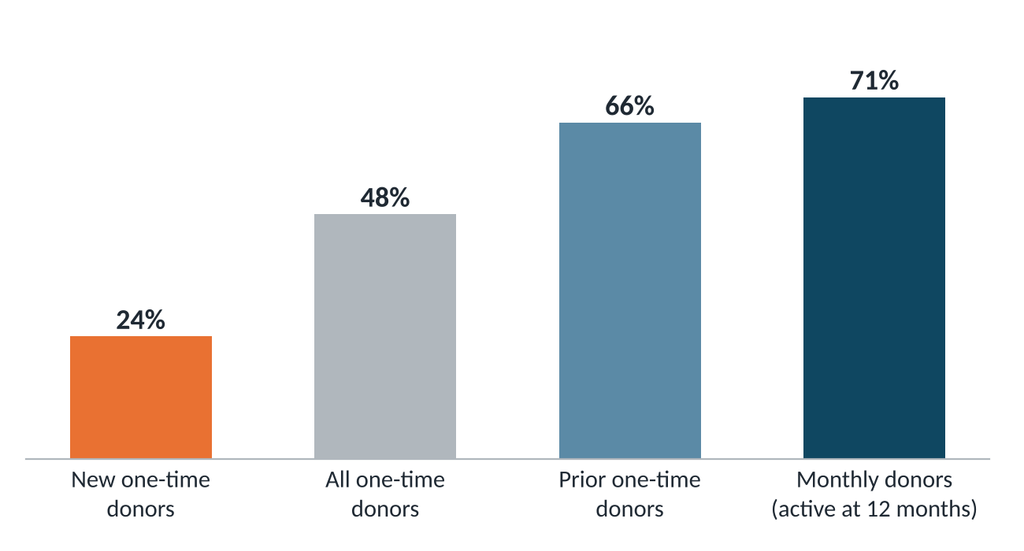
Source: M+R Benchmarks 2026.
Monthly giving: steadier, but not a default for everyone
Regular (monthly, quarterly, annual) giving accounted for 27% of online revenue in 2025. For larger organisations this is higher (37% for the largest 11-50m), but for smaller is lower (22% for <$1m online rev).
Overall the single / one-off gift element grew faster in 2025 (17% v 12%), and M&R think this is due to the response to emergencies.
Pragmatists will think, there’s no harm in offering an option – but don’t push it too far – 41% of US adults in a You Gov survey said that being asked to sign up to set up recurring gifts would put them off.
Match each channel to a job
Benchmarks demonstrated that channels were not fungible and that people were far more responsive to a request to do something than to a request for money.
Table 3. Channel benchmarks, 2025
| Channel | Benchmark | What it suggests |
|---|---|---|
| Fundraising email | 0.05% response rate; US$54 raised per 1,000 emails | Low response per message, so segment lists and limit frequency |
| Advocacy email | 1.4% response rate, about 28 times fundraising email | Use action requests (petitions, sign-ups, volunteering) to keep people engaged between appeals |
| Mobile messaging | 0.17% response for fundraising; 2.6% for advocacy | Same pattern: asks for action get more replies than asks for money |
| Website | 1.6% of visitors donate; US$1.33 revenue per visitor | Conversion is a page-level problem; test the donation form before buying more traffic |
| Device split | Mobile: 43% of online donations. Desktop: 57% of transactions and 72% of revenue | Design for mobile first, and check that desktop checkout works well for larger gifts |
| Direct mail | Revenue up 9% in 2025 | Offline channels still earn; record the results in the same CRM |
Ways to involve people beyond a gift
- Volunteer sign-ups and skills-based roles (attending as a volunteer or holding a position).
- Advocacy effect: not requesting a certain level of aid, which drew more responses than the donation appeal (Table 3).
- Member and community surveys, with feedback provided to those surveyed.
- Fundraising via tributes & memorial donations. 41% of nonprofits now run a tribute programme against 22% in 2019 (2026 Nonprofit Tech for Good Report).
- Campaigns are sent year-round. The giving tuesday chief data officer wrote that May through August was a lost window for giving, noting donors want to give, but there are too many campaigns at the end of the year.
Increasing Impact: Use Data to Run the Programme, Not Just the Appeal
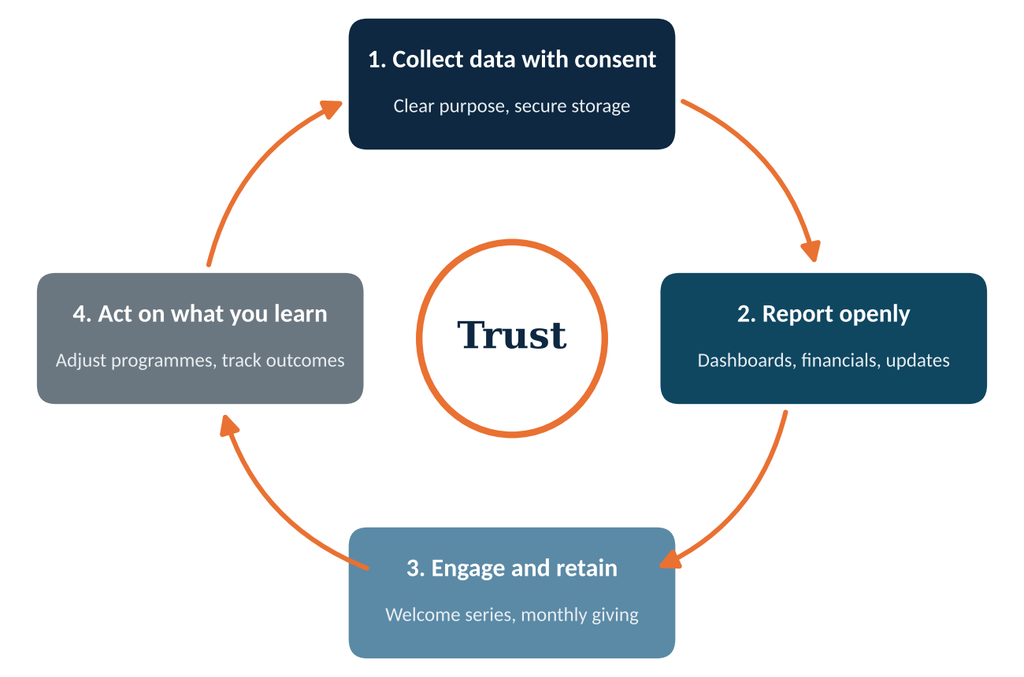
Trust. Engagement. Impact. Building on each other: Consent-led data collection enables open reporting – open reporting helps with retention – retention ensures programmes whose impact makes it into the next report.
The funding gap in India
Impact is constrained by resources as much as methodology – and the data from India is revealing just how big the challenge is.
The total social-sector funding in India was approximately INR 27 lakh crore in FY25 – of which 95% came from the government, and private philanthropy was roughly INR 1.43 lakh crore (USD 16 billion).
The report estimates an INR 16 lakh crore funding gap in India against NITI Aayog norms, with the figure projected to rise to INR 18 lakh crore in FY30.
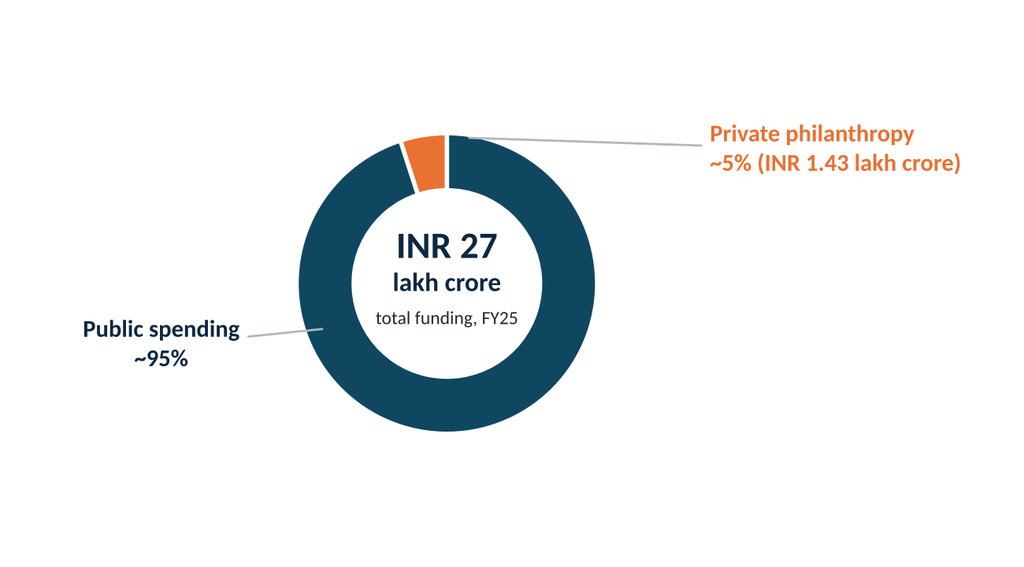
Source: Bain & Company and Dasra, India Philanthropy Report 2026.
Table 4. India social-sector funding outlook
| Indicator | Figure | Basis or period |
|---|---|---|
| Total social-sector funding | INR 27 lakh crore (US$310 billion) | FY25 |
| Projected total funding | INR 50 lakh crore (US$570 billion) | FY30 |
| Private philanthropy | INR 1.43 lakh crore (US$16 billion) | FY25 |
| Funding gap against NITI Aayog norms | INR 16 lakh crore (US$180 billion), widening to INR 18 lakh crore (US$210 billion) | FY25 to FY30 |
| Private giving growth needed to stop the gap widening | More than 25% a year | Assuming public spending trends hold |
| Share of private giving from families | About 42% | Personal giving plus family-business CSR |
According to the report, India’s everyday giving needs the support systems that can help it grow, such as data, storytelling and donating habits. An individual NGO can first work on donation records, impact reports, and simple online donation options.
AI and data: adopt with guardrails
AI is faster 61% of charities are using AI in 2024 (up from 76% in 2025 and 79% in 2026. Trust has not kept up: the proportion of charities that reported a lack of trust in AI tools increased from 15% in 2024 to 35% in 2026.

Source: Charity Digital Skills Report 2025 and 2026, as reported by Civil Society.
Most of this use is quite light. In the 2025 report, only 15% of charities used AI for qualitative analysis of data, 13% used it for numerical analysis of data, and only 4% used AI for predictive analysis of data. An April 2026 Charity Excellence report that collated this research reported most AI use as informal and ungoverned.
Where AI earns its place
- Writing draft versions of reports, grant text and newsletters that another person then edits.
- De-duplication and standardisation of names and addresses.
- Compiling supporter and beneficiary feedback for staff to view.
Where to be careful
- Appealing to the donor! US donors are less likely to be engaged if the content of your charity marketing was created with AI (38%) (You Gov, 2026).
- Public opinion: 37% of Americans say they are less trusting of how nonprofits use AI, according to Independent Sector, though that number jumps significantly for those who use it.
- Personal data: Do not disclose donor and recipient data on general-use AI applications unless you have a data-protection agreement.
- The Catalyst recommends that your organisation has an up-to-date digital strategy in place before you scale.
From scattered spreadsheets to one connected record
Since 2017, when we first published the Charity Digital Skills Report, the report has highlighted three chronic digital issues common among charities: lack of strategy, inability to use data to make decisions and digital skill gaps.
But the solution is often not a wider platform, but rather a single supporter record that consolidates all gifts, volunteering, event attendance, and communication preferences and is maintained by a person with time.
A 12-Month Roadmap
Small NGOs have the ability to step through tasks in a way that each task then enables the next to be completed. The Charity Digital Skills Report revealed 68% of small charities are still in the early stages of digitisation, so getting to grips with basic ideas and tools is to be expected.
Table 5. Phased roadmap
| Phase | Timing | Focus | Deliverables |
|---|---|---|---|
| Foundation | Months 1 to 3 | Data audit, consent and privacy, a single supporter record | Clean database, plain-language consent lines, DPDP gap list, baseline metrics |
| Engagement | Months 4 to 8 | Retention and communication | Welcome series for new donors, monthly giving option, preference centre, planned email and WhatsApp schedule |
| Impact | Months 9 to 12 | Reporting and measured use of AI | Public impact dashboard, quarterly update, a governed AI pilot with a human review step |
Metrics to track from the first month
Set your own baseline first. The benchmarks below come mainly from the US and should be treated as reference points, not targets.
Table 6. Starter metrics and reference benchmarks
| Metric | Reference benchmark | Source |
|---|---|---|
| New-donor retention (online, one-time) | 24% | M+R Benchmarks 2026 |
| Monthly donor retention at 12 months | 71% | M+R Benchmarks 2026 |
| Overall donor retention | 43.3% | Fundraising Effectiveness Project, 2025 |
| Website donation conversion | 1.6% of visitors | M+R Benchmarks, via Nonprofit Tech for Good |
| Fundraising email response rate | 0.05% | M+R Benchmarks 2026 |
| Mobile share of online donations | 43% | M+R Benchmarks, via Nonprofit Tech for Good |
Common Mistakes That Cost NGOs Supporters
- Buy the tools first and then plan your approach: This has been a criticism of the Charity Digital Skills Report for a number of years.
- Asking for personal data without saying why.
- “First gift as the finish line.” 76% of first-time online donors will not give the following year.
- The “one-size-fits-all” ask for all advocates. 40% of US adults say they would be discouraged if they get too many appeals.
- Publishing impact figures without a publication, method, or benchmark.
- Using AI-written donor communication without review.
Frequently Asked Questions
Where can a small NGO start?
Using what it already has. Find supporter details elsewhere, remove duplicate data, add only one simple consent line to existing forms and analyse who becomes a repeat donor after just their first donation (and it is all possible on a shoestring budget).
Is DPDP applicable to NGOs in India?
You decide what you do with the data and why – so any NGO that holds data about donors, volunteers or beneficiaries should assume it applies. There are a few exemptions so check with a lawyer.
Monthly giving for small NGO – is it worth it?
It could. Donations made on a monthly basis make up 22% of small nonprofit online income in the M+R study, and 71% of those who gave monthly donations said they were still giving one year later. Easy to find but not compulsory; 41% of adults in the US say that appeals to motivate them to become monthly donors would deter them.
Can I use AI when communicating with donors?
WITH LIMITS. Go for first drafts that a human can then revise, don’t put excessive personal information in a public tool and remember: 38% of US adults say they would be less likely to donate if AI content was included.
The Bottom Line
For most supporters, donations will still be the gateway for them. What digital transformation alters is what occurs after the donation: whether supporters can see the impact, whether they are asked properly and if their information is stored securely.
NGOs that get those three elements right year after year develop a supporter base that isn’t dependent on a pitch season, backed up with the evidence of impact to their funders and communities.
Get a Digital Transformation Consultation

Pooja Upadhyay
Director Of People Operations & Client Relations
Sources
https://www.associationsnow.com/2026/07/survey-trust-in-nonprofits-remains-strong
https://independentsector.org/blog/trust-in-nonprofits-in-a-polarized-america
https://yougov.com/en-us/articles/55814-why-americans-donate-to-charity-and-why-they-dont
https://static.pib.gov.in/WriteReadData/specificdocs/documents/2025/nov/doc20251117695301.pdf
