


Introduction
A few years ago, the CMS conversation was mostly about speed, templates, and headless architecture. Now it is about whether content systems can work with AI agents as active operators, not just add-on assistants.
That shift matters because enterprise content is no longer just published for people browsing a site; it is also being interpreted by AI systems that rewrite, recommend, and retrieve information across channels.
In practice, this means the old editorial model is starting to split. Humans will still set the voice, approve sensitive content, and make business calls, but AI agents are increasingly suited to tagging, variant generation, localization, QA checks, and workflow routing.
The question is not whether CMS teams will use AI; it is how much of the production layer they will trust it with by 2027.
Why CMS Is Changing
Enterprise content teams are under pressure from both scale and fragmentation.
Forrester’s 2025 research says over 70% of firms have generative or predictive AI in production, but many still lack the governance and long-term strategy to realize value. That gap is important: the technology is moving faster than the operating model.
At the same time, Adobe reports that AI-referred traffic to U.S. retail sites has surged sharply, including 138% year over year in May 2026 and 1,324% growth since October 2024 in the retail category it tracks.
Even if your business is not retail, the signal is clear: discovery is being reshaped by AI-led surfaces, which raises the bar for structured, trustworthy, machine-readable content.

This is not a literal market forecast; it is a practical way to think about where AI fits best. High-volume, rules-based work moves first, while high-risk decisions stay human-led.
What AI Agents Do
AI agents in CMS environments are not just chatbots sitting inside an editor. In the most relevant enterprise examples, they operate on specific parts of the content lifecycle: planning, optimization, localization, metadata enrichment, and governance checks.
That matters because the value comes from workflow execution, not from generating another paragraph.
There is already a visible split in vendor behavior. Forrester’s CMS coverage notes AI-powered content generation at scale and AI agents that enhance content teams’ interactions with digital content. In other words, the CMS is becoming less of a storage box and more of an operating layer for structured content operations.business.
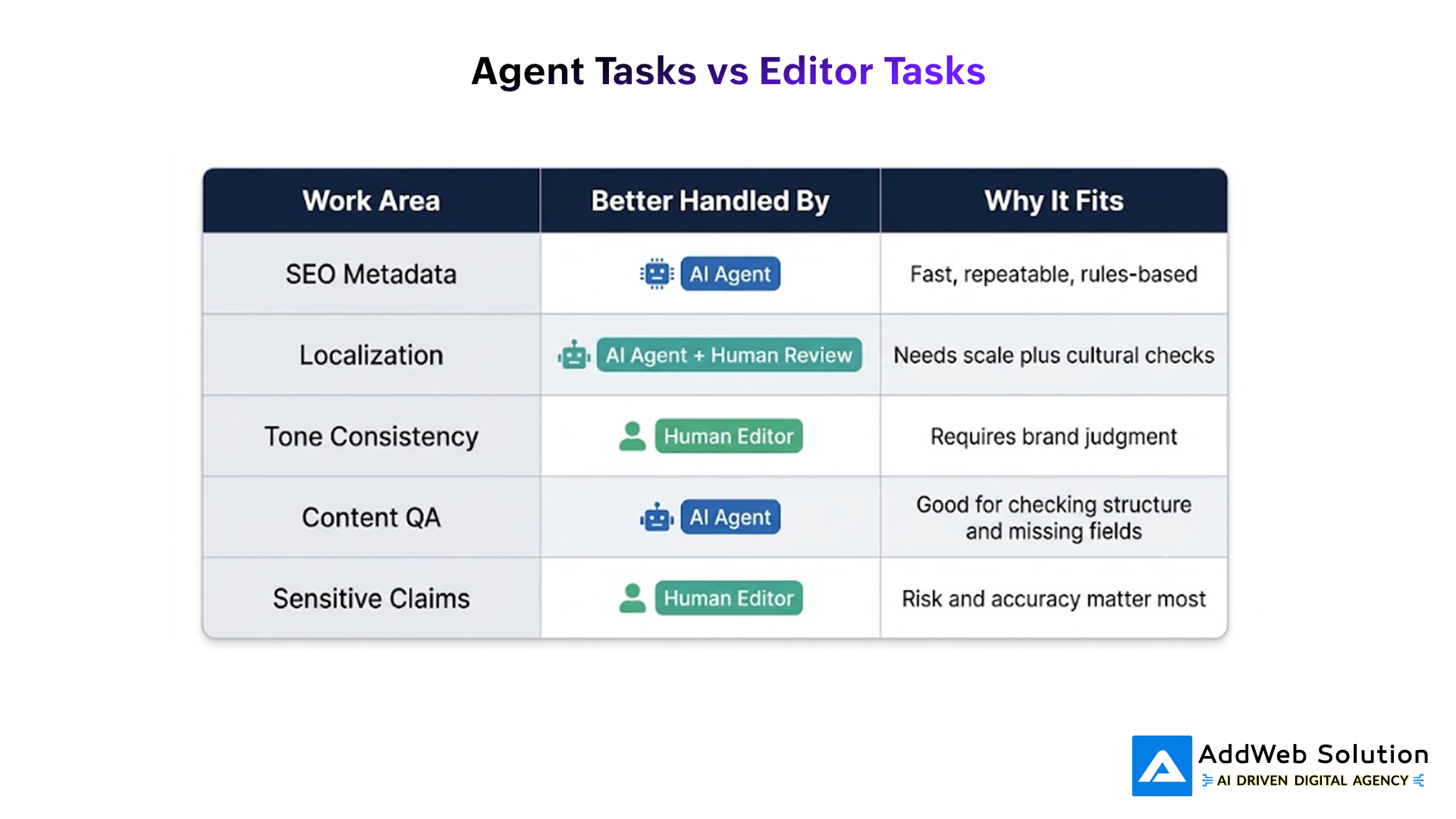
The practical takeaway is simple: AI agents are strongest where work is structured, measurable, and reversible. Editors remain essential where the cost of being wrong is high.


Editors vs Agents
The editor’s role is not vanishing; it is becoming more supervisory. In agentic CMS thinking, editors define the rules, review outputs, and keep the brand coherent while machines take over the repetitive lift.
That is a meaningful change in job design, and it will feel uncomfortable to teams that still measure productivity by how much manual drafting gets done.
Here is the bigger point: many enterprises just modernized their CMS, but not necessarily for agent operations. A headless CMS can still be too human-centric if every workflow assumes a person must click through every step.
By 2027, teams that treat AI as a sidebar feature may look slower than teams that redesign the whole workflow around agent-readable content structures.
Growth and Adoption
The adoption story is moving quickly. Forrester says AI is already in production across many firms, but governance remains a major barrier. Adobe’s traffic data adds a business reason to care: AI referrals are not just increasing in volume; they are often higher intent and more engaged once users arrive.

Adobe also reported that AI-referred retail traffic converted 54% better than non-AI traffic in May 2026, based on its tracking of more than 1 trillion visits to U.S. retail sites. That does not mean every industry will see the same curve, but it does show why structured content quality is becoming a business issue, not just an editorial one.
Tools and Patterns
The CMS vendors moving fastest are no longer talking only about content entry screens. They are focusing on workflow orchestration, content modeling, permissions, auditability, and machine-readable structure. That is the difference between adding AI decoration and building AI-native operations.
Here’s a practical comparison of where enterprises tend to land today:

The point is not that every company should replace its CMS tomorrow. The point is that CMS selection criteria are changing, and “AI-ready” now means more than having a generate button in the editor.
What Teams Should Do
The smartest move in 2026 is not to ask, “Will AI replace editors?” It is to ask, “Which parts of our content workflow should be automated, and which parts should remain human-controlled?” That question leads to better architecture, better governance, and fewer surprises later.
For enterprise teams, the first pilots usually belong in metadata generation, localization, QA, and content variant testing. The highest-risk areas, regulated claims, executive messaging, brand positioning, and legal-sensitive publishing, should still stay with human editors, at least for now.
Conclusion
By 2027, AI agents are unlikely to erase content editors, but they will almost certainly reshape what editors do every day. The teams that win will be the ones that treat AI as part of the content operating model, not just a writing shortcut.
At AddWeb Solution, that is exactly the kind of CMS and content transformation conversation we keep seeing from businesses that want scale without losing control.
Discover how AddWeb Solution helps businesses build AI-ready CMS platforms that automate content workflows while maintaining governance, quality, and brand consistency.

Pooja Upadhyay
Director Of People Operations & Client Relations
Source URL
https://www.forrester.com/report/the-state-of-ai-2025/RES189955
https://www.forrester.com/blogs/three-questions-that-will-define-ai-in-2026/
https://www.business.adobe.com/uk/blog/agentic-cms-web-experience-brand-asset
https://www.business.adobe.com/uk/blog/agentic-cms-do-you-need-one
https://www.uniform.dev/resources/gartner-innovation-insight-agentic-cms-2026
