



Product roadmaps rarely slip because your team is lazy. They slip because your tech stack quietly taxes every decision, every estimate, and every sprint. Legacy PHP projects, custom “franken‑stacks”, and underpowered frameworks all add invisible drag that shows up as missed milestones.
Laravel has become the leading PHP framework precisely because it attacks that drag head‑on: it standardizes patterns, bakes in the tools teams usually hand‑roll, and provides an ecosystem built for modern product delivery.
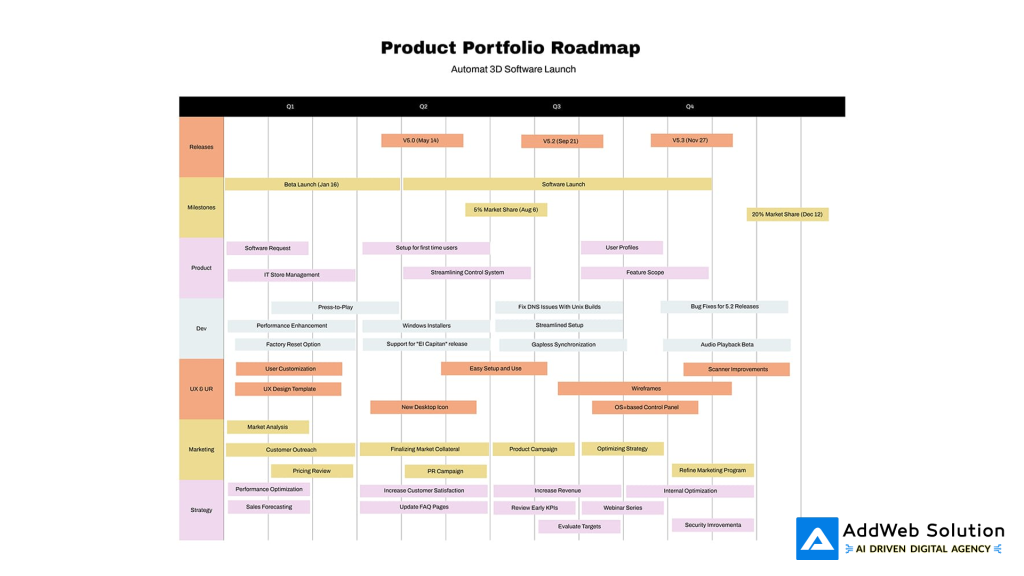
Product and engineering aligning on a roadmap – tech stack choices either accelerate this or slow it down.
How Tech Debt Hijacks Your Roadmap
Before we talk Laravel, it’s worth naming what usually slows teams down:
- Inconsistent patterns: Every feature feels “custom”, so onboarding and estimation are painful.
- Missing plumbing: Auth, queues, email, payments, monitoring, all hacked together differently in each module.
- Slow feedback loops: No standard approach to testing, staging, or deployment.
- Fear of change: “If we touch that part of the codebase, something else will break.”
Modern frameworks exist to reduce this friction. Laravel in particular gives teams a consistent structure (MVC), robust built‑in capabilities, and a mature ecosystem of tools that dramatically compress the time from idea to shipped feature.
Where Teams Actually Lose Time (Visual Snapshot)
Even high‑performing teams underestimate how much time gets spent around feature work rather than inside it.
Illustrative pie chart: How a sprint’s time gets spent
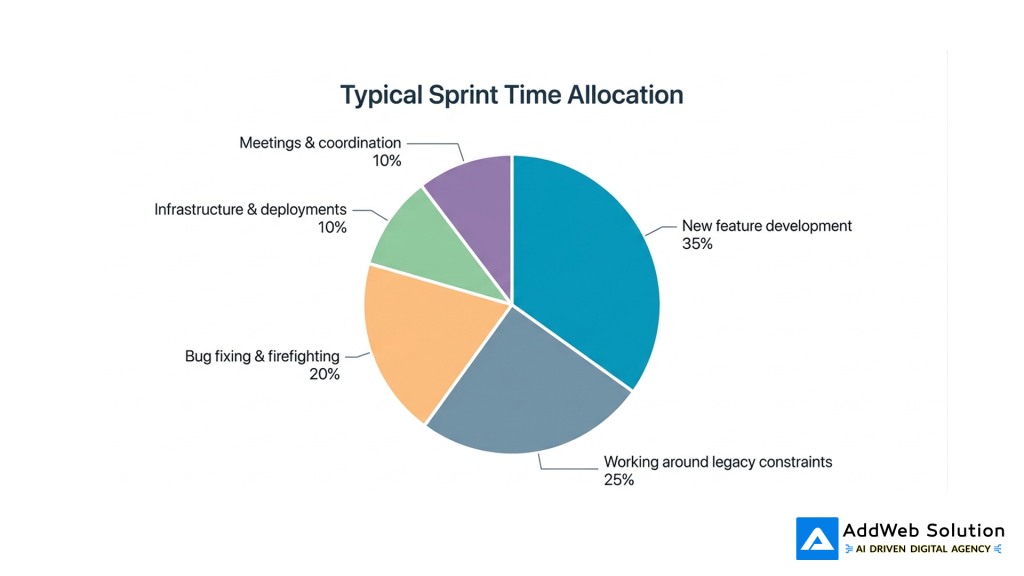
In many organizations, only a fraction of each sprint is true roadmap work. The rest is debt servicing, manual plumbing, and dealing with surprises. A framework like Laravel cannot remove meetings, but it can radically shrink the “legacy constraints”, “firefighting”, and “infrastructure” slices by giving you a stable, well‑documented foundation and opinionated tooling.
Snapshot: Legacy Stack vs Laravel Stack
A lot of roadmap pain is structural, not personal. Here’s a simple comparison.
Table: How Laravel changes day‑to‑day delivery

Laravel’s popularity is not an accident: surveys and market studies consistently show it leading the PHP framework category in usage and market share, with hundreds of thousands of sites in production and strong ecosystem momentum.
Laravel has evolved into an ecosystem designed around real‑world delivery pressures, not just syntax.
1. Laravel Standardizes Structure So Features Stay Predictable
When every feature looks structurally different, velocity collapses. Laravel’s opinionated architecture helps teams spend less time asking “where does this go?” and more time shipping.
What this looks like in practice:
- Clear MVC separation: Controllers, models, and views follow consistent conventions, so people can move between modules without re‑learning the layout.
- Consistent routing: A centralized, expressive routing system makes it obvious how requests flow through the app, which speeds impact analysis and refactors.
- Shared patterns across teams: Because Laravel is widely adopted, new hires already recognize the structure and can become productive faster.
Roadmap impact: Estimation improves because work is less “unknown”, onboarding time drops, and you can move engineers between squads without massive context overhead.
2. Built‑In Features Remove Weeks of Plumbing Work
Every roadmap has foundational features that almost every product needs: authentication, password resets, email, file storage, background jobs, payments, and more. Many stacks implement these differently in each project, which is error‑prone and slow.
Laravel takes a more batteries‑included approach:
- Authentication & user management: Out‑of‑the‑box auth scaffolding, plus starter kits like Breeze and Jetstream for modern session and token‑based flows.
- Queues & background jobs: First‑class queue support for emails, notifications, heavy computations, with Horizon providing a visual dashboard to monitor them.
- Mail, notifications, and billing: Unified APIs for sending emails and notifications, plus packages like Cashier for subscription billing and payments.
Developers focus on business logic while Laravel handles much of the infrastructure “glue”.
Roadmap impact: Instead of spending a sprint wiring up “yet another auth system” or patching a custom queue implementation, teams can plug into Laravel’s built‑ins and move straight to business logic. That means more roadmap items completed per release window.


3. The Laravel Ecosystem Compresses Your Tooling Decisions
Your framework is not just code — it’s the tools around it. Laravel’s ecosystem is a big reason teams report faster delivery and more predictable releases.
Some high‑leverage pieces:
- Forge & Vapor: Managed server and serverless deployment platforms tuned for Laravel, so teams deploy more often with fewer DevOps headaches.
- Nova & Filament: Admin panel and back‑office toolkits that turn internal dashboards into a days‑not‑weeks project.
- Horizon & Telescope: Deep visibility into queues and application internals, helping teams catch performance and reliability issues early.
- Pulse and APM integrations: Real‑time application monitoring to spot performance regressions before users do.
Table: How ecosystem tools shorten the path to “done”
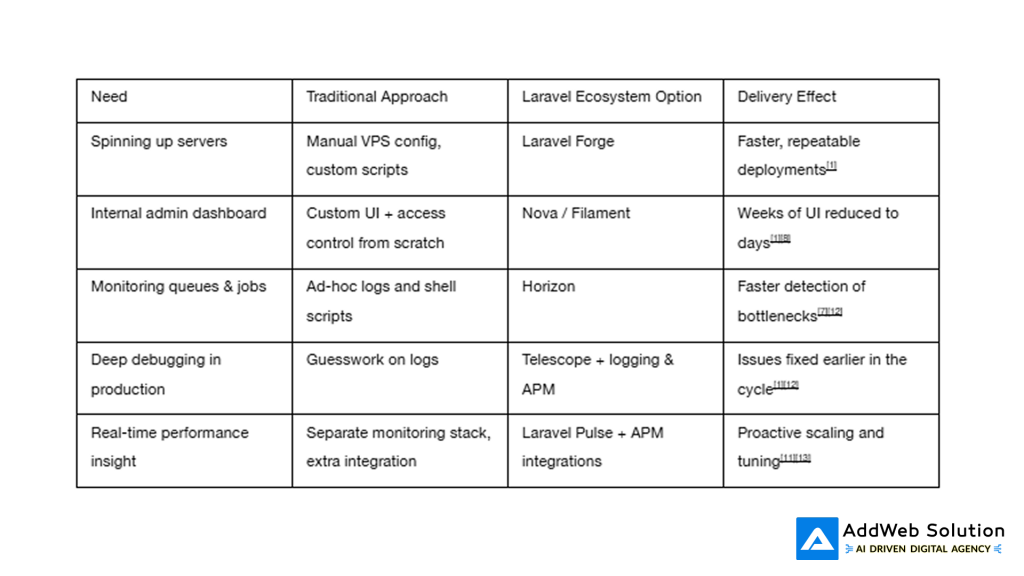
Roadmap impact: You spend less time choosing, integrating, and debugging tools and more time actually delivering the roadmap items those tools were meant to support.
4. Tooling that Automates the Boring Work
Boilerplate is where motivation and estimates go to die. Laravel leans heavily into automation via the Artisan CLI and convention‑driven scaffolding.
Key benefits:
- Artisan generators: Commands to scaffold controllers, models, migrations, and more, enforcing consistent patterns and reducing hand‑written boilerplate.
- Migrations & schema management: Database changes are versioned and reversible, which makes schema evolution a planned part of the roadmap instead of a risky event.
- Asset pipeline: Laravel Mix (and now Vite integration) simplifies bundling front‑end assets, so teams avoid separate, fragile build setups.
When the low‑value work is automated, teams have more bandwidth for high‑value feature design and iteration.
Roadmap impact: You reclaim hours every week from repetitive setup work. That time compounds over quarters into several extra roadmap items shipped — without adding headcount.
5. Observability and Safe Release Practices Speed Up Iteration
As your product grows, the cost of a bad release rises. Teams slow down not because they can’t code fast, but because they’re afraid of breaking things. Laravel’s ecosystem includes tools that make iteration safer and more data‑driven.
Highlights:
- Real‑time monitoring: Laravel Pulse plus APM tools show performance metrics in near real time, helping teams catch regressions early.
- Feature flags & progressive rollout: Tools such as Laravel Pennant and platforms like PostHog make it easy to roll features out gradually and roll back quickly if needed.
- CI/CD friendly design: Laravel plays well with GitHub Actions, GitLab CI, and specialized services, enabling automated test suites and predictable deployments.
A visible, instrumented system gives product and engineering confidence to ship more often.
Roadmap impact: When you can roll out to 5%, then 25%, then 100% of users with clear telemetry, you reduce the fear factor. Features hit production earlier, feedback loops shorten, and roadmap bets can be validated in weeks instead of quarters.
Visual: Time to Ship Features Before vs After Laravel
To make this concrete, here’s an illustrative comparison of how long a typical medium‑complexity feature takes to reach production as your stack evolves. These are not universal benchmarks, but they mirror patterns many teams report anecdotally.
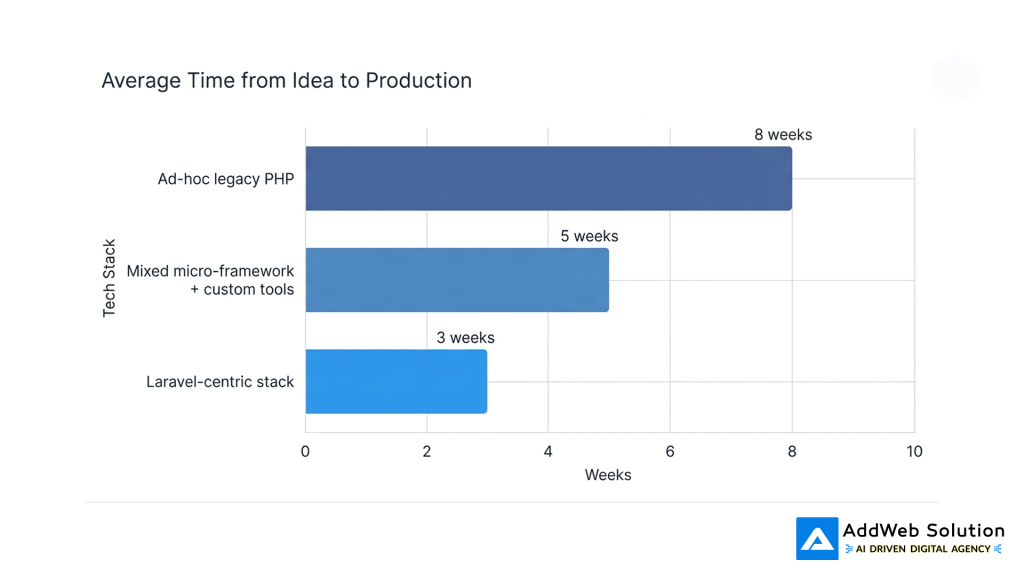
Laravel’s advantage comes from compounding effects: less boilerplate, better tooling, a standard structure, and an ecosystem built around modern delivery practices. Surveys show that Laravel‑based teams increasingly adopt the latest PHP versions and tooling, which reinforces those gains over time.
How to Tell If Your Tech Stack Is Holding Back Your Roadmap
You do not need a full rewrite to see the problem. A few simple questions often surface it quickly:
- Do estimates routinely double once developers “look under the hood”?
- Does every new feature require hunting down “how that was done last time”?
- Are you afraid to touch core modules because “something else will break”?
- Do deployments still feel like mini‑events instead of routine operations?
- Is onboarding a new engineer measured in months instead of weeks?
If you are nodding along, your roadmap isn’t just a prioritization problem, it is a platform problem. Given its maturity, market share, and ecosystem momentum, Laravel is a strong candidate to be that platform for PHP‑based teams.
Next Steps for Your Team
If you are considering Laravel to accelerate feature delivery, you do not have to flip the entire system overnight. Many teams:
- Start by building new modules or services in Laravel, leaving legacy code intact.
- Use Laravel for internal tools (admin dashboards, reporting) to get quick wins.
- Gradually migrate high‑churn areas of the product where roadmap pressure is highest.
- Standardize their CI/CD and monitoring around Laravel‑friendly tools to improve release quality.
The point is not to chase a shiny framework. It is to remove the structural friction that keeps your roadmap in a constant state of “almost there”. Laravel just happens to be one of the most battle‑tested ways to do that in the PHP world today.
Ready to Accelerate Your Product Roadmap?

Pooja Upadhyay
Director Of People Operations & Client Relations
⁂
- https://blog.jetbrains.com/phpstorm/2025/10/state-of-php-2025/
- https://blog.jetbrains.com/phpstorm/2024/09/laravel-trends-2024-the-latest-market-insights/
- https://www.monocubed.com/blog/why-laravel-php-framework/
- https://www.fifteendesign.co.uk/blog/why-laravel-is-the-tool-for-rapid-application-development/
- https://www.reddit.com/r/PHPhelp/comments/1djy9y6/why_is_laravel_so_popular_in_the_php_domain/
