


At some point, every serious online store faces the same question:
“Do we keep scaling on Shopify, or is it time to invest in a custom Laravel e‑commerce build?”
Both can work brilliantly. The real issue is where your money goes over time: subscriptions and apps vs. upfront build and engineering. In this article, we’ll break down the long‑term cost side, with numbers, charts, and practical scenarios, without getting lost in framework fanboy debates.
1. How Shopify and Laravel Charge You
Before we talk “cheap vs expensive,” it helps to understand how each ecosystem takes money out of your business.
Shopify: Low entry, recurring stack
With Shopify, you mainly pay for:
- Monthly subscription
Basic, Grow, Advanced, or Plus, depending on your scale. - Payment processing and transaction fees
Typically around 2.15%–2.9% + fixed fee per order when using Shopify Payments, with lower rates on higher plans. - Apps and integrations
Many real stores quietly pay hundreds of dollars per month in apps for reviews, subscriptions, bundles, loyalty, backups, and analytics.
For a typical growing store, this often looks like:
“We started at around 40–80 USD/month for the plan, and over time apps and fees became our real cost center.”
Custom Laravel: High upfront, controlled variable cost
With a custom Laravel e‑commerce build, you pay for:
- One‑time (or phased) development cost
For smaller startups, custom builds often start around 5,000–15,000 USD, scaling up to 25,000+ USD for more complex stores. - Hosting and infrastructure
From a few hundred to a few thousand USD per year depending on traffic and redundancy. - Ongoing maintenance and feature work
Retainers or ad‑hoc work with your dev team/agency, usually a few thousand USD per year for an actively evolving store. - Payment fees
Card/payment gateway fees similar to Shopify Payments, but without an extra platform transaction fee layer.
In other words: you pay more engineers, fewer apps. Your spend moves from monthly SaaS invoices to technical assets you own.
2. Quick Visual: Where Does the Money Go?
To make this tangible, here’s a simplified 3‑year illustration for a growing DTC brand moving from validation to serious scale. Numbers are directional but grounded in typical ranges.
Image: Cumulative 3‑Year Cost, Shopify vs Laravel
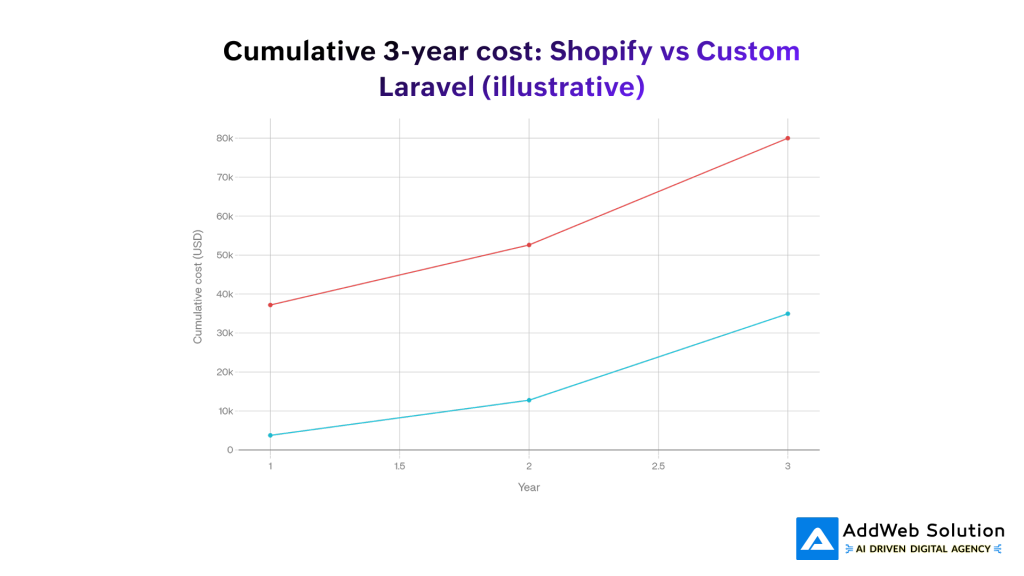
Interpretation (in plain language):
- Year 1: Shopify is clearly cheaper—no big build cost, just plans, apps, and fees.
- Year 2: The gap narrows as GMV and app usage grow.
- Year 3: For a store with strong turnover, the total Shopify spend (subscriptions, apps, and fees) can catch up with or even exceed the Laravel build + hosting + maintenance.
You can adapt this model to your own GMV and cost assumptions if you want a more precise forecast.
3. Cost Breakdown: Shopify vs Laravel by Year 3
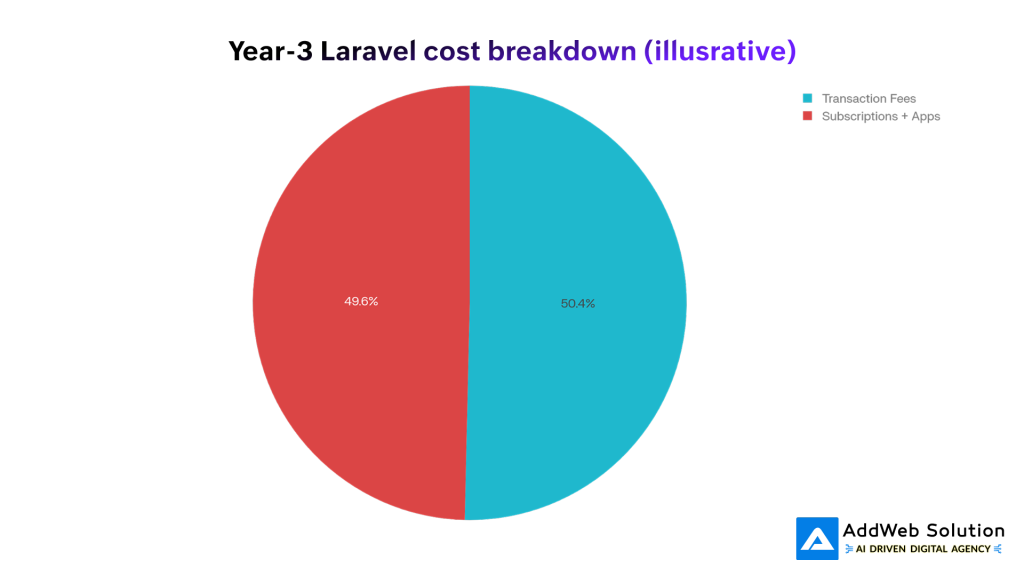
Let’s zoom into Year 3 for a typical “serious” store and look at what you’re paying for—not just how much.
Pie: Shopify Year‑3 Cost Structure

- A significant share of your spend is locked into transaction fees on every order.
- The rest is fixed monthly spend on your plan and apps, which creeps up as you bolt on more functionality.
Pie: Laravel Year‑3 Operating Cost Structure
- Once the build is paid for, Year‑3 costs lean more toward hosting and maintenance + standard payment fees, with no extra “platform tax” on each sale.
- Feature development is still an investment, but it’s tailored to your roadmap instead of app store pricing.
4. Shopify vs Laravel: Long‑Term Cost Table
Here’s a high‑level comparison focused only on cost dynamics, not features.
Table: Long‑Term Cost Profile

You can use this table as a “sanity check” when you look at your own numbers.
5. Scenario Walkthroughs: Where Each Option Wins
Scenario 1: Validating a new store (0–12 months)
- Profile: New brand, limited capital, uncertain product‑market fit.
- Tech needs: Standard catalog, simple checkout, basic email + analytics.
Why Shopify usually wins here
- Minimal upfront cost; you can often start for a trial and then a low monthly fee.
- You can plug in free or low‑cost apps to experiment with reviews, upsells, and basic automation.
- You do not yet know what you’ll need long‑term—locking 5–15k USD into custom development is risky at this stage.
When Laravel is overkill
- If you have no traffic and no validated offer, paying for a custom Laravel build is like architecting a skyscraper before you know if anyone wants to rent space in it.
Cost verdict (0–12 months):
For early validation, Shopify almost always saves more money and reduces risk.
Scenario 2: Growing brand with increasing GMV (12–36 months)
- Profile: You’re doing consistent sales, maybe 80k–600k USD/year in GMV, and starting to feel the constraints of themes and app spaghetti.
- Tech needs: Better performance, unique UX, multi‑step funnels, more automation, possibly multi‑store or regional logic.
What happens with Shopify costs
- You often jump from a basic plan to higher tiers for better rates and features.
- App list grows: subscriptions, bundles, A/B testing, custom pricing, B2B features, etc.
- It’s common to see app bills in the 300–1,000+ USD/month range for busy stores.
What happens with Laravel costs
- You pay a one‑time or phased build cost, plus maintainers and hosting.
- You still use some third‑party services (email, analytics, search), but your core business logic is code you own.
- As GMV grows, you don’t pay extra platform transaction fees, so variable cost per order can be lower over time.
Cost verdict (12–36 months):
If your GMV stays modest, Shopify continues to be cost‑effective.
If your GMV and feature demands spike, Shopify’s compound app + fee spend can overtake the amortized cost of a Laravel build.
Scenario 3: Complex operations and heavy customization
- Profile: Multi‑store, multi‑language, complex catalog rules, B2B/B2C hybrids, deep integrations with ERP/CRM/warehouse systems.
- Tech needs: Complex pricing logic, custom workflows, “if X then Y” behaviors that apps cannot handle cleanly.
In this world:
- Trying to glue everything together on Shopify often leads to:
- Many apps stacked together, each with its own monthly fee.
- Custom scripts and workarounds that are hard to maintain.
- Surprise performance or compatibility issues.
- Laravel, when done well, lets you bake that complexity into your own domain model, reducing monthly SaaS sprawl and rework cost.
Cost verdict:
For deeply custom operations, Laravel tends to win long‑term not just on cost, but on the “hidden cost” of reduced friction and fewer hacks.


6. Hidden Costs People Forget
Pure numbers never tell the full story. There are hidden cost drivers on both sides.
Hidden costs with Shopify
- App overlap and redundancy
You might pay multiple apps for overlapping features because it’s cheaper short‑term than consolidating or custom‑building, but it bloats your monthly burn. - Theme and app lock‑in
Migrating away from a heavy theme or complex app stack later costs time and money; many brands “rewrite” significant parts of the store when they finally outgrow their setup. - Performance tax on conversion
Too many apps and scripts can slow your store down, hurting conversion and paid traffic efficiency—a real but rarely quantified cost.
Hidden costs with Laravel
- Decision overhead
You now own architecture decisions: hosting, caching strategy, deployment pipeline, observability. Done poorly, that overhead eats your savings. - Talent and vendor risk
Good Laravel teams are an asset; bad ones are an expensive liability. Switching vendors mid‑stream has a cost of its own. - Under‑scoping the build
If you under‑spec requirements, you may end up doing costly rebuilds or large change orders later.
7. Simple Cost Graph: When Does Laravel Overtake Shopify?
If you like mental models, think of it this way:
- Shopify cost curve: Low start, steeper slope (grows with GMV and app count).
- Laravel cost curve: High start, flatter slope (grows with infrastructure and deliberate features).
Text‑based graph (for quick reference)
Cost
^
| / Shopify
| / /
| / /
| / /
| / Laravel
| /__________________> Time
- In the early phase, the Shopify line is far below Laravel.
- Over time, as volume and complexity rise, the Shopify line catches and may cross the Laravel line, where total spend is higher.
Your job as a founder or tech lead is to identify where that crossover is for your store, based on:
- GMV projections.
- App spend today vs likely future needs.
- Appetite for upfront investment.
8. Practical Checklist: Which One Saves You More Money?
Use this as a quick decision aid. Answer honestly; your wallet will thank you.
Choose Shopify if…
- You’re pre‑product‑market fit or early stage.
- Your expected GMV for the next 12–24 months is modest.
- You prefer predictable SaaS invoices over managing a dev team.
- Your needs fit within standard e‑commerce patterns and popular apps.
- You’re okay with paying more in the future if it gets you to market now.
Choose Custom Laravel if…
- You already have meaningful GMV or a very clear path to it.
- You are hitting hard limits with Shopify themes and apps.
- Your business logic is complex enough that apps feel like hacks.
- You want to reduce long‑term dependency on one platform and app vendors.
- You’re ready to treat your e‑commerce stack as a strategic asset, not just a storefront.
9. Making the Hybrid Path Work
In reality, many brands follow a hybrid path:
- Start on Shopify
Validate, iterate, learn what works, and avoid over‑investing too early. - Tighten your stack
Trim unnecessary apps, invest in a strong theme and a few high‑ROI tools. - Plan a Laravel migration once:
- Your fee + app bill crosses a threshold you’re uncomfortable with.
- You have clear requirements that justify custom development.
- You can afford to think in 2–3 year ROI, not just month‑to‑month.
This approach lets you enjoy the low initial cost and speed of Shopify, while still positioning yourself for the long‑term cost benefits and control of Laravel when the time is right.
Not sure whether Shopify or Laravel is the right investment for your business? Our Ecommerce consultants can help you evaluate costs, scalability, and ROI before you commit.

Pooja Upadhyay
Director Of People Operations & Client Relations
Source URLS:
https://www.shopify.com/in/pricing
https://qualimero.com/en/blog/shopify-fees
https://commerce-ui.com/insights/shopify-pricing
https://community.shopify.dev/t/shopify-app-pricing-the-next-generation-of-app-billing/34221
https://appmaker.xyz/blog/shopify-app-development-cost-build
https://smplx.media/en/wissen/apps-und-plugins-kostenanalyse
