


Executive Summary
What once constituted the “Shopify store” is being disrupted. Up until this point, every single individual visiting the merchant’s store encountered the same homepage, product grid, and promotional messaging. What is being quickly adopted, however, is something much more sophisticated, namely a store that responds in real-time to the individual visitor depending on where they are from, what device they use, previous purchases, and behavioral cues.
In this report, we will discuss the technologies behind the disruption, the means of personalization available to Shopify merchants, the data justifying the use of such strategies, and some of the limitations.
What Is 1:1 Commerce, and Why Is It Happening Now?
Defining the Concept
1:1 commerce is defined as a shopping experience where every single visitor sees a different take on the store layout, based on personal preferences, past purchases, physical location, and context. The “1:1” is literal: ideally, no two visitors would have the same experience in the store.
Compared to traditional segmentation, which puts customers into generalized groups, 1:1 experiences have greater detail and immediate responsiveness. Traditional segmentation can be described as something like “female shoppers age 25-34 in California.” 1:1 describes “the particular customer who just bought running shoes in March and visited the trail section twice this week, currently located in San Francisco on an iPhone.”
Why Now: The Platform and Market Conditions That Enable It
The confluence of several factors is what has made 1:1 commerce feasible for Shopify merchants at the enterprise level:
- The availability of data and control surfaces in Shopify’s Storefront API, Checkout Extensibility API, and Customer Segmentation APIs makes personalization possible – all without having to build out bespoke infrastructure across the board. Platform readiness has progressed sufficiently.
- Over one hundred apps in Shopify’s App Store focus on personalization, product recommendation, or dynamic merchandising – examples include Rebuy and LimeSpot, Nosto and Seguno. App readiness has also improved.
- With Google Chrome’s deprecation of third-party cookies and increasing privacy restrictions across browsers, there is significant value in using your own first-party data (events, purchase history, expressed preferences). Third-party cookie deprecation has pushed forward a first-party strategy.
- The recommendation models that used to require a team of data scientists in 2019 can now be accessed as hosted APIs by Shopify merchants via app integration. Not to mention reduced costs of ML inference.
The Shopify Personalization Technology Stack
Personalization in Shopify is not a standalone capability but rather a stack of capabilities offered by the platform itself, third-party service providers, and data driven by the merchant. It becomes crucial to understand how the stack layers interact to determine where efforts and investments need to be made.
Platform-Native Capabilities
Customer Segmentation API
The Customer Segmentation API provided by Shopify helps merchants create a dynamic audience based on specific rules involving different consumer characteristics, such as spend, location, product preference, and lifecycle stages. Segments are constantly being updated and refined depending on customers’ behavior and actions – this eliminates the issue with outdated static lists typical of older solutions.
Storefront API & Hydrogen
If the merchant uses Hydrogen (Shopify’s framework for ReactJS) to implement headless commerce functionality, he/she gets access to the advanced Storefront API, allowing the delivery of specific products, prices, and content based on different components rather than complete web pages. In turn, Hydrogen enables showing different sections on the homepage for various audience segments without reloading the page.
Shopify Functions
The concept of server-side logic injection via Functions in Shopify enables merchants to set up personalized pricing rules, discounts verification, shipping choices, and visibility of payment options at the checkout stage itself, and not the storefront. This is important as many websites make the mistake of doing personalized pricing on the product listing page, while the logic falls apart at the checkout point.
Metafields & Metaobjects
Metafields and Metaobjects enable merchants to add custom metadata to their products, customers, variants, and collections. The metadata forms the input data for the personalization rules; for instance, setting persona-fit metafields against products that can be filtered to make recommendations to certain visitors.
The App Ecosystem
Most Shopify merchants set up their personalization through third-party apps instead of writing code. There has been enough development within the app ecosystem that personalization can be achieved effectively by mid-market companies without a technical team. Here are some app categories:
| Category | Representative Apps | Primary Capability | Integration Layer |
|---|---|---|---|
| Product Recommendations | Rebuy, LimeSpot, Wiser | ML-driven upsell/cross-sell, carousel personalization | Storefront injection, post-purchase |
| Email/SMS Personalization | Klaviyo, Omnisend, Postscript | Behavior-triggered flows, segment-based campaigns | Customer events, purchase history |
| On-site Merchandising | Nosto, Searchanise, Boost | Dynamic search results, category sorting | Storefront, collection pages |
| Loyalty & Personalized Offers | LoyaltyLion, Yotpo, Smile.io | Tier-based UX, personalized reward visibility | Checkout, account, storefront |
| A/B Testing & CRO | Intelligems, Shoplift, Convert | Content/price/copy experimentation | Storefront, checkout |
| Zero-Party Data Collection | Octane AI, Typeform | Quizzes, preference capture, declared data | Customer profiles, segmentation |
Table 1: Shopify personalization app categories and their primary integration layers
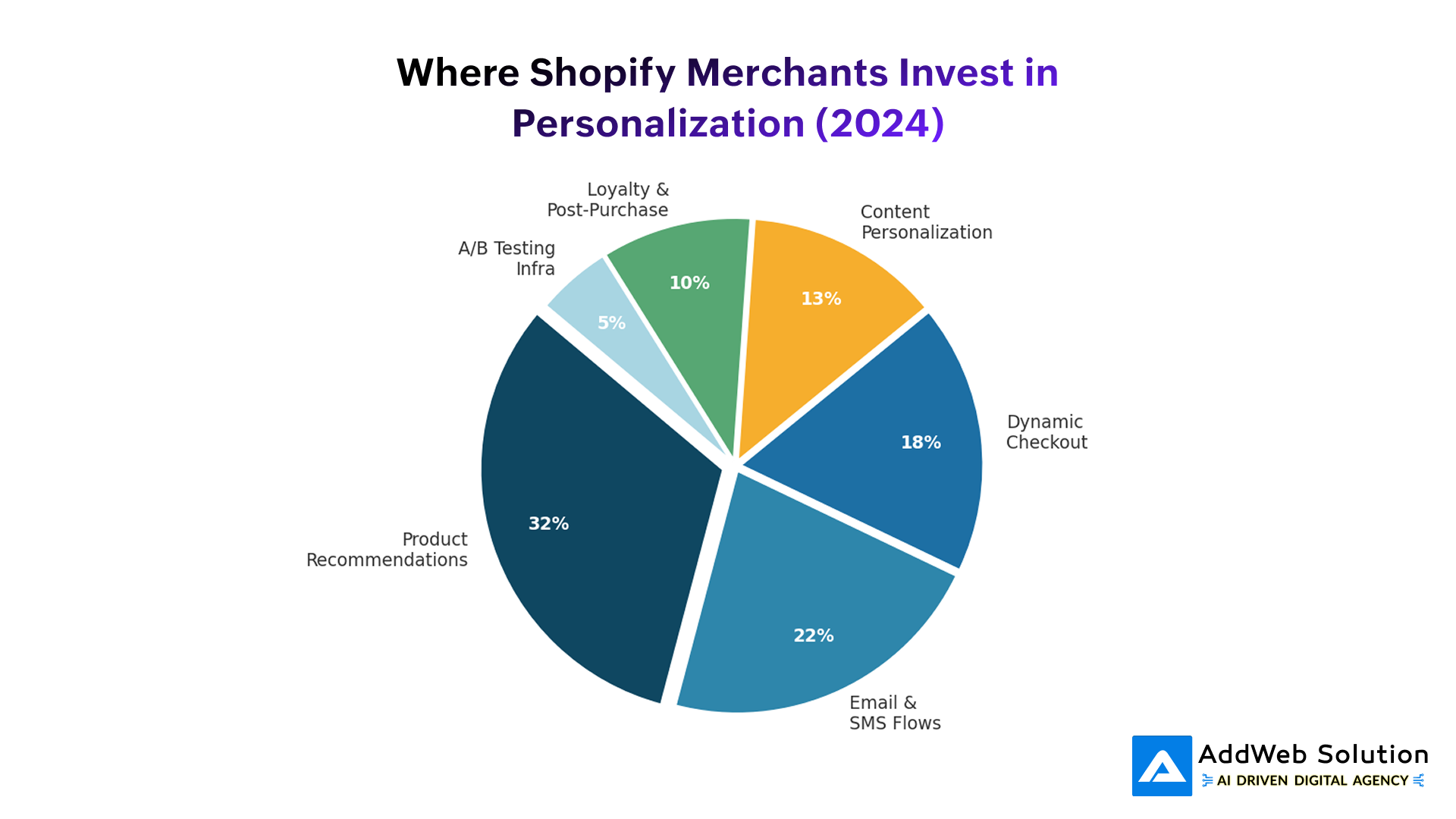
Figure 1: Where Shopify merchants allocate personalization investment (industry survey data, 2024 estimates)
Key Personalization Levers: What Changes Per Visitor
When instrumented for 1:1 commerce, here are aspects of the experience that would be personalized per visitor on a Shopify store. Not all merchants will require all of these aspects, but knowledge of them provides an idea about the limits of performance.
Homepage and Storefront Content
Since the homepage is the most impactful touchpoint for personalization due to being the landing page for the majority of traffic, the following variables can be personalized per visitor:
- Hero banner and headline: customized according to traffic channel (paid search, organic, email), device, or geographic location.
- Featured product carousel: customized according to predicted affinity calculated from purchase/browse history.
- Promotional banners: offering new customer discounts to first-time visitors and rewards/loyalty tier messages to returning visitors.
- Social Proof Blocks: displaying reviews of categories relevant to the individual (for example, displaying outdoor gear reviews to a visitor interested in the outdoors).
Product Recommendations
Product recommender systems are the most popular personalized services offered by Shopify merchants. These systems work with two types of signals:
- Behavioral signals: browsing history, products added to the cart, purchase rate, time since last purchase, and category preference.
- Contextual signals: items currently added to the cart, source of referral traffic, device, time of day, and geolocation.
Advanced recommendation engines such as Rebuy and Nosto use both collaborative filtering (identifying similarities between a shopper’s behavioral patterns and other shoppers) and content-based filtering (comparing product features with shopper preferences). Such a combination creates an additional value for recommendations.
Pricing and Offer Personalization
Personalized Pricing on Shopify could be done in a few ways:
- Pricing at the segment level: Since Shopify is built for B2B and wholesale, Shopify supports price lists per segment or business. For DTCs, customer tagging through functions will allow merchants to get similar results.
- Pricing offers based on the first order: Using the condition that a customer with no account and no purchase cookie is presented, discounts are offered exclusively to first-time buyers.
- Pricing offers based on loyalty status: Offering personalized discounts based on membership status to logged-in members at the product and cart level.
- Recovery abandoned carts: Discount offers are offered using exit intent overlays or email/SMS marketing campaigns for visitors who left the website while having something in their shopping cart.
Checkout Personalization
Checkout personalization is the most technically constrained surface on Shopify and for good reason. Shopify tightly governs what can be injected at checkout for security and compliance reasons. However, Checkout Extensibility (see Section 2.1) enables meaningful personalization within those guardrails:
- The personalized upsell recommendations were displayed mid-checkout through the use of Checkout UI extensions, which focused on the content of the cart and past customer behavior.
- Payment method prioritization, which involved recommending payment methods first, depending on the geographic location of the visitor.
- Showing the loyalty points earned by the visitor at the checkout payment process.
- Recommendation of preferred delivery methods depending on previous customer choices.
Post-Purchase Experience
The post-purchase stage – order confirmation, thank you page, order status, and email sequence following purchase, is commonly underutilized when it comes to personalization opportunities. It is possible with current technology to create:
- Personalized thank you page elements: By leveraging Shopify post-purchase extensions to present relevant product recommendations, referrals, or enrollments into a loyalty program based on the recent purchase.
- Behavioral email sequences: By activating customer journey emails tailored to certain categories (i.e., care guides, complementary categories) based on the recent purchase.
- Replenishment email sequences: For consumable products trigger reorder reminders based on the average use frequency calculated via purchase history.
The Business Impact: What the Data Shows
The calculation of return on investment (ROI) for personalization involves differentiating between incremental attribution (which measures the benefit beyond those experienced without personalization) and correlation (which measures benefits that are correlated with personalization but may be influenced by other factors). These benchmarks have been developed considering these differences.
Conversion Rate Lift by Personalization Type

Figure 2: Reported average conversion lift by personalization channel – Shopify merchant benchmarks (2024)


Revenue and AOV Impact
Personalization impacts revenue via two main avenues: increased conversion rates (more people making purchases) and increased average order value (people who make purchases spend more). The second effect may be underestimated in planning.
| Metric / Benchmark | Reported Range | Source Category | Notes |
|---|---|---|---|
| Conversion lift from personalized recommendations | +13–20% | Platform data | Rebuy, LimeSpot reported averages vary significantly by traffic quality |
| AOV increases from upsell/cross-sell personalization | +8–15% | Platform data | Most significant in categories with natural bundle affinity |
| Email revenue per recipient, personalized vs generic | 5–8x higher | Klaviyo industry data | Behavior-triggered flows vs. broadcast campaigns |
| Repeat purchase rate uplift, personalized post-purchase flows | +12–18% | Platform averages | Highest impact for consumable and replenishable categories |
| McKinsey: revenue from personalization leaders vs. peers | +40% more revenue | McKinsey & Company | “Next in Personalization 2021”; cross-vertical, directionally relevant |
| Customer LTV increase, loyalty-personalized programs | +25–35% | Yotpo, LoyaltyLion reports | Measured over 12-month customer cohorts |
Table 2: Revenue impact benchmarks for personalization – curated from published platform, research, and industry sources
Adoption Trends Among Shopify Merchants
Personalization adoption amongst the middle market merchants using Shopify has risen rapidly post-2021 due to growth on two fronts – platform capability expansion and maturing app ecosystem.
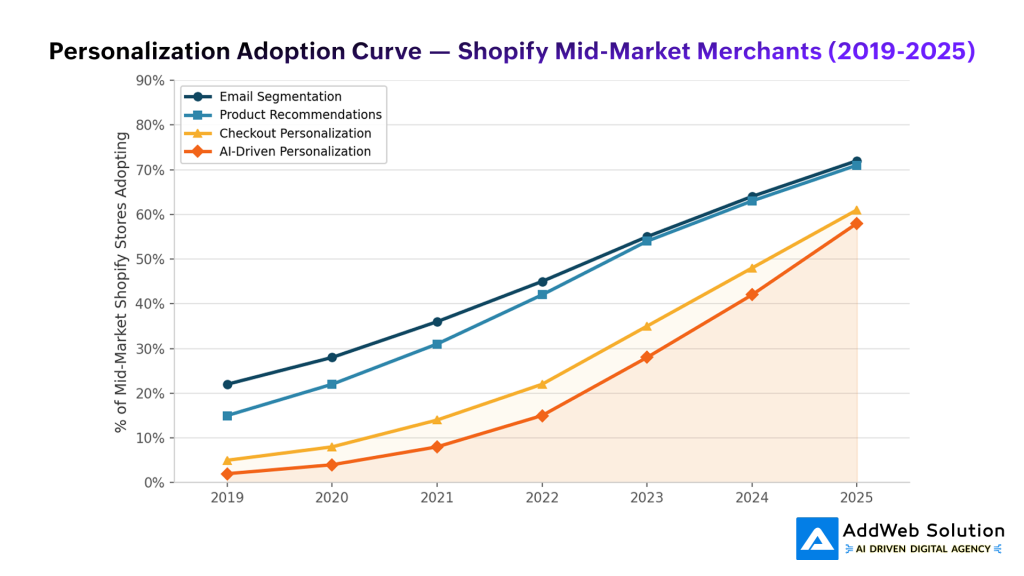
Figure 3: Personalization adoption curve – Shopify mid-market merchants by capability type (2019–2025, estimated)
The line “AI-powered personalization” is particularly insightful since it went from being non-existent in 2019 (being only available in an enterprise-grade variant) to reaching a majority of adoption among mid-sized businesses by 2025, solely through app-based use of recommendation systems built using ML technology, which don’t have to be developed and maintained by the merchant.
Implementation Approaches: Rules-Based vs. AI-Native
The selection of personalization technology type – rules-based, ML-based, or both – can have considerable effects on maintenance cost, data requirements, and personalization potential.
| Dimension | Rules-Based | ML / AI-Native | Hybrid (Recommended) |
|---|---|---|---|
| Setup complexity | Low – logic defined in UI | Medium – model training/tuning | Medium – rules + model config |
| Data volume required | Low – works with minimal history | High – needs meaningful transaction volume | Low initially; improves with volume |
| Personalization ceiling | Segment-level (still grouped) | True individual-level inference | Individual-level for known visitors |
| Maintenance burden | High – rules go stale manually | Low – model adapts automatically | Moderate – rules reviewed periodically |
| Best use case | Campaign logic, pricing tiers, seasonal | Product recommendations, search ranking | Most production Shopify implementations |
| Representative tools | Shopify Segments + Functions, Klaviyo flows | Rebuy, Nosto, LimeSpot | Most enterprise apps combine both |
Table 3: Implementation architecture comparison — rules-based vs. AI-native vs. hybrid personalization
The ROI Comparison by Strategy
However, not all personalization efforts yield equal returns. The following ROI calculation is derived from results observed within the context of case studies involving Shopify merchants.

Figure 4: Estimated ROI by personalization strategy – Shopify merchant benchmark data
Personalized upselling at checkout has the best ROI in this comparison since this happens at the peak of intent during the purchase process, which occurs with minimal costs of implementing the feature (adding a Checkout interface extension). The next most promising solution is AI-based recommendation systems for products due to the compounded effect of improved performance as the system receives more data over time.
First-Party Data, Zero-Party Data, and Privacy Compliance
Personalization on a larger scale demands the use of data, which must be legally and technically handled within an environment that has changed significantly since 2018. This topic is mandatory for all businesses that operate within territories where the GDPR applies or US jurisdictions that have passed consumer privacy legislation.
The Data Hierarchy
There are three types of data involved in making 1:1 commerce possible, with separate ways of collecting them, legal justification, and different levels of data quality:
- Zero-party data: Data willingly and actively offered by the consumer – survey answers, preferences set manually, interests indicated. Highest quality; legal; most costly to collect.
- First-party data: Data collected through direct contact – transaction history, web activity, email interactions, search keywords. High quality; legal based on consent and legitimate interest.
- Second/third-party data: External data from various sources, like data brokers, online advertisements, and partners. Decreasing usefulness with the death of the cookie; least legal; subject to the highest level of scrutiny.
Shopify’s Customer Events API and Consent Framework
The Shopify customer events API via Web Pixel extensions runs in a sandboxed setting and is connected with Shopify’s consent management solution. Main consequences of how it works for merchants:
- Automatic forwarding of consent signals to Web Pixel extensions when the Shopify native cookie consent banner is used, which addresses the gap of consent implementation for tracking purposes.
- Different modes of the sandbox (strict and lax) influence what type of customer data pixels can collect, with a strict one enabling post-consent data collection only.
- Customer event tracking by means of the native API rather than scripts helps minimize the risk of PCI DSS compliance problems (no scripts run around payment card data).
Zero-Party Data Collection Strategies
Shopify’s most successful personalization strategies rely on collecting zero-party data systematically. Effective ways to do this include:
- Preferential quizzes during onboarding: Using either in-product native or Octane AI or Typeform quizzes that ask about the customer’s preferences, such as skin type, fitness intentions, sizes they prefer, etc., and saving those preferences within customer metafields.
- Gradual profiling through account navigation: Asking customers for one additional information point regarding their preferences during each login and purchase, thus gradually building a rich set of preferences without asking customers to fill out a one-time questionnaire.
- Explicit preference center: Creating an email and SMS communication preference center that collects information not only regarding their communication channel and frequency but also about preferred categories and brands.
A Practical Personalization Implementation Roadmap
Most of the time, when merchants try to “personalize” without a road map, they wind up with piecemeal solutions, inconsistent customer experiences, and an attribution model that does not allow for attribution to any single investment. The road map below addresses these issues.
| Phase | Timeframe | Focus Area | Platform Tools | KPI |
|---|---|---|---|---|
| 1 Foundation | Months 1–2 | Data hygiene, Customer Segmentation API setup, Consent framework, Customer events audit | Customer Segmentation, Web Pixels, Shopify Analytics | Data completeness % |
| 2Quick Wins | Months 2–4 | Product recommendation widgets, Segmented email flows, Personalized Thank You page | Rebuy or LimeSpot, Klaviyo, Post-purchase extensions | Rec CVR lift, Email RPR |
| 3 Storefront | Months 4–7 | Homepage personalization, Search ranking by affinity, Dynamic banners by segment | Nosto or Hydrogen, Searchanise, Shopify Segments | Homepage CVR, search CTR |
| 4 Checkout | Months 6–9 | Checkout upsell extensions, Personalized payment method sequencing, Loyalty visibility at checkout | Checkout UI Extensions, Shopify Functions, LoyaltyLion | Check out CVR, AOV |
| 5 — Optimization | Ongoing | A/B testing personalization rules, Zero-party data programs, Cross-channel attribution | Intelligems, Shoplift, Octane AI | LTV, Repeat rate, NPS |
Table 4: Recommended personalization implementation roadmap – sequenced by dependency and impact
What Lies Ahead: The 1:1 Commerce Trajectory
These features for personalization discussed above constitute the current status quo, but definitely not the limit. There are certain trends and developments that can advance the one-to-one commerce model further during the next 24 to 36 months in the Shopify environment and more broadly.
AI-Native Merchandising
Presently, all recommender systems are based on the behavior analysis of previous shopping activity. However, the new generation of such systems uses large language model prediction for interpreting unstructured input, like search queries, chat dialogues, or even product descriptions. It helps to match them much more accurately than the previous approach using collaborative filtering techniques.
The emergence of the Sidekick AI assistant within the Shopify environment shows that this technology trend is here to stay. Specifically, the company is actively moving towards AI-driven merchandising tools, which would help with personalization opportunities identification and decision-making without any human interaction at all.
Real-Time Contextual Commerce
Today’s personalization is mostly built on retrospectively gathered data – what have they done before? The next logical place to look for leverage in personalization is prospectively and contextually – what is this visitor doing now, and what context is influencing them in this exact instance?
This could involve weather conditions (when visiting the site in a chilly climate outside Chicago, cold-weather apparel is presented, rather than summer collections), real-time stock scarcity, local context (curating products based on the proximity to a local sports event), and behavior within the current session that detects when someone is “on the verge of abandoning” shopping.
The Personalization Moat
There exists a compound dynamic effect here that is underestimated. When merchants make investments in data collection infrastructures for first and zero-party data, they are establishing themselves with data assets that cannot be transferred or easily replicated by other players. This stands out against an ad-spend or inventory advantage, both of which are directly replicable through monetary means.
Conclusion
This movement towards 1:1 commerce on Shopify is not just an idea but something very much grounded in fact, for the merchants leading the pack by conversion rate, average order value, and lifetime value of customer are already working with the 1:1 model, and the technological platforms required to facilitate this are ready for use (Customer Segmentation API, Checkout Extensibility, Shopify Functions, and Web Pixel). The ecosystem of apps required to create this 1:1 experience with AI-based recommendations, personalized checkouts, and behavior-based emails is fully formed and available at mid-market pricing.
What sets the merchants benefiting from 1:1 commerce apart from the merchants still offering a single-storefront approach to all visitors is not a matter of whether or not they have access to the technology; what sets them apart is the conscious and considered choice they made about making this investment. The merchant who does this today enjoys a compounding advantage over the merchant who makes this move in 12 months.
Every customer interaction in the meantime provides additional data that will be used to increase personalization and customer lifetime value.
Ready to deliver personalized shopping experiences that increase conversions and customer loyalty? Let’s build a smarter Shopify store together.

Pooja Upadhyay
Director Of People Operations & Client Relations
References & Further Reading
https://shopify.dev/docs/apps/build/checkout
https://shopify.dev/docs/apps/build/functions
https://shopify.dev/docs/api/storefront/latest
https://stripe.com/blog/how-we-tested-the-conversion-impact-of-global-payment-methods
https://www.yotpo.com/resources/state-of-brand-loyalty
https://support.google.com/google-ads/answer/6261395
https://cheatsheetseries.owasp.org/cheatsheets/Third_Party_Javascript_Management_Cheat_Sheet.html
