


Executive Summary
Shopify integrations are rarely broken by an incompetent programmer writing poor-quality code. Shopify integrations are broken because of the platform’s limitations, its rate limits, guarantee of webhook delivery, and sunset of API versions were treated as “not my problem” until it suddenly became the problem.
Typically, when a merchant realizes that something is wrong, it manifests itself either in a stuck order, an inflated stock counter, or a 429 error during a flash sale.
In this post, I’m going to discuss seven limitations of Shopify that you’ll come across frequently in your integration journey, the reason why they exist on the architectural level and not on the code level, and the corresponding solution to get rid of each of them forever.
All figures below are based on Shopify’s official developer documentation and engineering research. No vendor marketing.
Shopify deprecated the REST Admin API in October 2024 and switched to mandatory usage of the GraphQL API for all new public app submissions.
The integrations that are currently using the REST product endpoints are fine; however, they accumulate migration debt, just like what happened in the case of checkout.
Why Integrations Break: The Architecture Behind the Symptoms
There are several interfaces where Shopify provides access to commerce data: the Admin API (REST and GraphQL), webhooks, Shopify Flow, the embedded app interface, and finally, for checkout, an extensibility layer of its own.
Each interface has its own throughput limitations, retry policies, and versioning schedule. A piece of integration software that fails to take into account any of these will not simply crash; it will crash under load, which is exactly what you don’t want.
The unifying principle behind most of the problems arising from rate limits is the leaky bucket algorithm.
Each app-and-store combination has its own bucket, which has a certain capacity and empties at a certain rate; if the rate at which requests arrive is higher than the emptying rate, those requests get rate limited by returning 429, as opposed to being queued or silently discarded.
The Seven Most Common Integration Bottlenecks
These are ranked roughly by how often they appear in post-incident reviews across Shopify Plus and mid-market integration work, not by theoretical severity.
1. API Rate Limiting and Throttling (429 Errors)
This is the most visible choke point since it fails noisily. The REST Admin API is based on the request count bucket, which has 40 requests for regular plans and 80 requests for Plus, refilled at a rate of 2 and 4 requests per second, respectively.
On the other hand, the GraphQL Admin API is measured using the calculation of query cost and not the request count, where the bucket has 1,000 points and is refilled at a rate of about 50 points per second for regular plans.
Why it happens
- Sequential REST API calls within a loop rather than batching or bulk requests
- GraphQL requests for deeply nested relationships (like all variants of each product) with no pagination cap
- No exponential back-off mechanism; thus, if there is a 429 response, then retrying immediately causes another throttling
How to eliminate it
- Analyze the data returned by the cost/throttle on each GraphQL response, and request based on what is left in the bucket rather than a fixed interval.
- Use exponential backoff with jitter for 429 responses instead of a fixed-interval retry.
- Send any operation involving more than a few hundred records via the Bulk Operations API (see bottleneck #7).

2. REST-to-GraphQL Technical Debt
The REST product and variant endpoints have been deprecated by Shopify for apps that require more than 100 variants, and they have forced any public apps on the older product APIs to migrate by February 1, 2025.
The integrations that remain tied to the REST product/variant endpoints are not broken, but they are structurally unable to accommodate the new 2,048-variant product model.
Why it happens
- Integrations built years ago on REST were never revisited once they “worked”
- GraphQL’s schema complexity is treated as a migration cost to defer, not a resilience investment
How to eliminate it
- Audit all REST endpoint calls in the codebase against the deprecation log of Shopify every quarter.
- Start with product and variants management migration because it is the set of endpoints that is currently the most vulnerable to deprecation
- Consider GraphQL’s field-level cost as a constraint in the initial stage of the system design.
3. Webhook Delivery Gaps and Silent Data Loss
Webhooks drive the real-time synchronization, order creation, inventory management, and status fulfillment; however, webhooks are only delivered at-least-once and are never guaranteed to be exactly-once, nor are they guaranteed for order processing by Shopify.
Integration relying on a webhook to be received, delivered once, or even in sequence is guaranteed to receive a duplicate order or skip an update sometime down the road.
Why it happens
- Idempotency Key or Duplicates Handling Not Implemented on Receiver Side
- Receiver Endpoint Unavailability at the Time of Deployment Window Without a Reconciliation Job
- Business Logic Depends on Webhooks Arriving in a Certain Order (for instance, order created must precede order paid)
How to eliminate it
- Remove duplicates based on the event ID in the webhook before processing, and not after.
- Create a background task to run periodic reconciliations between Shopify’s current state and yours, comparing their state with yours. Webhooks will speed up synchronization, but should not be the only source of truth.
- Return a 200 status code within Shopify’s timeout limit and process it asynchronously from the queue.
4. Inventory and Order Sync Drift Across Sales Channels
Multi-location inventory, combined with multiple sales channels (POS, marketplaces, wholesale), creates race conditions: two channels can both see “3 in stock,” and both sell the last unit before either system updates the other.
This shows up as oversells, not as an error message, which is why it’s often discovered by a customer service ticket rather than a monitoring alert.
How to eliminate it
- Treat Shopify’s inventory levels as the single source of truth and push changes there first, then propagate outward
- Use inventory reservation windows during checkout rather than decrementing stock only after payment confirms
- Build a scheduled drift-detection report comparing external system stock counts to Shopify’s, flagged above a configurable variance threshold
5. OAuth Token Expiry and Authentication Failures
Custom and public apps authenticate via OAuth access tokens and, in some flows, session tokens with short lifespans.
An integration that caches a token indefinitely, or doesn’t handle a merchant revoking app access, fails at the worst possible time, mid-sync, with no clean way to resume.
How to eliminate it
- Handle 401 responses as a distinct failure class that triggers re-authentication, not a generic retry
- Store refresh logic separately from business logic so a token refresh never blocks on an unrelated code path
- Alert on authentication failures immediately rather than letting them surface as “the sync just stopped” days later
6. Third-Party App Conflicts and Script Bloat
Shopify stores commonly run a dozen or more apps simultaneously: reviews, upsells, analytics, loyalty, many of which inject their own scripts into the storefront or checkout.
Shopify’s own guidance is direct on this point: pixels are scripts, too many scripts slow a store, and a broken script can run indefinitely and degrade page load without ever throwing a visible error.
How to eliminate it
- Audit installed apps quarterly and remove anything not actively driving a measurable outcome
- Migrate tracking and measurement to the Web Pixels API, which runs in a sandboxed environment instead of injecting directly into the page
- Load-test storefront performance after every new app install, not just at initial launch
7. Bulk Data Operations Done the Slow Way
The single most common architectural mistake in Shopify integrations is using a paginated loop to read or write large record sets.
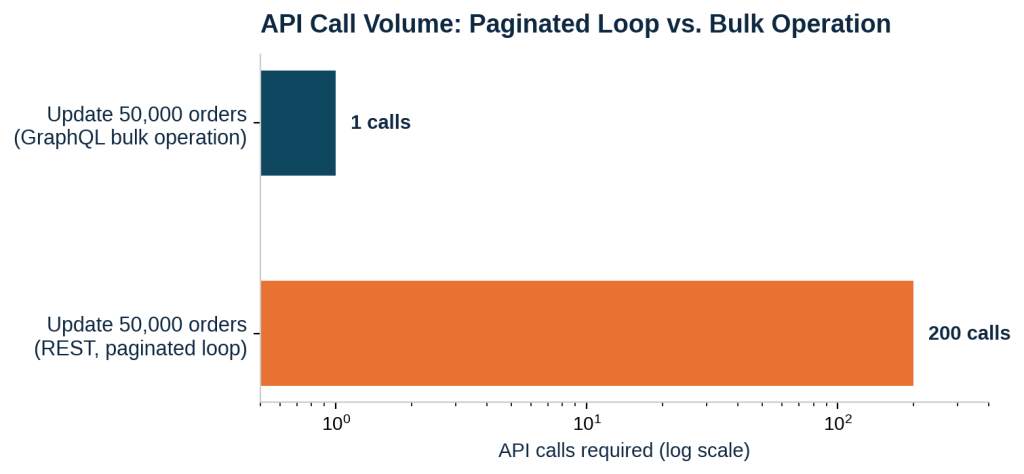
A job that updates 50,000 orders in batches of 250 runs roughly 200 sequential API calls, competes with every other interactive request for the same rate-limit budget, and takes minutes to hours depending on throttling.
The Bulk Operations API runs the equivalent job asynchronously on Shopify’s infrastructure and returns the result as a single downloadable file, without touching the interactive rate-limit bucket at all.
How to eliminate it
- Default to the Bulk Operations API for any job touching more than a few hundred records
- Reserve interactive REST/GraphQL calls for genuinely real-time, low-volume operations
- Monitor bulk operation job status via webhook rather than polling; polling for completion burns rate-limit budget for no benefit


Where Integration Failures Actually Originate
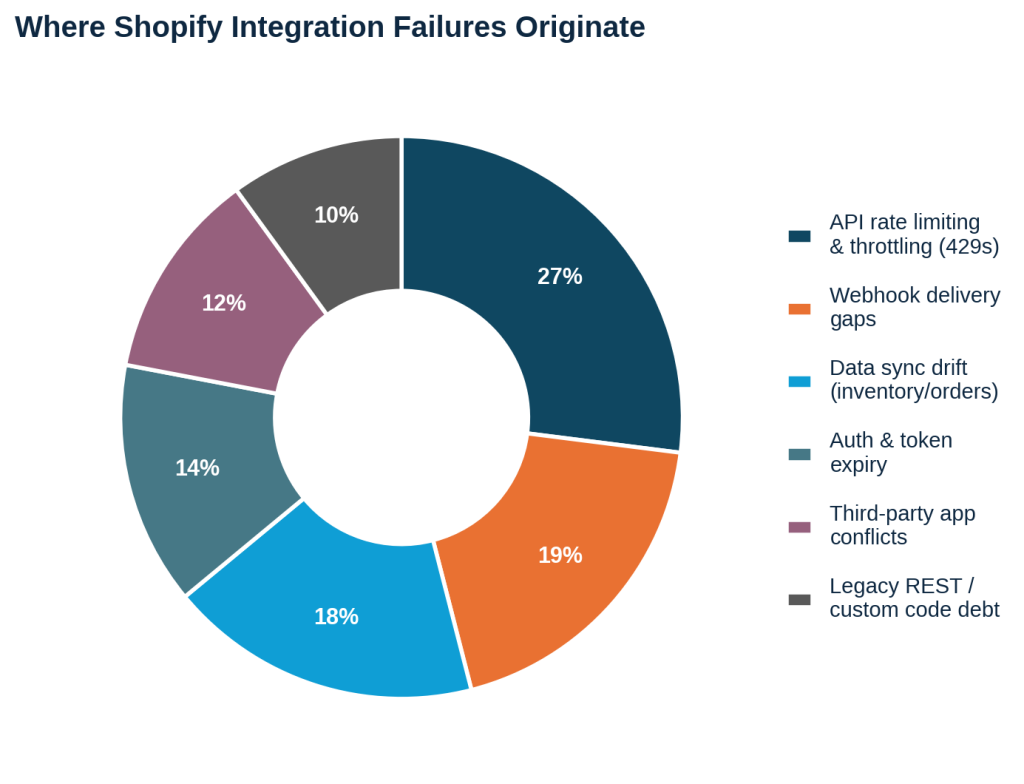
The distribution below is an illustrative split drawn from patterns across Shopify Plus and mid-market integration post-mortems, useful for prioritizing engineering time, not a precise industry-wide statistic.
Rate limiting and webhook handling consistently account for the largest share, which tracks with both being failure modes that are silent until they aren’t.
Benchmarks and Platform Facts Worth Keeping on Hand
This table is deliberately reference-grade: figures that come up repeatedly in scoping and incident-review conversations, sourced from Shopify’s developer documentation.
| Metric / fact | Value | Why it matters |
|---|---|---|
| REST Admin API bucket (Standard / Plus) | 40 requests / 80 requests | Sets the ceiling for how much interactive REST traffic a single app-store pair can sustain |
| REST refill rate (Standard / Plus) | 2 req/sec / 4 req/sec | Determines how quickly a throttled integration recovers after a burst |
| GraphQL Admin API bucket (Standard) | 1,000 cost points, ~50 pts/sec refill | Cost-based limiting rewards efficient queries more than REST’s flat request count |
| Maximum single-query cost | 1,000 points (hard ceiling) | A query that requests too much nested data gets rejected before it ever runs |
| Array input argument limit | 250 items per call | Caps how much can be written in a single mutation, shaping batch size design |
| REST Admin API status | Marked legacy as of Oct 1, 2024 | New feature development is GraphQL-only; REST integrations are on borrowed time |
| New public app requirement | GraphQL-only since Apr 1, 2025 | Any new App Store submission built on REST will not be accepted |
| Bulk Operations API | Asynchronous, separate from interactive rate limit | The only reliable path for large-volume reads/writes without starving other requests |
A Practical Elimination Framework
Fixing bottlenecks one incident at a time is expensive. The teams that stop firefighting run the same three-phase cycle on a recurring schedule instead.
Audit
- Inventory every API call pattern currently in production, REST vs. GraphQL, endpoint, average call volume per sync
- Cross-reference against Shopify’s developer changelog for upcoming deprecations
- Identify every job that loops over paginated results instead of using a bulk operation
Architect
- Design new integration work against GraphQL’s cost model from the outset, not REST’s request count model
- Separate real-time operations (checkout, inventory checks) from batch operations (catalog sync, historical backfills) at the architecture level
- Build idempotency and deduplication into every webhook consumer as a default, not a patch
Automate and Monitor
- Alert on 429 rates, webhook delivery failures, and authentication errors as distinct, first-class metrics, not buried in generic error logs
- Run scheduled reconciliation jobs for inventory and order state rather than trusting webhooks as the sole source of truth
- Re-run the audit phase quarterly; Shopify’s API versioning cadence means the answer changes even if your code doesn’t
Quick Reference Checklist
Before your next integration review, confirm:
- Every large-volume job routes through the Bulk Operations API, not a paginated loop
- Webhook consumers deduplicate by event ID and return within Shopify’s response window
- 429 responses trigger exponential backoff, not immediate retry
- REST product/variant calls have a migration owner and a target date
- A reconciliation job catches inventory and order drift independent of webhooks
- Installed third-party apps are reviewed quarterly for script and performance impact
Conclusion
None of these seven bottlenecks are exotic. They’re well-documented, predictable, and, critically, cheaper to design around upfront than to firefight under deadline pressure.
The pattern across all of them is the same one Shopify’s own platform direction keeps reinforcing: treat rate limits, webhook guarantees, and API versioning as architectural constraints from the first line of code, and integration stability stops being a recurring incident and starts being a solved problem.
Stop Shopify Integration Issues Before They Impact Sales

Pooja Upadhyay
Director Of People Operations & Client Relations
Source URLs:
https://shopify.dev/docs/api/usage/limits
https://shopify.dev/changelog/deprecation-timelines-related-to-new-graphql-product-apis
https://shopify.dev/docs/api/release-notes/previous-versions/2024-04
https://community.shopify.com/t/graphql-rate-limit-per-minute/101658
https://community.shopify.com/t/rest-api/371578
