


Node.js has become the natural backend choice for rapidly growing SaaS organizations due to its combination of concurrency, real-time capabilities, and speed in one programming environment built around JavaScript.
For startups looking for an efficient solution, it presents a great combination of efficiency, ecosystem readiness, hiring options, and cloud-native capabilities.
Growth and pressure in SaaS architectures
The SaaS market will cross the $700 billion line by 2028, thus forcing software to deliver faster and handle more users, integrations, and SLAs at the same time.
Modern SaaS solutions are integration-driven, which means they use a whole variety of APIs, webhooks, payment gateways, CRMs, analytics services, and messaging tools talking to each other in real time.
From an aesthetic standpoint, most of the SaaS dashboards are full of analytical consoles with charts, notifications, and streams, just the kind of applications that put pressure on traditional thread-based backends.
Node.js – the brief summary
Node.js is a minimalistic, event-driven framework based on the V8 engine of Chrome that executes JavaScript code on the server side.
Unlike other runtimes that launch a new thread per each request, Node.js uses an event loop with asynchronous I/O operations, which means that one process can manage a high number of connections.
Using the same programming language both in the browser and at the backend, developers can reuse the code, validation rules, and other tools.
Why Node.js works well for SaaS today
Three features are key to scaling the backends of rapidly growing SaaS startups:
- High concurrency in order to handle APIs, webhooks, and background tasks.
- Real-time functionality for dashboard, notification, chat, and collaboration applications.
- Development approach that enables rapid iteration and continuous delivery.
These are essentially what Node.js has been built for:
- Its non-blocking and asynchronous approach to handling I/O operations makes Node.js perfect for dealing with I/O-intensive tasks such as API gateways, integrations, streaming, and messaging systems.
- It is best suited for handling small amounts of CPU work but high concurrency, which applies to most of the SaaS traffic (small API calls, many users concurrently).
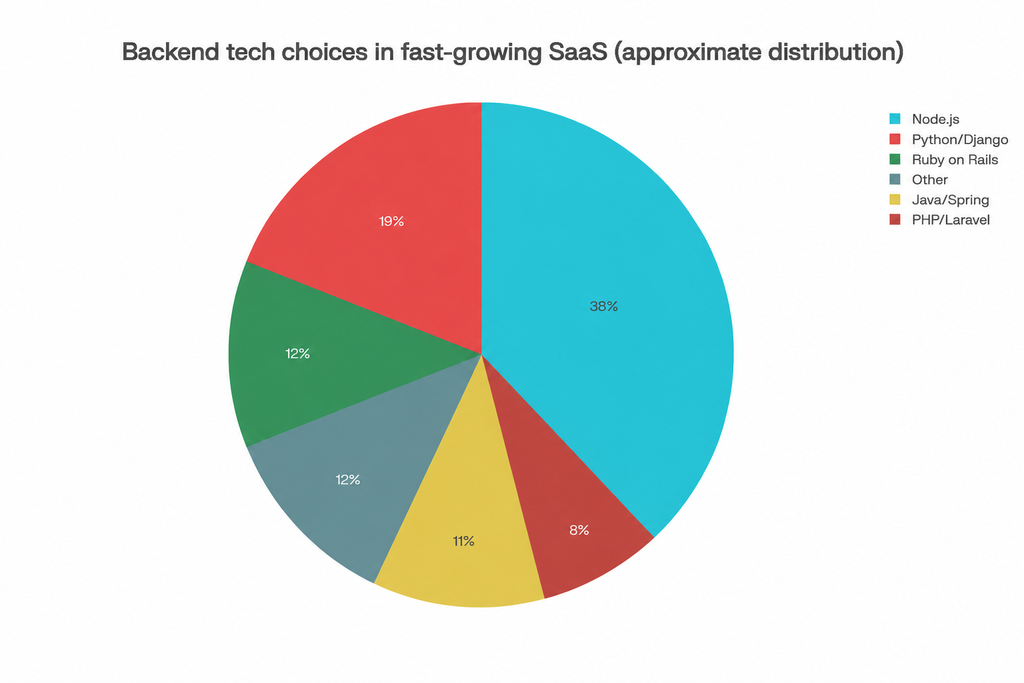
Pie chart: backend choices in fast‑growing SaaS
The most popular backend stacks in SaaS software development along with traditional backend stacks such as Python/Django, Java/Spring, and Ruby on Rails can be named Node.js based on the researches on backend stack ecosystem popularity.
The statistics may differ in certain sources, but this does not affect the fact that Node.js is not treated as an alternative anymore; instead, it becomes the primary backend stack for SaaS applications development.
Below you can see the pie chart, reflecting the approximate percentage of different backends within the topic of SaaS architecture discussion. It can be considered the reflection of the present state of Node.js usage in SaaS development.
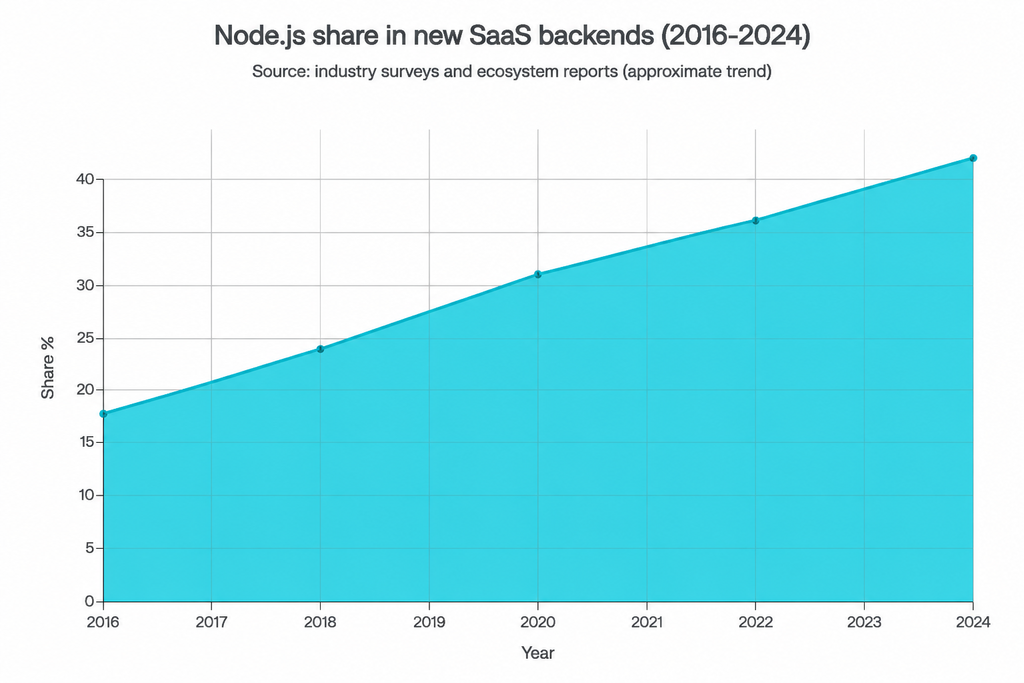
Graph: Node.js adoption trend in SaaS
As early as 2015, it is already visible that there was a noticeable rise in the amount of benchmarking posts, job vacancies, and case studies involving people’s use of Node.js in cloud native and software-as-a-service applications.
In the graph presented below, one may see how adoption grew depending on the share of new SaaS backends built with Node.js.
Again, this is the hypothetical trend graph corresponding to the trend rather than actual figures of any specific company, but based on numbers from prominent engineering blogs and surveys.
Event‑driven performance and concurrency
The capability of Node.js to perform Concurrent Processing is what makes Node.js an ideal platform to develop SaaS applications.
As Node.js is non-blocking while waiting for I/O requests (databases, external API, and files requests), it can simultaneously process other requests.
This architecture allows one instance of Node.js to keep up several connections at once, consuming a little bit of processing power and memory; therefore, it is the best choice to create multi-tenant SaaS applications with lots of lightweight API requests.
Benchmarking from academic and commercial sources demonstrates that Node.js is able to deliver low latencies and high throughput rates in case of Concurrent Processing if the number of I/O requests exceeds the number of complex computational requests.
Node.js usually outperforms all the other platforms in latencies and memory usage.


Scalability for hyper‑growth
It is very important for fast-growing SaaS companies that the stack operates properly as the number of users increases from a few hundred to a few thousand and above. Some examples of the ways to scale Node.js are listed below:
- Horizontal scaling: Set up several instances of Node.js with a load balancer. Due to the event loop, it is possible to have thousands of connections on each Node.js instance.
- Clustering: Utilize clustering from the standard library to distribute work between CPU cores using the Node.js coding style.
- Microservices and serverless: Decompose the application into microservices running independently: billing, notifications, and reports. Deploy microservices separately using Kubernetes, serverless architectures, or another tool.
Because each microservice is small and fast to deploy, it is possible to set up a new microservice in a few minutes if necessary due to increased load on certain features.
Full‑stack JavaScript and developer velocity
Developing a SaaS platform in JavaScript (or TypeScript) from front-end through to the back-end is not only comfortable; it is also a tool that increases developer productivity. For example, front-end and back-end developers can:
- Reuse validation, types, and utility modules in both sides of the project.
- Use the same programming techniques (for example, middleware, error handling, authentication flows) without implementing it in another language.
- Move from feature to feature without creating silos and potential bottlenecks while working under pressure.
Using this technique will allow developing a solution with a shorter ramp-up phase and faster iterations. This is a really big competitive advantage for SaaS companies when they update their solution each week or even every day.
Ecosystem, npm, and time‑to‑market
The npm registry, or the Node.js package ecosystem, is currently the largest publicly available registry of packages for any particular language.
Sources state that there are well over a million modules for everything from authentication and payment to logging, observability, caching, and third-party SDKs.
It means that for SaaS teams it means:
- Quicker prototype development: Stripe, Twilio, AWS, and almost all major SaaS adjacent services release production-ready Node.js SDKs and client libraries.
- Less boilerplate: Basic requirements like JWT-based authentication, validation, rate limits, and ORM layer can be fulfilled with existing packages.
- Shortened time-to-market: New functionality can be composed from tried-and-true components, and the team can concentrate on core logic and UI instead of plumbing.
The above mentioned pie chart is intentionally designed to emphasize the advantage of Node.js ecosystem: when the stack share is similar to other languages, Node tools’ richness and maturity often shift the architecture towards Node.js for a greenfield SaaS project.
Cloud‑native, microservices, and DevOps alignment
Integration with the existing process of developing and deploying SaaS applications is smooth for Node.js:
- Microservices architecture compatible: Frameworks like Express, Fastify, and NestJS make it possible to build highly-specialized services and define their API.
- Containerization is easy: Lightweight applications written in Node.js can be easily packed into containers.
- Observability instrumentation: Logging, metrics, distributed tracing, performance profiling is available via profiling flags and APM support.
This all translates into predictable management of the Node.js-based application by DevOps since its images will be lightweight, deployment will be fast, and scalability will not demand complicated threading.
Cost, performance, and hiring benefits
Node.js is expected to bring cost savings for Saas companies in terms of infrastructure costs as well as manpower costs:
- Infrastructure optimization: Since a single Node.js instance is capable of handling multiple connections at once, less server capacity is needed to achieve similar levels of performance than in the case of legacy technology stacks.
- Availability of developers: It is easy to find JavaScript developers and there are many frontend engineers that can switch to becoming backend Node.js developers.
- Cost of maintenance and updates: The use of one programming language decreases the scope of toolset and dependencies that need to be maintained.
Several case‑study style articles explicitly tie Node.js adoption to improvements in performance metrics (latency, responsiveness) and reductions in maintenance overhead, especially in integration‑heavy SaaS platforms.
Table: how Node.js compares to other SaaS stacks
Following is the table that explains how Node.js stacks up against other popular server-side platforms, such as Python Flask, Ruby on Rails, and Go, when it comes to handling a typical SaaS workload characterized by API-driven and IO-heavy multi-tenant applications.
| Metric | Node.js | Python/Django | Ruby on Rails | Java/Spring |
| Cold start time | Very fast for lightweight services | Moderate, depends on WSGI server | Moderate, heavier framework footprint | Slower, JVM warm‑up and footprint |
| Throughput (req/sec) | High for I/O‑bound workloads | Medium for mixed workloads | Medium for typical CRUD apps | High, especially for CPU‑bound APIs |
| Latency under concurrency | Low, event‑driven non‑blocking I/O | Medium, depends on async stack | Medium, can need tuning & caching | Low, strong threading and tuning options |
| Ecosystem packages | Very large npm registry | Large PyPI ecosystem | Moderate gem ecosystem | Large Maven/Gradle ecosystems |
| Real‑time features | Excellent (WebSockets, streams) | Good with async frameworks | Fair, needs specialized tooling | Good but heavier to implement |
| Microservices suitability | Very high; lightweight services | High; popular in Python microservices | Moderate; often used in monoliths | Very high; long history in enterprise |
| Developer hiring availability | Very high; JS talent pool | High; widespread Python usage | Medium; smaller but strong community | High; especially in enterprise sectors |
For fast‑growing SaaS specifically, the most decisive rows tend to be concurrency, ecosystem, microservices suitability, and hiring availability, all areas where Node.js scores particularly well.
Where Node.js shines most in SaaS
Node.js shines particularly bright when used to develop SaaS applications that are:
- Integration-heavy and API-based: Applications that need to integrate with payment gateways, CRMs, marketing tools, analytics, and support platforms using APIs and webhooks.
- Real-time by nature: Collaboration apps, live dashboards, notifications, chats, and streaming interfaces requiring persistent connections and low-latency.
- Microservices architecture: Architecture where the application is split up into lots of independently-deployable microservices, often containerized or even serverless.
These include B2B SaaS dashboards, multi-tenant analytics platforms, customer success platforms, or applications which run in the browser but need to interact with backend systems constantly.
Limitations and when Node.js isn’t ideal
All stacks have flaws, and one of the parts of being credible in B2B content is knowing how Node.js is not always the best option:
- CPU-heavy applications: Node.js performs well in I/O-bound tasks; however, for CPU-intensive operations, it’s advised to delegate work to workers or external services.
- Transactionally synchronized code: There are still developers who favor JVM and .NET stacks for transactional systems that rely heavily on legacy enterprise infrastructure.
- Security and governance challenges: With large npm ecosystems comes more dependencies that require strict dependency auditing, SBOMs, and governance.
This list doesn’t make Node.js less attractive as a tool for SaaS, but it makes an impact on the architecture design: Many organizations use Node.js for the real-time and API layer and some other technologies for compute-heavy components.
Practical takeaways for SaaS leaders
For a fast‑growing SaaS company, choosing Node.js as the default backend is less about hype and more about aligning with real constraints: concurrency, ecosystem, hiring, and time‑to‑market.
If you’re evaluating stacks for your next SaaS product or a re‑platforming initiative, Node.js is particularly compelling when:
- Your product is API‑driven, multi‑tenant, and integration‑heavy.
- You expect real‑time features and live dashboards to be core to the user experience.
- You want one language across the stack to streamline hiring, collaboration, and maintenance.
Used thoughtfully – often alongside microservices, containers, and strong DevOps practices – Node.js gives fast‑growing SaaS companies a pragmatic, future‑ready backbone for scaling from early traction to enterprise‑grade adoption.
Discuss Your SaaS Development Project

Pooja Upadhyay
Director Of People Operations & Client Relations
Source URLs:
https://www.ijmrsetm.com/admin/img/11_Scalable%20and%20Efficient.pdf
https://trepo.tuni.fi/bitstream/handle/123456789/26173/tapaninen.pdf
https://josenobile.co/guides/nodejs/
https://www.ironin.it/blog/why-nodejs-is-great-choice-for-a-saas-project.html
