


“Webflow eliminated all the developers from the process of updating the website.”
You know the feeling. A SaaS founder or marketing lead opens a competitor’s site and thinks, “How are they shipping landing pages this fast while looking this polished?” The answer, more often than people admit, is Webflow.
It rarely makes the loudest noise in tech Twitter threads, yet it powers a growing share of the sites that actually convert for high-growth SaaS companies. In 2026, that quiet advantage is hard to ignore.
I’ve watched this shift up close while working with product and marketing teams at AddWeb Solution. The companies scaling fastest don’t always pick the tool with the biggest market share.
They pick the one that lets marketing move without waiting on engineering sprints. Webflow has become that tool for a surprising number of them.
Why SaaS teams keep choosing Webflow
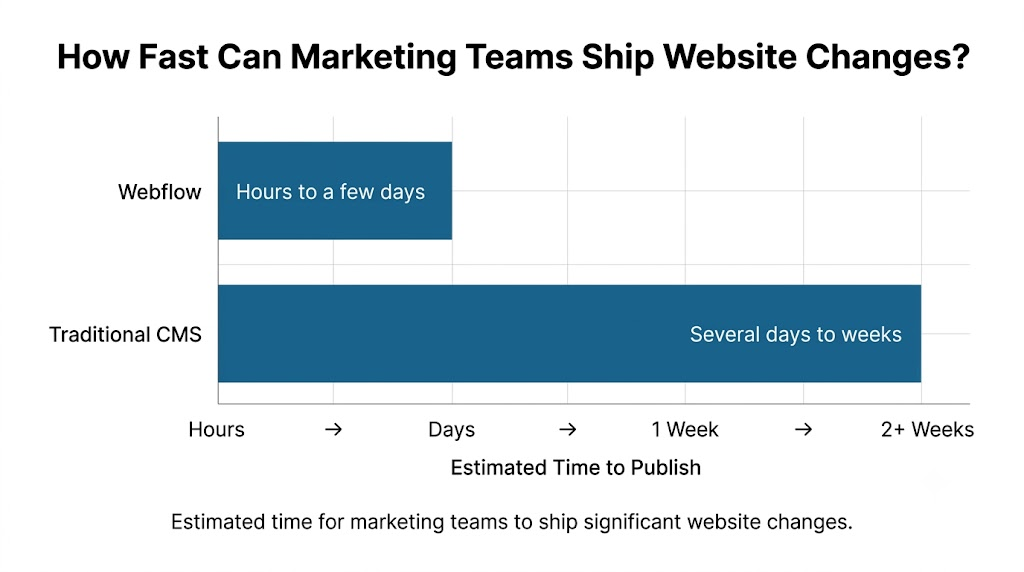
SaaS websites live or die by speed of iteration. A new feature drops, a competitor launches a campaign, or product messaging needs a tweak. Traditional stacks force marketing to file tickets and wait. Webflow flips that.
Designers and marketers work in a visual canvas that outputs clean, production-ready code, with a native CMS that handles blogs, changelogs, customer stories, and resource hubs without plugins fighting each other.
That independence shows up in results. A Forrester Total Economic Impact study commissioned by Webflow found organizations saw a 332% ROI over three years and a 94% reduction in the time required for major site changes.
Those numbers stick with teams who previously spent weeks coordinating simple updates.
Webflow also ships strong Core Web Vitals out of the box. Independent comparisons in 2026 put its pass rate noticeably higher than typical WordPress setups on the same metrics, which matters when Google and AI search surfaces reward fast, stable pages.
Add enterprise features, localization support, and growing AI tooling (including AEO analytics for how brands appear in AI answers), and the platform stops feeling like a “designer toy” and starts looking like infrastructure.

The data behind the quiet rise
Webflow still sits well below WordPress in raw market share, and that is fine. WordPress powers roughly 41–43% of all websites, depending on the tracker. Webflow sits around 0.7–0.8% of all sites and about 1.2% of sites that use a known CMS. What matters is the trajectory and the segment it owns.
Revenue hit $213 million in 2024, a 66% jump from the prior year. User base estimates land around 3.5 million, with more than 100,000 paying customers across 190 countries.
Active sites have climbed into the mid-hundreds of thousands (figures vary by tracker between roughly 493,000 and higher estimates). One specialized tracker lists over 26,000 SaaS products already using Webflow, with hundreds added in recent 30-day windows.
Here’s a simplified comparison of where teams land when choosing tools for marketing sites in the SaaS space:
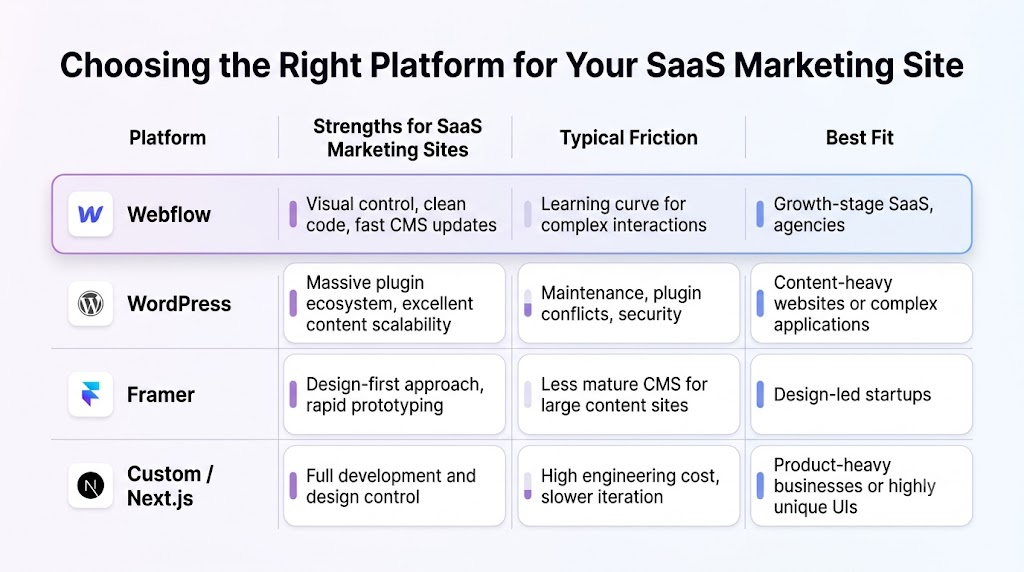
The pattern is clear: when design quality, page speed, and marketing autonomy sit at the top of the brief, Webflow wins more of the shortlists.
Performance and speed that actually matter
Speed is not just a Lighthouse score. It is how quickly a team can respond to market signals. SaaS buyers increasingly start research in AI tools before they ever hit a traditional search results page. Sites that load fast, structure content cleanly, and can be updated the same day a new positioning angle appears have an edge.
Webflow’s hosting and code output help here. Many teams report cleaner Core Web Vitals than their previous WordPress or heavily customized setups.
The platform also continues expanding analytics around AI visibility, letting teams track mentions and AI-referred traffic. That feature set matches the reality of 2026 buyer journeys.
Growth in Webflow usage among higher-value sites has been steadier than the overall web average. Trackers show continued year-over-year gains even while the total CMS pie shifts.


Real SaaS companies running on Webflow
Look at the sites of companies many of us follow. Jasper rebuilt multiple times on Webflow Enterprise and saw meaningful lifts in demo requests after redesigns.
Lattice moved content operations fully onto the platform so marketing no longer needed developers for every update. Other familiar names that appear in SaaS-on-Webflow lists include Typeform, Greenhouse, Mixpanel, monday.com elements, and a long tail of AI and productivity tools.
Even larger properties such as Discord and Prezi surfaces have used the platform.
These are not hobby projects. They are growth engines that need to look premium, load fast, and change often. Webflow lets the people closest to the customer message own the surface.
Interesting Fact Box
- Webflow generated $213 million in revenue in 2024, growing 66% year-over-year.
- More than 26,000 SaaS companies are tracked as using Webflow.
- A Forrester study reported 332% ROI and 94% faster major site changes for organizations using the platform. Sources: company-reported figures compiled by industry analysts, SaaS Browser, and Forrester TEI.
Practical takeaway
If your SaaS site still requires a developer ticket for every landing page or messaging tweak, you are leaving speed on the table.
Webflow is not the right answer for every product (complex authenticated apps often still need custom stacks), but for the marketing and growth surface that most prospects see first, it has become the quiet default for many of the fastest-moving companies.
At AddWeb Solution we help SaaS and digital product teams evaluate, migrate to, or optimize Webflow builds so the site stops being a bottleneck and starts compounding results. The companies already running on it are not waiting for the rest of the market to notice. They are simply shipping.
Make Your SaaS Website Faster and Easier to Manage

Pooja Upadhyay
Director Of People Operations & Client Relations
Source URLs:
https://w3techs.com/technologies/details/cm-webflow
https://w3techs.com/technologies/comparison/cm-elementor,cm-webflow,cm-wordpress
https://tei.forrester.com/go/webflow/webexperienceplatform/?lang=en-us
https://webflow.com/blog/forrester-tei-study
https://ramp.com/vendors/webflow
https://www.wmtips.com/technologies/website-builders/webflow/
