



As a CTO in the current competitive market, selecting the ideal PHP framework isn’t merely a technical choice, but a strategic one that affects your productivity, product scalability, and profitability. With Laravel taking 58% of the PHP framework market share and Symfony claiming 14%, these two leaders are the most logical choices for enterprise development. This in-depth review will guide you to make a well-informed decision that serves the purpose of your organization and technical needs.
Market Dominance and Industry Adoption
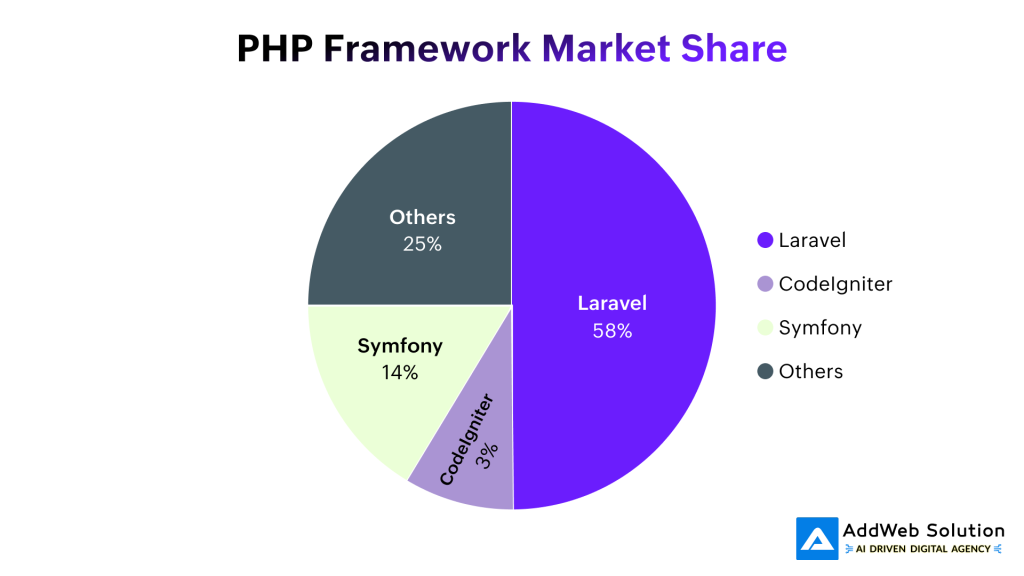
PHP Framework Market Share 2025 – Laravel leads with 58% market share
The PHP framework market picture indicates a definitive pecking order, with Laravel’s commanding position as a testimony to its broad base of adoption on 737,158 live websites worldwide. This market dominance reflects real-world benefits: greater talent pool, rich community resources, and established scalability across various sectors.


Enterprise Adoption Patterns:
- Laravel: Empowers startups to mid-sized businesses, with great success in e-commerce and content management
- Symfony: Favored by enterprise-level applications, government websites, and high-traffic applications such as Yahoo! services
Well-known companies utilizing Symfony include DailyMotion and several Yahoo! services, proving its ability to manage 500+ million user sites. Laravel’s enterprise usage keeps on increasing, with companies like Vogue Archive and Explore Georgia proving its aptness.

Comparison table of Laravel, Symfony, Zend/laminas, CodeIgniter, and CakePHP PHP frameworks showing versions, requirements, databases, security, and usage
Performance Analysis: Where Speed Matters
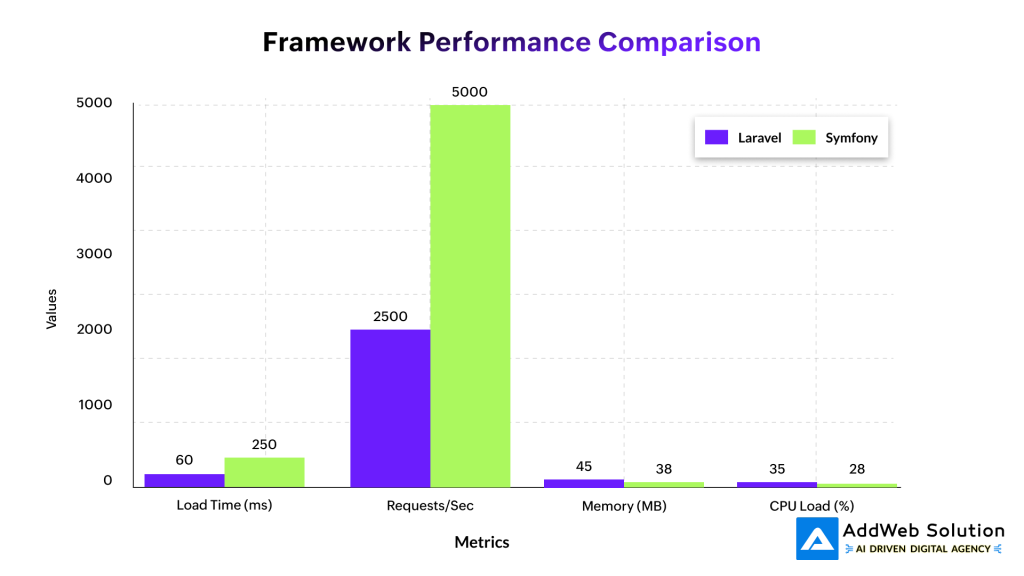
Laravel vs Symfony Performance Metrics – Complete performance comparison across key metrics
Performance benchmarks uncover vital differences that directly affect user experience and operational costs:
| Metric | Laravel | Symfony | Winner |
| Load Time | 60ms | 250ms | Laravel |
| Requests/Second | 2,500 | 5,000 | Symfony |
| Memory Usage | 45MB | 38MB | Symfony |
| CPU Load | 35% | 28% | Symfony |
Key Performance Insights:
- Laravel is superior in initial load speed, perfect for content-intensive applications where first-page load is crucial
- Symfony owns throughput capacity, with 2x the concurrent requests important for high-volume enterprise use cases, youtube
- Symfony’s reduced resource usage means lower infrastructure expenses at scale
Feature Comparison: Matching Framework to Business Needs

Laravel vs Symfony Feature Comparison – Detailed scoring across key development criteria
The feature analysis reveals distinct strengths aligned with different organizational priorities:
Laravel Competitive Strengths:
- Learning Curve (9/10): Fast team ramp with easy-to-understand syntax and extensive documentation
- Development Speed (9/10): Integrated features such as Eloquent ORM and Blade templating to speed up project delivery
- Community Support (9/10): 71.8k GitHub stars and massive ecosystem with Laravel Forge and Envoyer
Symfony’s Enterprise Strengths:
- Scalability (9/10): Component-based architecture for long-term, complex projects
- Performance (9/10): Optimized for high-load applications with high-end caching mechanisms
- Flexibility (9/10): 50+ reusable components enable fine-grained customization
- Enterprise Ready (9/10): Inherent security features and enterprise-level architecture
Cost Analysis and ROI Considerations

Laravel vs Symfony Developer Salaries by Region – Symfony developers generally earn higher salaries
Development Costs:
- Laravel: Lower initial development costs due to rapid prototyping capabilities and shorter learning curve
- Symfony: Higher upfront investment but lower total cost of ownership for large-scale applications
Salary Market Analysis:
The developer salary landscape shows Symfony developers commanding 5-8% premium across all major markets:
- North America: Laravel ($120K) vs Symfony ($130K)
- Western Europe: Laravel (€85K) vs Symfony (€90K)
- Eastern Europe: Laravel ($50K) vs Symfony ($55K)
This price difference accounts for Symfony’s expert business focus and increased level of skill necessary for sophisticated implementation.
Strategic Decision Framework
Choose Laravel When:
- Fast time-to-market is essential for competitive market success
- Team scaling demands simple integration of junior to mid-level developers
- Project size encompasses small to medium-sized applications (less than 1M monthly users)
- Budget limitations favor reduced up-front development expenses
Choose Symfony When:
- Scale performance is not negotiable for your business model
- Long-term upkeep and system growth are top of mind
- Sophisticated integrations with current enterprise platforms are necessary
- Security compliance requires enterprise-class built-in capabilities
Turn framework choices into strategic wins for CTOs

Pooja Upadhyay
Director Of People Operations & Client Relations
Future-Proofing Your Technology Stack
Market Growth Drivers:
- PHP Framework market expected to hit $2.8 billion by 2032 at 9.5% CAGR
- Asia-Pacific region expected to demonstrate highest growth due to digital transformation efforts
- Cloud integration becoming a standard requirement for both frameworks
Technology Evolution:
- Laravel 2025: Emphasis on better performance optimization and improved developer experience
- Symfony 2025: Ongoing enterprise features add and microservices architecture support
Key Decision Criteria Summary
| Factor | Laravel | Symfony | Decision Impact |
| Time to Market | ⭐⭐⭐⭐⭐ | ⭐⭐⭐ | Critical for startups |
| Scalability | ⭐⭐⭐ | ⭐⭐⭐⭐⭐ | Essential for growth |
| Team Productivity | ⭐⭐⭐⭐⭐ | ⭐⭐⭐ | Affects delivery speed |
| Enterprise Security | ⭐⭐⭐⭐ | ⭐⭐⭐⭐⭐ | Regulatory compliance |
| Long-term Costs | ⭐⭐⭐ | ⭐⭐⭐⭐⭐ | Budget planning |
Actionable Recommendations
For Startup CTOs: Laravel’s 9/10 development speed rating and large community support make it the best fit for MVP development and quick iteration cycles.
For Enterprise CTOs: Symfony’s better performance figures (5,000 vs 2,500 requests/second) and enterprise-ready design make the added complexity worth it for high-scale applications.youtube
For Growing Companies: Use Laravel for initial development with an eventual migration path to Symfony when scale requirements increase many developers find the jump tractable because there are common design principles.
The decision between Symfony and Laravel really depends on your organization’s strategic imperatives: speed-to-market vs. long-term scalability, team usability vs. performance optimization, and initial cost minimization vs. overall ownership economics. Both frameworks are solid solutions; the trick is to align their strengths with your particular business environment and technical needs.
Sources:
1) https://webtechsurvey.com/technology/symfony
2) https://www.youtube.com/watch?v=LJRfB6wuLz8
3) https://clouddevs.com/symfony/annual-salaries/
4) https://www.turing.com/kb/laravel-vs-symfony
5) https://dataintelo.com/report/global-php-framework-market
