



Author’s Note
Nobody likes losing a client.
Especially when you’ve invested months building the relationship.
The project went well.
The team worked hard.
The client seemed happy.
Then, for one reason or another, they leave.
Earlier in my career, my first instinct was to ask:
“What went wrong?”
Today, I ask a slightly different question:
“What can this teach us?”
Because not every lost client means you did something wrong.
Sometimes their business changed.
Sometimes budgets changed.
Sometimes leadership changed.
Sometimes they simply found a different direction.
But sometimes…
They leave because we gave them a reason to.
Those are the losses worth studying.
Not defending.
Not rationalizing.
Studying.
Key Takeaways
- Losing a client doesn’t automatically mean failure.
- Some client losses are external; others reveal internal weaknesses.
- Exit conversations can reveal problems that happy clients don’t mention.
- The right response isn’t always winning the client back.
- A lost client can improve your business if you’re willing to learn from it.
Introduction
Winning a client feels like validation.
Someone trusted you.
They chose you over competitors.
They gave you an opportunity.
Everyone celebrates.
Losing one feels completely different.
There’s disappointment.
Sometimes frustration.
Sometimes even defensiveness.
After all the work we’ve put in, it’s natural to think:
“What did we do wrong?”
But over the years, I’ve learned that there are actually several very different reasons why clients leave.
Some have nothing to do with you.
Others have everything to do with you.
The difficult part is knowing which is which.
1. Why Losing Clients Hurts
A client relationship isn’t just a revenue number.
Over time, people become familiar.
You understand their business.
They understand how your team works.
You know their preferences.
Your team has context.
So when that relationship ends, you’re not simply losing an invoice.
You’re losing accumulated knowledge and trust.
That’s why losing an established client can feel disproportionately painful.
But emotional reactions aren’t always useful.
The better response is curiosity.
What actually happened?
2. Not Every Loss Is Your Fault
This is important.
We shouldn’t turn every lost client into a self-criticism exercise.
Businesses change.
Companies get acquired.
Budgets get cut.
Executives move.
Internal teams are built.
Projects get cancelled.
Strategic priorities shift.
Sometimes a client leaves despite excellent delivery.
That’s business.
Trying to prevent every possible client departure is impossible.
The goal isn’t zero churn.
The goal is understanding the churn you can influence.
That distinction matters.
3. Happy Clients Don’t Always Tell You Everything
Here’s something I’ve learned the hard way.
A client saying they’re happy doesn’t necessarily mean everything is perfect.
People don’t always complain.
Sometimes they quietly adapt.
Sometimes they tolerate small frustrations.
Sometimes they don’t want confrontation.
And sometimes they simply start looking elsewhere.
Then one day, you hear:
“We’ve decided to go in another direction.”
That sentence can be surprisingly difficult to process.
Because there may have been warning signs.
We simply didn’t see them.
That’s why I increasingly value uncomfortable conversations.
I’d rather hear:
“This isn’t working for us.”
while we still have time to fix it…
than hear it after the decision has already been made.
4. The Warning Signs We Ignore
Some client departures are preceded by subtle changes.
Response times become shorter.
Meetings become less engaged.
Questions become more transactional.
Approvals slow down.
The client starts involving someone else.
They stop discussing future plans.
None of these necessarily means a client is leaving.
But together, they may indicate something has changed.
The mistake is assuming silence means satisfaction.
Sometimes silence simply means disengagement.
I’ve learned that relationships need active attention, not just successful delivery.
5. What Lost Clients Can Reveal
A lost client can expose weaknesses that successful projects hide.
Maybe communication wasn’t clear enough.
Maybe we weren’t proactive enough.
Maybe our pricing stopped making sense for their situation.
Maybe we became too dependent on a particular person.
Maybe the client didn’t understand our value anymore.
Maybe we delivered exactly what they asked for…
But not enough of what they actually needed.
Those are uncomfortable conclusions.
They’re also valuable.
Because a client who leaves gives you something that a happy client often doesn’t:
a reason to examine the relationship honestly.


6. Don’t Chase Every Lost Client
Another lesson I’ve learned is that not every client should be won back.
Sometimes the relationship wasn’t a good fit.
Maybe the expectations were unrealistic.
Maybe the margins were too low.
Maybe the communication was consistently difficult.
Maybe the client required a business model you don’t want to operate.
Winning them back might increase revenue.
It might also recreate the same problem.
That’s why the objective shouldn’t be:
“How do we get this client back?”
It should be:
“What should we learn from losing this client?”
Those are very different questions.
7. Turning Loss Into Improvement
The most valuable client loss isn’t the one you recover.
It’s the one that changes something.
A process improves.
Communication becomes clearer.
A warning sign gets added to the account-management checklist.
A pricing model changes.
A particular type of client gets removed from the ideal customer profile.
A team member learns something important.
That’s when the loss starts paying dividends.
You didn’t recover the revenue.
You recovered the lesson.
And that lesson can influence every client relationship that follows.
Statistics
Client retention has a direct relationship with long-term business economics.
Bain & Company has highlighted the significant economic value of customer retention and loyalty, noting that relatively small improvements in retention can have a substantial effect on profitability in many businesses.
Source:
https://www.bain.com/insights/putting-the-service-profit-chain-to-work
Harvard Business Review has examined customer loyalty extensively and emphasizes that understanding why customers leave is critical to improving retention and long-term customer value.
Source:
Qualtrics’ customer experience research also emphasizes the importance of identifying the drivers behind customer dissatisfaction rather than relying solely on broad satisfaction scores.
Source:
https://www.qualtrics.com/customer-experience
A Few Observations
- A client leaving isn’t automatically a failure.
- Silence from a client doesn’t necessarily mean satisfaction.
- The most useful feedback is often the feedback that is hardest to hear.
- Not every client should be won back.
- A lost client becomes valuable when the lesson improves future relationships.
Frequently Asked Questions
Should you always ask a departing client why they’re leaving?
Yes, when the relationship allows for an honest conversation.
Even if the answer is uncomfortable, it can reveal valuable information.
What if the client simply says they’re moving in another direction?
Accept it professionally.
You may not get the complete answer.
But the way you handle the departure can determine whether the relationship remains positive in the future.
Should you offer discounts to retain a client?
Not automatically.
If price is genuinely the issue, it may make sense.
But discounting a fundamentally unhealthy relationship can simply postpone the problem.
How do you distinguish a bad client from a client you failed?
Look for patterns.
If multiple clients raise the same concern, it’s probably a business problem.
If one relationship is uniquely difficult, it may be a fit issue.
My Framework – The Lost Client Review™
When a client leaves, don’t stop at:
“Why did they leave?”
Review the relationship across five areas:
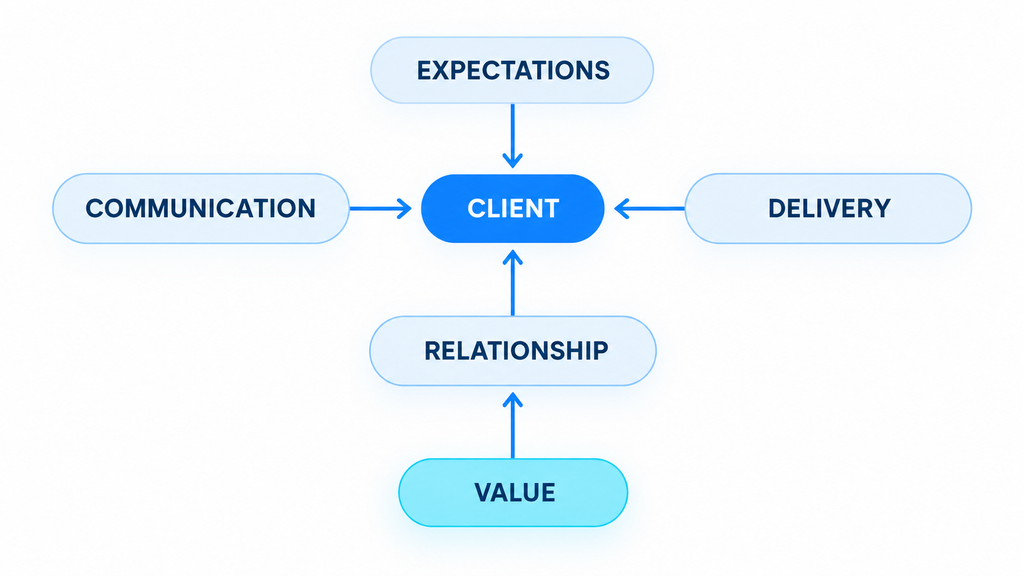
Ask:
1. Expectations
Did we understand what success meant to them?
2. Communication
Did we communicate proactively enough?
3. Delivery
Did we deliver consistently?
4. Relationship
Did we build trust beyond the immediate project?
5. Value
Could the client clearly see the value we created?
Then ask one final question:
What will we do differently with the next client because of this experience?
That’s where the real value of the loss appears.
A Thought to Leave You With
A lost client closes one relationship.
It doesn’t have to close the lesson.
Sometimes the most valuable thing a departing client leaves behind isn’t revenue.
It’s perspective.
Strengthen Your Client Relationships

Pooja Upadhyay
Director Of People Operations & Client Relations
Closing Thoughts
I’ve learned to treat client departures differently over the years.
I still don’t enjoy them.
I don’t think any business owner does.
But I no longer believe every loss needs to be immediately fixed.
Sometimes it needs to be understood.
Because if we only celebrate the clients we win, we learn from one side of the story.
The clients who stay tell us what we’re doing right.
The clients who leave sometimes tell us what we’re missing.
We need both.
And perhaps the most mature response to losing a client isn’t:
“How do we get them back?”
It’s:
“What did this relationship teach us that will make the next one better?”
If we can answer that honestly, then the client may be gone…
But the value of the relationship doesn’t have to be.
My Principle
Winning a client validates your approach. Losing one can challenge it.
And sometimes, the challenge is exactly what a growing business needs.
