


Machine learning suddenly seems powerful because all three of the following happened simultaneously: we collected an enormous amount of data, had access to extraordinary compute, and developed algorithms (transformers and scaling laws) that actually make use of those resources efficiently.
Once all three came together, ML reached a tipping point where models could suddenly do things like writing, seeing, predicting, and automation.
Why Machine Learning Suddenly Got Strong
For most of the history of machine learning, improvements seemed to be done in a trial-and-error manner; tweak a model to get slightly better performance and repeat the process again and again.
Starting from about 2017-2022, the situation began to change as it became clear that transformers, scaled up training, and neural scaling laws made predictable improvements in performance possible when the size of model, amount of data and compute were increased.
The three core ingredients
In essence, modern ML is powered by three synergistically reinforcing elements:
- Large, high-quality datasets: text, image, logs, clicks, code, sensor data gathered in an internet-scale operation.
- Efficient computing power: GPUs, TPUs, specialized computers which make it possible to train very large models within a feasible timeframe.
- Improved algorithmic approaches: transformers, self-supervised learning, scaling laws which convert data + computing power into competence.
Each one of these had its own place in the history of ML before, but it was only recently that they converged at such a level to unlock general-purpose ML models like large language models, vision models, and multimodal models.
Ingredient 1: Data at unheard-of scale
First comes the sheer amount and variety of data available for training.
- Trillions of tokens of text, billions of images and video clips, and huge datasets of code and sensors are all available on the internet.
- Companies nowadays monitor everything they can: interactions, user experiences, telemetry from devices, operations, all forming massive data lakes labelled and unlabeled.
- Thanks to the developments in storage and distributed computing, we have made it possible to store and stream from terabytes to petabytes of data to our training pipelines.
There is something called neural scaling laws that state that the error in deep models scales by a power law as you increase the amount of data used for training, as well as the size of the model and compute resources.
Ingredient 2: Compute you couldn’t imagine in 2010
The second element has been the proliferation of inexpensive, highly parallel compute tailored for ML tasks.
- GPUs and TPUs offer thousands of cores tuned for matrix multiplication operations at the heart of deep learning.
- Cloud providers offer the ability to build large numbers of such accelerators on the fly, changing capital expense into operational expense.
- Optimizations in algorithm and systems design (more efficient kernels, mixed precision training, parallel approaches) make more use out of each FLOP.
Research into computing trends in eras of ML has found that training runs for leading edge models have increased orders of magnitude in computational resources allocated compared to classical machine learning tasks, keeping up roughly with the “Moore’s law for training”, as well as heavy use of parallelism.
Concurrently, advances in technology make these compute costs lower, hence the ability of startups as well as hyperscalers to train significant models or fine-tune pretrained models.
Ingredient 3: Algorithms that scale (Transformers & scaling laws)
The third component is perhaps the most important one: algorithms which scale gracefully with data and compute.
Transformers: the architecture shift
Transformers were proposed in the paper “Attention Is All You Need” in 2017, where recurrence and convolutions were substituted with self-attention in modeling sequences.
- Work better with very long sequences compared to traditional RNNs and LSTMs.
- Scale easily on modern hardware due to computation of attention for tokens in large batches.
- Can serve as the universal backbone for text, images, audio, code, and even multimodal inputs.
Therefore, transformers have become the standard architecture for large language models and other vision and multimodal models.
Scaling laws: from alchemy to engineering
In 2020, Kaplan et al. showed that the performance (cross-entropy loss) of language models follows smooth power-law scaling with model size, dataset size, and compute over several orders of magnitude.
Later work, such as Hoffmann et al.’s “Chinchilla” and subsequent analyses, refined this picture, recommending that, for a fixed compute budget, you should increase data and parameters together to stay “compute optimal.”
Key takeaways from this scaling-law line of work include:
- Larger models are more sample-efficient, they reach the same loss with fewer training tokens than smaller models.
- Performance improvements are predictable as you scale, making capacity planning and R&D investment more like engineering than guesswork.
- There is an optimal trade-off between model size and dataset size for a given compute budget (e.g., roughly 20 training tokens per parameter in Chinchilla-style recipes).
Put simply: once you know how loss will behave as you scale N (parameters), D (data), and C (compute), you can plan your way to better models instead of hoping for them.
How the three ingredients interact
These three forces don’t act independently, they amplify one another.
- Better algorithms make it worthwhile to collect and curate more data, because the marginal improvement per extra token is predictable.
- More data motivates investment in compute infrastructure, since you can quantify the ROI: more FLOPs → lower loss → better downstream performance.
- Additional compute makes it feasible to train more complex algorithms and explore architectures that were previously too expensive to evaluate.
The net effect is a flywheel: data, compute, and algorithms improve together in a self-reinforcing loop, driving the rapid capability jumps we’ve seen in language, vision, and multimodal models since around 2018.
Visual snapshot: the three ingredients
To make this more concrete, here’s a conceptual pie chart that captures the “recipe” behind modern ML success. You can embed this as an image in your blog.
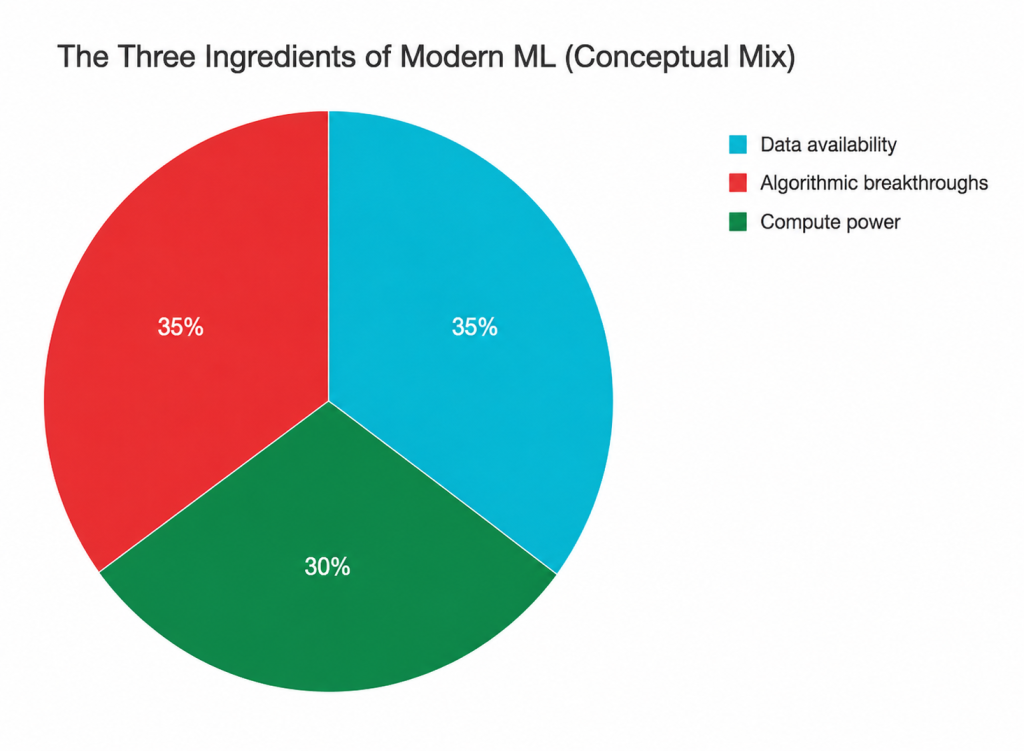
Even though the exact percentages will vary by application, the idea is that powerful ML systems are never “just about the algorithm” or “just about the data”, all three ingredients must be present in a reasonable proportion.
Conceptual growth of model size
Below is a conceptual line graph illustrating how the parameter count of flagship models has exploded over the last two decades, from millions of parameters to hundreds of billions and beyond.
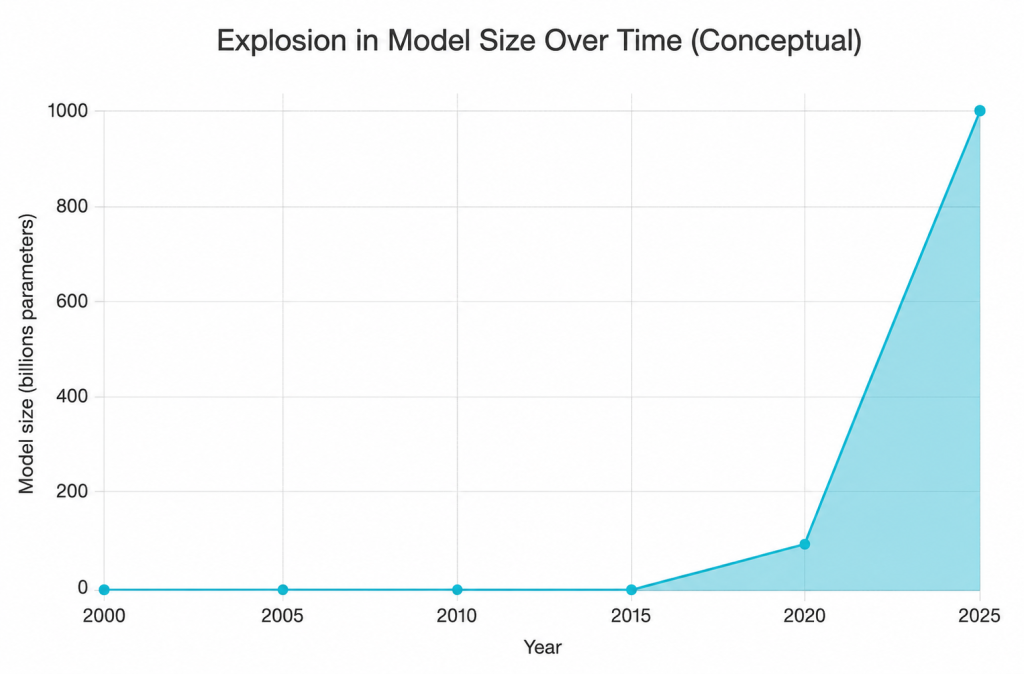
The precise numbers depend on the specific models you consider, but the trend is clear in empirical studies and historical overviews of deep learning: model capacity has grown by orders of magnitude, driven by better architectures and more available compute.


Table: three eras of machine learning
Here’s a human-friendly table you can copy directly into WordPress, Medium, or Markdown to contextualize the shift:
| Era | Approx years | Typical data size (indicative) | Typical compute (indicative) | Key algorithms |
| Pre-deep learning | <2010 | MB–GB | Single CPU / small GPU | SVMs, random forests, shallow nets |
| Early deep learning | 2010–2017 | GB–TB | GPU clusters | CNNs, RNNs, LSTMs |
| Transformers & scaling | 2017 onward | TB–PB | TPU pods / large GPU clusters | Transformers, diffusion, RLHF, LLMs |
These ranges are indicative rather than exact, but they mirror the historical narrative in deep learning surveys and compute-trend analyses: more data and more specialized compute enable more expressive models, which in turn demand even more data and compute.
Why it feels “sudden” (especially in business)
From a business or product perspective, ML’s rise feels sudden because the capabilities crossed visibility thresholds in consumer-facing use cases.
- Language: LLMs moved from clunky autocomplete to tools that can generate coherent articles, code, emails, and strategies.
- Vision: Foundation models power image generation, visual search, defect detection, and medical imaging analysis with human-like quality in many narrow tasks.
- Multimodal: Models now process text, images, audio, and code together, which makes them far more useful for real-world workflows.
Under the hood, though, this is the continuation of trends that researchers have been tracking for years, scaling curves, algorithmic innovations, and hardware advances quietly compounding until they became visible to non-specialists.
Practical implications for teams and products
If you’re building products, platforms, or content around ML, the “three ingredients” lens is a useful way to stay grounded.
1. Data: invest beyond volume
- Prioritize data quality, coverage, and freshness; scaling laws assume reasonably clean, representative data.
- Capture event-level logs, user journeys, and edge cases, but build pipelines for deduplication and filtering.
- Consider synthetic data and weak supervision where labeled data is scarce, but keep evaluation on real-world distributions.
2. Compute: design for scale and cost
- Map your ambitions (model size, refresh cadence) to realistic compute budgets and latency requirements.
- Use cloud accelerators for experimentation, but optimize hot paths with model distillation, quantization, and caching.
- Monitor energy usage and environmental impact; large-scale training is compute- and energy-intensive, and responsible AI increasingly includes sustainability.
3. Algorithms: stand on the shoulders of giants
- Leverage proven architectures (transformers, diffusion, graph neural networks) instead of reinventing the wheel.
- Fine-tune and adapt existing foundation models when possible; it’s often cheaper and more effective than training from scratch.
- Follow scaling-law-informed practices (e.g., balancing data and parameters) to avoid wasting compute on suboptimal configurations.
Bringing it all together (in your content)
For a technical or business audience, you can frame the story like this:
- “Machine learning didn’t suddenly get smart, it finally got the right mix of data, compute, and algorithms.”
- “Transformers and scaling laws turned model training from alchemy into engineering.”
- “If you want powerful ML in your product, think in terms of these three levers and how they interact in your stack.”
Combine the pie chart, the growth graph, and the eras table with concrete examples from your domain (e-commerce, SaaS, DevOps, etc.), and you’ll have a visually engaging, authoritative blog that explains why ML suddenly feels powerful, without resorting to hype.
Explore how modern machine learning, LLMs, and intelligent automation can transform your business.

Pooja Upadhyay
Director Of People Operations & Client Relations
Source URLS:
https://www.sciencedirect.com/science/article/pii/S1568494625006891
https://www.cs.umd.edu/~miyyer/cmsc848o/slides/scaling_laws.pdf
https://lilianweng.github.io/posts/2026-06-24-scaling-laws/
https://arxiv.org/abs/2001.08361
https://www.pnas.org/doi/10.1073/pnas.2311878121
https://ocw.mit.edu/courses/6-7960-deep-learning-fall-2024/mit6_7960_f24_lec20.pdf
https://openreview.net/pdf/84d2b007d5109b66762818426b58c936984d2acc.pdf
