


Executive summary
The concept of a smart factory is used to define a situation where there is a connection that exists between a machine, a human, and a software program to form an entity that is driven by the use of data. However, as a firm is moving from its current state, which consists of individual machines as well as a paper-based system, to a situation where there is a connection with a smart factory setup, there is a need for a strong integration platform that is capable of integrating with the physical shop floor as well as the digital business stack.
The use of the Laravel framework is best for creating a secure API, controlling the flow of data, creating a dashboard, as well as communicating with the upstream system. It is a strong integration platform. This report is a guide on how the Laravel framework is used as a core platform for a smart factory stack. The report will contain the architecture patterns, use cases, as well as visualizations for a smart factory.
1. Smart factory basics
1.1 What is a smart factory?
Smart factory is a digitized manufacturing environment wherein machines, devices, and manufacturing systems are connected with each other through a network, enabling the continuous sharing and analysis of information with the aim of improving the manufacturing environment. Smart factory leverages different technologies, such as the Industrial Internet of Things (IIoT), cloud computing, big data analytics, and artificial intelligence, to integrate the physical and virtual worlds.
The main characteristics of a smart factory include:
- Continuous information gathering from machines, sensors, and individuals.
- Real-time awareness of machine, sensor, and human states.
- Automated or enabled decision-making.
- Self-optimization of different manufacturing processes.
1.2 Why manufacturers are investing in smart factories
The smart factories are being utilized to address the following recurring issues:
Unplanned downtime, quality problems, increasing costs of inputs, and reduced lead times along with greater customization. The advantages reported in the literature are:
- Increased efficiency and productivity using real-time monitoring and identification of bottlenecks.
- Better quality control using the identification of defects during the production process.
- Increased flexibility to produce smaller batches and customized products at reasonable setup costs.
- Reducing energy and resource waste using efficient resource utilization.
1.3 Market momentum
Smart factories are no longer a side project. In fact, the market for smart factories is expected to see robust growth, as evidenced by the following market estimates:
- The smart factory market is expected to see a rise of around USD 97.1 billion in its market size between 2023 and 2028, with a CAGR of around 10.9 percent.
- The smart factory market is expected to grow from around USD 60 billion in 2024 to around USD 165 billion by the end of 2030, with a CAGR of around 14.5 percent.
- The smart factory market is expected to reach around USD 141.5 billion in 2024 and around USD 353 billion by the end of 2034.
Asia-Pacific and North America are the key markets for smart factories, with robust adoption of Industry 4.0 concepts, IIoT-based machines, and AI-based manufacturing analytics.
2. Where Laravel fits in the smart factory stack
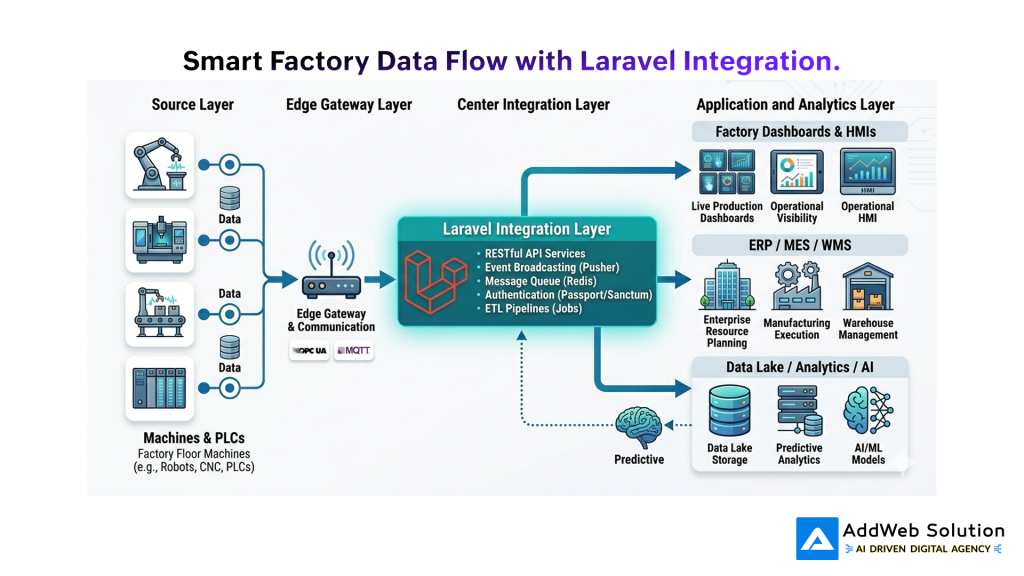
2.1 Conceptual architecture
A typical smart factory architecture can be visualised in four layers:
- Physical layer – Machines, PLCs, robots, conveyors, sensors.
- Connectivity / edge layer – Gateways using OPC UA, Modbus, MQTT, or proprietary drivers to collect and normalize machine data.
- Application / integration layer – APIs, data models, workflows, and business logic.
- Business & analytics layer – MES, ERP, quality systems, planning tools, dashboards, and AI or analytics platforms.
Laravel sits squarely in the application / integration layer, acting as the “glue” between edge data and business applications. It exposes REST or GraphQL APIs, handles authentication and authorization, processes events, applies domain logic, and feeds cleaned, structured data into BI tools or enterprise systems.
A simplified flow looks like this:
2.2 Why Laravel is a good fit
Laravel is popular for developing business applications due to its balance of developer experience and robustness. For smart factory applications, some key benefits are:
- API-first development : With resource controllers, API resources, and routing, developing clean and versioned APIs for machines and production is a breeze.
- Queues and background jobs : Laravel Queues with Redis, SQS, or RabbitMQ are perfect for handling bursts of machine events and long-running integration tasks.
- Task scheduling : The scheduler makes it simple to schedule recurring tasks like aggregating production data every minute or synchronizing with ERP systems periodically.
- Authentication & authorization: With Laravel Sanctum or Passport, developers can use token-based auth for operator tablets, machine UIs, and systems.
- Rich ecosystem : Packages for MQTT, OPC UA connectors, auditing, multi-tenancy, and BI integration can significantly cut down development time for smart factory applications.
3. Visual snapshot of integration priorities
The diagram below illustrates an example effort distribution when building a smart factory integration layer using Laravel. The numbers are indicative – actual splits depend on plant complexity and legacy systems.
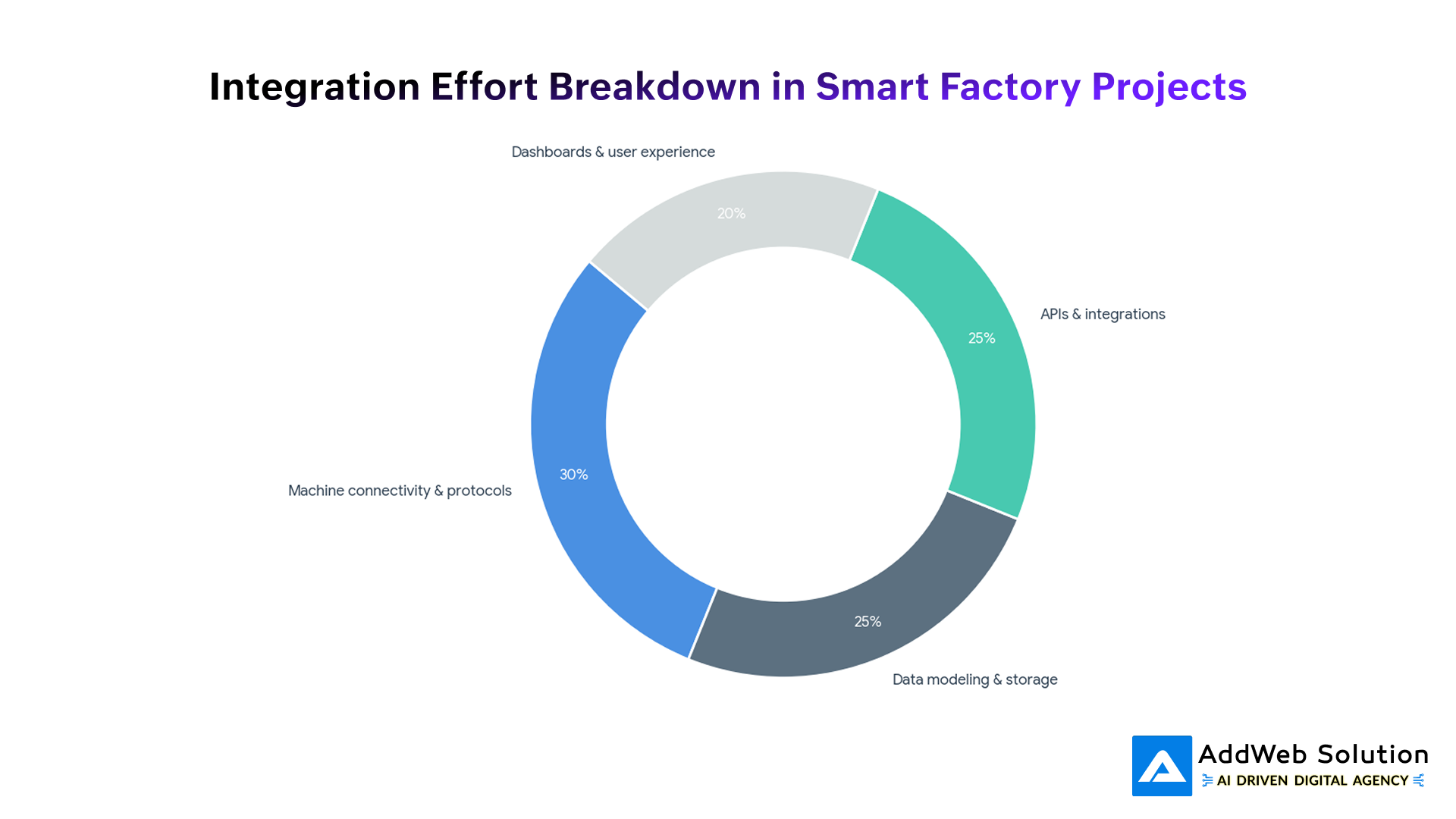
This highlights a critical point: Laravel does more than build dashboards. A significant portion of the work involves modeling production data correctly, designing stable APIs, and orchestrating with existing MES/ERP systems.
To complement this, the table below compares three common approaches.
3.1 Integration approach comparison
| Aspect | Ad-hoc scripts & point-to-point links | Off-the-shelf MES only | Laravel integration layer (with MES/ERP) |
| Architecture | Many custom connections between systems | Monolithic vendor platform | Central API layer orchestrating all systems |
| Flexibility | Low – changes often require rewrites | Medium – limited to vendor roadmap | High – in-house or partner-controlled code |
| Maintainability | Fragile, hard to document | Good, but vendor-dependent | Good – standard framework conventions |
| Data ownership | Scattered across systems | Often locked into vendor schemas | Centralized models under your control |
| Upfront cost | Low (if done internally) | Medium to high licenses | Medium implementation, leverage open source |
| Best use case | Small plants with few systems | Plants that fit vendor templates | Plants needing tailored workflows and integrations |
4. Key Laravel-driven use cases in smart factories
4.1 Real-time production and OEE dashboards
Overall Equipment Effectiveness (OEE) improves when downtime, speed losses, and quality losses are measured consistently and made visible to operators in real time. Laravel can aggregate machine tags and production events into a normalized database and expose:
- Live status boards (running, stopped, changeover, maintenance).
- OEE by line, shift, product, or work order.
- Alerts when performance drifts from target.
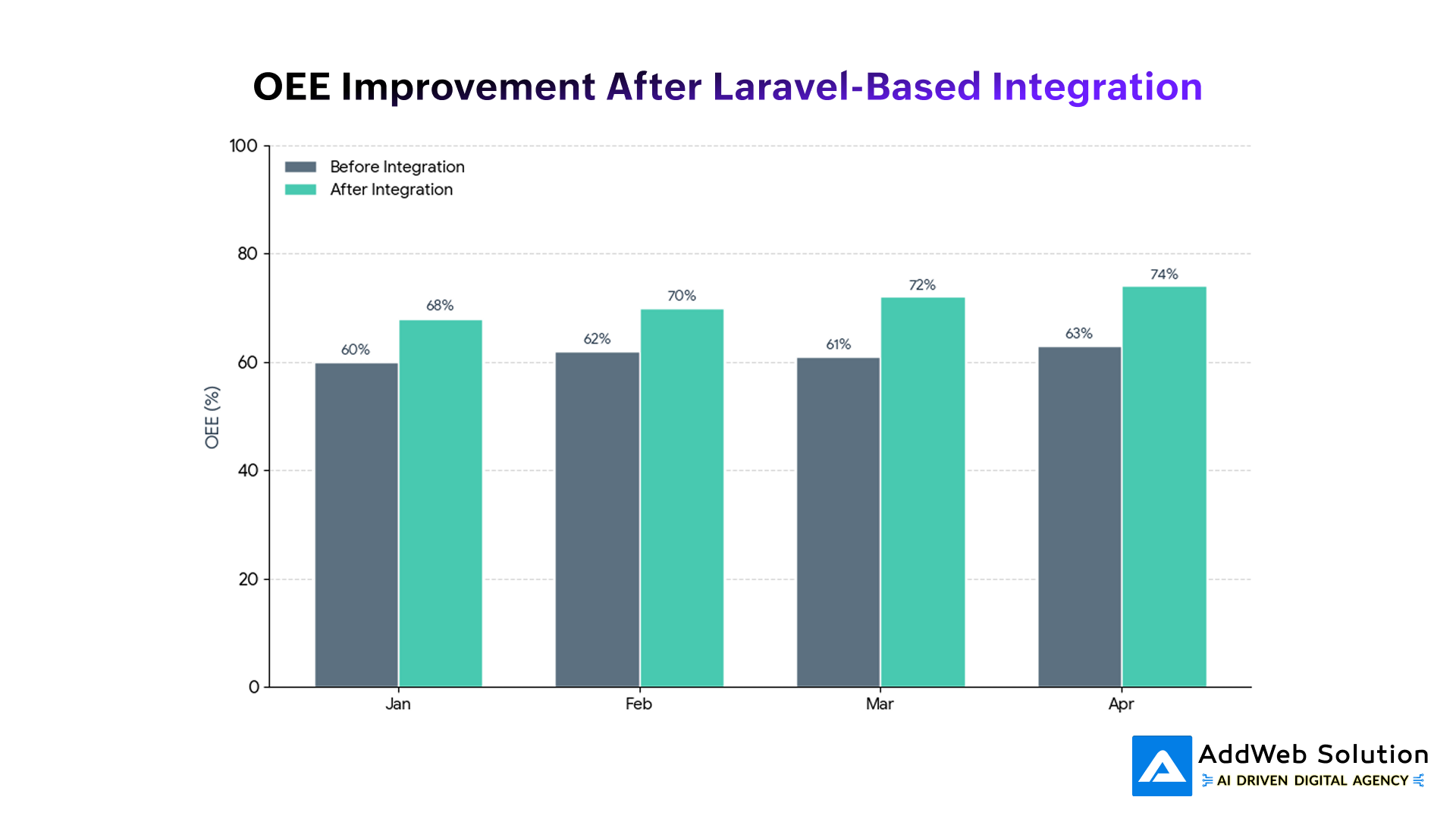
An example bar chart representation for an internal blog or engineering portal might look like this:
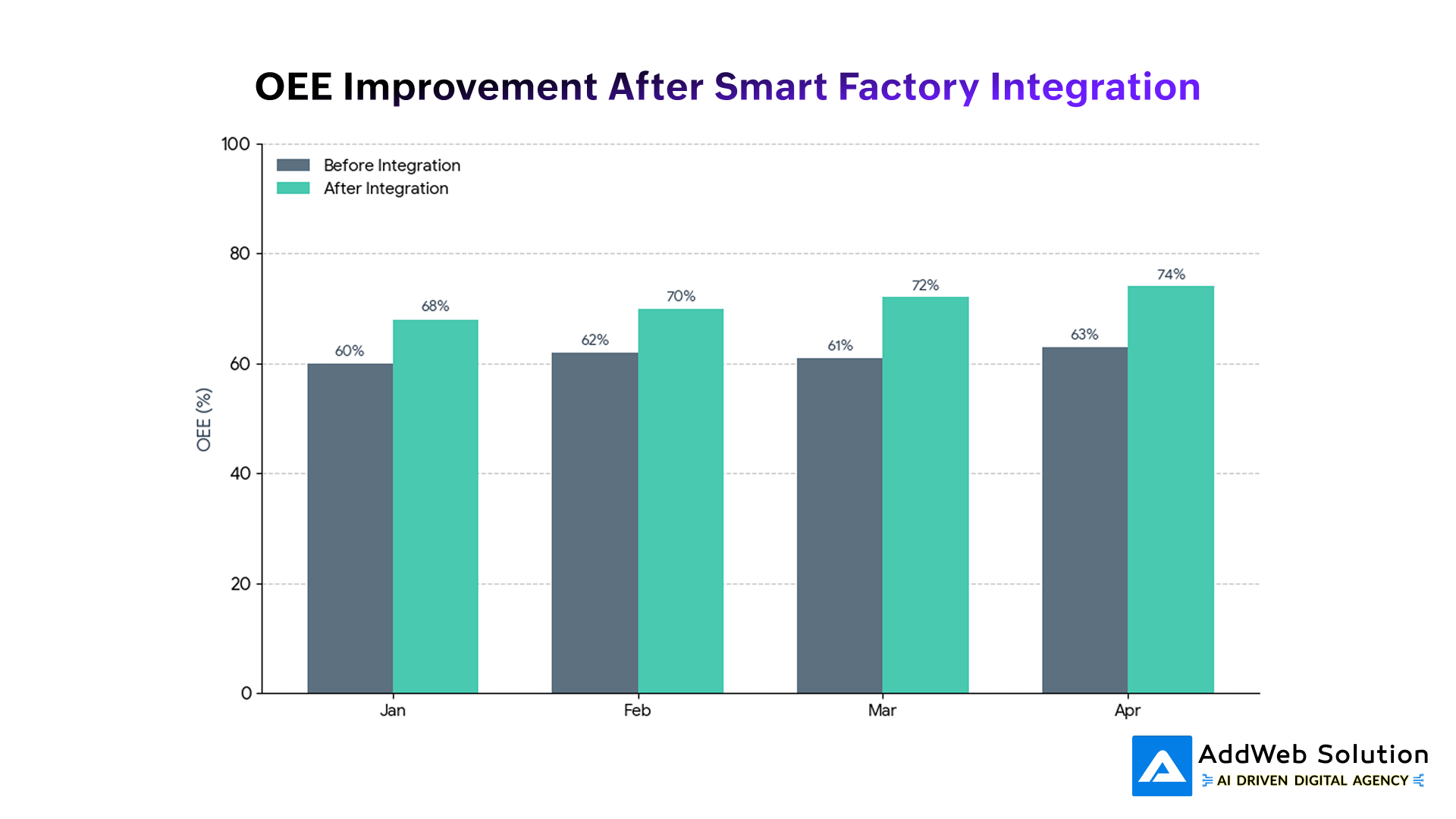
Even if the exact numbers differ plant-by-plant, this pattern – visibility leading to measurable OEE gains – is a recurring outcome in smart factory projects.[6][7]
4.2 Digital work instructions and traceability
Paper-based work instructions and manual log sheets create gaps in traceability and make it difficult to analyze root causes of quality issues. Laravel can power:
- Responsive web apps for operators with role-based access to the latest instructions.
- Digital checklists, approvals, and signatures linked to work orders.
- Automatic capture of lot numbers, tool IDs, and inspection results.
Because Laravel handles authentication and database relationships well, it is straightforward to attach every production record to a specific machine, operator, batch, and material lot, enabling deep traceability when issues arise.
4.3 Predictive maintenance and condition monitoring
Smart factories use condition-based monitoring of equipment to minimize downtime and prolong equipment life. Although significant analytics work is done on a specialized system, Laravel is able to:
- Get vibration data, temperature data, or cycle count data using MQTT or HTTP from edge gateways.
- Apply rules and thresholds to create work orders.
- Push events to external data lakes or ML pipelines and retrieve the scored predictions.
- Offer a web interface for the maintenance team showing the status of the equipment and suggested actions.
4.4 Quality analytics and feedback loops
Quality control is a core benefit of smart factory implementations – real-time monitoring and analytics reduce scrap and rework. Laravel-based applications can:
- Capture in-line and end-of-line inspection data directly from test stands or operator terminals.
- Correlate quality results with machine settings, material lots, and environmental conditions.
- Present Pareto charts and trend graphs to quality engineers (often by feeding BI tools such as Power BI or Metabase).
5. A practical Laravel-centric reference architecture
5.1 High-level components
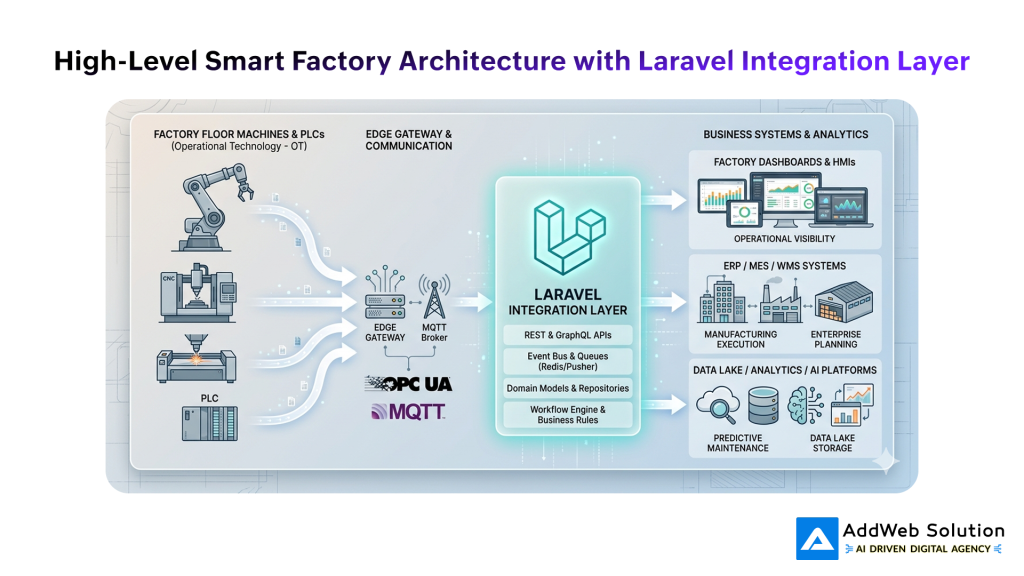
The following diagram shows a practical, vendor-neutral reference architecture putting Laravel at the center of a smart factory integration landscape.

In this setup:
- Edge components handle protocol translation and buffering.
- Laravel focuses on data modeling, business rules, security, and orchestrating flows between systems.
- Business systems consume clean APIs and event streams rather than connecting directly to raw machine data.
5.2 Example data flow table
| Step | Source | Laravel responsibility | Destination |
| 1 | Machine tag change (OPC UA) | Receive normalized event via gateway webhook, validate schema | Event queue |
| 2 | Event queue | Enrich with work order, product, and operator context | Time-series table and aggregates |
| 3 | Aggregates | Compute KPIs (OEE, scrap rate, cycle time) | API responses and dashboard queries |
| 4 | KPI deviations | Trigger business rules and notifications | Operator HMI, maintenance app, or MES alert |
| 5 | Confirmed event | Log and optionally push to ERP/MES | ERP production posting or MES history |
Laravel’s job and queue system is particularly valuable here, allowing the application to scale with bursts of machine events while maintaining responsiveness for human users.
6. Laravel implementation patterns for smart factories
6.1 Domain-driven design for production
Smart factory projects can leverage a Domain Driven Design (DDD) strategy by directly mapping core production concepts to Laravel’s model and service layers. Typical aggregates include:
- WorkCenter, Machine, and ProductionLine
- WorkOrder, Operation, and Shift
- MaterialLot, Tooling, and Fixture
- QualityCheck, Measurement, and NonConformance
Value objects and domain services can be used to keep the intricacies of the protocols and vendor-specific nuances out of the core layers.
6.2 API design best practices
For APIs used by HMIs, mobile apps, or external systems:
- Use resource-oriented paths (e.g., /api/work-centers/{id}/status), versioned under /v1, /v2, etc.
- Token-based authentication using Sanctum or Passport.
- Standardized error formats and error codes for reliable handling by edge gateways or external systems.
- Optional use of webhooks or Server-Sent Events for push notifications to HMIs without constant polling.
6.3 Event-driven integration
This model of event-driven programming maps naturally onto how machines and humans interact in a factory:
- Machine events such as start, stop, alarm, or changeover occur as events.
- Human actions such as approve, reject, or record reason for downtime are also events.
The events, listeners, and queue worker provided by Laravel are a natural fit for:
- Notifying other components of important conditions via events when they occur (e.g., OeeDroppedBelowThreshold).
- Registering multiple listeners for an event without coupling components too tightly together.
- Replaying events when business rules change.
6.4 Security and compliance considerations
Smart factories process sensitive production data and often personal data about operators and supervisors, so security and compliance matter:
- Use TLS everywhere and restrict direct access to edge nodes.
- Centralize authentication and authorization in Laravel and external identity providers where appropriate.
- Log access and changes for auditability (for example, who changed a work instruction or quality limit).
- Apply role-based access control so operators, supervisors, maintenance staff, and external partners see only what they need.
7. Example visuals for a Laravel-powered smart factory blog
When explaining smart factory concepts to stakeholders, using images can help to make abstract concepts like integration more concrete. Below are some examples that can be used in a blog or documentation site.
7.1 Hero image: connected factory control room
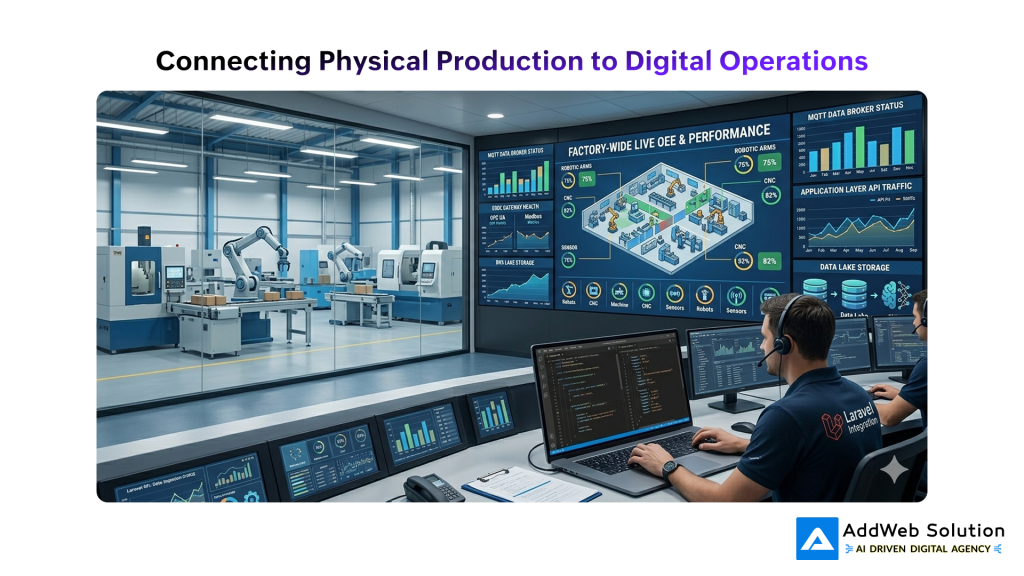
A potential hero image could be a picture of a modern control room with a view of a factory floor, with large wall-mounted dashboards displaying live OEE metrics, machine status, etc., and a developer screen in the foreground displaying Laravel code or an API definition. This visually reinforces the idea of Laravel connecting the physical and digital worlds.
It could be referenced in Markdown like:
7.2 Architecture diagram
The flowchart from section 5 can be exported as an image (for example, using Mermaid tooling) and embedded similarly:
7.3 Data flow or OEE trend graph
A line or bar chart showing OEE or downtime trends before and after integration can make benefits concrete. Values should be based on your actual plant data, but the structure can follow the illustrative Mermaid bar chart in section 4.
7.4 Table: integration roadmap
The following table can be adapted into a project plan slide or blog section.
| Phase | Focus | Typical Laravel deliverables |
| Phase 1 | Visibility | Basic machine connectivity, data ingestion APIs, live status dashboard |
| Phase 2 | Control | Work instructions, digital forms, downtime classification, alerts |
| Phase 3 | Optimization | KPI dashboards, advanced analytics integrations, automated decision rules |
| Phase 4 | Expansion | Multi-plant roll-out, standardized integration patterns, shared component library |


8. Practical recommendations for manufacturers
8.1 Start small, with clear value
Rather than trying to change everything at once to a smart factory approach, you might consider focusing initially on a single line, cell, or family of products where there is a known problem, such as downtime or scrap related to a key asset. Consider using Laravel to:
- Implement a small integration layer to collect key machine information.
- Implement one or two focused dashboards or apps that address a particular problem.
- Prove success, then iterate.
8.2 Standardize patterns and components
Once the first use cases succeed, turn the solution into a reusable integration toolkit:
- Shared Laravel packages for domain models (work centers, work orders, lots).
- Standardized API contracts for machines, gateways, and business systems.
- Common front-end components for status tiles, downtime forms, and trend charts.
This reduces marginal cost for each new line or plant brought into the smart factory ecosystem.
8.3 Combine Laravel with specialized tools
Laravel is not a replacement for PLC programming, MES functionality, or advanced AI platforms. Instead, it connects and orchestrates them:
- Let edge and SCADA systems handle real-time control and interlocks.
- Use MES and ERP where they fit well for scheduling, inventory, and compliance.
- Let analytics platforms perform heavy modeling and forecasting.
- Use Laravel to provide cohesive APIs, consistent user experiences, and integration logic.
9. Conclusion
Smart factory initiatives succeed when they create a tight feedback loop between the physical production environment and the digital systems that plan, monitor, and improve it. Laravel offers a practical, flexible way to build that integration layer: powerful enough to support complex enterprise integrations, yet accessible for teams that want control over their own roadmap.
By combining Laravel’s strengths in API development, background processing, and security with proven industrial technologies such as IIoT gateways, MES, and analytics platforms, manufacturers can move step by step toward a connected, data-driven factory – without locking themselves into rigid, black-box solutions.
Get a custom Laravel integration strategy for your plant

Pooja Upadhyay
Director Of People Operations & Client Relations
References
- https://www.twi-global.com/technical-knowledge/faqs/what-is-a-smart-factory
- https://www.ibm.com/topics/smart-factory
- https://www.oracle.com/in/manufacturing/what-is-smart-factory/
- https://www.autodesk.com/solutions/what-is-smart-factory
- https://www2.deloitte.com/us/en/insights/focus/industry-4-0/smart-factory-connected-manufacturing.html
- https://www.mckinsey.com/capabilities/operations/our-insights/smart-factories
- https://www.statista.com/topics/5298/smart-factory/
- https://www.marketsandmarkets.com/Market-Reports/smart-factory-market-1162.html
