


The talent shortage is structural, not a blip
Even after the “tech correction” and round of layoffs in 2023-2024, the demand for skilled software engineers far exceeds supply, especially for cloud computing, security, artificial intelligence, and business-critical applications. In fact, according to various global reports published by market watcher IDC, there is a projected shortfall of up to 4 million software engineers worldwide by 2025.
The overall skilled labor gap is predicted to be around 85 million people worldwide by 2030, and technology-specific roles are among the hardest to fill. That equates to billions of dollars in lost projects and revenue.

What this looks like inside most organizations
- Open roles for experienced engineers that remain unfilled for months.
- Product roadmaps that keep slipping because “engineering is at capacity.”
- An ever‑growing IT backlog of small but important internal tools, reports, and automations.
- Business teams quietly building spreadsheets, Access databases, or shadow SaaS tools to work around IT delays.
The pattern is clear: you don’t just have a hiring problem—you have a capacity and empowerment problem.
Enter the non‑programmer app builder
The response from the market has been the rise of the “citizen developer” or business technologist: people in finance, operations, marketing, HR, or customer support who use low‑code or no‑code tools to build software that solves their own problems. These are not traditional programmers, but they understand the business process deeply and can work visually with forms, workflows, and data.
Gartner and other analysts now expect these non‑IT builders to dominate parts of the app‑development landscape:
- Large enterprises are expected to have four times more citizen developers than professional developers.
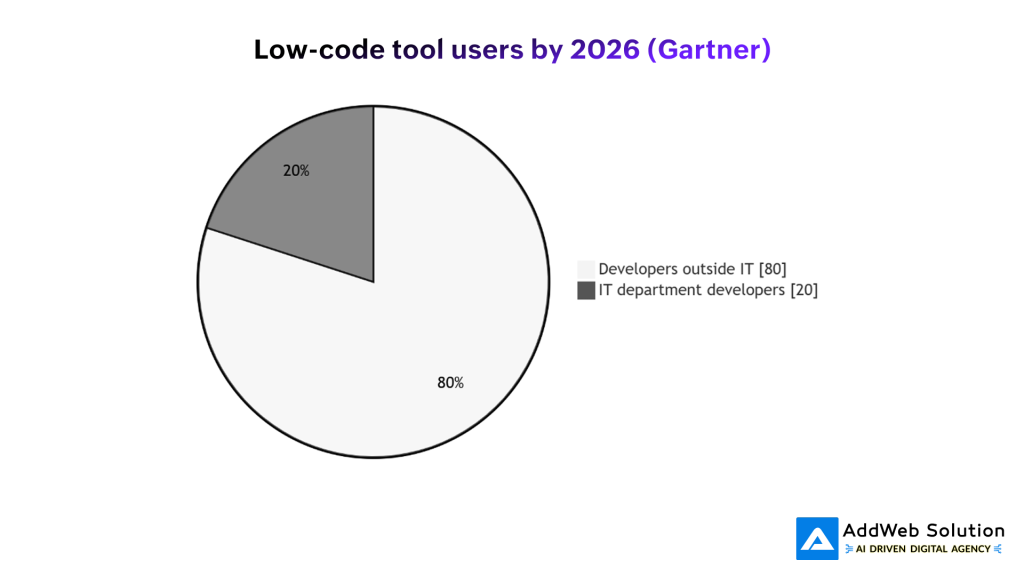
- By 2026, developers outside formal IT will account for at least 80% of the user base for low‑code development tools.
- Around 30% of custom apps built outside IT are already created by people with limited or no traditional development experience.
- The share of software team members from non‑traditional technical backgrounds is projected to rise from about 20% in 2025 to 40% by 2028.
In other words: non‑programmers are no longer “helping” IT; they are becoming a core part of the delivery engine.
Pie chart: who’s using low‑code tools?
Here’s a simple, copy‑ready Mermaid pie chart you can embed to visualize the 80/20 split in low‑code adoption by 2026 (Gartner’s projection of low‑code users outside vs inside formal IT).
You can drop this directly into any Markdown‑friendly editor or convert it to an image for your blog.
Why Laravel is part of this story
Citizen development is often discussed around generic low‑code platforms, but Laravel quietly sits in the middle as a powerful, business‑friendly framework that pairs extremely well with non‑programmer builders.
A few hard facts about Laravel’s position in the market:
- Laravel powers over 1.5 million websites worldwide and has one of the largest footprints among PHP frameworks.
- Some analyses estimate Laravel holds roughly a third of the PHP framework market, and more than half of PHP developers report using it regularly.
- In recent surveys, about 95% of respondents said they use Laravel for business applications, not just side projects or experiments.
This matters because when non‑programmers build on Laravel, they’re not playing with an obscure niche tool—they’re working inside a mainstream, well‑supported ecosystem that professional teams already trust.


What makes Laravel friendly to non‑programmers?
Non‑programmers are not going to hand‑code complex domain logic from scratch—but they can configure, extend, and co‑own Laravel applications when the framework does the heavy lifting.
Laravel strengths that help non‑programmers
- Opinionated structure. Clear conventions for routing, models, controllers, views, and configuration mean business users don’t have to guess “where things live.”
- Rich ecosystem. The Laravel ecosystem includes tools for deployment, server management, and admin panels, which reduce the amount of “from‑scratch” coding needed.
- Scaffolding and generators. Reusable starter kits and code generators make it easy for a pro developer to set up the skeleton, then hand over safe pieces for non‑developers to extend (fields, copy, workflows, permissions).
Here’s a compact table you can use in the blog:
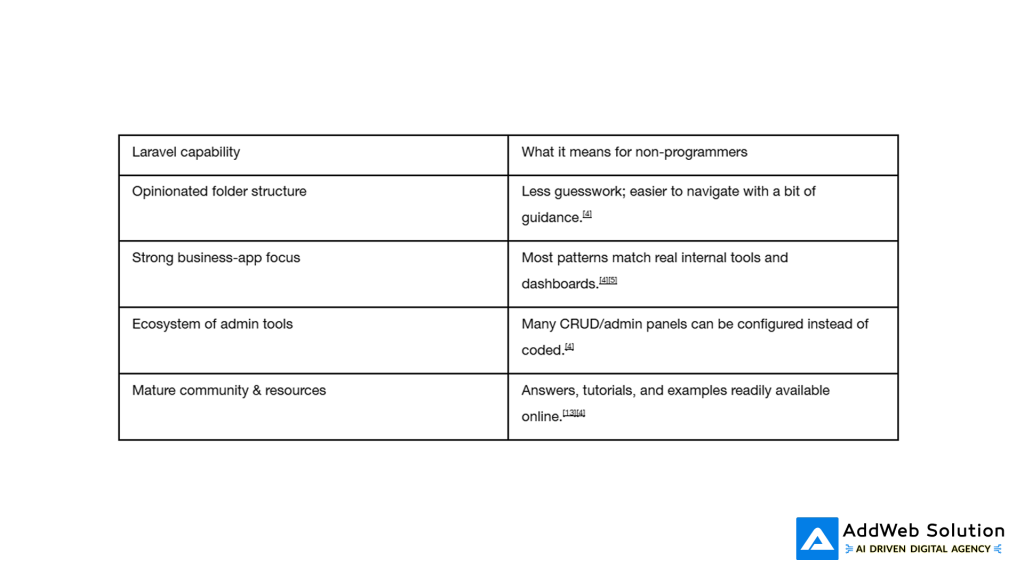
The net effect: a senior Laravel developer can architect the foundation, and non‑programmers can safely work on configuration, content, forms, and workflows without constantly touching risky core code.
Graph: citizen developers vs professional developers (relative)
Analysts expect large enterprises to have roughly four times as many citizen developers as professional developers. You can visualize that relationship with a simple relative bar chart:
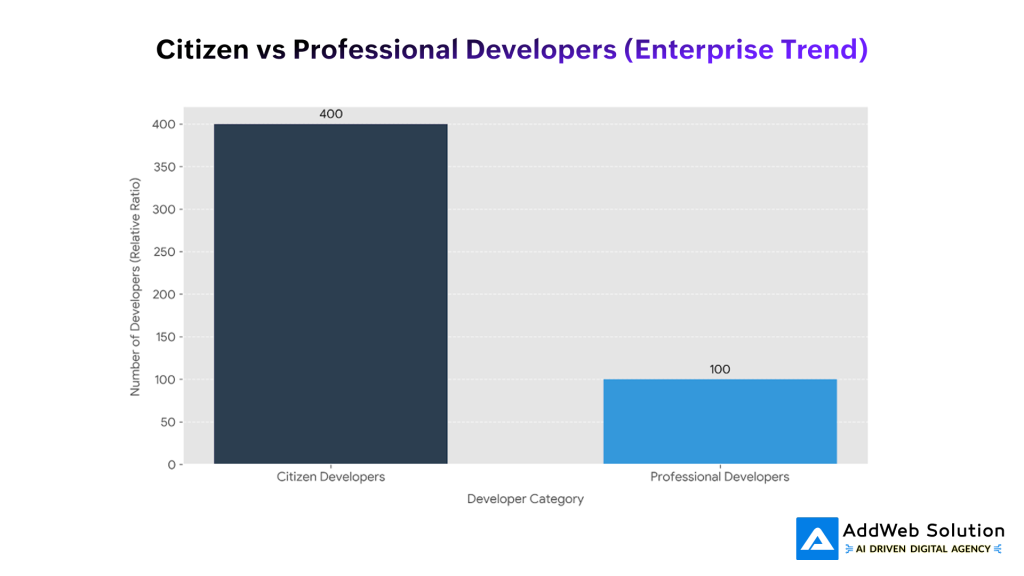
This isn’t an absolute headcount chart—it’s a clean way to show the 4× ratio that keeps showing up in research.
How non‑programmers actually contribute to Laravel projects
The phrase “non‑programmers are building Laravel apps” doesn’t mean accountants are suddenly writing complex service containers. It means their role in the delivery pipeline has expanded.
Common patterns that are working well:
- Content & configuration first. Business users manage copy, forms, field definitions, and validation rules through Laravel‑powered admin UIs or configuration files, while engineers handle the plumbing.
- Workflow modeling. Non‑programmers define statuses, approval flows, notifications, and business rules, often through configurable workflow engines sitting on top of Laravel.
- Data ownership. Operations or finance teams own the structure of reports, filters, and dashboards while developers build the underlying queries and secure access layers.
- Fusion teams. IT forms mixed squads where one or two experienced Laravel developers pair with several business technologists to co‑design and co‑build applications.
In these setups, Laravel is the stable backbone; non‑programmers work through interfaces, schemas, and configuration rather than raw PHP.
Where Laravel plus non‑programmers shines
Not every application should be driven by non‑programmers. But there is a large class of “stuck in the backlog forever” use cases where this model is ideal.
Good fits for non‑programmer‑driven Laravel builds
- Internal request and approval workflows (purchases, HR, facilities, IT tickets).
- Lightweight CRMs or deal trackers tailored to one team’s process.
- Inventory, asset, or content catalogs with custom reporting.
- Partner or vendor portals where the logic is more about forms and permissions than complex algorithms.
- Operational dashboards that pull together data from a few known systems.
Use cases that should stay with pro devs
- Safety‑critical systems (healthcare, aviation, industrial control).
- Heavily regulated workflows where small mistakes have huge compliance impact.
- High‑scale, latency‑sensitive consumer products.
- Complex financial calculations, pricing engines, or risk models.
You can turn this into a clear, skimmable table:
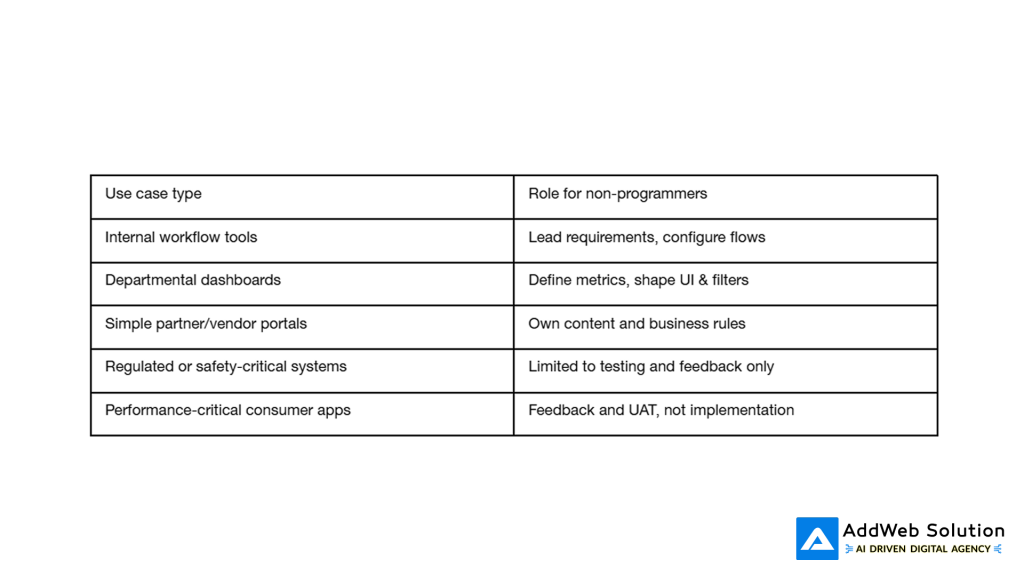
This framing helps leadership decide what belongs in the “citizen developer + Laravel” bucket and what absolutely does not.
Why companies like this model (beyond cost)
Yes, there is a cost angle—fewer fully loaded senior developer hires—but the deeper value is strategic.
- Backlog reduction. Many of the long‑tail internal tools that never get priority can finally get built when business teams own pieces of the delivery.
- Faster iteration. The people closest to the problem can tweak fields, forms, and workflows directly, instead of sending tickets and waiting for a sprint slot.
- Better fit‑for‑purpose software. Because non‑programmers bring day‑to‑day process knowledge, the resulting Laravel applications often match reality better than top‑down designs.
- Talent diversification. As research shows, the share of software team members from non‑traditional backgrounds is rising fast—this model turns that from a risk into an asset.
For engineering leaders, this isn’t about replacing developers. It’s about redeploying them toward hard problems while giving business users a real, governed way to ship software.
Guardrails: avoiding the “shadow IT” trap
The legitimate fear is that handing power to non‑programmers will create security holes or messy, unmaintainable Laravel projects. That risk is real—but manageable with the right guardrails.
Concrete practices that keep things sane:
- Clear “play zone” vs “no‑go zone.” Document exactly which parts of the Laravel codebase or admin UI non‑programmers can touch (e.g., form definitions, content, email templates) and what remains under engineering control.
- Reusable patterns and blueprints. Provide pre‑vetted modules for login, permissions, audit logging, and integrations so business users never reinvent these from scratch.
- Code reviews and promotion paths. Even if a change is made via a visual tool, it should pass through a version control and review process before hitting production.
- Security and privacy training. Short, practical training for citizen developers on data handling, access control, and basic security hygiene pays for itself quickly.
With these in place, your “citizen developer + Laravel” program looks less like chaos and more like a structured, scalable capability.
Practical roadmap to start using non‑programmers on Laravel
If you already have Laravel in your stack, you don’t need a massive transformation programme. You can treat this like a focused capability experiment.
Step 1: Identify your potential citizen developers
Look for people who:
- Already run complex spreadsheets or build internal tools on their own.
- Are comfortable experimenting with new software and can think in terms of processes and edge cases.
- Have deep knowledge of how work actually gets done in their team.
Often, they’re the “go‑to” person everyone asks for a better spreadsheet or internal form.
Step 2: Pick the right pilot project
Good pilot characteristics:
- Clear, narrow scope (one workflow or one small portal).
- Low regulatory and security risk.
- High visibility and nuisance value (“this is annoying every day”).
- Clear success metrics: fewer manual steps, reduced email ping‑pong, faster approvals, etc.
Tie that pilot to an existing Laravel app or a new, intentionally small Laravel service.
Step 3: Architect for collaboration
Have your Laravel lead:
- Set up the base project, authentication, permissions, and core domain models.
- Expose configurable pieces (fields, validations, labels, email content, status flows) through a friendly admin UI or structured config files.
- Document simple “recipes” so non‑programmers know how to safely make changes.
The goal is to keep business users out of risky internals while still giving them meaningful control.
Step 4: Train, pair, and iterate
- Run short, practical sessions on the basics of the Laravel app structure and the specific tools they’ll use.
- Pair a developer with each citizen developer for the first few weeks to answer questions and prevent bad patterns from forming.
- Treat it like any other agile initiative: short feedback loops, retrospectives, and continuous improvement.
Over time, you’ll see patterns you can standardize: reusable components, shared field libraries, template workflows, and more.
The bigger picture: Laravel as a bridge, not a silo
Zoom out, and a pattern emerges:
- The developer shortage is real and persistent.
- Non‑programmers are rapidly becoming a major force in software delivery, especially via low‑code tooling.
- Laravel is a mainstream, business‑oriented framework with a mature ecosystem and strong adoption across industries.
When you combine those three facts, a very pragmatic strategy appears: use Laravel as the backbone and invite non‑programmers into the build process—intentionally, with guardrails—so you can ship more software without endlessly waiting for hard‑to‑hire talent.
The companies that move early on this are the ones that will quietly reduce their backlog, modernize faster, and get more leverage from the people they already have.
Empower Your Digital Transformation With Our Laravel Development Services!

Pooja Upadhyay
Director Of People Operations & Client Relations
⁂
- https://kissflow.com/citizen-development/citizen-development-statistics-and-trends/
- https://blog.jetbrains.com/phpstorm/2024/09/laravel-trends-2024-the-latest-market-insights/
- https://www.itransition.com/software-development/statistics
- https://www.tecla.io/blog/tech-talent-shortage
- https://mumabusinessreview.org/2024/MBR-08-13-173-180-Muhammad-CitizenDeveloper.pdf
- https://telefonicatech.uk/articles/tech-trends-2024-citizen-developers-2/
- https://laravel-news.com/state-of-laravel-survey-2024
- https://survey.stackoverflow.co/2024/
